The account opening process in banks has six steps: collect the applicant's identifying information, verify it, check the name against government lists, read a checking account report, deliver the disclosures, and verify and hold the opening deposit; then the bank opens the account or refers it to a person. Most banks run those steps one after another, often in different systems, and the time adds up in the back office when one of them stops. The federal rules fix the order of much less than that sequence suggests: name, date of birth, address and an identification number must be obtained "prior to opening an account" (31 CFR 1020.220), and the account disclosures must be delivered before an online account opens, but verification may finish within a reasonable time afterwards. Botminds' Deposit Account Opening starts each check the moment its data exists, so by the applicant's last tap every check has already run once.
The rules are quoted from the eCFR and the US Code, linked where they appear. The examples come from a fictional bank, Corvane National Bank, and a fictional applicant, Jordan Ellery, as his application runs through the solution.
One consumer account: staff time today, and the sample application
30min
of staff time to collect and review customer information for a new consumer account, on GAO’s 2018 estimate
$15
average customer due diligence cost per new account, from $5 to $44 by bank (GAO, 2018 data)
7:40
minutes from the sample applicant’s first tap to submit, on a phone
4s
from his last tap to the decision, with every check already run once
The procedure of opening a bank account, step by step
Opening a consumer checking or savings account comes down to the same six steps at any US bank, whether the applicant sits at a desk or taps on a phone. What differs is who does each step, in which system, and in what order.
1. Collect. Name, date of birth, a street address and an identification number, which for a US citizen is a taxpayer identification number, before the account opens. The bank must also give notice that it is asking for this information to verify identity. 2. Verify. Check the information against documents, such as a driver's license, or other sources, such as a consumer reporting agency or a public database, and record how any discrepancy was resolved. 3. Screen the name. Check the applicant against OFAC's sanctions lists and, if the bank chooses to at opening, the most recent 314(a) list from FinCEN.
4. Read the history. Pull a checking account report, usually from ChexSystems or Early Warning Services, and apply the bank's policy to it. 5. Disclose and consent. Deliver the account terms under Regulation DD, the electronic transfer terms under Regulation E, the privacy notice, the E-SIGN consent if the documents are electronic, and the overdraft choice, which must be an opt-in. 6. Fund. Verify the card or account the opening deposit comes from and hold it until the account is approved. Then the account opens, or a person decides.
What the rules require before the account opens, and what can follow
Only two groups of steps must be complete before the account opens: the four identifying items with the CIP notice, and the disclosures and consents. Verification, list screening and even some disclosures may legally follow the opening. The table sets out each step's timing as the rule states it.
Each account opening step, and the timing the rule actually sets
| Step | Timing in the rule | Rule |
|---|---|---|
| Name, date of birth, address, ID number | "prior to opening an account" | 31 CFR 1020.220(a)(2) |
| Notice that identity will be verified | "before opening an account" | 1020.220(a)(5) |
| Verify identity | "within a reasonable time after the account is opened"; earlier is allowed | 1020.220(a)(2)(ii) |
| Compare with designated government lists | "within a reasonable period of time after the account is opened, or earlier" if another law requires | 1020.220(a)(4) |
| Account disclosures (Regulation DD), online | "before the account is opened or the service is provided" | 12 CFR 1030.4(a)(1)(ii) |
| Electronic transfer disclosures (Regulation E) | when the consumer contracts for the service or before the first transfer | 12 CFR 1005.7(a) |
| Overdraft opt-in for ATM and one-time debit | before any fee is charged; affirmative consent after a segregated notice | 12 CFR 1005.17(b) |
| Consent to electronic documents | before the electronic record replaces a written one | 15 U.S.C. 7001(c) |
| Adverse action notice | when the bank acts on a consumer report against the applicant | 15 U.S.C. 1681m(a) |
The point of the table is not that a bank should verify after opening. A bank has good reason to know who it is dealing with before money moves, and FATF's standard is that verification happens before the relationship starts or while it is being set up (FATF Recommendations). The point is that nothing in the rules forces the checks into a queue. A bank that runs them one after another is choosing to.
Why the account opening process runs serially, and what it costs
The process runs serially because the systems were built that way: the digital platform collects the form, then calls the identity service, then the screening service, then the core. Each waits for the one before it, and a stop at any point sends the application to a back-office queue with a code rather than a reason. A specialist then has to repeat the checks to learn what happened.
FinCEN prices the identity rule at two minutes per account (FinCEN, 2024); the GAO, asking banks, found about thirty minutes of staff time per consumer account. The difference is the exceptions and the second look. On our estimate, a referred application worked by hand takes about fifty minutes across a specialist and a team lead, and most of that is finding out why it stopped, not deciding.
Where a referred application's minutes go: most of them are finding out, not deciding
| Step on one referral | By hand | Checks already run |
|---|---|---|
| Finding out why the platform said refer | 10 min | 0.5 min: the reason is written |
| Re-running identity and list checks in other systems | 8 min | 0: they ran once while the applicant typed |
| Reading the checking account report against the policy | 8 min | 2 min: the entry and the policy test side by side |
| Checking the opening deposit and its hold | 4 min | 0.5 min |
| Writing the letter and the FCRA notice | 10 min | 1 min: drafted from approved wording |
| A second person checks and sends | 10 min | 3 min |
| Total | 50 min | about 7 min |
Online bank account opening process: checks that start as the data arrives
Online, the process can run in parallel because each check needs only part of the application. The sanctions lists need a name. Document verification needs the ID photo. The identity data match needs the address and number. The checking account report needs the number. None needs the applicant to have finished.
Take the sample application. Jordan Ellery started Everyday Checking on the fictional bank's app at 7:02:05 PM. He gave his name at 7:03:10, and the OFAC check came back clear two seconds later, the 314(a) check at 7:03:58. He photographed his license and took a selfie at 7:04:20; the document was verified at 7:04:31. He entered his address and Social Security number at 7:05:40; the identity data were verified on two sources at 7:05:44 and the checking account report was read at 7:05:52. Disclosures were delivered at 7:06:33, his overdraft choice, not to opt in, was recorded at 7:07:52, and his $150 debit card deposit was verified and held at 7:08:44.
Two lanes on one clock: what the applicant did, what the checks did
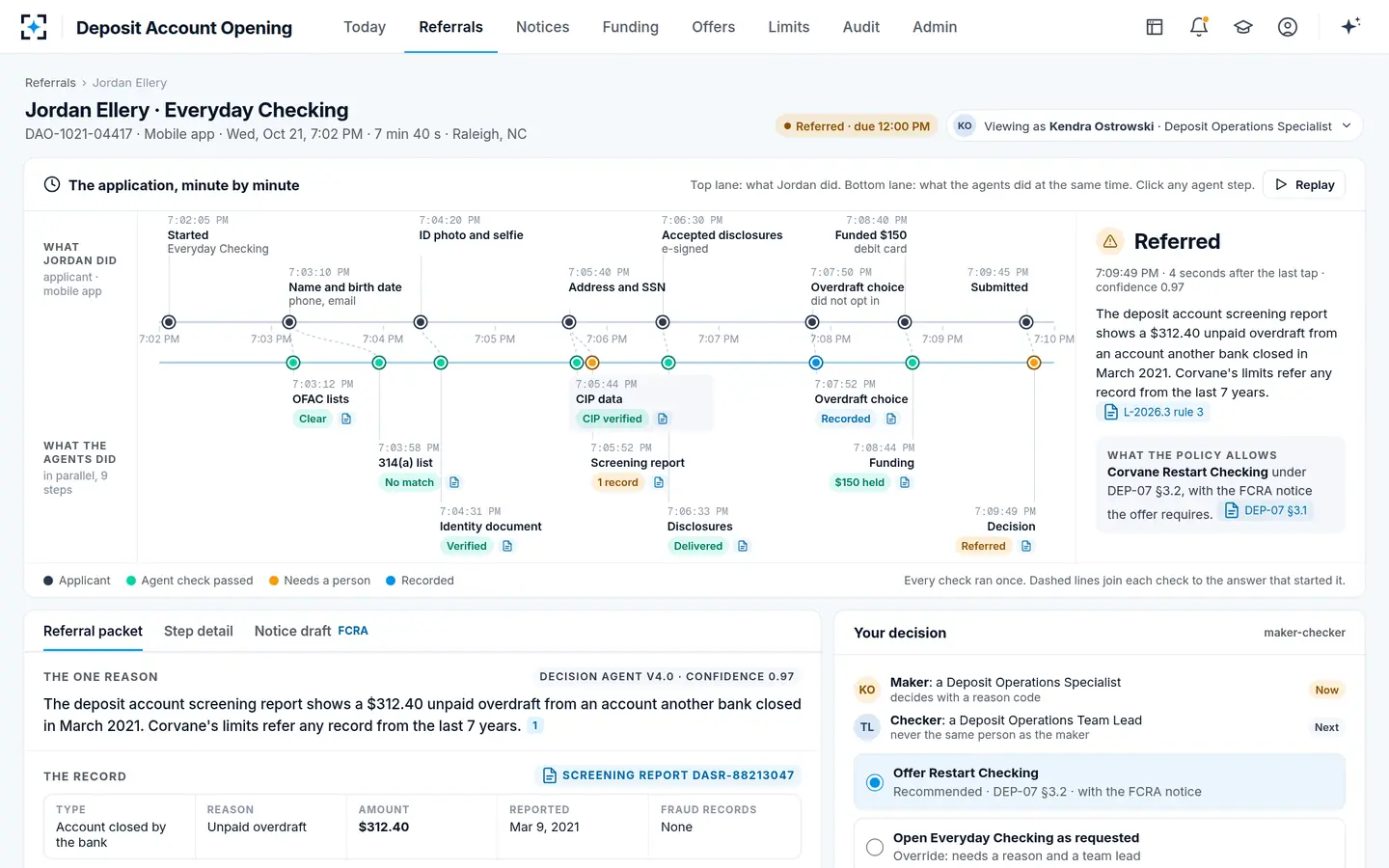
He submitted at 7:09:45 PM. Four seconds later the application was referred, for one reason: the report showed a $312.40 unpaid overdraft from 2021, and the bank's limits refer any entry from the last seven years. Everything else had come back clear minutes earlier, so the referral named one thing for a person to decide. Digital account opening software that keeps the core explains how those checks connect to the systems a bank already has.
The same six steps, run in sequence and run as the data arrives
In sequence: Run after the form is submitted, often in a separate screening tool.
As the data arrives: Run when the name is typed; a potential match goes to the sanctions team before anything else happens.
In sequence: Called once the form is complete; a failure ends the session or sends a code to the back office.
As the data arrives: Document and selfie checked at the photo, data matched at the address and number; a mismatch is written up as a question.
In sequence: Pulled at the end, sometimes by a person in a different system.
As the data arrives: Read against the bank’s policy as soon as the number is known, so the outcome is known before submit.
In sequence: Shown as one block of documents near the end.
As the data arrives: Delivered and logged with versions and times; the overdraft choice is recorded as an opt-in or not.
In sequence: Taken after approval, or captured before checks finish.
As the data arrives: Verified and held while the applicant types; captured only when the account opens.
In sequence: A code, and a person re-running checks to learn why.
As the data arrives: Open inside the bank’s limits, or a referral with one reason and the action the policy allows.
How long does it take to open a checking account?
Opening a checking account online takes the applicant a few minutes of form-filling, and the bank's decision can take seconds or a day depending on whether a person has to look at it. The sample application took 7 minutes 40 seconds to complete and 4 seconds to decide. A clean application inside the bank's limits opens at that point; the bank's target is that 89% of completed applications do.
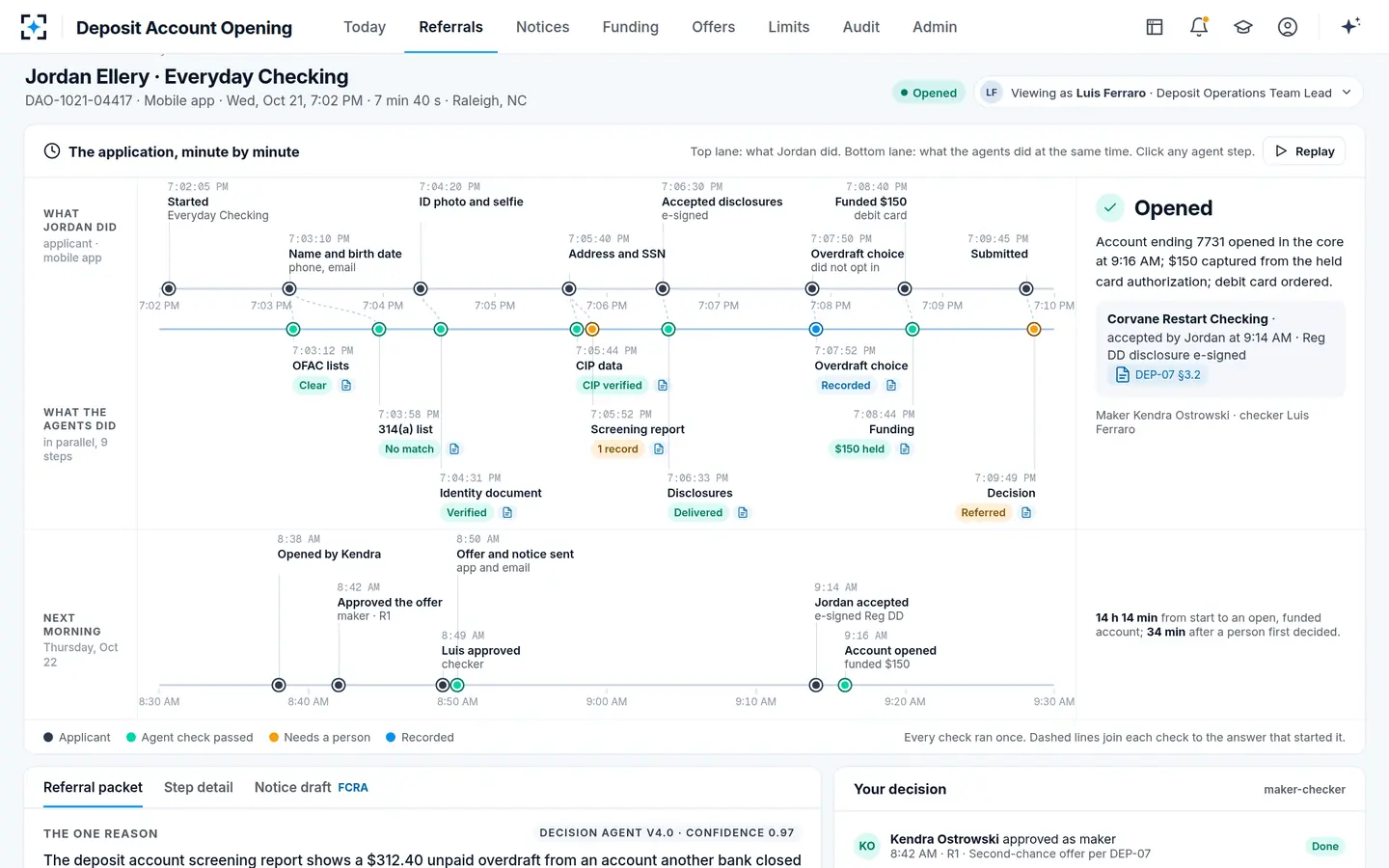
A referral takes longer because a person decides it. The sample referral was opened by a deposit operations specialist at 8:38 the next morning, approved as a second-chance offer at 8:42, checked by a team lead at 8:49 and sent at 8:50. The applicant accepted at 9:14 and the account was open and funded at 9:16: 14 hours 14 minutes from the first tap, 34 minutes after a person first decided. The bank's target is that every referral is decided the same business day, or by noon for applications that arrive after hours.
The next morning, on the same time axis
Account opening KYC: what the bank must know at the end
For a consumer deposit account, know-your-customer at opening means the bank can show it reasonably believed it knew who the customer really was, checked the required lists, and understands the account well enough to set the customer's risk profile. The CIP part has a specific test: examiners sample new accounts and check that information was obtained before opening, identity was verified, discrepancies were resolved and recorded, and names were compared against the lists, and they deliberately include accounts "opened with incomplete verification information" (FFIEC BSA/AML Manual).
Running the checks in parallel changes how that file is built, not what it must contain. Each check in the sample carries its result, its time and the source it rests on, so the file an examiner samples is the same one the specialist read. Opening an account without a Social Security number covers the identification-number rules for applicants who are not US citizens.
An account opening checklist for a consumer deposit account
An account opening checklist is useful when it follows the rule's timing rather than the screen order. The list below is ours, built from the rules in the table above, for a consumer checking or savings account opened online or at a desk.
Account opening checklist: what must be true before the account opens, and just after
- Name, date of birth, street address and identification number collected
Before opening. A non-US person may give a passport, alien ID or other government photo ID number instead of a TIN.
- CIP notice given
Before opening, on the form, the website or in the branch.
- Identity verified, and any discrepancy resolved and described
Within a reasonable time; the record must describe how each substantive discrepancy was resolved.
- Name checked against OFAC and, by policy, the current 314(a) list
A potential match is reviewed by a person; a 314(a) match is kept confidential.
- Checking account report read against written policy
If it leads to a denial or a lesser account, an adverse action notice naming the company.
- E-SIGN consent, Regulation DD and E disclosures and the privacy notice delivered
Online, the account disclosures before the account opens; versions and times kept.
- Overdraft choice recorded as an affirmative opt-in or not
No overdraft fee on ATM or one-time debit card transactions without it.
- Opening deposit verified and held, captured only at opening
The card or account in the applicant’s name; new-account hold rules apply after.
- Decision recorded with its reason, and a second person on every referral
Who decided, when, why, and on which evidence.
What still has to wait for a person
Parallel checks do not remove people from the process; they move them to the decisions. In Deposit Account Opening, the agents open an application on their own only when every check falls inside limits the bank has written down. A potential sanctions match goes to the sanctions team, an identity mismatch goes to a specialist with a proposed resolution, a fraud-type entry on a checking account report always goes to a person, and no application is ever declined by an agent.
Every decision a person makes is checked by a second person, and every adverse action notice is drafted from wording the bank's compliance officer approved, then sent only after both approve (15 U.S.C. 1681m). Account opening automation, agent by agent sets out each of those limits. To see the process on a bank's own past applications, start from Deposit Account Opening.
Questions people ask
What documents are needed to open a bank account?
The rule requires information rather than particular documents: name, date of birth, a street address and an identification number. Most banks verify with an unexpired government photo ID, such as a driver's license or passport, and may ask for proof of address. A bank can also verify by checking your details against other sources instead of documents.
Can a bank open an account before verifying identity?
The CIP rule lets verification finish within a reasonable time after opening, so yes, within the bank's procedures. Those procedures must say how the customer may use the account while verification continues, and when the bank will close it if verification fails. A bank may still choose to verify first, especially online.
What is the CIP notice when opening an account?
It is the notice the CIP rule requires before opening, telling customers that the bank will ask for information to verify their identity. The rule offers sample wording headed "Important Information About Procedures for Opening a New Account", and the bank may post it in the lobby, on its website or on the application.
Do disclosures have to be given before an account is opened online?
Yes, for the account disclosures: Regulation DD requires them before the account is opened when the consumer applies electronically. Electronic transfer disclosures under Regulation E are due when the consumer contracts for the service or before the first transfer, and E-SIGN consent must come before electronic records replace written ones.
Why does online account opening ask for my SSN so early?
Because several checks depend on it: the identity data match and the checking account report both need the number. When those checks start as soon as it is entered, they can finish before you submit. Since 2025 a bank may also obtain the number from a third-party source, but it must still have it before the account opens.