Can you open a bank account without a Social Security number? If you are not a US citizen, federal rules allow it: the Customer Identification Program rule lets a non-US person give "a taxpayer identification number; passport number and country of issuance; alien identification card number; or number and country of issuance of any other government-issued document evidencing nationality or residence and bearing a photograph" instead of an SSN (31 CFR 1020.220). A US citizen needs a taxpayer identification number, but a bank's program may let one who has applied for it open the account while it arrives. What the rule permits, each bank decides whether to offer, and online forms are often narrower than branches. Botminds' Deposit Account Opening runs a bank's identity checks while the applicant fills in the form and sends anything outside the bank's limits, such as an ITIN that needs its IRS letter, to a person with the reason written out.
The rule text is quoted from the eCFR and FinCEN, linked where it appears. The sample screens come from a fictional bank, Corvane National Bank.
Which number each applicant may give instead of, or as, a Social Security number
US citizen with a Social Security number
The rule acceptsThe SSN (a taxpayer identification number)
What it means in practiceThe usual case. Since 2025 the bank may take the number from a trusted third-party source rather than ask you to type it, but it must still have it before the account opens.
US citizen who has applied for a number but not received it
The rule acceptsProof that the application was filed
What it means in practiceAllowed only if the bank’s program provides for it: the bank confirms the application before opening, and collects the number within a reasonable time after.
Non-citizen with an SSN or an ITIN
The rule acceptsThe SSN or the ITIN
What it means in practiceBoth are taxpayer identification numbers. An ITIN is issued by the IRS to people who need a tax number but cannot get an SSN.
Non-citizen with no SSN or ITIN
The rule acceptsA passport number and country, an alien identification card number, or the number and country of another government photo ID showing nationality or residence
What it means in practiceThe rule lets a non-US person use any one of these. Whether a bank accepts each one, online or only in a branch, is its own policy.
What the federal rule actually requires before an account opens
Before opening an account, a US bank must collect four things from the customer "at a minimum": name, date of birth, address and an identification number. That is the whole list. The rule does not say the identification number must be a Social Security number; it says what kind of number each kind of customer gives.
For a US person the answer is "a taxpayer identification number". For a non-US person it is "one or more of" the four options quoted above. The definition of US person decides which column you are in, and it is narrower than most applicants assume: "a United States citizen", or an entity organised under US law (31 CFR 1010.100). A green-card holder, a student or a worker on a visa is a non-US person for this purpose, whatever their tax residency.
Verification comes after collection, "within a reasonable time" and by documents, other means, or both. For an individual the documentary example the rule gives is a current government photo ID that shows nationality or residence, such as a passport or driver's licence (whether an expired one can serve is covered in opening a bank account with an expired ID). A foreign passport is therefore both an identification number and a verification document, which is why it is the most widely accepted route for newcomers.
Can I open a bank account without an SSN or ITIN?
Yes, if you are not a US citizen and the bank accepts your passport, alien identification card or another government photo ID with its number. The rule treats a taxpayer identification number as one option among four for a non-US person, not as a requirement. Many people asking this question are new arrivals, international students, or spouses on dependent visas such as the H-4, and for all of them the passport route is in the rule.
The practical limits come from the bank. A bank may accept a passport only in a branch, where an employee can examine it, and require an SSN or ITIN to apply online. A bank must also use other verification methods when a customer cannot show an unexpired government photo ID, when it is not familiar with the documents presented, or when the customer does not appear in person, so an online application with a foreign passport asks more of the bank's process than a branch visit does.
Lacking the right ID keeps people out of banks
16.4%
of unbanked households interested in an account say they lack the ID required to open one
20.4%
of households that have never had a bank account give the same reason
4.2%
of US households, about 5.6 million, were unbanked in 2023
Can I open a bank account with an ITIN?
Yes. An Individual Taxpayer Identification Number is a taxpayer identification number, so it satisfies the rule's first option for a non-US person in the same way an SSN would. The IRS issues ITINs to people who need a federal tax number but are not eligible for an SSN, so they are common among the applicants this page is for.
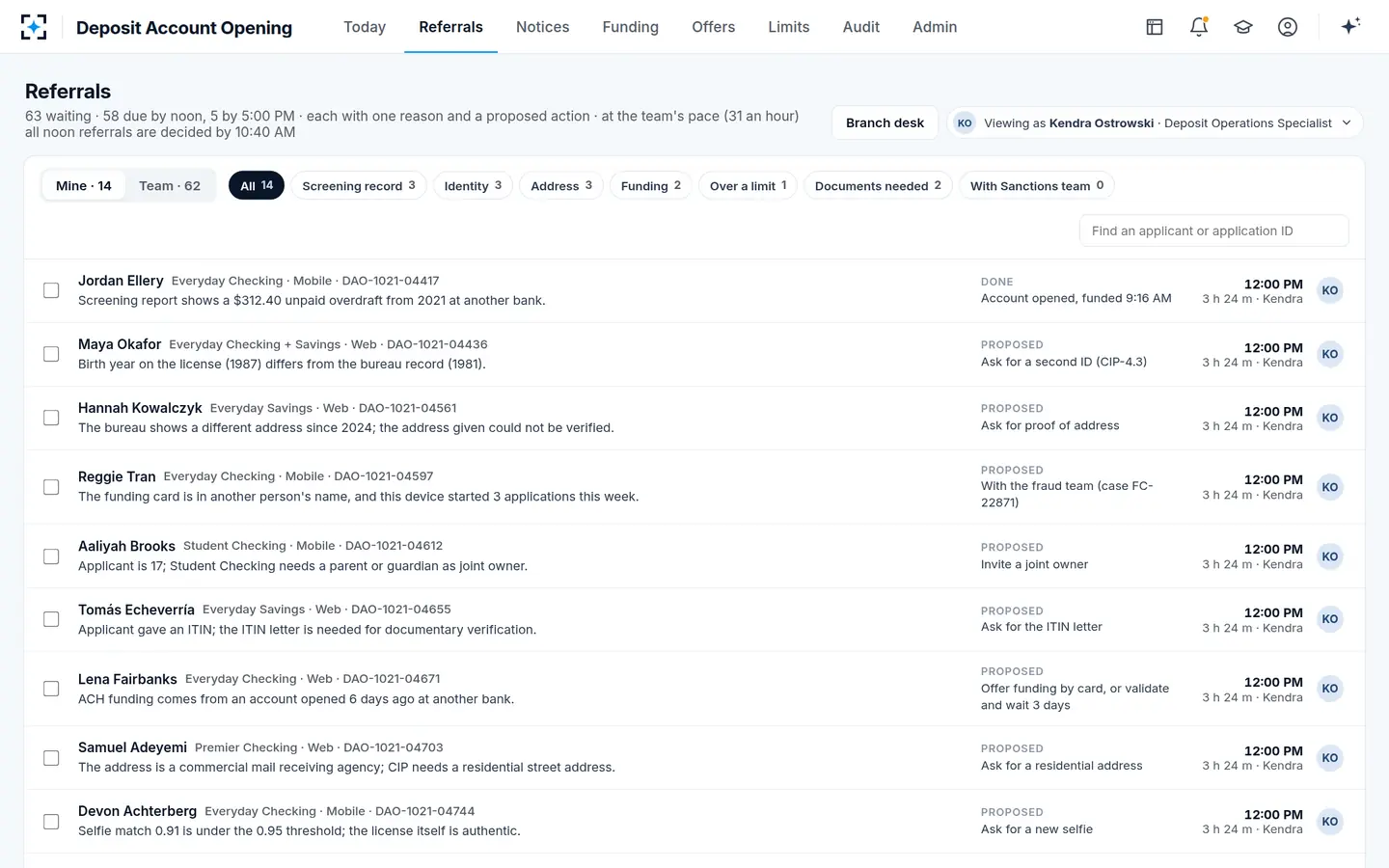
Verification is where an ITIN application can stall. An ITIN is not a photo ID, and the data sources a bank uses to check an SSN may know less about an ITIN holder, so a bank's process may ask for the IRS assignment letter, a passport, or both. In the sample bank's queue, an applicant who gave an ITIN online was referred with a one-line reason, "the ITIN letter is needed for documentary verification", and the agents proposed asking for it rather than declining.
An ITIN application referred for one document, not declined
Can I open a bank account online without a Social Security number?
Sometimes. Nothing in the rule forbids it, but an online application asks the bank to verify identity without seeing the person or the document, and the rule names that situation as one where the bank must use non-documentary methods. Some of those methods, such as matching your details against a credit bureau's file, depend on an SSN, which is one reason an online form may insist on one.
A bank that wants to serve applicants without an SSN online can do it: verify a passport's chip or image and a live selfie, match the passport data to other sources, and refer what does not match to a person. The standard to aim for is a remote proofing level such as NIST's IAL2, which NIST identity assurance levels for account opening explains. Whether a bank invests in that is a product decision, not a legal limit.
What the rule decides, and what each bank decides for itself
Set by the federal rule: A US citizen gives a taxpayer identification number; a non-US person gives a TIN, passport number, alien ID number or other government photo ID number.
Set by each bank’s policy: Which of the non-US options it accepts, and in which channel: online, in a branch, or both.
Set by the federal rule: A program may allow an account for someone who has applied for a TIN, if it confirms the application first and collects the number later.
Set by each bank’s policy: Whether to offer that at all, and what counts as proof the application was filed.
Set by the federal rule: Since 2025 the TIN may come from a third party instead of the customer, but still before opening.
Set by each bank’s policy: Whether to use that option, and which sources it trusts.
Set by the federal rule: Within a reasonable time, by documents, other methods or both; other methods are required when the customer is not in person.
Set by each bank’s policy: Which documents it can examine, which data sources it uses, and what it does when they disagree.
Set by the federal rule: Nothing about which accounts a non-US person may hold.
Set by each bank’s policy: Which accounts are open to applicants without an SSN, and any limits on them.
Can I open a bank account with only a passport?
If you are not a US citizen, a passport can be enough under the rule: its number and country of issuance are the identification number, and the passport itself is an accepted verification document. You still need to give a name, date of birth and an address, and the address is where many passport-only applications stop.
The rule asks an individual for "a residential or business street address". Only someone without one may give an Army or Fleet Post Office box, or the street address of next of kin or another contact. A newcomer staying with family can use that contact's address; a commercial mailbox on its own will not do. A bank may ask for proof of a US address, such as a lease or a utility bill, as part of their own verification.
The address rule, and what to bring if your situation is unusual
| Your situation | What the rule allows | What to bring |
|---|---|---|
| You live at a US street address | A residential or business street address | Anything your bank accepts as proof: a lease, a utility bill, a bank or government letter |
| You have just arrived and live with family or friends | The street address of next of kin or another contact, if you have no street address of your own | That person’s name and address, and a letter from them if the bank asks |
| You are in the military with an APO or FPO address | An Army or Fleet Post Office box number, if you have no street address | Your military ID and orders, if the bank asks |
| You only have a commercial mailbox | Not enough on its own for an individual | A residential or contact street address as well |
Matricula consular and other foreign IDs
A foreign government's identity card can fit the rule's fourth option for a non-US person: the number and issuing country of some other government document that shows nationality or residence and carries a photograph or a similar safeguard. Consular identification cards, such as the Mexican matricula consular, are often discussed in that light.
Whether a bank accepts one is its own decision, made in its written program. A bank that does should say how it verifies the card, because the rule also names documents the bank "is not familiar with" as a situation that calls for additional, non-documentary checks. If your bank does not accept a consular ID, a passport is the more widely accepted alternative.
What changed in 2025: the SSN no longer has to come from you
Since June 27, 2025, banks supervised by the OCC, FDIC and NCUA have been allowed to collect a customer's taxpayer identification number "from a third party rather than from the bank's customer", under a FinCEN order (FinCEN, 2025). A Federal Reserve order of July 31, 2025 extended the same option to Board-supervised banks, and stressed both that the bank must still "obtain TIN information prior to opening an account" and that "there is no requirement to use this exemptive relief" (Board and FinCEN order).
For applicants with an SSN this shortens the form. For applicants without one it changes nothing, since a third-party source cannot supply a number that does not exist, and the non-US options remain the route. It is a reminder that the identity rule is about the bank being reasonably sure who the customer really is, not about any one document.
How a bank can say yes to applicants without an SSN, consistently
The applicants this page is for are often referred, and a referral is only as good as the reason it carries. If an online form simply refuses an applicant without an SSN, the bank never sees them. If it accepts them and stops at verification, a back-office specialist has to work out what is missing, often after the applicant has gone elsewhere.
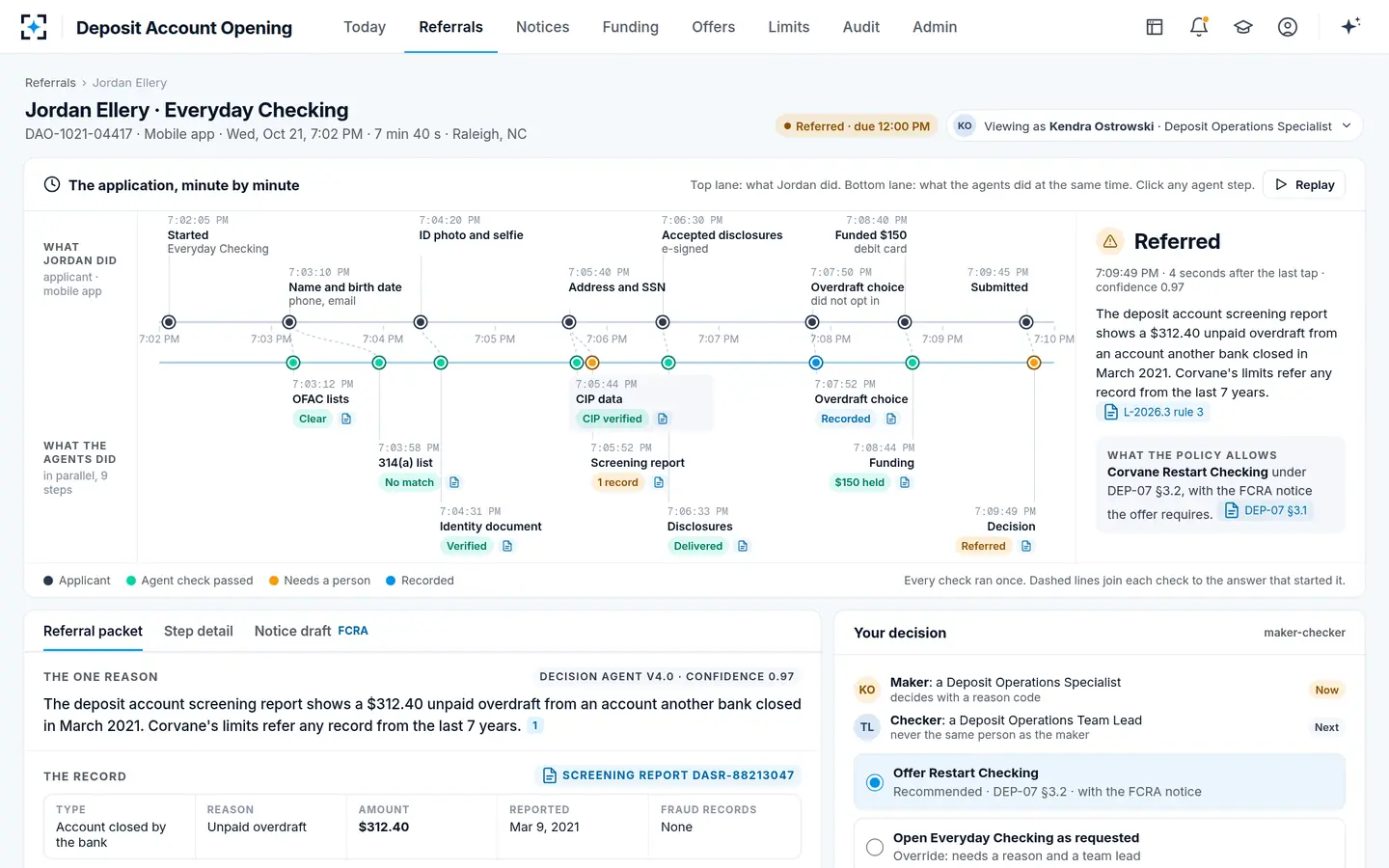
In Deposit Account Opening, the Identity agent verifies the ID, the selfie and the data on two sources while the applicant types, and proposes how a discrepancy is resolved under the bank's procedures; it never resolves one on its own. When a passport applicant's data cannot be matched, or an ITIN needs its letter, the referral names exactly that, and a specialist decides. Take a sample application as it runs through the solution: on the fictional bank's timeline, an applicant's identity document was verified 11 seconds after the photo was taken, and the identity data on two sources 4 seconds after the address and number were entered.
Identity checks run as each piece of data arrives
Examiners care about these files in particular. The FFIEC's CIP procedures tell them to include in their sample, on a risk basis, accounts opened under the TIN-applied-for exception and accounts opened before verification was complete (FFIEC BSA/AML Manual). A bank that serves applicants without an SSN well can show each one's documents, checks and resolution in one place. The account opening process in banks shows how those checks fit around the rest of the application, and why an application is denied covers what to do if yours is refused. The solution itself is Deposit Account Opening.
What to bring if you are opening an account without an SSN
- Your passport, unexpired
Its number and country of issuance can serve as your identification number, and the passport as your verification document.
- Your ITIN letter, if you have an ITIN
The IRS letter that assigned the number, in case the bank asks for documentary proof.
- Your US visa, residence card or other immigration document
An alien identification card number is itself an accepted number; other documents may help the bank verify you.
- A US street address and proof of it
Your own, or that of a relative or contact if you have none; a commercial mailbox alone is not enough.
- A second form of ID if you have one
A foreign driving license or national ID card can help when one source does not match.
- Patience for a branch visit if the online form refuses you
A bank may accept more document types in person, where an employee can examine them.
Questions people ask
Can a green card holder open a bank account without an SSN?
Under the rule, yes: for these purposes a permanent resident is a non-US person, because the definition of US person covers citizens only, so an alien identification card number or a passport number can stand in for an SSN. Most permanent residents have an SSN, and a bank may ask for it if you do.
Can an H-4 visa holder open a bank account without an SSN?
The rule allows it: an H-4 holder is a non-US person and may give a passport number and country of issuance. Whether a given bank opens the account, and whether online or only in a branch, is its own policy, so it is worth asking before applying.
Can I open a bank account while I wait for my Social Security number?
A US citizen can, if the bank's program allows accounts for customers who have applied for a taxpayer identification number. The bank must confirm the application was filed before opening the account and collect the number within a reasonable time afterwards. A non-citizen can usually use a passport instead and add the SSN later.
Do I need an SSN to open a savings account?
The identity rule is the same for savings and checking accounts: a citizen needs a taxpayer identification number, and a non-US person may use one of the alternatives. Interest-bearing accounts also raise tax reporting questions, which is one reason a bank may ask for an ITIN or a tax form.
Why does my bank ask for an SSN if the law doesn't require it?
For a US citizen, the rule does require a taxpayer identification number, which is usually the SSN. For others, a bank may still ask because its verification sources and tax reporting work best with one. The rule sets a minimum; a bank's program can ask for more, as long as it is applied consistently.