Can you open a bank account with an expired ID? Often yes, but rarely on the expired ID by itself. No federal rule bans expired identification. The Customer Identification Program rule that every US bank and credit union follows gives an unexpired government photo ID, such as a driver's license or passport, as its example of a document a bank may rely on, and it requires every bank to have another way to verify people who cannot present one. Which other way, and whether it is offered online or only at a branch, is each bank's written policy. Identity checks like this are what Botminds' CIP Verification is built for: it helps a bank's account opening team handle the exceptions, such as an expired license, under its own procedure, with a person approving each decision.
This page is for the applicant. It quotes the rule so you can see what the bank is working with, and it explains why two banks can give you different answers on the same day and both be within the law.
What the CIP rule says about expired identification, clause by clause
(a)(2)(ii)(A)(1)
“These documents may include … unexpired government-issued identification evidencing nationality or residence and bearing a photograph or similar safeguard, such as a driver’s license or passport”
An example of a document a bank may rely on, not a list of the only ones allowed. An expired license is not this example, so the bank cannot treat it as one.
(a)(2)(ii)(B)(2)
“The bank’s non-documentary procedures must address situations where an individual is unable to present an unexpired government-issued identification document …”
The rule plans for you. Every bank must have another route for an applicant without a current photo ID.
(a)(2)(ii)(B)(1)
“These methods may include contacting a customer; … checking references with other financial institutions …”
What the other route looks like: your details checked against sources you do not control, such as a credit bureau or a public database. The full list of methods is in how banks verify identity.
(a)(3)(i)(B)
“A description of any document that was relied on … the place of issuance and, if any, the date of issuance and expiration date”
The bank writes down the expiry date of whatever it relied on, so an expired document is visible to anyone who reads the file later.
Can I open a bank account with an expired ID?
You can open a bank account with an expired ID at a bank whose procedure accepts another way to verify you. The federal rule sets the outcome the bank must reach, a "reasonable belief" that it knows who you are, and leaves the method to the bank. The FFIEC, which writes the examiners' manual, puts it this way: banks are expected to review an unexpired government photo ID for most individuals, but other identification is acceptable if it lets the bank reach that reasonable belief about who the customer is (FFIEC BSA/AML Manual).
So the honest answer has three parts. The expired ID will usually not be the document the bank relies on. The bank must have a second route for you, by rule. And whether that route is a second document, a database check, a phone call or a branch visit is up to the bank, which is why the answer at one bank may be "upload your renewed license" and at another "bring your passport".
What the CIP rule actually says about expired identification
The rule never uses the word "expired". It uses "unexpired" twice. Once, in the list of documents a bank "may" rely on: an "unexpired government-issued identification" with a photograph. And once in the list of situations its non-documentary procedures must cover: an applicant "unable to present an unexpired government-issued identification document" (31 CFR 1020.220). Read together, they say that an expired ID is not the rule's standard example of a document, and that the rule expects some applicants not to have a current one.
Federal identity standards take the same view from the other side. NIST's identity proofing guidance, SP 800-63A-4, notes that "evidence can remain a useful means to prove identity, even if it is expired", and leaves each service to define its own policy for expired evidence (NIST SP 800-63A-4). An expired license still carries a photo, a name, a date of birth and a number a bank can check against other sources. It is weaker evidence, not worthless evidence.
Why a bank may still ask for a current ID
Banks ask for a current ID because it is the simplest evidence to verify, and because their own procedure says so. A current license or passport can be checked for tampering by the identity verification service, matched to a selfie, and described in the bank's file in one line. An expired one pushes the file into an exception queue, where someone has to choose and document another method. Some banks decide that the cleaner path, for them and for most applicants, is to ask for one current document.
That is a policy choice, and it is visible in the file. The rule requires the bank to record the document it relied on, including "the date of issuance and expiration date". A bank that relied on an expired license would show that on the record an examiner reads, so it needs a written step that allows it and other evidence that supports it.
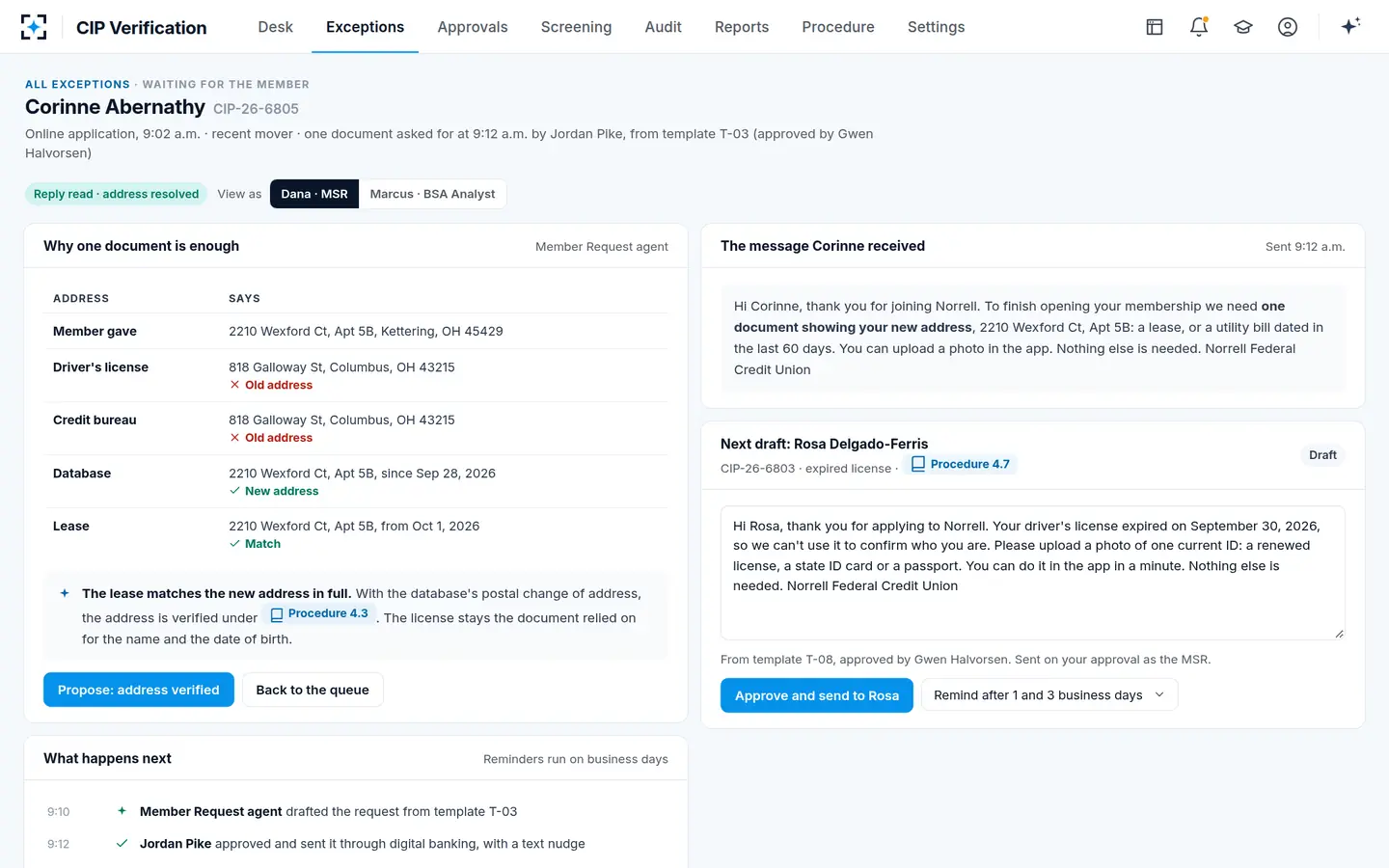
A request for a current ID in CIP Verification, approved before it is sent
Can you open a bank account with an expired driver's license online?
Online is harder than in a branch, because there is no one to look at your other documents. An online opening usually asks you to photograph the front and back of your license and checks it automatically; a check designed to accept only current documents will stop at the expiry date, and the application goes to a person or asks you for another ID. You may be offered an upload of a passport or state ID card, a call, or an invitation to a branch.
Two things help. Applying with a passport or a renewed license, if you have one, avoids the exception entirely. And if your state issued you a paper receipt or temporary document while a renewal is in the post, ask the bank whether it accepts it; the answer is in its procedure, not in federal law.
Expired ID at a branch and online: what usually changes
At a branch: An employee, who can look at a second ID or a bill you brought.
Online or by app: An automated document check, then a person only if it refers your file.
At a branch: The employee follows the bank’s procedure for no current ID.
Online or by app: A check set to current documents stops; you are asked for another ID or another step.
At a branch: A second document, a database match, a call to a number the bank finds itself.
Online or by app: Database match, a one-time code, an upload of another document, a video or branch visit.
At a branch: Often at the desk, unless the file goes to the back office.
Online or by app: Minutes if the other route is automated; a day or more if it waits for a person.
What to bring if your ID has expired
Bring more than one thing. The FFIEC encourages banks to look at a second document even when the first one is current, so a second document helps an application with an expired one. The list below is not a federal requirement; it is what tends to let a bank use its non-documentary route quickly.
What to bring if your only photo ID has expired
- The expired ID itself
It still shows your photo, name, date of birth and number, which the bank can check against other sources.
- Any current government photo ID
A passport, passport card, state ID card or military ID, if you have one, usually ends the exception.
- Your Social Security number or ITIN
The rule requires an identification number before opening, and it is how databases find you.
- Proof of your current address
A lease, a utility bill or a government letter, especially if you have moved since the ID was issued.
- Proof you have applied to renew
A receipt or temporary document from your motor vehicle agency, if the bank accepts it.
- A phone you can receive a code or call on
Non-documentary methods often include contacting you on a number the bank sources itself.
Can you open a bank account without ID?
Possibly, at a bank whose procedure verifies identity without documents, but expect to give the same four items either way. The rule requires your name, date of birth, address and an identification number "prior to opening an account", and it lets a bank verify them with "non-documentary methods", such as comparing them with a consumer reporting agency or a public database. It does not require a photo ID as such. Whether a particular bank offers a route without documents, and in which channel, is written in its procedure, so ask before you apply.
Missing ID is a real barrier. In the FDIC's 2023 survey, 13.0% of unbanked households said they did not have the identification required to open an account; among households that had never had a bank account, the share was 20.4%, against 4.8% for those that had been banked before (FDIC, 2023 survey). The FFIEC also points banks to guidance encouraging non-documentary methods for customers "who cannot provide standard identification documents because of the effects of natural disasters".
Missing ID keeps some households out of banking altogether
13.0%
of unbanked households cite not having the ID required to open an account
20.4%
of households that have never been banked cite it
4.8%
of households that had a bank account before cite it
Why can't the bank verify my identity?
Usually because one of your details does not match a source the bank checks, not because anyone thinks you are someone else. An expired ID is one cause; others are an address you moved from months ago still on your credit file, a married surname on one record and not another, a date of birth keyed in the wrong order, or no credit file at all because you are young or new to the country. Each of these has an ordinary fix, usually one document or one confirmation. Banks may not be able to tell you every reason, but you can ask which item did not match and what the bank needs to clear it.
If the bank asks for something unexpected, it is following its own procedure. How banks verify identity explains the checks behind the request, and how often the people and machines doing them get it wrong.
How a bank handles an expired ID behind the counter
Behind the counter, an expired ID turns your application into a CIP exception with a named route: the rule's "unable to present an unexpired" situation. The bank's procedure decides what replaces the expired document, and a second person usually approves the result. If you are already a customer of the bank, the CIP rule may not apply to a new account at all: a person with an existing account is not a new "customer" if the bank already has a reasonable belief it knows who they are (31 CFR 1020.100).
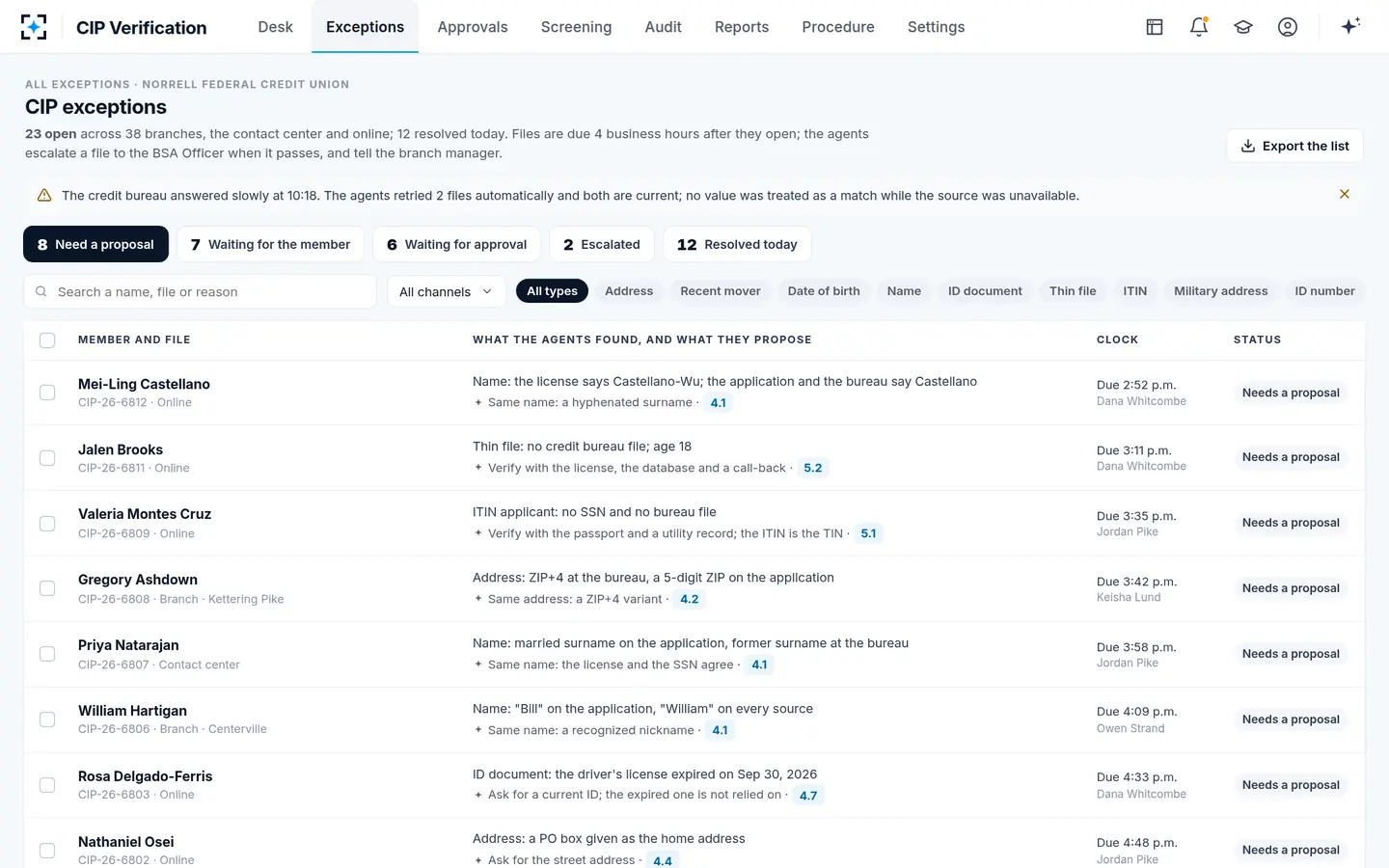
Here is how it looks in CIP Verification, on fictional sample data. A sample applicant's license expired on September 30, 2026. The agents marked the document as expired rather than treating its data as wrong, and drafted the one request the bank's sample procedure allows: a photo of a current ID, through the bank's app, with reminders after one and three business days. A member service representative approved and sent it; when the new document arrives, it is read, compared with the other sources, and the resolution goes to a BSA analyst for approval.
An expired license as one row in CIP Verification's exception queue
A bank that accepts expired IDs with other evidence can write that as a step too, and the agents will propose it the same way. The rule leaves room for either, as long as the step is written, applied consistently and recorded. The route an expired ID takes is one of five the rule names; CIP exceptions, route by route covers the others, and the CIP Verification page describes the whole solution.
Questions people ask
Can I open a bank account with an expired passport?
The same rule applies: an expired passport is not the rule's example of a document, but a bank may use it alongside other evidence if its procedure allows. A non-US person can also give a passport number and country of issuance as the identification number, which is a separate question from which document verifies identity.
Will a bank accept a temporary paper license?
It depends on the bank's procedure. A temporary document is government-issued and current, but some carry no photograph, so a bank may want it alongside the expired photo license or another source. Ask before you go.
Can a bank refuse to open my account because my ID is expired?
A bank may decline if it cannot form a reasonable belief that it knows who you are under its procedure. It can also ask for one current document instead, and you can ask what other evidence it would accept.
Do I need ID to open a bank account for my child?
If you open the account for a minor, you are the bank's customer for CIP purposes, so your identification is the one that counts. If the minor opens it, the minor is the customer; the agencies' FAQ gives a school savings program, verified with a student ID or a teacher's confirmation, as an example.
How long does a bank have to verify my identity?
The rule allows verification to finish within a reasonable time after the account opens, and leaves the length to the bank to define. While it verifies, your account may be restricted under terms the bank's procedure sets, such as no outgoing payments.