How long does identity verification take at a bank? Seconds for most applicants, and half an hour or more for the ones a person has to clear, which is why it costs far more than its official price suggests. FinCEN's paperwork estimate for the Customer Identification Program is two minutes per new account. GAO, studying eleven banks, estimated about thirty minutes to collect and review the information for a new consumer account, and more than an hour for a business. The files that pass automated checks take seconds; the files that do not (a date of birth keyed wrongly, a recent move, an ITIN applicant, a thin credit file) take a person reading four screens, writing to the applicant, waiting, and writing down a resolution the rule requires. Botminds' CIP Verification is an agentic solution built for those minutes: agents compare and draft, and people approve. This page shows where the minutes go and how to price software against them.
The official price of CIP, and the measured one
2min
per account in FinCEN’s CIP burden estimate
verification, records, list checks
30min
to collect and review a new consumer account, GAO estimate
over 1 hour for business accounts
$15
average CDD cost per new account at eleven banks
range $5 to $44, 2018 data
29%
of direct BSA cost spent on customer due diligence, on average
the costliest BSA area
What does identity verification cost a bank?
Identity verification costs a bank the price of its vendors plus the staff time on every file the vendors cannot clear, and the second part is the larger one that nobody publishes. GAO's study of eleven banks found customer due diligence, of which CIP is the first step, cost about $15 a new account on average in 2018, ranging from $5 to $44, and was the costliest BSA area, about 29% of direct BSA/AML compliance cost on average (GAO-20-574). The cost per account was highest at a very large bank, $44, and $6 at another very large bank that opened more than 500,000 new accounts a year.
Smaller institutions feel it most. A 2025 study of a decade of state supervisors' survey data found the smallest banks spent roughly 11% to 15.5% of payroll on compliance tasks, against 6% to 10% at the largest (CSBS, 2025). For a community bank or credit union, identity verification is a staffing question before it is a software question.
Two minutes or thirty: FinCEN's estimate against GAO's
The two numbers measure different things, and the difference is instructive. FinCEN's estimate, renewed in June 2024, allows "two minutes per account opened by a financial institution to obtain and verify a customer's identity (i.e., verification and recordkeeping requirements, and consulting government lists)", across 54,327,000 new account relationships a year at 16,232 institutions: 1,989,452 hours and $211.5 million in total (FinCEN, 2024). That works out to about $106 an hour, fully loaded (our arithmetic). It is a paperwork-burden estimate for the incremental work of the rule, not a time study.
GAO's thirty minutes is closer to a time study. It covers the staff time needed to gather and review customer information for a new personal account, which includes the CIP, the rest of customer due diligence and the review a second person does. Business accounts took more than an hour, often because of beneficial ownership and documents such as certificates of good standing.
FinCEN's own figure carries a warning. Its 9.3 million new accounts at banks with a federal regulator is described as "a lower bound" built from credit union memberships and Bank On accounts, not a count of all bank accounts opened. Use the national totals for scale, and your own volumes for decisions.
Where the minutes go on one CIP exception
On the exceptions, most of the minutes go on reading and relaying, not deciding. Botminds' own estimate of the working time on one CIP exception handled by email, kept deliberately modest, is 65 minutes across the member service representative and the BSA analyst, before counting the overnight wait for the BSA mailbox or the applicant's reply. With agents doing the reading and drafting, the same estimate falls to 9 minutes.
Where 65 minutes go on one CIP exception, and where 9 go with agents
By hand, by email: 65 min
- Reading vendor codes, comparing screens · 23%
- Finding the procedure step · 15%
- Emailing the BSA team · 15%
- Writing to the applicant · 12%
- Analyst checking sources · 19%
- Writing the resolution · 16%
With agents: 9 min
- Reading the comparison · 22%
- Step · 11%
- Hand-off · 11%
- Message · 11%
- Analyst checking sources · 34%
- Resolution · 11%
The second bar is the more interesting one. With the reading and relaying gone, a third of what remains is the analyst checking the sources before approving, which is the part that should stay. A product that claims to remove that too is removing the control, not the cost.
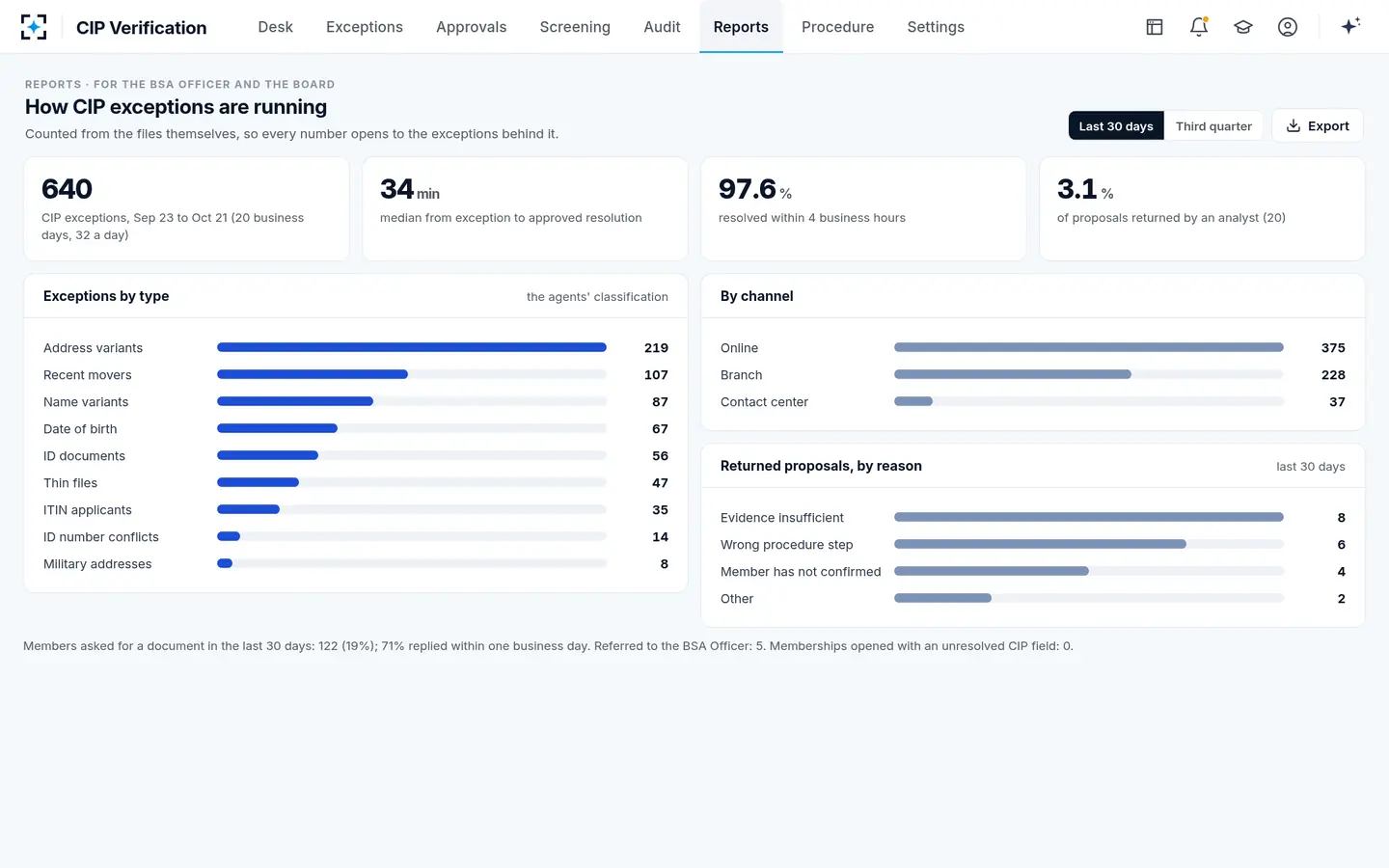
Elapsed time is a different measure from working time. In thirty days of fictional sample data at a credit union using CIP Verification, the median from exception to approved resolution was 34 minutes and 97.6% were resolved within four business hours; those figures include waiting for applicants to reply.
How CIP exceptions are running in CIP Verification, counted from the files
What does identity verification cost per account?
Per account, the honest answer is a blend: a few dollars of vendor and data charges on every account, plus the staff cost of the share that becomes exceptions. Vendor prices are rarely published, so the staff side is the part a bank can measure and the part worth pricing carefully. Using BLS medians for 2025, new accounts clerks earned $47,670 a year and compliance officers $80,730 (BLS), about $22.92 and $38.81 an hour before benefits.
On Botminds' 65-minute estimate, split 43 minutes at the desk and 22 with the analyst, one exception handled by email costs about $31 in wages; with agents, about $4.50 (our arithmetic). For scale, GAO's average for the whole of customer due diligence on a new account in 2018 was $15. On these assumptions, one exception costs about twice what an average account's entire due diligence did, which is why the exception rate, not the vendor's per-check fee, drives the bill.
Minutes per file, by who is counting and what they count
Identity verification software vs KYC verification software: what each prices
The market sells three things under similar names, and each prices a different part of the minutes. Identity verification software checks documents, selfies, liveness and data, and is usually priced per check; it clears the passes. KYC verification software or onboarding platforms add customer due diligence questions, risk rating and workflow, and are usually priced per account or per seat. Exception handling, the refers, the requests to applicants, the analyst's review and the written resolution, is usually left to people and to email.
That third category is where the 65 minutes sit. A bank comparing products should ask each one which of the six tasks in the split above it removes, and on what share of files. A product that improves the pass rate by a point and leaves every exception to email may save less than one that leaves the pass rate alone and halves the minutes on each exception.
How long does CIP take per account?
For an applicant whose data agrees everywhere, CIP takes seconds of machine time and a minute or two of the employee's. For an exception, it takes as long as the slowest hand-off. The rule itself sets no clock beyond verifying within a reasonable time once the account is open (31 CFR 1020.220), so the clock a bank lives by is its own service level and its applicants' patience.
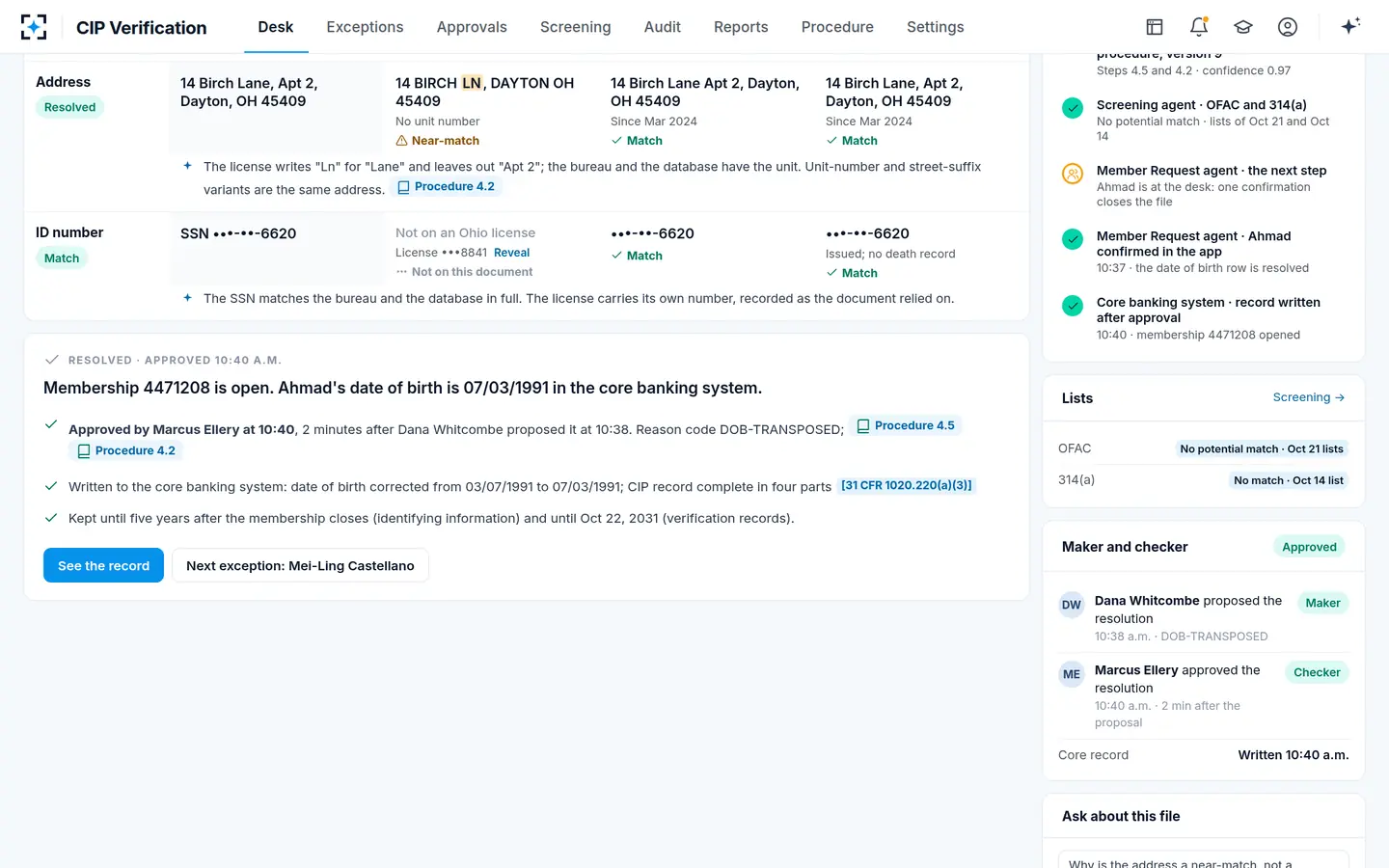
The hand-off is the expensive part. In the sample credit union's old process, an exception emailed to the BSA mailbox was answered the next business day, and the applicant either waited or left. In the sample data, Ahmad Rezaei, a fictional applicant whose day and month of birth were swapped on his form, had his resolution proposed at 10:38 a.m. and approved by a BSA analyst at 10:40, sixteen minutes after he applied, while he was still at the desk.
Resolved at the desk: approved two minutes after it was proposed
Pricing the exception work at your bank
Price identity verification software against four terms, two gains and two costs, using your own volumes and wages. The first is the one this page has been building toward.
A return on CIP exception handling, written as a sum
Desk minutes saved
exceptions × (desk minutes now − with tool) × desk wage
Reading, finding the step, hand-offs, writing to the applicant. 38 minutes on Botminds’ estimate.
Priced by: deposit operations
Analyst minutes saved
exceptions × (analyst minutes now − with tool) × analyst wage
Checking sources and writing the resolution. 18 minutes on the same estimate; the check itself stays.
Priced by: the BSA officer
Software, data and connection
licence + per-check fees + integration
Core, account opening platform, document imaging, bureau and screening connections.
Priced by: IT and procurement
Oversight
validation hours + sampling QA hours
Testing the tool before relying on it, and sampling its output after.
Priced by: second line and audit
A worked example, on fictional sample volumes: a credit union with 32 CIP exceptions a business day, about 8,000 a year, saving 56 minutes on each, frees about 7,470 staff hours a year, roughly $209,000 in wages before benefits at the BLS medians above (our arithmetic on Botminds' estimate and the sample volume). Your own number will differ by volume, wage and exception mix; the point is that it can be computed from files you already have.
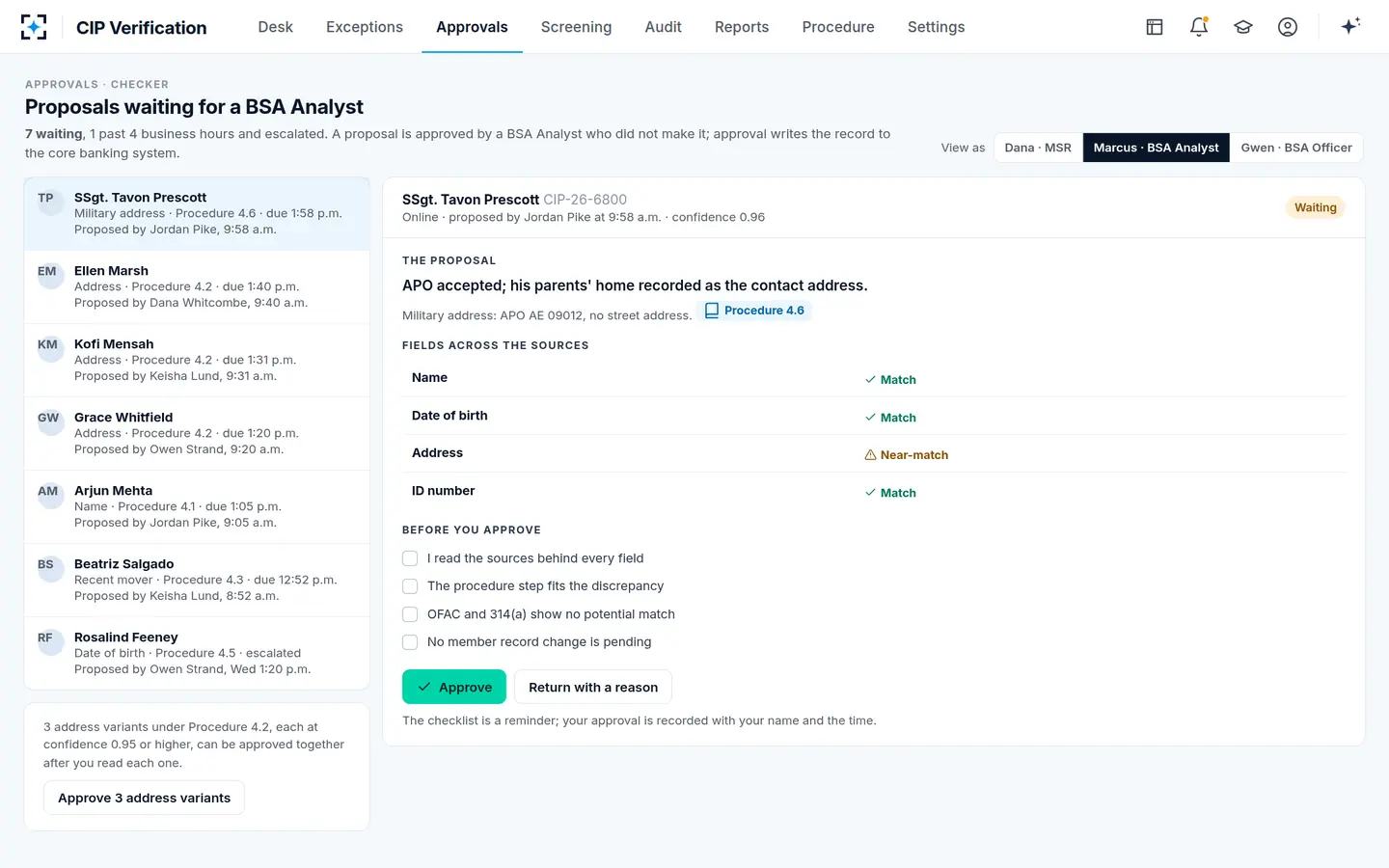
Bulk approval only where it is safe, in CIP Verification
What to look for in identity verification for banks
Look for software that reduces human minutes per exception without removing the human decision, and that can show the reduction on your own files. These questions separate the two.
Buying questions for identity verification software, priced in minutes
- What share of our past applicants would it have referred?
Run it on last quarter’s applications; the refer rate drives the staff cost.
- Which of the six exception tasks does it remove?
Reading, finding the step, hand-offs, applicant messages, the analyst’s check, the written resolution.
- Does every resolution cite our procedure step?
If the analyst still has to look it up, the minutes are still there.
- Can the applicant answer in one tap or one upload?
The elapsed time is set by the slowest reply.
- Does a person still approve, and can the maker approve their own?
Saving the check is a control failure, not a saving.
- Does the price scale with checks, accounts or exceptions?
Match it to the cost driver you are trying to remove.
- What will validation and oversight cost us?
Model risk, audit and sampling time belong in the price.
Where CIP Verification fits in the price, and where it does not
CIP Verification prices against the exception minutes, not the checks. It works with the identity verification service, credit bureau and screening a bank already uses, and takes over the reading, comparing, step-finding, drafting and record-writing on the files they refer. A member service representative proposes each resolution and a BSA analyst approves it; nothing is written to the core system until then. It does not replace the document, selfie and liveness checks, and it does not lower the per-check fees a bank pays its vendors.
For a bank whose exceptions are few and simple, the return may be small, and the honest advice is to measure first. For a bank with a large online channel, many thin-file or ITIN applicants, or a BSA team answering a mailbox the next day, the minutes add up quickly. An eight-week go-live plan sets out how to test that on your own exceptions, and the CIP compliance analyst's seat describes the people whose time this is. The solution is described in full on the CIP Verification page.
Questions people ask
How much does identity verification cost per check?
Vendor prices are rarely published and vary with volume and features. What a bank can measure is its own staff cost per exception, which on Botminds' estimate is about $31 in wages by hand and dominates the cost of the files that need a person.
Is two minutes per account a realistic CIP time?
For files that pass automated checks, roughly. FinCEN's two minutes is a paperwork-burden estimate for the rule's incremental work; GAO found about thirty minutes to collect and review a consumer account, and on Botminds' estimate an exception handled by hand takes about an hour of working time.
What is the difference between identity verification software and KYC software?
Identity verification software confirms who the applicant is, through documents, biometrics and data. KYC software adds customer due diligence, risk rating and workflow. Neither necessarily handles CIP exceptions, which is where most staff time goes.
Does identity verification software reduce BSA staff?
It reduces minutes per file; whether that becomes fewer people or faster service is a management choice. The analyst's check and the BSA officer's decisions remain, and so does the oversight of the software itself.
How should a bank measure the time spent on CIP?
Sample a month of exceptions and time each task: reading, finding the step, hand-offs, the applicant request, the analyst's check and the written resolution. Measure elapsed time from exception to approval separately, because waiting is a different problem from working.