Deepfake identity verification fraud is the use of AI-generated or AI-altered photos, videos and identity documents to get through a bank's customer identification checks. FinCEN's alert of November 2024 says it has seen a rise in such reports since 2023, and it gives banks a concrete list of red flags: a photo that does not fit the date of birth, documents that disagree with each other, a webcam plugin during a live check, device or location data that does not match the ID. The difficulty is that the human eye, the traditional backstop, is no longer reliable against synthetic faces. Botminds' CIP Verification is an agentic solution for customer identification exceptions; it does not detect deepfakes itself, but it lays every identifying field beside every source, which is where several of FinCEN's red flags show up, and it keeps suspected cases away from the applicant's view.
FinCEN's analysis of BSA data indicates that criminals have used GenAI to create falsified documents, photographs, and videos to circumvent financial institutions' customer identification and verification and customer due diligence controls.
FinCEN, FIN-2024-Alert004
What is deepfake identity verification fraud?
It is identity fraud in which the evidence itself is generated or altered by AI. FinCEN describes two methods: "modifying an authentic source image or creating a synthetic image", used on driver's licenses, passport cards and passport books, and sometimes combined "with stolen personal identifiable information (PII) or entirely fake PII to create synthetic identities" (FinCEN alert). The resulting accounts have been used to receive the proceeds of check fraud, credit card fraud, authorized push payment fraud, loan fraud and unemployment fraud, and as funnel accounts.
The attack is aimed at the remote channel. Treasury's December 2024 report on AI in financial services lists "criminals thwarting customer identification programs through document and image manipulation or creation (e.g., 'deepfake' images)" among the threats firms described (US Treasury, 2024). Synthetic identity fraud more broadly, real and invented data stitched into a person who does not exist, is a related problem that fraud teams own; this page stays with the deepfake evidence presented at opening.
What FIN-2024-DEEPFAKEFRAUD asks banks to watch for
FinCEN asks banks to file SARs on suspected deepfake activity with the key term "FIN-2024-DEEPFAKEFRAUD" in field 2 and in the narrative, and it lists red flags. It is careful to add that "no single red flag is necessarily indicative of illicit or suspicious activity". The flags fall into two groups: those visible at account opening, and those that show up in how a new account is used.
FinCEN's deepfake red flags, sorted by when a bank can see them
- The photo is internally inconsistent, or does not fit the person’s data
Visual tells of alteration, or a date of birth that makes the person much older or younger than the photo.
- Several identity documents disagree with each other
Names, dates or numbers that differ between the documents the applicant submits.
- A third-party webcam plugin, or “technical glitches”, during a live check
Or a request to change communication method in the middle of verification.
- The applicant declines multifactor authentication
FinCEN names MFA and live audio or video checks as best practices.
- The ID photo matches a gallery of AI-generated faces
Found by a reverse-image lookup or open-source search.
- Deepfake or GenAI-text detection software flags the photo, video or answers
Commercial or open-source tools.
- Device or location data is inconsistent with the identity documents
An IP address or device far from the address on the ID.
- After opening: rapid transactions, risky payees, chargebacks
Gambling sites or digital asset exchanges, rejected payments, funds withdrawn as soon as they land.
Read as a set, the list has a pattern. Only two flags depend on inspecting the image itself; most are inconsistencies: the photo against the date of birth, one document against another, the device against the address, the account's behaviour against what a new customer usually does. That is the useful lesson for CIP teams. A synthetic face can be perfect and still sit on a file whose other facts do not agree.
Can deepfakes pass KYC?
Yes, they already have. FinCEN reports that "malicious actors have successfully opened accounts using fraudulent identities suspected to have been produced with GenAI". NIST's identity proofing standard explains how: AI tools create or modify images and video of applicants and their evidence "to defeat automated document validation processes, biometric operations, and visual comparisons done by proofing agents", often by injecting forged media between the camera and the system that checks it (NIST SP 800-63A-4).
Video is not a safe harbour either. Treasury's March 2024 report on AI-specific risks, based on 42 interviews, put it bluntly: "even live video interactions with a known client may be no longer sufficient for identity verification because of advances in AI-driven video-generation technology" (US Treasury, March 2024). The defence therefore cannot be a single stronger check. It has to be several checks that fail in different ways.
Why a sharper eye is not the defence
People cannot reliably tell an AI-generated face from a real one. In a study published in PNAS, 315 participants classified faces as real or synthesized and averaged 48.2% accuracy, "close to chance performance of 50%". A second group of 219, given training and trial-by-trial feedback, reached 59.0%, and did not improve over the course of the test (Nightingale and Farid, PNAS, 2022). The paper's title gives the second finding: synthetic faces were rated more trustworthy than real ones.
People spot AI-generated faces about as often as a coin toss would
This matters for training as much as for technology. A branch employee told to "look closely at the photo" is being asked to do something the evidence says people cannot do for synthetic faces, and the instruction can create false confidence. Training is better spent on the inconsistency flags, which a careful person can check, and on what to do when one appears.
How do banks detect fake IDs?
Banks detect fake IDs with layers: automated document checks, biometric comparison with liveness, cross-checks of the identity data against independent sources, device and location signals, and a second look at the opening documents when the account later behaves oddly. FinCEN's analysis found that institutions "often detect GenAI and synthetic content in identity documents by conducting re-reviews of a customer's account opening documents", using reverse image searches, metadata and detection software, and treating as reasons for more scrutiny "inconsistencies among multiple identity documents" and "inconsistencies between the identity document and other aspects of the customer's profile".
Each layer fails differently, which is why deepfake defence needs several
What the layer checks: Security features, barcode against the front, signs of editing.
How a deepfake gets past it, and what still catches it: A well-made synthetic document passes; an inconsistency between it and other sources may not.
What the layer checks: That the face matches the ID photo and belongs to a live person.
How a deepfake gets past it, and what still catches it: Injected or replayed video; presentation attack detection and live prompts raise the cost.
What the layer checks: Name, date of birth, address and number against bureau and public records.
How a deepfake gets past it, and what still catches it: Stolen real data passes; a photo that does not fit the date of birth, or a number linked to someone else, does not.
What the layer checks: Where and on what the application was made.
How a deepfake gets past it, and what still catches it: Masked by proxies; still a red flag when it contradicts the address on the ID.
What the layer checks: The opening documents, looked at again when the account behaves oddly.
How a deepfake gets past it, and what still catches it: Too late to stop the opening, but the route FinCEN says most often finds GenAI content.
Is liveness detection required?
Not by a US banking rule. The CIP rule does not mention liveness, selfies or biometrics; it requires a risk-based procedure that produces a reasonable belief in the customer's identity. FinCEN describes "live verification checks in which a customer is prompted to confirm their identity through audio or video" as a best practice, and notes that criminals may claim "repeated technical glitches" to avoid them.
Two standards go further. NIST SP 800-63A-4 requires a service that collects biometrics remotely to "implement presentation attack detection (PAD) capabilities" with an impostor attack presentation accept rate below 0.07; it is binding on federal agencies and voluntary for banks. In the European Union, the EBA's remote onboarding guidelines tell institutions using unattended remote onboarding to "perform liveness detection verifications" (EBA/GL/2022/15). For a US bank that takes selfies at remote opening, these are the published benchmarks a second line, an auditor or an examiner can hold the vendor's liveness check to. Government test results show how far products differ, and an eight-week go-live plan for remote ID verification sets out how to test one on your own applicants first.
What the CIP file should show when a deepfake is suspected
The file should show what raised the suspicion, what was checked, who decided and what happened next, without any of it reaching the applicant. Under the CIP rule, a suspected deepfake at opening is a verification failure: the bank cannot form a reasonable belief that it knows who the applicant is, and its procedure decides whether to decline, restrict or close, and whether to file a SAR. The record keeps the identifying information and the resolution; the SAR decision belongs in the BSA case system, not on the account file a branch can see.
A suspected deepfake at account opening, from flag to decision
Agent
Identity verification serviceRuns the document check, selfie match and liveness, and returns pass, refer or fail with reasons.
Agent
Cross-source comparisonLays the ID’s data beside bureau, database and device signals; flags each inconsistency in words.
Never: decides the applicant is genuine because the image passed
A person decides
Analyst stops the routine pathA file with inconsistencies a procedure step cannot explain is not resolved; it is referred.
A person decides
BSA officer decidesDecline, ask for in-person verification, or restrict; considers a SAR with the FinCEN key term.
Two habits make the file useful later. Keep the evidence the decision rested on, including the vendor's reasons, not just its score. And record which re-review found the problem if it is found after opening, because FinCEN's own analysis says that is how these cases are often found. How banks verify identity, and how often people get it wrong sets out the evidence on human and machine error rates in more detail.
Where CIP Verification fits, and where it does not
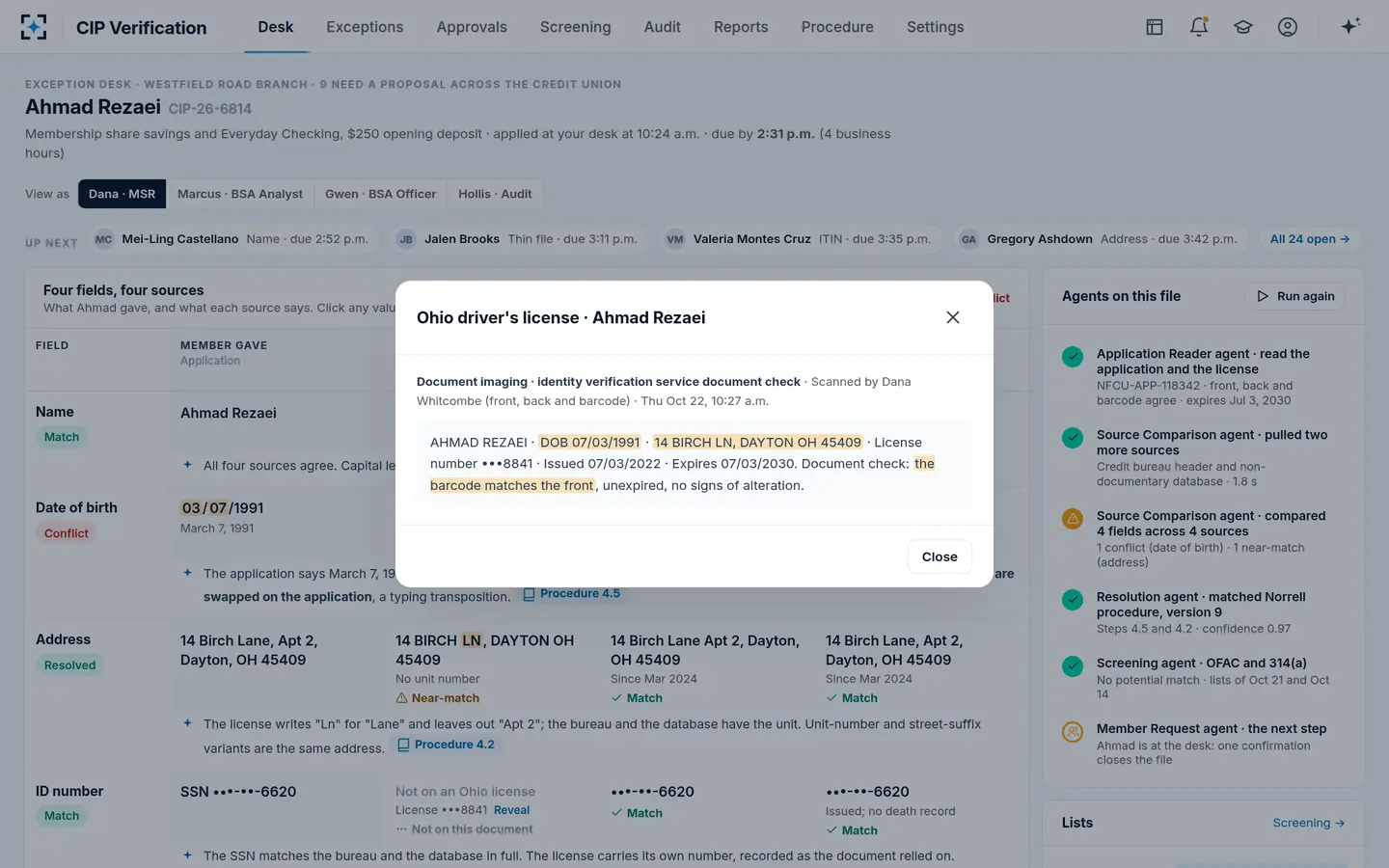
CIP Verification does not judge whether an image is synthetic. That is the job of the identity verification service and its document, selfie and liveness checks, and the solution works alongside the one a bank already uses. What it does is the cross-source work that several of FinCEN's flags depend on. Its agents read the ID document, front, back and barcode, pull the credit bureau header and a non-documentary database, and compare name, date of birth, address and identification number across every source, explaining each disagreement in a sentence.
Every value opens the source it came from, for the second look FinCEN describes
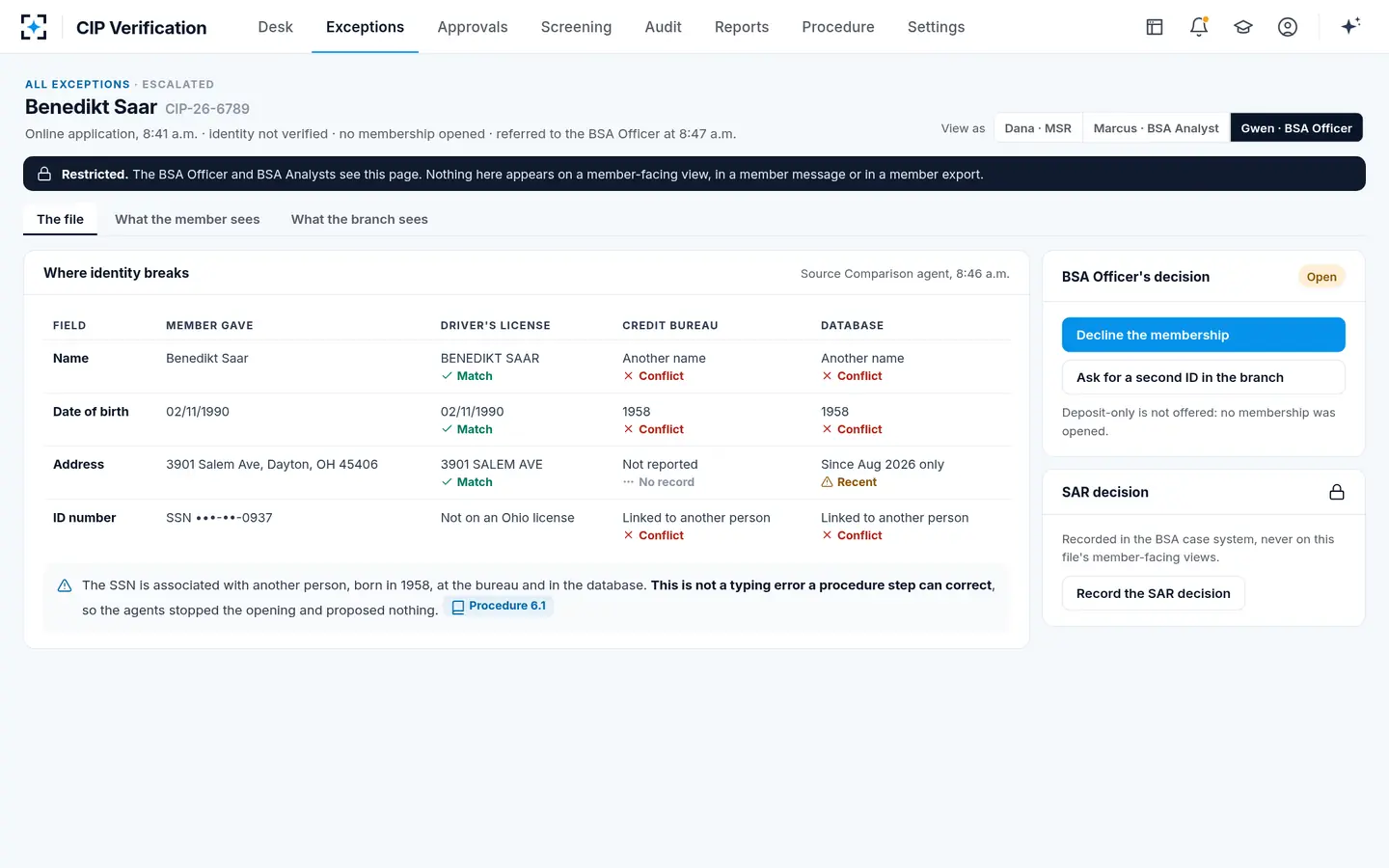
When the sources do not agree in a way a procedure step can explain, the agents stop. In one sample file, the applicant's name, date of birth and address matched his license, but his Social Security number belonged to another person, born in 1958, at both the bureau and the database. The agents proposed nothing and sent the file to the BSA officer, on a restricted page; the applicant and the branch saw a neutral status. That is the behaviour a deepfake case needs: no automated approval on an image that looks right, and no tipping off.
A restricted referral in CIP Verification: the applicant sees a neutral status
The limits are worth stating plainly. If a deepfake is paired with a real person's stolen data that is consistent across every source, cross-source comparison will not catch it; that falls to the image checks, the device signals and monitoring after opening. The solution's part is to make sure no exception is closed by default, and that the evidence for every decision is there for the re-review. Its full description is on the CIP Verification page.
Questions people ask
What is FIN-2024-DEEPFAKEFRAUD?
It is the key term FinCEN asked financial institutions to put in SAR field 2 and in the narrative when reporting suspected deepfake-related activity, under its alert FIN-2024-Alert004 of November 13, 2024. It lets FinCEN find those reports across the data it receives.
Can a selfie check be fooled by a deepfake?
Yes. NIST notes that injection attacks insert forged media between the camera and the system doing the comparison, and that "a biometric comparison performed with a captured sample does not prevent these attacks". Live document capture and presentation attack detection make them harder, not impossible.
Does a one-time passcode stop deepfake account opening?
Not on its own. It proves control of a phone or an email address, not that the face on the ID is real. FinCEN treats a customer declining multifactor authentication as a red flag, which makes MFA a useful signal rather than a cure.
What should a bank do if it finds a deepfake after the account is open?
Treat it as a failed verification under the CIP procedure: restrict or close the account as the procedure says, consider a SAR with the key term, and review related accounts. FinCEN reports that institutions often find GenAI content this way, by re-reviewing opening documents after other suspicious signs.
Is deepfake fraud the same as synthetic identity fraud?
They overlap. A deepfake is falsified evidence, an image, video or document; a synthetic identity is a person who does not exist, built from real and invented data. FinCEN notes that criminals combine the two, attaching AI-generated images to stolen or invented personal information.