KYB software is software that helps a bank verify business customers: reading formation and ownership documents, checking state business filings, verifying and screening owners and signers, and keeping the file an examiner will ask for. Whether it is worth buying depends less on its features than on the bank's size, because the rules behind KYB cost the same to follow at a bank with one branch as at one with a thousand, and small banks spread that cost over far fewer accounts and staff. GAO found total BSA compliance costs of about 2% of operating expense at the smallest banks it studied against about 0.6% at the largest; state supervisors find small banks spending up to 15.5% of payroll on compliance tasks. Botminds' Business Account Opening (KYB) is a solution for community and regional banks, and this guide sets out when that cost case holds and when it does not.
The cost research on this page comes from GAO, the Conference of State Bank Supervisors, the Federal Reserve Bank of St. Louis and FinCEN. The worked arithmetic is ours and shows its assumptions, and the product figures come from fictional sample data or the product team's estimate, labelled where they appear.
The same rules, a different weight
2%
of operating expense spent on BSA compliance at the three smallest banks in GAO's study
0.6%
at the three largest banks in the same study
15.5%
of payroll spent on compliance tasks at the smallest banks, at the top of the range
$15
average customer due diligence cost per new account, across 11 institutions (range $5 to $44)
What is KYB software, and who is it for?
KYB software covers three kinds of product, and buyers often compare across them by mistake. Data providers sell access to business registries and identity databases through an interface or an API. Verification services run checks on a business or person and return a result. Workflow software runs the bank's own account opening process: it takes the packet, applies the bank's document rules, uses data and verification sources, routes decisions to people and writes the result to the core. Most banks need something from all three; the question is which one carries the work their staff does today.
For a community bank opening a few hundred business accounts a year, the work is mostly reading and reconciling, done by a business banker who is also selling the relationship. Data alone does not remove that work, because someone still has to compare the data with the packet. For lenders the question has a further dimension: SBA eligibility asks about every owner and affiliate, not just those at 25%, which KYB compliance software for SBA eligibility covers in detail.
What does KYB cost per account?
GAO's study of 11 banks and credit unions gives the only public, regulator-grade figure: in 2018 the banks it studied spent an estimated $15 a new account, on average, on customer due diligence, with individual banks ranging from $5 to $44 (GAO-20-574, page 43; how that figure becomes a cost per file is in KYC automation priced per file). That figure covers personnel time to collect and review identifying information for customers and beneficial owners, the nature and purpose of the account and the risk rating; it excludes enhanced due diligence and ongoing monitoring, and it mixes personal and business accounts.
Customer due diligence cost per new account, by institution: size alone does not set the price
The chart corrects a common assumption. Per-account cost does not fall smoothly with size; it depends on the mix of accounts and how much reading each needs. The very large bank at $44 opened between 100,001 and 500,000 accounts a year; GAO puts the spread down partly to the kinds of accounts each bank opened and how long its staff took to gather and review customer information. A business account sits at the expensive end of every bank's mix: GAO estimated over an hour of staff time for one, against about 30 minutes for a personal account.
Why smaller banks pay more per business account
Smaller banks pay more relative to their size, not always per file. GAO found total direct BSA compliance cost "about 2 percent, on average, for the three smallest banks in our review", against "about 0.6 percent of operating expenses for each of the three largest banks". The Federal Reserve Bank of St. Louis found the same slope across all regulations: banks under $100 million in assets "reported costs averaging 8.7 percent of their noninterest expenses", against 2.9 percent for banks of $1 billion to $10 billion (St. Louis Fed, Scale Matters, 2016).
Compliance cost as a share of noninterest expense, by bank size
The newest data says the gap has not closed. The Conference of State Bank Supervisors, reviewing ten years of its survey, found "the smallest banks reported spending roughly 11% to 15.5% of their payroll on compliance tasks", "compared with 6% to 10% at the largest institutions" (CSBS, Too Small to Scale, 2025). And in the 2025 CSBS survey, community bankers said "BSA/AML represents 25% of their total compliance burden" (CSBS).
The mechanism is fixed cost. The beneficial ownership rule, the 25% threshold, the single control person, the verification and the retention periods are identical at every bank. GAO's implementation figures make the point at the extremes: a very large bank opening over 36,000 legal entity accounts a year spent about $3.7 million and trained about 4,000 staff to add beneficial ownership, while a small credit union that opened one legal entity account spent under $100. The work per account is similar; the infrastructure to do it well is not.
Is KYB software worth it for a community bank?
On staff hours alone, often not by much; on the full case, it can be. The arithmetic below is ours and every assumption is visible, so a bank can replace each one with its own number. Take a community bank opening 300 business accounts a year, a fifth of which arrive with a gap. The complete packets take about GAO's hour each. The gap packets take far longer, and the product team's estimate for one small-business packet with a gap is about 5.5 staff hours by hand against about 0.8 hours with the solution.
Staff hours on 300 business accounts a year: one way to size the saving
| Line | Assumption | Hours a year |
|---|---|---|
| Complete packets | 240 accounts at about 1 hour (GAO's average) | 240 |
| Packets with a gap, by hand | 60 accounts at about 5.5 hours (product team estimate) | 330 |
| Packets with a gap, with the solution | 60 accounts at about 0.8 hours (product team estimate) | 48 |
| Hours saved on gap packets alone | 330 − 48 | 282 |
| In wages, unloaded | 282 hours at $22.92 to $38.81 an hour | $6,460 to $10,940 |
Ten thousand dollars a year does not pay for software at most banks, and a vendor that says it does should show its arithmetic. FinCEN's own estimate, from the 2016 rule, is of the same order: a small bank opening 471 legal entity accounts a year at 20 to 40 extra minutes each, at $16.77 an hour, would spend "$2,550 to $5,100" a year on the beneficial ownership step (81 FR 29398). For a community bank the case rests on what the staff-hour line leaves out.
The full case for KYB software at a community bank: four terms, one of them a cost
Staff hours
gap packets × hours saved × wage
Usually the smallest term at a community bank; the table above sizes it.
Deposit operations manager
Days returned to the owner
accounts × days saved × value of an earlier relationship
A business that waits a week for its account may open it elsewhere; the earlier deposit and the payroll account are the bank's.
Head of business banking
Findings avoided
files with a missing owner or unresolved discrepancy × cost to remediate
A missing 25% owner found by an examiner means a lookback across every similar file.
BSA officer
Software and oversight
licence + implementation + the bank's own governance time
Including testing agents on the bank's own packets and reviewing overrides.
CFO
The arithmetic for one bank: hours, wages and the gap packets
The three numbers that move the result most are the bank's own: how many business accounts it opens, what share arrive with a gap, and how long a gap packet really takes. None is published for the industry. At the fictional sample bank in the solution, 22% of packets arrived with a gap over the last 30 days, which is sample data, not a benchmark. The way to get the real figure is to pull the last fifty business files and count how many needed a second contact with the owner.
The second number to measure is the owner's wait. A bank that records when a packet arrived and when the account opened can compare its median with the bank's touch time, as how long it takes to open a business bank account does for one sample case. If the wait is days and the touch time is an hour, software that only shortens the hour will disappoint; software that removes the second and third contact will not.
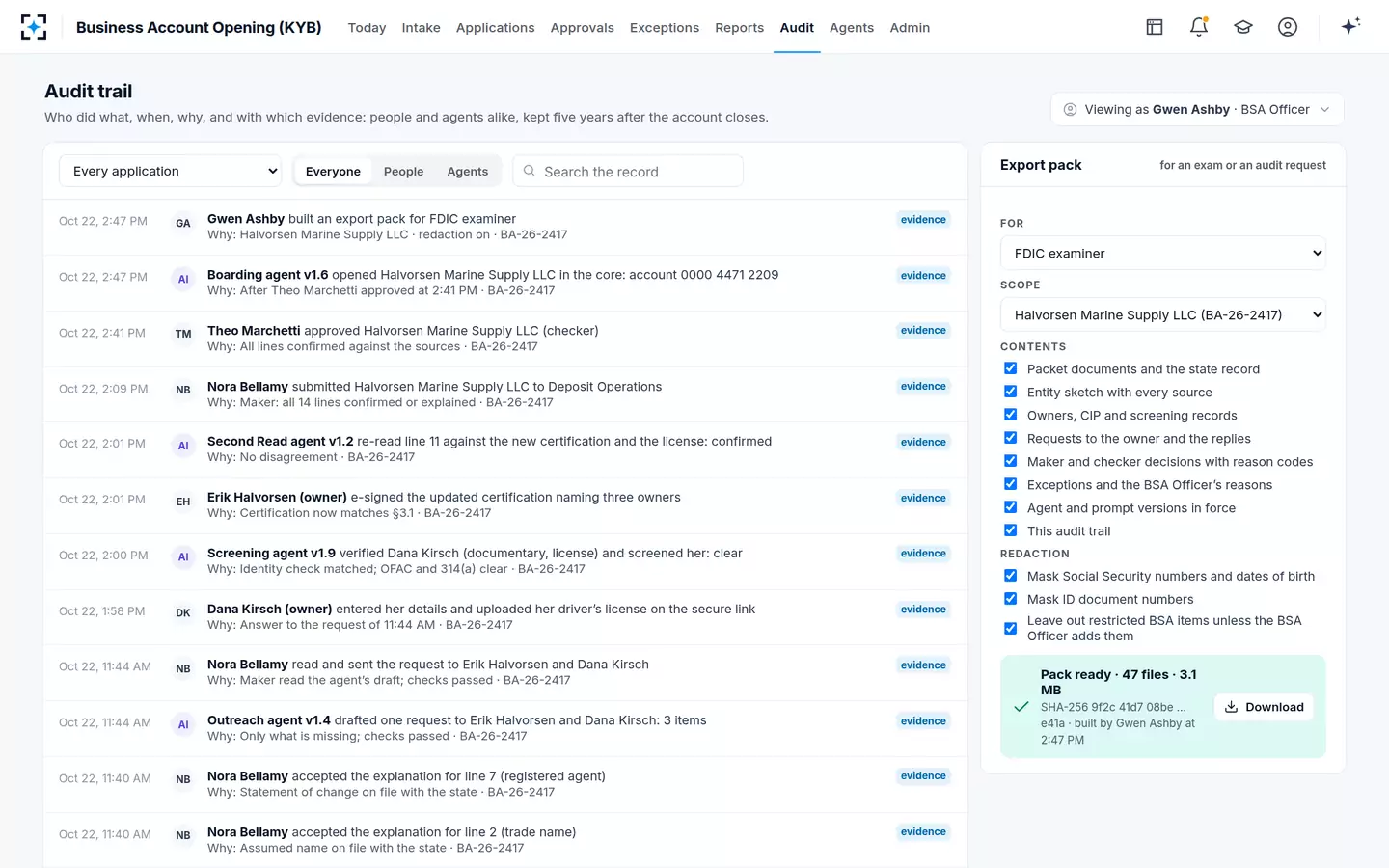
What the examiner gets: a file that does not need reassembling
Best KYB software for banks: what to look for
The best KYB software for a bank is the one that removes the work its staff actually does, at its volume, without a second system to maintain. For a community bank that usually rules out tools priced for fintech volumes and tools that require the bank to rebuild its account opening around them. The checklist below is about fit and cost; the behaviours to test on screen are in KYB automation that asks the owner once.
KYB software for banks: fit and cost questions for a community bank
- Priced for your volume
Per-check pricing built for high-volume onboarding can cost more than the staff time at a few hundred accounts a year.
- Reads your packets as they arrive
Branch scans, emails and the online application, not only a vendor's own intake form.
- Your document rules, by entity type
LLC, corporation, partnership, sole proprietorship, nonprofit and trust-owned, held as the bank's settings and changed under approval.
- Uses the data sources you already pay for
State business filings, your identity verification and OFAC screening tools, rather than a mandatory bundle.
- Writes to your core, not around it
Approved fields written to the existing core banking system, imaging and CRM; no second system of record.
- Examiner-ready without assembly
An export with sources, decisions and versions, personal data masked and restricted items excluded.
- Testable on your closed files before you sign
A replay on a labelled sample of your own business packets, with results per measure.
- Governed by your BSA officer
Changes to thresholds or agents proposed, tested and approved inside the bank, with overrides counted.
Where KYB software does not pay
It does not pay at a bank that opens very few business accounts and has a banker with the time to read each one. The credit union in GAO's study that opened one legal entity account in 2018 spent under $100 on the beneficial ownership requirement; software would cost more than the problem. It pays poorly where business accounts are mostly sole proprietorships, which need no certification, or where the packets are already complete and the waits are short.
It also does not pay if it adds a system. GAO's study shows what manual effort looks like at the small end: one small credit union searched each 314(a) subject by hand, "requiring about 8 hours per list", while the other ten institutions "all used automated software processes to conduct searches—requiring about 1 hour or less per list". That is the case for automation where the task is repetitive and the tool fits; a KYB tool that requires rekeying its output into the core recreates the manual step it was bought to remove.
Business Account Opening (KYB) and the community bank case
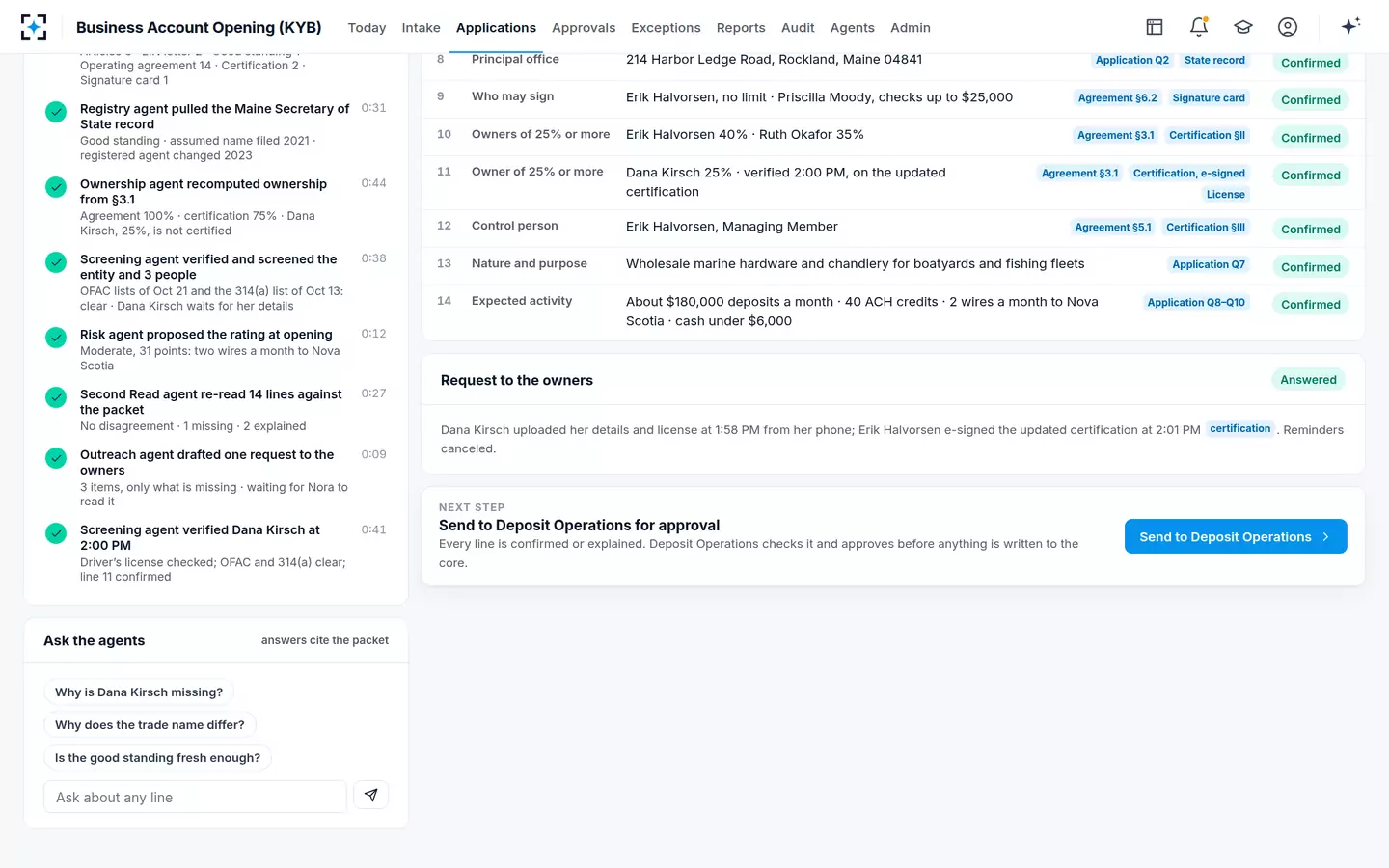
Business Account Opening (KYB) is built for the community bank case: a business banker, a deposit operations specialist and a BSA officer who is also the compliance department. It reads the packet as it arrives, applies the bank's document rules by entity type, uses the bank's own state-filing, identity and screening sources, and writes to the bank's existing core only after a checker approves. Its savings show up first in the terms the staff-hour line misses: gap packets found in minutes, one request to the owner, a file the examiner can take as a download.
One next step in Business Account Opening (KYB), locked until every line is confirmed
It is not the right purchase for every bank. A bank whose business accounts are mostly sole proprietors, or whose volume is a few dozen a year, will find the staff-hour case thin, and should weigh the owner's wait and the examiner's file before deciding. A bank that wants to keep its core and its verification vendors will find it fits around them, which KYB verification that plugs into your core sets out.
Questions people ask
How much does KYB cost per business account?
GAO estimated customer due diligence at $15 per new account on average in 2018, with a range of $5 to $44 across 11 institutions, covering personal and business accounts. Business accounts take more staff time: over an hour against about 30 minutes for a personal account, so their cost sits at the upper end of each bank's range.
Who are the main KYB providers?
They fall into three groups: data providers that supply business registry and identity data, verification services that run checks and return results, and workflow software that runs the bank's own account opening process. A community bank usually already has some data and verification sources, so the gap is more often the workflow.
What is a KYB platform?
A KYB platform usually means software that combines data, checks and workflow in one product for onboarding business customers. For a bank, the test is whether it writes to the bank's existing core and keeps the bank's rules and approvals, or whether it becomes a second system that staff must reconcile.
Is KYC software the same as KYB software?
No. KYC software verifies individuals; KYB software verifies a business and then runs KYC on its owners, controller and signers. The extra work in KYB is ownership: reading governing documents and reconciling them with the beneficial ownership certification.
Do small banks have to meet the same KYB rules as large banks?
Yes. The Customer Identification Program rule and the beneficial ownership rule apply to every bank regardless of size, with the same 25% threshold and the same single control person. That is why compliance takes a larger share of a small bank's expenses: the fixed work is spread over fewer accounts.
Can a community bank use the same KYB software for SBA loans?
Partly. The beneficial ownership rule stops at 25%, while SBA eligibility looks at every owner and at affiliates, so a lender needs more than KYB for SBA files. The SBA case is covered in the guide to KYB compliance software for SBA eligibility.