The bank account requirements for an LLC are set by two federal rules. The Customer Identification Program rule requires the LLC's legal name, physical address and taxpayer identification number before the account opens, verified from documents such as its articles of organization. The beneficial ownership rule, 31 CFR 1010.230, requires the bank to identify and verify every individual who owns 25% or more of the LLC and one individual who controls it. A single-member LLC therefore always names its member; a multi-member LLC names each member at or above 25%; and other kinds of business, such as a sole proprietorship or a nonprofit corporation, fall under different parts of the rule or outside it. Botminds' Business Account Opening (KYB) applies those distinctions as the bank's document rules by entity type, so the banker classifies once and the packet follows.
This guide is for new-accounts staff and business bankers, and for owners who want to know why their bank asks what it asks. The examples use fictional sample customers at a fictional community bank, as they appear in the solution.
Which rules apply to this business? Five questions, in order
1Was the business created by filing a document with a Secretary of State, or is it a general partnership?
YesIt is a legal entity customer, unless step 2 excludes it.
NoSole proprietorship or unincorporated association: identify and verify the individual under the CIP rule. No beneficial ownership certification.
2Is it one of the 16 excluded types, such as a regulated bank, an SEC-reporting issuer or a state-regulated insurer?
YesVerify the entity under CIP. No owners or controller to certify.
NoGo to step 3.
3Is it a nonprofit corporation that filed with the state, or a pooled vehicle advised by a non-excluded institution?
YesControl prong only: name and verify one controller. No ownership prong.
NoGo to step 4.
4Who holds 25% or more, directly or indirectly?
YesName and verify each such individual, up to four. A trust at 25% points to its trustee; an excluded entity at 25% needs no individual for that stake.
NoNobody at 25%: name only the controller.
5Is this the business's first account at the bank?
YesIdentify and verify the owners and the controller now.
NoUnder FIN-2026-R001 the bank may rely on the owners it already verified, unless facts call them into question or its risk procedures say otherwise.
What are the bank account requirements for an LLC?
An LLC is the textbook case the beneficial ownership rule was written for. The regulation defines a legal entity customer as "a corporation, limited liability company, or other entity that is created by the filing of a public document with a Secretary of State or similar office, a general partnership, and any similar entity formed under the laws of a foreign jurisdiction that opens an account" (31 CFR 1010.230(e)(1)). An LLC is created by filing articles of organization, so it is covered from its first day.
That brings two duties on top of the identification every customer gets. The ownership prong: each individual who holds 25% or more of the equity, whether directly or indirectly, by contract, arrangement, understanding or any other relationship. The control prong: one person who carries significant responsibility for controlling, managing or directing the LLC (1010.230(d)). The rule's own note does the arithmetic: up to four owners, and only one controller. FinCEN's 2016 rulemaking spelled out what follows: "it is possible that a legal entity could have up to five beneficial owners" (81 FR 29398).
The documents that answer those duties are covered in documents needed to open a business bank account. This guide is about the step before the documents: deciding which duties the business in front of you actually carries.
Single-member LLC bank account requirements
A single-member LLC has one owner holding 100%, so that owner is always on the certification, and is often the control person as well. The bank verifies the LLC as an entity under the CIP rule and the member as an individual under the beneficial ownership rule. If the member is itself a company, the bank looks through it to the individuals who hold 25% or more of the LLC indirectly.
The tax side confuses many first-time owners. For federal income tax a single-member LLC is, by default, "an entity disregarded as separate from its owner", and the IRS says a disregarded single-member LLC with no employees and no excise tax liability does not need an EIN (IRS, Single member limited liability companies). For the bank it is still a separate legal entity created by a state filing, so it is still a legal entity customer, and the IRS confirms that such an LLC may obtain an EIN if it needs one for a bank account. Being disregarded for income tax does not make an LLC disregarded for the beneficial ownership rule.
Single-member and multi-member LLC bank account requirements, side by side
Single-member LLC: Yes: created by filing articles with the state
Multi-member LLC: Yes: same test
Single-member LLC: The one member (100%), or the people behind it if the member is a company
Multi-member LLC: Each member at 25% or more, up to four; members below 25% are not named
Single-member LLC: One individual; usually the member or a manager
Multi-member LLC: One individual, such as the managing member, however many managers there are
Single-member LLC: EIN, or the member's SSN if the LLC is disregarded and has none (bank policy decides)
Multi-member LLC: EIN: a multi-member LLC is a partnership for tax by default
Single-member LLC: Articles and, if one exists, a short operating agreement
Multi-member LLC: The operating agreement and its amendments: the only place the percentages are written down
Single-member LLC: A member that is a company, and nobody looks through it
Multi-member LLC: A member at exactly 25% left off the certification
Multi-member LLC bank account requirements: the 25% line and one controller
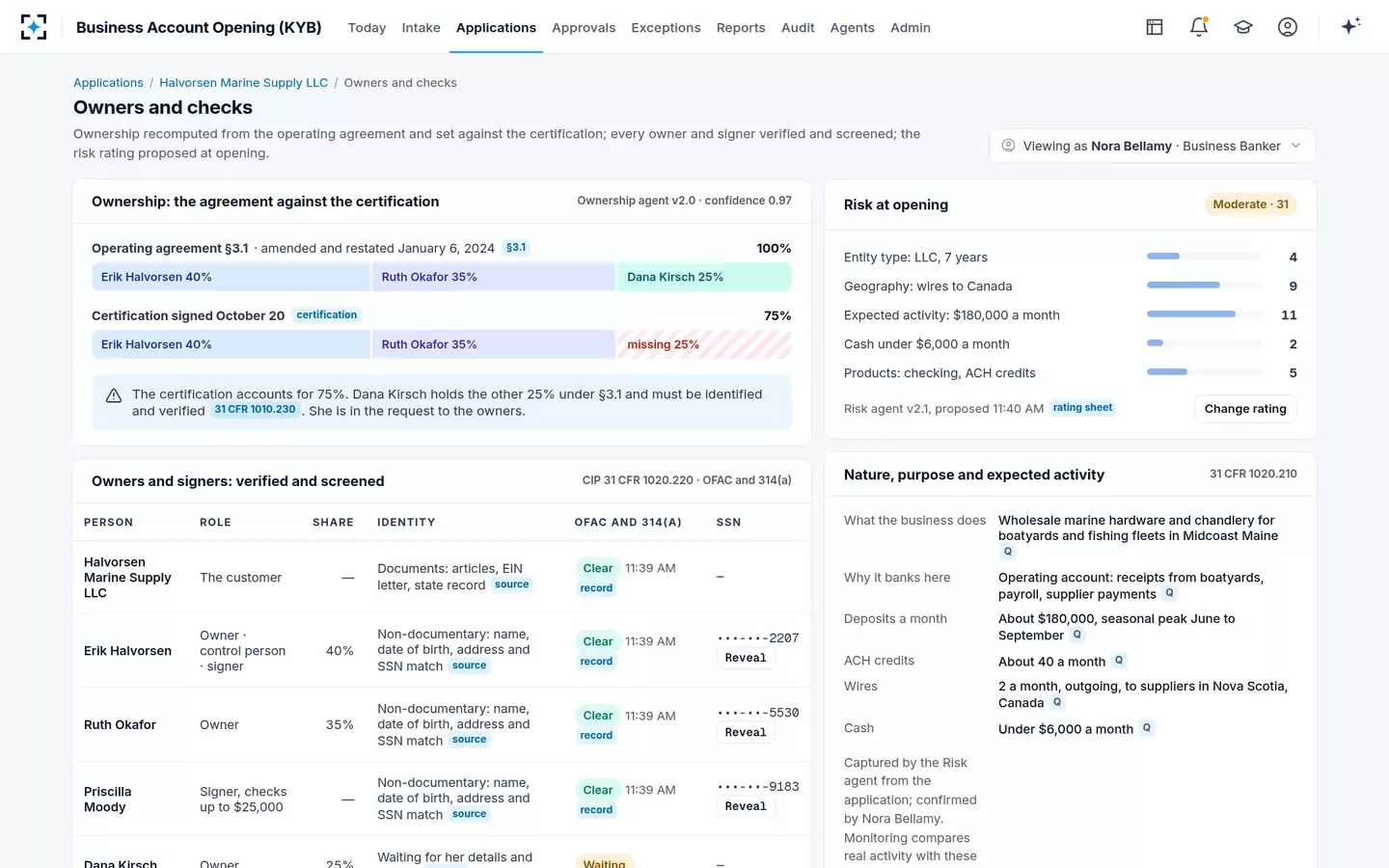
A multi-member LLC names every member who holds 25% or more, and the boundary is inclusive: a member at exactly 25% is in. That is where files go wrong, because the person filling in the certification tends to list the people they think of as owners. In the sample case at Tessaly Community Bank, a fictional bank in the solution, the operating agreement of Halvorsen Marine Supply LLC listed three members at 40%, 35% and 25%; the certification named the first two. The third member was a required beneficial owner, and the only document that said so was section 3.1 of the agreement.
Indirect ownership is the second trap. The US rule says "directly or indirectly" but gives no formula. A common method is to multiply through the chain: a person who owns 60% of a holding company that owns 50% of the LLC holds 30% indirectly and is named. The European Union's Anti-Money Laundering Regulation, which applies from 10 July 2027, writes that method into law: indirect ownership is worked out by multiplying the stakes held at each layer of the chain (Regulation (EU) 2024/1624, Art. 52; worked examples are in how to calculate beneficial ownership percentage). For a US bank it is a defensible method, not a US requirement.
Three ownership structures, and who goes on the certification
| Structure | Arithmetic | Named under the ownership prong |
|---|---|---|
| Members A 40%, B 35%, C 25% | Direct holdings | A, B and C: 25% is at the line, not below it |
| Members A 60%, Holding Co 40%; Holding Co owned by D 70%, E 30% | D: 70% × 40% = 28%. E: 30% × 40% = 12% | A and D. E is under 25% indirectly |
| Member A 50%, Family Trust 50%; trustee T, beneficiaries F and G | The trust holds 50% | A, and T as trustee. F and G are not named for the trust's stake |
The control prong is simpler and stricter at once. Exactly one individual, however many managers the LLC has, and it must be a person with real authority over how the business is run, such as a managing member, a manager or a chief executive. An owner can be the controller, so a two-member LLC where one member manages names two people in total.
Sole proprietor and DBA bank account requirements: no beneficial ownership form
A sole proprietorship is not a legal entity customer, even when it files a trade name with the state. FinCEN said so plainly when it wrote the rule: the definition "would not include, for example, sole proprietorships or unincorporated associations even though such businesses may file with the Secretary of State in order to, for example, register a trade name or establish a tax account". The reason it gave is the point of the whole rule: neither is "an entity with legal existence separate from the associated individual or individuals that in effect creates a shield permitting an individual to obscure his or her identity" (81 FR 29398).
So a sole proprietor's business account is opened on the individual's identification under the CIP rule, with the trade name as a second name on the account. The DBA filing, or assumed-name certificate, ties the name on the checks to the person; it does not create an entity. The same rulemaking noted, from IRS data, that "approximately 75 percent of all businesses filing tax returns are sole proprietorships", which is why a business banking desk opens so many accounts that need no certification at all.
Does a nonprofit need beneficial ownership for a bank account?
A nonprofit corporation needs a control person but no owners. The rule places "Any legal entity that is established as a nonprofit corporation or similar entity and has filed its organizational documents with the appropriate State authority as necessary" under the control prong only (1010.230(e)(3)(ii)). A nonprofit has no equity holders to name, so the ownership prong would be empty anyway; the rule makes that explicit and asks for one individual who runs it, such as an executive director or board chair.
FinCEN's 2016 rulemaking suggested how such an organization could show it qualifies: "by providing a certified copy of its certificate of incorporation or a certificate of good standing from the appropriate State authority". An unincorporated club or association that never filed with the state is outside the definition altogether, like a sole proprietorship, and is identified through the individuals who open the account.
Trusts, holding companies and the 16 excluded entity types
A trust that owns 25% or more of a business does not make its beneficiaries the owners. The rule is specific: where a trust holds 25% or more of the equity, directly or indirectly, the trustee is the person the bank names for that stake (1010.230(d)(3); does a trust need beneficial ownership covers trusts as customers). Where the trustee is itself a company, such as a trust company, the bank's own procedures decide how far to look; the sample bank sends every trust-owned company to its BSA officer.
At the other end, 16 types of entity are excluded from the definition entirely. They include banks regulated by a federal or state regulator, issuers whose securities are registered with the SEC or who report under the Exchange Act, registered investment companies and advisers, bank holding companies, state-regulated insurance companies and foreign governmental bodies acting in a governmental capacity (1010.230(e)(2)). An excluded entity that owns 25% of a customer also cuts the chain: no individual has to be named for that stake.
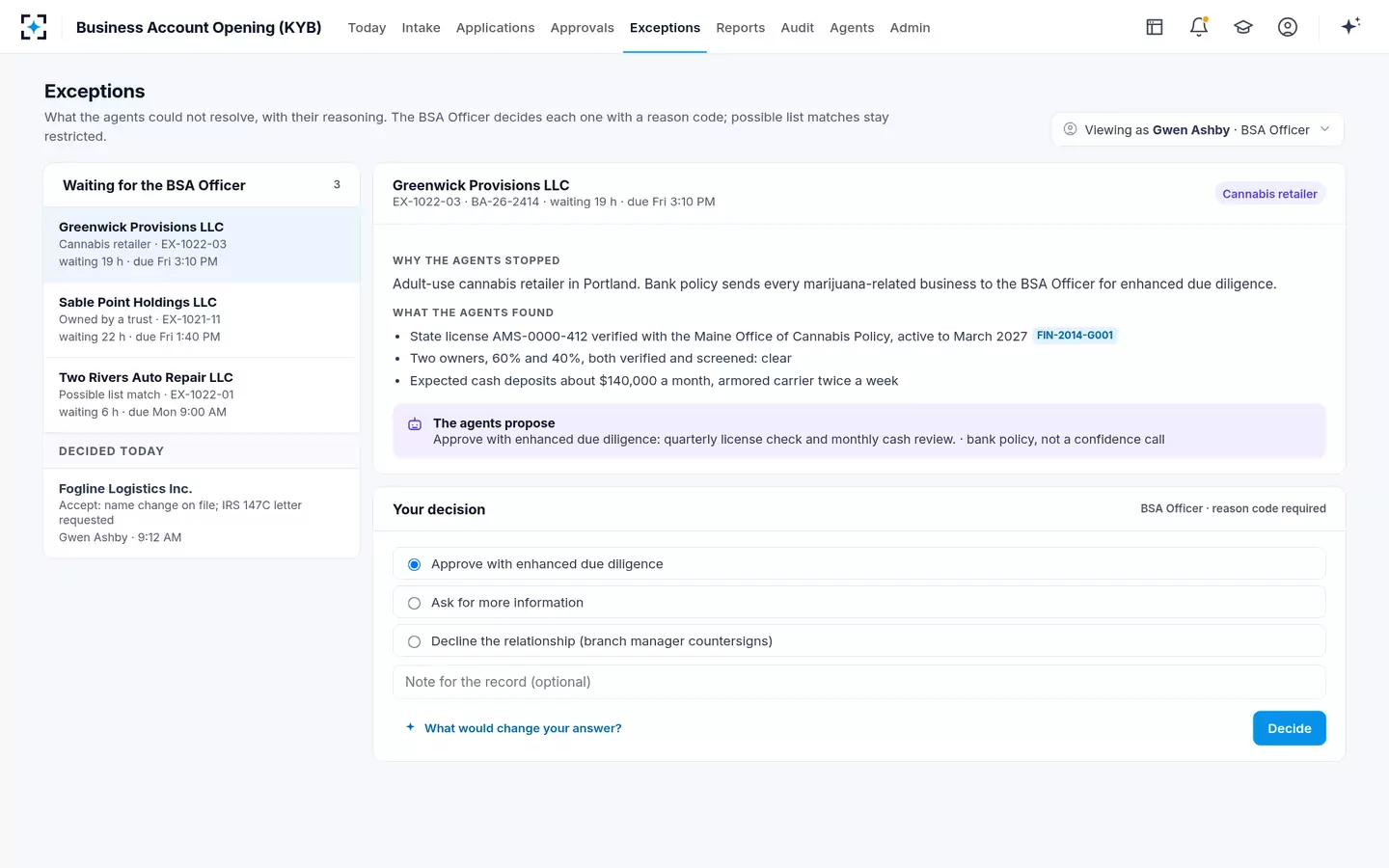
A trust-owned company waiting for the BSA officer in Business Account Opening (KYB)
Classify first, then collect: why the order matters
Collecting a full packet before classifying the entity wastes the owner's time in one direction and misses duties in the other. A sole proprietor asked for a certification is annoyed; an LLC whose sole member is a company, treated like a sole proprietor, goes onto the books without the people behind it. The cheaper order is to classify from the first document, usually the articles or the application, and then ask only for what that classification requires.
Classifying a business customer before the packet is complete
- Read the formation document first
Articles of organization or incorporation, a partnership agreement or a trade name filing tells you which branch of the tree you are on.
- Check the exclusions before collecting owners
A regulated bank, a listed issuer or a state-regulated insurer needs no certification; confirm the status from a public source.
- Look for nonprofit status in the state filing
A nonprofit corporation needs a controller only; an unincorporated association is not a legal entity customer.
- Trace every member that is not a person
Multiply through holding companies; stop at an excluded entity; name the trustee for a trust at 25% or more.
- Count to 25% inclusively
A member at exactly 25% is named. Check the certification against the operating agreement, including amendments.
- Ask whether this is the first account
For an existing business customer, FIN-2026-R001 lets the bank rely on owners already verified, with the customer's confirmation.
The last item changed in 2026. Under FinCEN order FIN-2026-R001, a bank may identify and verify an existing customer's owners at its first account and rely on that information later. Is beneficial ownership still required at the bank covers the order and its three triggers.
How Business Account Opening (KYB) applies the entity rules
In Business Account Opening (KYB) the required documents by entity type are a setting the bank owns: one list each for a limited liability company, a corporation, a partnership, a sole proprietorship, a nonprofit corporation and a company owned by a trust. The onboarding administrator proposes a change, and the BSA officer approves it, so the rule the banker works to is the bank's written policy rather than a memory of it.
The Ownership agent does the arithmetic. It recomputes ownership from the operating agreement or other governing documents, sets it against the certification, finds the control person, and applies the trust and nonprofit rules. It never removes a person from the owners, and any doubt below its confidence threshold goes to the BSA officer. Whether the entity is still active and the filing matches the packet is a separate question, covered in business entity verification.
Ownership recomputed from the agreement and laid over the certification
Questions people ask
Is beneficial ownership required for a single-member LLC?
Yes, at the bank. A single-member LLC is a legal entity customer because it is created by a state filing, so its member, who holds 100%, is named and verified on the certification, along with one control person who is often the same individual. Being a disregarded entity for income tax does not change that.
Is beneficial ownership required for a sole proprietorship?
No. FinCEN excluded sole proprietorships from the definition of a legal entity customer in 2016, even when they file a trade name with the state, because the business has no legal existence separate from its owner. The bank identifies and verifies the owner as an individual under the CIP rule instead.
What are DBA bank account requirements?
A DBA is a trade name, not an entity, so the requirements follow whoever owns it. For a sole proprietor that is the owner's identification and the assumed-name filing that links the trade name to the owner; for an LLC operating under a trade name, it is the LLC's full packet plus the filing that links the two names.
Do LLC members below 25% have to give their information?
Not under the ownership prong; only members at 25% or more are named. A member below 25% may still be named as the control person, and a bank may ask for more under its own risk procedures, for example when several small members are related.
Can an LLC owned by another LLC open a bank account?
Yes. The bank looks through the parent to the individuals who own 25% or more of the customer indirectly, and names one control person of the customer itself. If the parent is an excluded entity, such as a listed company, no individual is needed for its stake.
Who counts as the control person for an LLC?
One person who carries significant responsibility for running the LLC, such as the managing member, a manager or a chief executive. FinCEN expects a high-level official responsible for how the business is run, and the rule asks for exactly one, however many managers there are.