KYB automation is software that does the mechanical part of verifying a business customer: reading the documents, comparing them with the state's business filing, checking the beneficial ownership certification against the operating agreement, verifying and screening the owners and signers, and drafting the request for whatever is missing. Done well, it changes the shape of business account opening from a conversation of five calls to one request, because every gap is found before the customer is contacted. Done badly, it guesses the missing pieces, and a guessed owner percentage is exactly the kind of error an examiner finds. Botminds' Business Account Opening (KYB) is built on the first design: eight agents read, check and draft, and the banker, deposit operations and the BSA officer decide.
The worked example is a fictional sample customer at a fictional community bank, as it runs through the solution; the regulatory and enforcement material is quoted from FinCEN, the OCC and FATF.
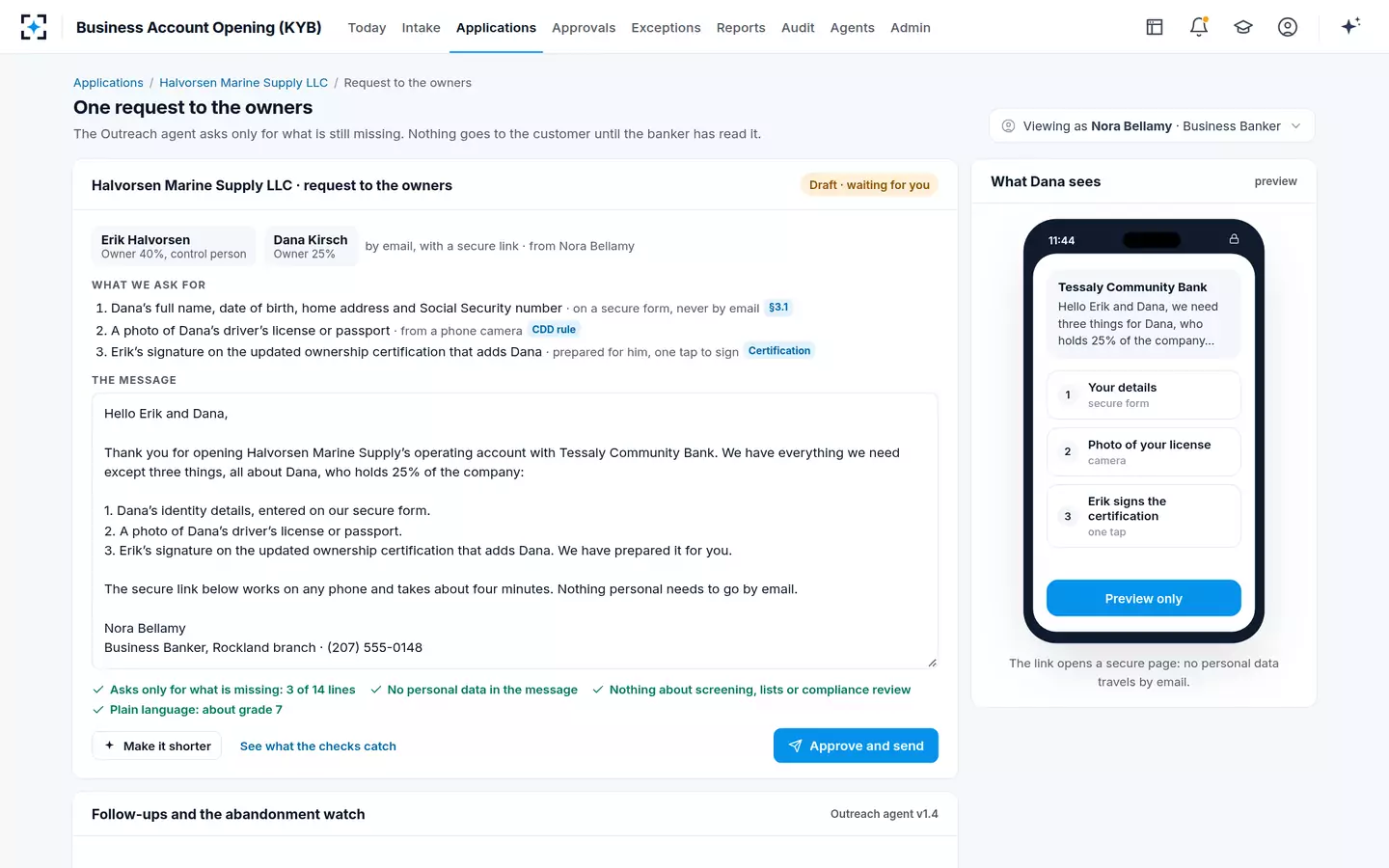
The output that matters in Business Account Opening (KYB): one request, only for what is missing
What is KYB automation, and what should it automate?
KYB automation should automate reading, comparing and drafting, and nothing that is a judgement. In a business account file the reading is large and repetitive: articles, an IRS letter, a certificate of good standing, an operating agreement of a dozen pages, a certification, a signature card. The comparing is exacting: the legal name in four places, the registered agent against the state's filing, the owners in the agreement against the owners on the form. The drafting is a message to the customer. All three can be done by software and checked by a person in a fraction of the time.
The judgements are few and specific: whether an explanation for a difference is acceptable, what the risk rating should be, whether a possible list match is real, whether to decline, and whether the file is right to write to the core. KYB automation that takes any of those away from a named person moves the bank's risk from the file into the software, where an examiner will look for it later.
Can KYB be automated end to end?
The reading can; the decisions should not be. FATF's review of new technologies in anti-money laundering says that technology "can help identify risks and focus compliance efforts", while stressing that people reviewing the output and adding their judgement still matter a great deal (FATF, Opportunities and Challenges of New Technologies for AML/CFT, 2021). The OCC showed what the alternative looks like in its 2026 consent order with Community Federal Savings Bank, where flaws in the logic, data and method of an automated triage system led it to close, on its own, alerts that a person should have reviewed, and it ended up closing a very high share of everything it received (OCC, AA-ENF-2025-21; what that order means for buying review software is in KYC refresh software).
That order concerned transaction alerts, not account opening, but the lesson transfers. An automated step that closes, clears or fills in on its own is the step that fails silently. An automated step that lists, flags and drafts for a person to accept fails loudly, because the person sees it.
The back-and-forth is the cost: one call per gap
The most expensive part of a business account is not reading the packet; it is the conversation about what the packet lacks. Botminds' own estimate for one small-business packet that arrives with a gap puts calls and emails to the owner at about 1.5 of 5.5 staff hours, the largest single share, before counting the days the owner takes to reply. Each call restarts the owner's clock, which how long it takes to open a business bank account measures.
The calls multiply because gaps are found one at a time. A banker who reads the certificate on Monday, the agreement on Tuesday and the owners' IDs on Wednesday asks three times. Automation that reads everything first changes the arithmetic: in the sample case, five agents had checked the whole packet in about five minutes and found one missing owner and two explainable differences, so the owners received one message with three items.
One packet, one request: the sample case in numbers
14
lines on the entity sketch, each with its source and one word: confirmed, differs or missing
3
items in the single request to the owners: only what was missing
134min
the owner took to answer; the longest part of a 3-hour-12-minute opening
How to cut back-and-forth in business account opening
Cut it by finding every gap before the first contact, and by asking for each missing item in a form the owner can answer immediately. Four design rules follow. Read the whole packet first, including the operating agreement, before deciding what to ask. Ask only for what is missing, never for what the bank already holds. Send personal details through a secure form, not by email, so the owner does not have to wait for a branch visit. And never ask the owner something the bank can explain from public records: a trade name already on file as an assumed name with the state needs a banker's click, not a call.
The fourth rule removes more calls than it seems. In the sample case two of the fourteen lines differed from the state's filing: the trade name and the registered agent. Both had public explanations, an assumed name filed in 2021 and a statement of change filed in 2023, and the banker accepted both on the screen. Neither reached the owner.
What one good request to a business owner contains
A single request works only if the owner can finish it in one sitting, so its contents matter as much as its timing. Each item should say what is needed, why, and how to supply it: "Dana Kirsch's date of birth, address and ID number, because the operating agreement shows her holding 25%, through the secure form below" is answerable; "please send outstanding KYB documents" is not. Items that need a signature should arrive ready to sign, with the change already marked, so the signer reads one sentence rather than re-completing a form.
The request should also be honest about what happens next. The CIP rule lets a bank open an account before verification is finished only under written terms for what the customer may do in the meantime, and the request is where those terms reach the customer: whether the account can take a deposit now, and what stays restricted until the last item arrives. A banker who reads the draft before it goes, as every request in the solution requires, is checking all three things at once: that nothing is missing, that nothing already held is asked for again, and that nothing in the wording reveals a screening review.
Two kinds of KYB automation: one that guesses, one that asks
Automation that fills gaps: Infers it from the agreement and writes it onto the certification
Automation that lists gaps and asks: Shows the agreement's figure beside the certification and asks the signer to certify
Automation that fills gaps: Uses its best reading
Automation that lists gaps and asks: Below 0.85 confidence, asks for a clearer copy
Automation that fills gaps: Picks one
Automation that lists gaps and asks: Shows both with the filing that explains the difference; the banker accepts or asks
Automation that fills gaps: Clears it on a score
Automation that lists gaps and asks: Never clears it; the BSA officer decides
Automation that fills gaps: Sent automatically on a template
Automation that lists gaps and asks: Drafted, checked for personal data and tipping-off language, and read by the banker
Automation that fills gaps: A clean file whose numbers nobody certified
Automation that lists gaps and asks: A file where every line names its source and every decision names its person
FinCEN has already penalised the human version of the left-hand column. In its 2021 action against CommunityBank of Texas it found that "Where CDD questionnaires were flagged as incomplete, AML staff were instructed to obtain additional information from customer account officers rather than from the customers themselves" (FinCEN, Consent Order No. 2021-03). The bank paid $8 million. Filling a customer's gap from inside the bank, whether from an account officer's memory or a model's inference, is not the same as asking the customer.
Can AI fill in the beneficial ownership certification?
AI can prepare it; it cannot certify it. The rule is built on the customer's word: the bank takes the certification from the person who opens the account for the company, and that person vouches for its accuracy as far as they know (31 CFR 1010.230(b)(1); the form is dissected in beneficial ownership certification). The bank's protection depends on that: it may rely on what the customer says about who its owners are, as long as it knows of nothing that gives it reasonable cause to doubt the answer.
Read with that condition in mind, an operating agreement that lists a 25% member missing from the certification is a fact in the bank's own file that calls the certification into question. Software that finds it has done the bank a favour; software that silently corrects the form has removed the customer's certification and left the bank relying on its own inference. In the sample case the solution prepared an updated certification adding the missing owner, and the managing member e-signed it from his phone. The customer still certified; the agents only made it easy. FinCEN's 2016 rulemaking has the bank verify each named person's identity, not whether that person really is an owner, which is why reading the agreement is a check the rule permits rather than one it demands.
What a person should still decide in KYB
A person should decide anything that ends in a yes or a no about the customer. In Business Account Opening (KYB) that is written into the agents' limits, and the flow below shows where each line is drawn.
Business Account Opening (KYB): eight agents and the lines they never cross
Agent
Packet ReaderSplits whatever arrives into documents, types each one and reads every page.
Never: guesses a page it reads with less than 0.85 confidence; it asks for a clearer copy.
Agent
Registry agentPulls the state's business filing and compares it with the articles line by line.
Never: accepts a certificate of good standing older than the bank's limit.
Agent
Ownership agentRecomputes ownership from the operating agreement and sets it against the certification.
Never: removes a person from the owners; a doubt goes to the BSA officer.
Agent
Screening agentVerifies each owner and signer and screens them and the entity against OFAC and the 314(a) list.
Never: clears a potential match.
Agent
Risk agentRecords nature, purpose and expected activity and proposes a risk rating with its factors.
Never: sets the rating; the banker owns it and changes it with a reason code.
Agent
Second Read agentRe-reads every line against the packet and the state's filing before a person sees it.
Never: edits a line; it flags a disagreement.
A person decides
Business bankerAccepts or questions each line, owns the risk rating and reads every message before it goes.
Agent
Outreach agentDrafts one request to the owners for only what is missing, with a secure link and reminders.
Never: sends without the banker, puts personal data in an email or mentions screening.
A person decides
The ownerAnswers once, from a phone, and signs the updated certification.
A person decides
Deposit operationsApproves or returns every field that will be written, with a reason code.
Agent
Boarding agentWrites the approved fields to the core, imaging and the CRM.
Never: writes before a checker approves, or writes a field that was not approved.
Five decisions stay with people. The banker accepts or questions each line and owns the risk rating, which the Risk agent only proposes with its factors. The banker reads every message before it goes. The BSA officer decides every possible list match, every ownership doubt and every exception the bank's policy reserves, such as trust-owned companies and marijuana-related businesses. A deposit operations specialist, never the banker who submitted the file, approves what is written to the core. And the branch manager countersigns declines and large opening deposits.
Eight agents, and the message that cannot be sent
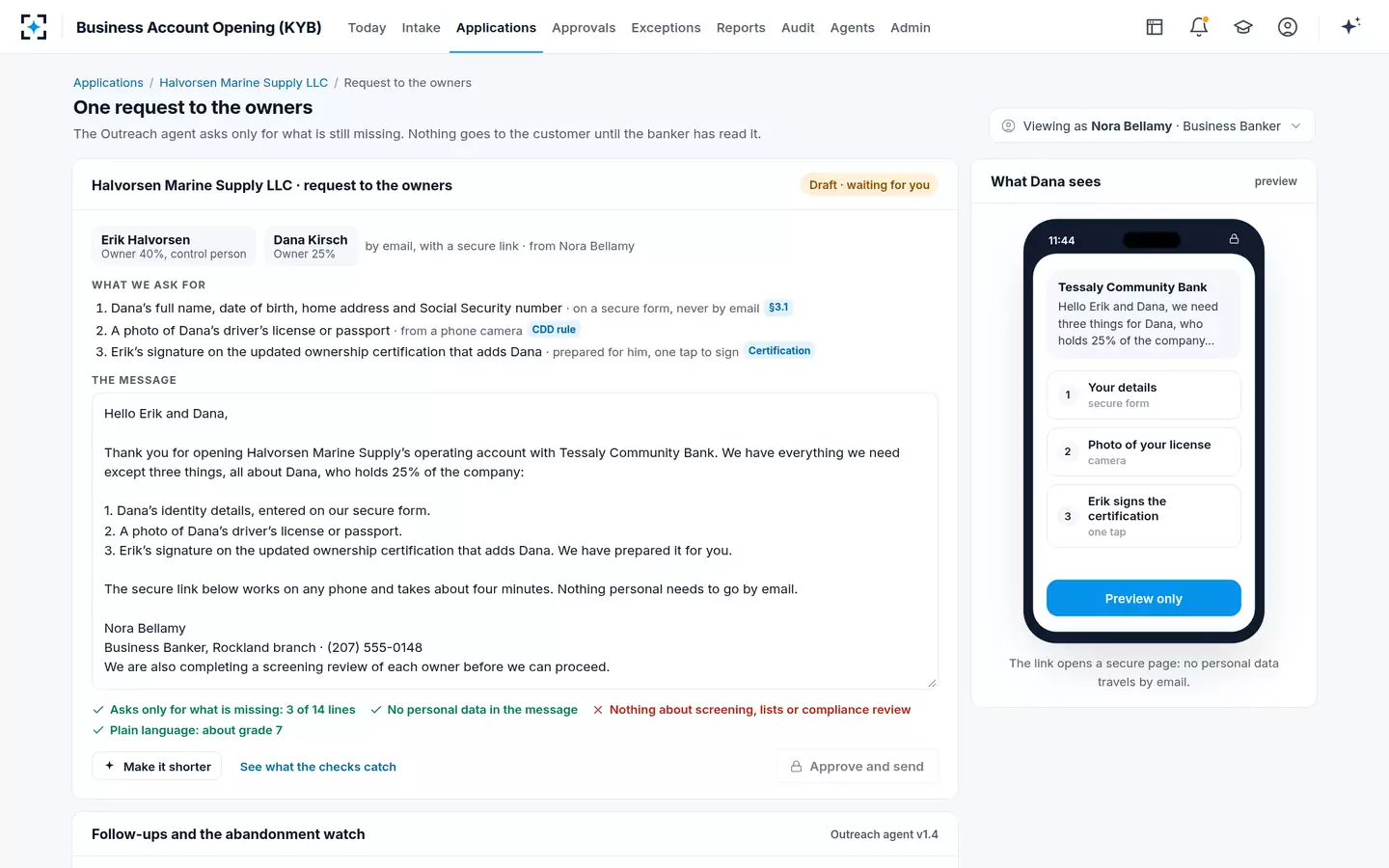
The clearest test of an automation's limits is the message to the customer, because that is where a mistake leaves the bank. Federal rules prohibit disclosing a suspicious activity report or anything that would reveal one (31 CFR 1020.320(e)), and a bank that tells an applicant it is "completing a screening review" invites questions it cannot answer. In the solution the Outreach agent's draft is checked for personal data, for anything about screening, lists or compliance review, and for reading level. A failing check locks the send button until the line is removed.
A tipping-off sentence turns the check red and locks sending
How to judge a KYB automation tool before you buy
Judge it on your own past packets, and on what it refuses to do. A demonstration on clean sample files shows the reading; only a replay on files your bank has already opened, with the gaps your bankers actually found, shows whether it finds what a careful person finds and nothing that is not there. The checklist below turns the design rules into questions a vendor should be able to answer on screen.
Questions to put to any KYB automation tool
- Does it list every gap before contacting the customer?
Ask to see one request built from a packet with three problems. It should contain three items, once.
- Does every finding open its source?
A line that says "missing owner" should open the page and section that proves it.
- Does it ever fill in a missing value?
It should show the agreement's figure beside the certification, not write it onto the certification.
- Can it clear a sanctions match?
The right answer is no, at any score.
- Does a person read every outbound message?
And does a tipping-off or personal-data check block sending, not merely warn?
- Does it write to the core only after a different person approves?
Maker and checker should be enforced, not configurable away by the maker.
- Can you replay it on your own closed files?
Ask for results on a labelled set of your packets: lines read correctly, missing owners found, explanations right.
- Are overrides counted?
Every time a person overrules an agent, the reason should be recorded and reported.
The last two questions are where most evaluations stop too early. In the solution's sample governance view, a labelled set of 120 sample packets is the yardstick for any agent change: on the latest run, 99.1% of lines read correctly, all 14 missing owners found, and no potential match cleared by an agent. Those are results on fictional sample data, useful as the shape of a test, not as a promise; the bank's own replay is the evidence. What the tool costs relative to a bank's size is in KYB software and bank size, and how it should connect to the core and the systems a bank already runs is in KYB verification that plugs into your core.
Questions people ask
What is automated KYB?
Automated KYB uses software to read a business customer's documents, check them against public filings, verify and screen the owners and draft follow-up requests. The bank still makes the decisions: accepting explanations, setting the risk rating, resolving list matches and approving the account.
What is the difference between KYC and KYB automation?
KYC automation verifies an individual; KYB automation verifies a business and then runs KYC on each owner, controller and signer. The extra work in KYB is the ownership: reading governing documents, computing who holds 25% or more, and reconciling that with the customer's certification.
Can AI verify beneficial owners?
AI can verify that each named owner is a real person, using the same documentary and non-documentary methods as the CIP rule, and can check the named owners against the operating agreement. It cannot certify who the owners are; under 31 CFR 1010.230 that certification comes from the person opening the account.
Is KYB automation allowed by regulators?
Yes. No rule requires KYB to be done by hand, and FinCEN's 2026 proposed AML program rule says institutions that responsibly use innovative technology would not face added enforcement risk solely for doing so; it is not yet final. Regulators look at whether the program works, including how the bank supervises its tools.
How many times should a bank contact a business owner during onboarding?
As few as the gaps require, ideally once. No rule sets a number, but every contact restarts the owner's wait, and FinCEN penalised a bank in 2021 for filling gaps from its own account officers instead of asking the customer. Reading the whole packet before the first contact is what makes one request possible.