KYC refresh software keeps existing customers' due diligence files current: it reads the systems where changes show up, links each change to a customer, decides whether it matters under the bank's policy, redrafts the affected parts of the file, re-screens anyone new, re-runs the risk rating and drafts any request to the customer. The useful question for a buyer is not how much it automates but where each automated step stops, because the regulatory failures in this area are mostly automation that decided when it should have escalated. Botminds' Perpetual KYC (pKYC) is built as seven agents, each with one job and a written limit, and an analyst and a different QC reviewer who make every decision. This page uses it as a worked example of what to look for, and is plain about where it does not fit.
Four thresholds at which Perpetual KYC (pKYC) hands over to a person
0.90
link confidence below which an analyst confirms which customer an event belongs to
0.80
materiality confidence below which an analyst decides the event
0.85
name-match score above which a screening candidate is examined
10%
of "no action" calls sent to QC every day, by trigger family
What KYC refresh software has to do
KYC refresh software has five jobs: watch the sources, decide which events matter, redraft what changed, check new parties and the rating, and route every change to people for approval. A sixth job runs through all of them: keep the reason for every call, including the calls to do nothing, so the program can be tested and examined later.
The sources are where the work starts and where most products are weakest. In the sample bank they are six systems: a corporate registry data service for state and foreign filings, the core banking system, sanctions and politically exposed person screening, an adverse media service, transaction monitoring and the client lifecycle management system that holds the file. Software that reads only one or two of these is a screening tool or a workflow tool, not a refresh tool.
Can KYC refresh be automated?
Most of the work can, and none of the decisions should be. Detecting changes, linking them to customers, drafting new section text with sources, clearing similar names on identifiers, proposing a rating and drafting a customer letter are all automatable and auditable. Deciding that a change is material when the evidence is unclear, approving a change to the file, applying a rating, contacting a customer and clearing a potential sanctions match are judgements that the bank should keep with named people.
US financial regulators apply the same discipline to themselves. Asked by the GAO how they use AI in supervision, regulators said they used AI outputs alongside other information to inform staff decisions, and never let it decide alone or treated it as their only input (GAO-25-107197, 2025). That is a reasonable bar for a bank's own refresh program.
The agents in Perpetual KYC (pKYC), and where each one stops
Perpetual KYC (pKYC) splits the work into seven agents, each with a single job and a limit it cannot cross, and two people who make the decisions. The chain below follows one event, a filing with the Panama Public Registry showing a new 30% owner of a fictional sample customer, Tidewater Freight Brokers LLC.
Seven agents, two people: who watches, drafts, checks and stops
Agent
Event WatcherReads six feeds, removes duplicates and links each event to a customer and the sections it may touch: the Panama filing, linked to Tidewater at 0.99 on legal name and Delaware file number.
Never: decides materiality; a link below 0.90 goes to an analyst.
Agent
Materiality agentDecides the event under the bank's versioned trigger policy, with a plain-language reason, the rules (T-07 and T-12) and a confidence of 0.96.
Never: closes a material event; below 0.80 the event goes to an analyst.
Agent
Section RefresherRedrafts only the two sections the event touches, with nine citations to the registry entry, the lifecycle file and the 2025 certification.
Never: writes to the customer file; the analyst is the maker.
Agent
Screening agentRe-screens the new company and its owner on sanctions, PEP and adverse media; two similar names cleared on date of birth and nationality.
Never: clears a potential true match; that goes to the Sanctions Screening team.
Agent
Risk Rating agentRe-runs the rating model on the factors that changed: geography 4 to 18, ownership structure 6 to 14, Medium 41 to High 63.
Never: applies a rating; it proposes one for the maker and the checker.
Agent
Outreach agentDrafts the request for a signed ownership certification and the new owner's share register, and runs the tipping-off check.
Never: sends a message, or mentions monitoring, alerts, investigations or reports.
A person decides
KYC analyst, makerChecks the sources, adds a note from the wire history and approves with a reason code, 11 minutes after routing.
A person decides
KYC QC reviewer, checkerApproves each of five items separately, or returns any one with a reason; approval writes the sections, the rating and the request to the systems of record.
Agent
QC SamplerSends 10% of the day's "no action" calls to QC by trigger family and opens a rule review when a family's pass rate falls under 97%.
Never: changes a rule; it proposes a review to the head of KYC operations.
Read the "never" lines as the specification. They are what a buyer should ask every vendor to state in writing, and then test. A product that cannot say which of its components may write to the customer file, apply a rating or send a message has not been designed around the decisions that matter.
What KYC refresh software should never do
KYC refresh software should never close an event it judged material, decide quietly when it is unsure, apply a rating, write to the file, contact the customer or clear a potential sanctions match. Each of those has a safe automated counterpart, and the difference between the two columns below is most of what separates a refresh tool from a liability.
Where KYC refresh automation helps, and the line it must not cross
Automate, with a source on every output: Read registry, core, screening, media, monitoring and lifecycle feeds; link events to customers.
Keep with a named person: Confirm a customer link the software is unsure of.
Automate, with a source on every output: Apply the written trigger policy and keep the rule and reason for every call.
Keep with a named person: Decide any event below the confidence threshold; approve every change to the policy.
Automate, with a source on every output: Draft new section text with a citation for each value.
Keep with a named person: Approve the change as maker; a different person approves as checker.
Automate, with a source on every output: Clear similar names on two or more identifiers, citing them.
Keep with a named person: Decide every potential true match.
Automate, with a source on every output: Re-run the model on the factors that moved and show each one.
Keep with a named person: Apply the rating, after maker and checker.
Automate, with a source on every output: Draft the request and check it for tipping off.
Keep with a named person: Edit, approve and send it.
Automate, with a source on every output: Keep them all with reasons; draw the daily sample.
Keep with a named person: Grade the sample; change a rule when a family fails.
The auto-closing lesson every buyer should know
The clearest warning about refresh automation is an OCC order about alert triage. In its consent order against Community Federal Savings Bank, signed April 24, 2026, the OCC found that the bank "utilized an automated alert triage system, but several deficiencies in its logic, data, and methodology resulted in the system auto-closing alerts that should have been escalated for further review. As a result, the system auto-closed a very high percentage of all ingested alerts" (OCC, AA-ENF-2025-21). The same paragraph found the bank's customer due diligence program ineffective.
Three design choices in refresh software answer that finding directly. A material event can never be closed by software. A not-material call is never silent: it keeps its rule and reason. And not-material calls are sampled every day by people, with pass rates by trigger family, so a rule that is closing the wrong events shows up in weeks rather than in an examination. In the sample bank, the screening and media family fell to 96.1% against a 97% floor, and a rule review opened before anyone outside the bank noticed. How to test an event-driven KYC review with planted events goes further, measuring what the software misses before go-live.
Tipping off: the check that cannot be switched off
Any software that drafts messages to customers during a refresh must be prevented from revealing that a suspicious activity report exists or that the customer is under scrutiny. The rule is categorical: no bank, and nobody acting for it, may disclose a SAR or anything that would reveal one exists (31 CFR 1020.320(e); KYC outreach to non-responders shows what that means for customer letters). A refresh triggered by monitoring is exactly the situation in which a careless sentence can do that.
The request to the customer, with the phrase the check removed
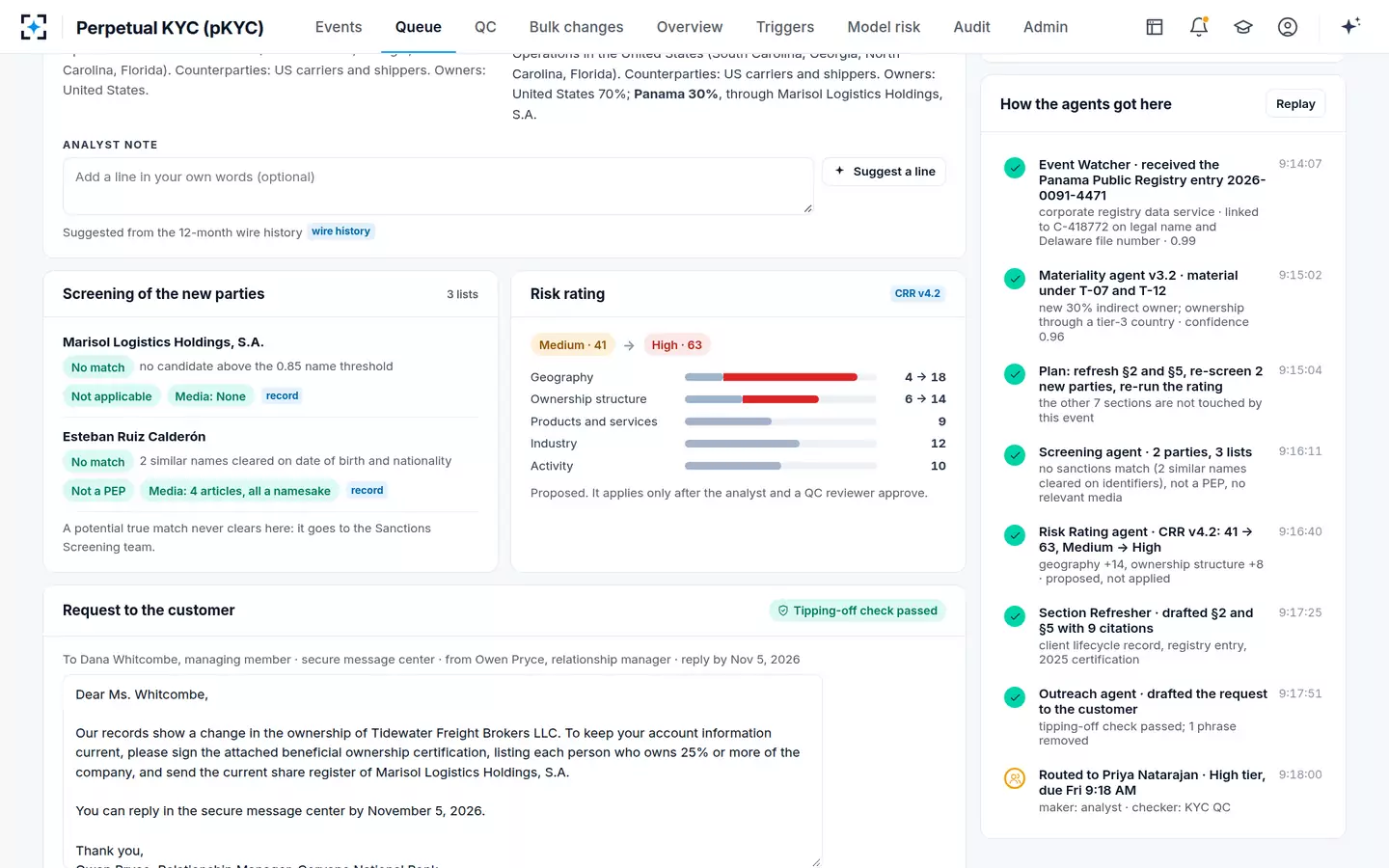
Two further controls belong with it. Restricted referrals should be visible only to the BSA officer and never appear on a view a relationship manager might read aloud to a customer. And the check should run on every message, with no setting to disable it, because the people most likely to want it off are the ones under time pressure.
Who governs the agents?
The bank does, through its own risk management, because the interagency model risk guidance does not. SR 26-2, issued on April 17, 2026, replaced SR 11-7 and states plainly that generative and agentic AI fall outside its scope because they are new and changing fast, and that a bank's own risk management and governance should set the controls for tools the guidance does not cover (Federal Reserve SR 26-2; agentic AI for KYC reads the passage in full).
That puts the burden on the buyer to define the controls. In the sample bank, the trigger policy is versioned, a rule change is drafted by the head of KYC operations, tested on 30 days of events and approved by the BSA officer, with the bank's model risk function involved as its own governance requires; agent versions and thresholds are changed only through that process, and analysts' overrides carry reason codes. Those are the bank's choices, not a regulatory template. A vendor that says its agents are "validated under SR 11-7" is pointing to guidance that has been superseded, and whose replacement leaves agents to the bank.
What to ask before you buy KYC refresh software
Ask for evidence, on your own events, of each limit. A demonstration on the vendor's data shows the interface; a replay of your last quarter shows whether the software decides the way your policy does.
Ten questions for a KYC refresh software evaluation
- Which of your sources can it read, and which must we build?
Registry, core, screening, media, monitoring, lifecycle; each one missing is a class of trigger missed.
- Can it hold our trigger policy as numbered, versioned rules?
And show, for any past event, the rule version in force that day.
- What happens below each confidence threshold?
The answer should be a named queue, not a default.
- Can any component close a material event?
The answer should be no.
- Is every not-material call kept with its reason and sampled?
Ask to see pass rates by trigger family.
- Does every drafted value open its source?
Click through on a real file, not a slide.
- Can one person approve their own change?
Maker and checker must be enforced, item by item.
- How are mass events handled?
A list update or policy change should become one batch with a sample, not thousands of tickets.
- Is the tipping-off check always on?
And are restricted referrals hidden from customer-facing views?
- What does an examiner export contain?
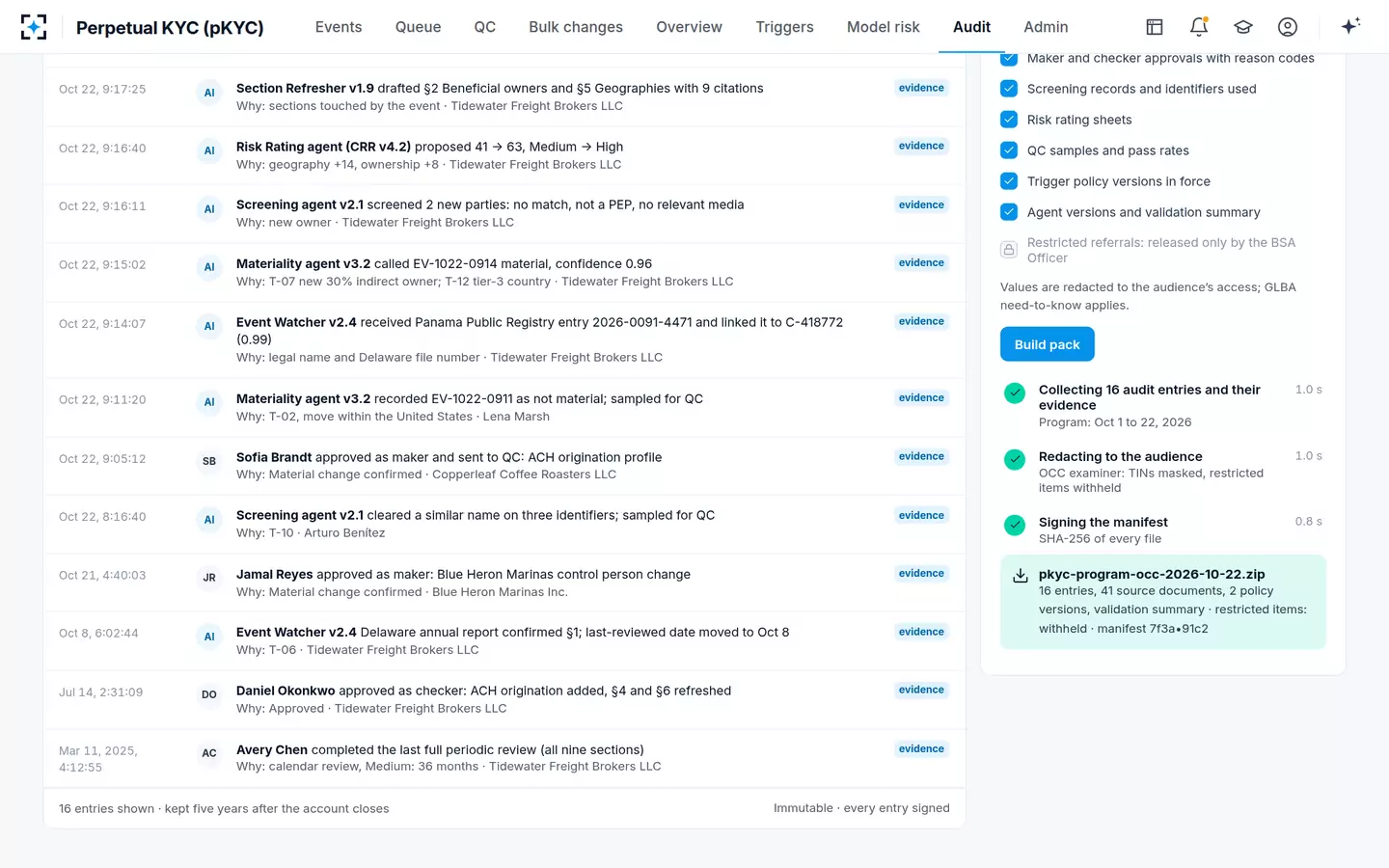
Every action with who, what, when, why and the evidence, redacted to the audience.
The last question matters more than it looks. The sample bank keeps every action by a person or an agent for five years after the account closes, which meets the general BSA rule that required records be "retained for a period of five years" (31 CFR 1010.430). A bank may choose longer under its own policy.
The audit trail an examiner reads: every agent and person, with the reason
Where Perpetual KYC (pKYC) fits, and where it does not
It fits a bank that already runs screening, transaction monitoring and a client lifecycle system, has files organised into sections or can organise them, and wants to move from calendar reviews to event-driven refresh with a backstop. It is strongest on corporate and business customers, where ownership and geography change and registry filings reveal it.
It does not replace the systems it reads. It is not a sanctions screening engine, a transaction monitoring system or an onboarding tool, and it does not perform identity verification at account opening. It does not fix a back book that was never complete; a remediation project comes first. And it needs a written trigger policy: a bank that cannot say which events are material will find the software asks that question on day one. Piloting customer due diligence software on last year's refreshes describes how to test the fit on your own book before deciding.
Questions people ask
What is KYC review software?
Software that supports the review of existing customers' due diligence files, from scheduling periodic reviews to event-driven refresh. The more capable products read the bank's source systems for changes, draft the affected sections with sources and route each change to a maker and a checker.
What is perpetual KYC software?
Software that refreshes customer files when trigger events arrive rather than on a calendar. It needs feeds from registries, the core, screening, media and monitoring, a versioned trigger policy and a way to test the events it closed without action.
Is KYC monitoring software the same as KYC refresh software?
Not quite. Monitoring software watches for changes, such as screening hits or activity alerts; refresh software turns those changes into an updated file, rating and customer request. A refresh tool consumes monitoring outputs as its triggers.
Do AI agents in KYC fall under model risk guidance?
Not under the interagency guidance. SR 26-2 (April 2026) excludes generative and agentic AI and tells banks to govern such tools through their own risk management, while its principles still apply to traditional models such as most customer risk rating models.
Can KYC refresh software send messages to customers on its own?
It should not. Drafting a request is safe to automate if every draft is checked for anything that could reveal monitoring or a SAR, which 31 CFR 1020.320(e) forbids disclosing; sending should follow approval by the analyst and the checker.