Business entity verification is the check that a company is real in the legal sense: that a state formed it, that its legal name, formation date, registered agent and status match what the applicant says, and that it is still active or in good standing. Banks do it by reading the company's formation documents and searching the Secretary of State's business entity filing, and the Customer Identification Program rule treats documents such as certified articles as proof that the entity exists. It is necessary and it is not enough. An active filing says nothing about whether the person in front of the banker controls the company, whether the owners on the beneficial ownership certification are all of them, or whether the business does what its application says. Botminds' Business Account Opening (KYB) treats entity verification as the first of fourteen lines, each matched to the packet, the owners and the stated activity, and each with its source.
The examples use a fictional sample customer at a fictional community bank, as it appears in the solution. The research is from FinCEN, Treasury, NYDFS, the FFIEC and a peer-reviewed field experiment.
What the state's filing says, and what the bank's file must show
The Secretary of State filing shows: The entity was formed on a date, with a charter number
The bank's file must also show: The entity in the packet is that entity: same name, number and state
The Secretary of State filing shows: Active, in good standing, or dissolved, as of today
The bank's file must also show: Standing checked inside the bank's freshness limit, on the day of opening
The Secretary of State filing shows: Legal name and any assumed names filed
The bank's file must also show: The name on the application and on the checks ties to one of them
The Secretary of State filing shows: Registered agent and a principal office, if the state collects one
The bank's file must also show: Where the business actually operates, which may differ from the agent's address
The Secretary of State filing shows: Often organizers or managers, rarely owners and never percentages
The bank's file must also show: Every 25% owner and one controller, certified and verified
The Secretary of State filing shows: Nothing
The bank's file must also show: Nature, purpose and expected activity that fit the business and its premises
What is business entity verification?
For a bank, business entity verification is the part of the Customer Identification Program that applies to a customer who is not a person. The rule lets the bank verify through documents that prove the entity exists, or through non-documentary methods. The examples it gives are getting in touch with the customer, checking what the customer supplied against a consumer reporting agency, a public database or another independent source, taking references from other financial institutions, and asking for a financial statement (31 CFR 1020.220(a)(2)(ii); how banks combine them is in how banks verify identity). For an entity, the Secretary of State's business filing is the obvious public database.
The rule asks the bank to verify enough to form a reasonable belief that it knows who the customer really is. For an entity, that means which legal person this is. It does not mean who stands behind it; that is a separate rule, the beneficial ownership rule, and a separate check. The error this guide is about is treating a passed entity check as if it had answered both.
What a Secretary of State search proves, and what it does not
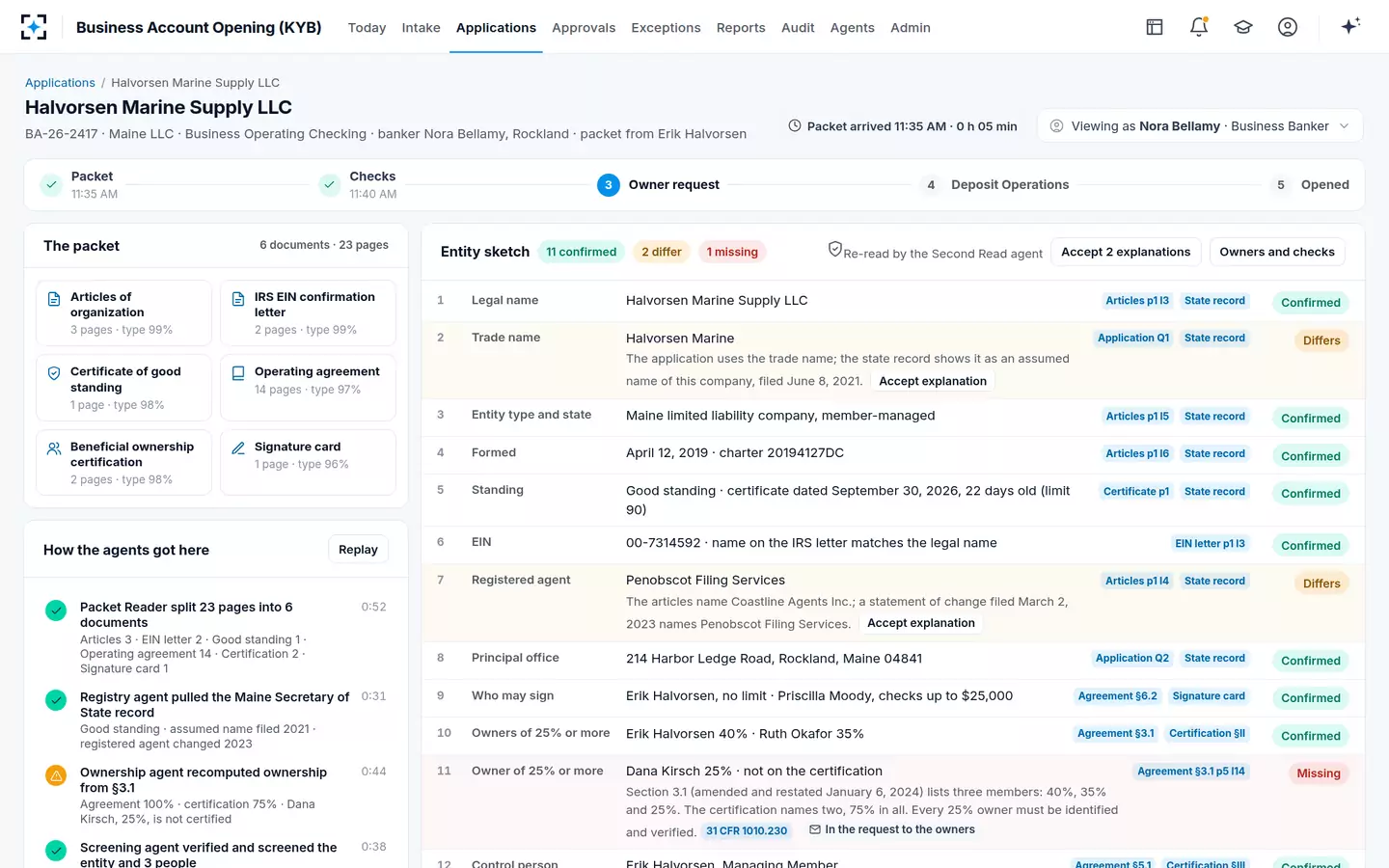
A Secretary of State search proves that a state formed the entity and what the state currently says about it. In the sample case, the state's filing for Halvorsen Marine Supply LLC confirmed the legal name, the entity type, formation on April 12, 2019, good standing and the principal office. It also showed two differences from the packet: the application used a trade name, and the articles named a registered agent that had since been replaced. Both were explained by later filings on the state's own record.
Fourteen lines on one sample entity: what matched, what differed, and why
| Line | Packet says | State filing or other source | Result |
|---|---|---|---|
| Legal name | Halvorsen Marine Supply LLC | Same, on the articles and the state's filing | Confirmed |
| Trade name | Halvorsen Marine (application) | Assumed name filed June 8, 2021 | Differs, explained |
| Registered agent | Coastline Agents Inc. (articles) | Statement of change, March 2, 2023: a new agent | Differs, explained |
| Standing | Certificate dated September 30, 2026 | 22 days old, inside the bank's 90-day limit | Confirmed |
| EIN | Number on the application | Name on the IRS letter matches the legal name | Confirmed |
| Owners of 25% or more | Certification: two members, 75% | Operating agreement §3.1: three members, 100% | Missing: one owner |
The table also shows the limit. The only line that mattered for the bank's risk, the missing owner, came from neither the state nor the certification. It came from comparing two documents in the packet with each other. A process that stops when the state's filing comes back clean would have opened the account with three-quarters of the ownership on file.
What does a certificate of good standing prove?
It proves that, on the date it was issued, the state treated the company as active and up to date with its filing and fee obligations. GAO's study of bank compliance costs found banks collecting certificates of good standing from state agencies to verify business customers, a certificate showing that the business has registered with the state and may do business there (GAO-20-574). It does not prove anything about owners, signers or activity, and its value decays: a certificate from last year says nothing about a lapse this spring, which is why a bank may set a freshness limit. The sample bank's is 90 days, held as a setting.
Can a dissolved LLC open a bank account?
Not as an ordinary new customer. An LLC the state lists as dissolved, forfeited or revoked fails the standing check the bank relies on to verify it exists in good order, and what a dissolved company may still lawfully do is a question of the state's law, typically limited and sometimes reversible by reinstatement. In the solution a lapsed standing is a line marked "differs" or "missing" that the banker cannot accept without an explanation, and the sample bank's rule sends anything it cannot resolve to the BSA officer. The practical answer for the owner is to reinstate first and apply second.
How to verify a business owner, not just the business
Verify the owner's identity, and separately test whether the owners on the form are all of them. The two are different checks, and the rule only requires the first. FinCEN explained its choice in the 2016 rulemaking: verification meant that institutions "were required to verify the identity of the individual identified as a beneficial owner (i.e., to verify the individual's existence), and not his or her status as a beneficial owner" (81 FR 29398). The bank confirms that each named person is real; whether they are really the owners rests on the customer's certification.
That design leaves one door open: the owner who is not named. A real, verifiable person on the form tells the bank nothing about a second person who should have been. The only evidence in a typical packet is the operating agreement, bylaws or partnership agreement, which is why reading it against the certification is the most valuable check a bank is not obliged to make. In the sample case it found a member at exactly 25% whom the certification had left out. How the 25% line and the control person apply by entity type is in LLC bank account requirements.
Every line of the entity sketch in Business Account Opening (KYB) names its source
How to verify a business is legit: matching filing, packet, owners and activity
A business is legitimate for a bank's purposes when four things agree: the state's filing, the documents in the packet, the owners and controller, and the activity the business expects. The fourth is the one most often skipped, and NYDFS's 2025 order against Paxos shows the cost. The regulator found that the company "onboarded customers with limited insight into their true identities, the legitimacy of their businesses, or the sources of their funds", and that customers "were also able to onboard with false or insufficient documentation (e.g., invoices and bank statements) that did not align with the entity's stated business activity or purpose" (NYDFS consent order, August 7, 2025).
Forming a company that passes the entity check is easy, which is why the check cannot stand alone. In a field experiment published in International Organization, researchers posed as consultants requesting confidential incorporation "from 1,264 firms in 182 countries" (Findley, Nielson and Sharman, 2013). The University of Texas summary of the wider study reports that "almost half of the firms they solicited failed to ask for proper identification", and that in the United States "the researchers were able to seal the deal in less than three hours after trying about a dozen approaches" (University of Texas at Austin, 2014). An entity with a clean filing can be three hours old and owned by anyone.
Business entity verification that a regulator would accept as verified
- The filing matches the packet
Legal name, entity type, state, formation date and charter number agree across the articles, the IRS letter and the state's filing.
- Every difference has a written explanation
An assumed name, a statement of change, a merger: the filing that explains it is cited, and a person accepted it.
- Standing is current
Checked inside the bank's freshness limit, on or near the opening date.
- The owners on the form are all the owners
The certification read against the operating agreement, bylaws or partnership agreement and their amendments.
- Each named person is verified
Owners, the controller and signers verified by documents or non-documentary methods, and screened.
- The activity fits the business
Nature, purpose and expected activity recorded and plausible for the premises and the trade.
What examiners test and what a defensible file shows
Examiners test the file, not the filing. For beneficial ownership the FFIEC procedures have them pull a sample of accounts opened for legal entities since May 11, 2018, and check that identifying information was obtained, that verification happened within a reasonable time after opening, and that unverifiable cases were resolved (FFIEC BSA/AML Manual, beneficial ownership examination procedures). The version captured in April 2026 had not been updated for FinCEN's February 2026 relief order, so a bank using the relief should be ready to show where it relied on an earlier certification and why.
The CIP rule sets the standard for what the file must say about differences. Among the records it requires is an account of how the bank settled each substantive discrepancy it found while checking the customer's information, and that account must be kept for five years from the day it is made (31 CFR 1020.220(a)(3); how banks handle those exceptions is in CIP exceptions). A trade name accepted with a citation to the state's assumed-name filing meets that standard; a trade name accepted on a banker's recollection does not.
Treasury's 2024 National Money Laundering Risk Assessment explains why this keeps coming up: enforcement actions "indicate that some banks have failed to follow the procedures to identify their customers in a timely manner and are not properly utilizing technological solutions to mitigate customer risk" (Treasury, 2024 NMLRA). The failure it names is procedural and documentary, not exotic. The checks across applicants that a single file cannot show are in KYB checks that look across files.
Measuring accuracy: how Business Account Opening (KYB) is tested
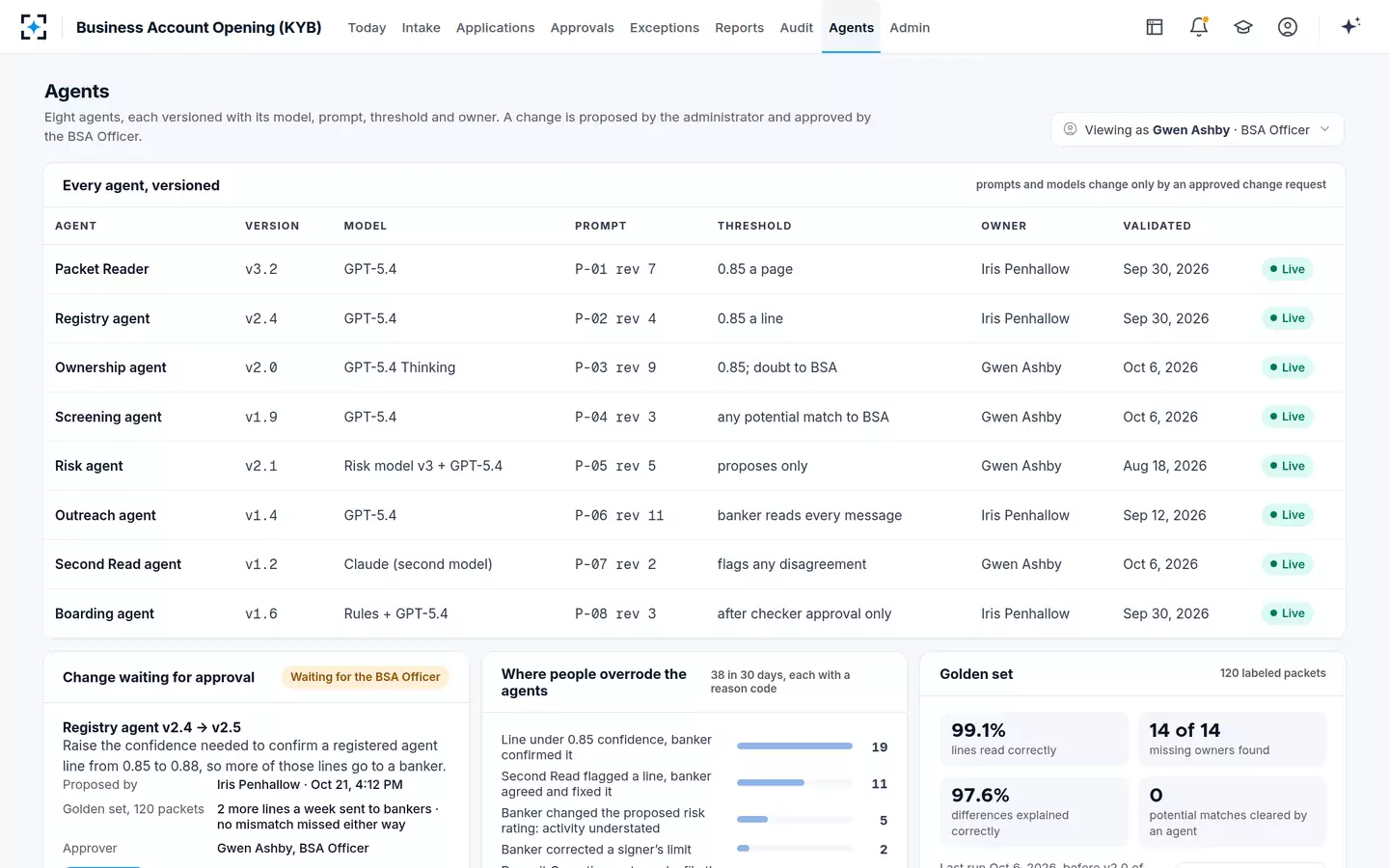
An entity check is accurate when its "confirmed" means confirmed and its "missing" finds what is missing. Business Account Opening (KYB) is measured that way, on a labelled set of 120 sample packets that every agent change must pass before the BSA officer approves it. The figures below are the latest run on that fictional sample set, shown in the solution's governance view; they illustrate the measures, not a bank's result.
The accuracy measures that matter for an entity file, on 120 sample packets
99.1%
of lines read correctly from the packet and the state's filing
14/14
missing owners found where the certification left someone out
97.6%
of differences explained correctly, such as assumed names and agent changes
0
potential list matches cleared by an agent
Two of those measures deserve more weight than the overall accuracy. Missing owners found is a recall measure on the one error that matters most and that a clean filing hides. Matches cleared by an agent should be zero by design, because no agent may clear one. A vendor that reports only "accuracy" across all lines is reporting mostly the easy lines. KYB automation that asks the owner once sets out the other questions to put to any tool.
Agents under governance: versions, thresholds and the labelled test set
Questions people ask
How do I verify a business with the Secretary of State?
Search the business entity database of the state where the company was formed, by name or charter number, and compare the legal name, entity type, formation date, status and registered agent with the company's documents. Some states also show assumed names and filing history, which explain many differences.
What is a business entity check?
A business entity check confirms from public filings that a company exists, is active and matches the identifiers it gave. For a bank it is part of the Customer Identification Program; it does not cover the company's owners, which the beneficial ownership rule handles separately.
Is a certificate of good standing enough to verify a business?
It verifies existence and current status, which satisfies part of the CIP rule, but not who owns or controls the business or what it does. A bank still needs the beneficial ownership certification, verification of the named people, and an understanding of the account's purpose.
Why does my business name not match the state's filing?
Usually because the business operates under a trade name, the legal name includes punctuation or a suffix the application dropped, or the IRS holds a slightly different version. A filed assumed name or the IRS letter normally explains it; the bank records the explanation as the resolution of the discrepancy.
Does the bank verify that the owners on the form are really the owners?
The rule requires the bank to verify each named person's identity, not their status as an owner, and lets it rely on the customer's certification unless it knows facts that call it into question. Banks that read the operating agreement against the certification catch owners left off the form.