The documents needed to open a business bank account for an LLC or corporation are usually six: the formation document (articles of organization or incorporation), the IRS letter confirming the employer identification number, a recent certificate of good standing from the state, the operating agreement or bylaws, a beneficial ownership certification naming every owner of 25% or more and one person who controls the business, and identification for those people and every signer. Each one answers a federal rule or a bank control, which is why a bank will not open the account on five of them. Botminds' Business Account Opening (KYB) is the bank-side solution that reads the whole packet, checks each paper against the rule it serves, and sends the owner one request for only what is still missing.
This guide is written for the owner who has to assemble the packet, and for the banker who has to explain it. The worked example is a fictional sample customer, Halvorsen Marine Supply LLC, opening an account at a fictional community bank in the solution; the rules are quoted from the regulations and the IRS.
One business account packet, annotated: what each document proves and which rule asks for it
Articles of organization or incorporation
What it provesThat the entity exists, its exact legal name, its state and date of formation
Which ruleCIP verification, 31 CFR 1020.220(a)(2)(ii)
How firmRequired in practice
IRS EIN confirmation (CP 575, or Letter 147C)
What it provesThe taxpayer identification number and the name the IRS holds for it
Which ruleCIP identification number, 1020.220(a)(2)(i)
How firmRequired in practice
Certificate of good standing
What it provesThat the state still treats the entity as active and authorized to do business
Which ruleCIP verification; the bank's own freshness rule
How firmOften required
Operating agreement, bylaws or partnership agreement
What it provesWho owns what share, who manages, who may bind the business
Which ruleSigner authority (bank control); a check on the certification
How firmUsually asked for
Beneficial ownership certification
What it provesEach owner of 25% or more and one control person, certified by the person opening the account
Which rule31 CFR 1010.230(b)
How firmRequired for legal entities
Identification for each owner, the controller and each signer
What it provesThat each named person exists and is who they say
Which rule1010.230(b)(2) for owners; bank policy for signers
How firmRequired for owners
Trade name (DBA) filing, if one is used
What it provesThat the name on the checks is lawfully the business's
Which ruleBank practice; matches the state's assumed-name filing
How firmWhen it applies
Signature card and account resolution
What it provesWho may sign and up to what limit
Which ruleBank control
How firmRequired by the bank
What documents do I need to open a business bank account?
The list depends on what kind of business it is, because the rules that drive the list apply differently to each entity type. A limited liability company or corporation brings the full packet above. A general partnership brings its partnership agreement in place of articles. A sole proprietor, who is legally the same person as the business, brings personal identification and, if the business uses another name, its trade name filing; no beneficial ownership certification is needed.
Documents needed to open a business bank account, by entity type
| Entity | Formation proof | Tax ID | Owners named on a certification | Usually also asked for |
|---|---|---|---|---|
| Single-member LLC | Articles of organization | EIN, or the owner's SSN if the LLC has no EIN | The sole member (or the people behind it, if the member is a company), plus one controller | Operating agreement, good standing, signer ID |
| Multi-member LLC | Articles of organization | EIN | Every member at 25% or more, plus one controller | Operating agreement, good standing, resolution |
| Corporation | Articles of incorporation | EIN | Every shareholder at 25% or more, plus one controller | Bylaws or corporate resolution, good standing |
| General partnership | Partnership agreement | EIN | Every partner at 25% or more, plus one controller | Trade name filing, if any |
| Nonprofit corporation | Articles of incorporation | EIN | One controller only (no ownership prong) | Board resolution, IRS determination letter if exempt |
| Sole proprietorship | None (not a separate entity) | Owner's SSN, or an EIN if it has one | None: not a legal entity customer | Trade name (DBA) filing |
Why a bank asks for the same facts twice, as a document and as an answer on the application, is the subject of the rest of this guide. The short version: the application gives the bank the information, and the documents let it verify that information. Both steps are required, and they are required at different times.
The four identity items the bank must have before it opens
Before any business account opens, the bank must hold four pieces of identifying information. The Customer Identification Program rule is blunt about the timing: "the bank must obtain, at a minimum, the following information from the customer prior to opening an account: (1) Name; (2) Date of birth, for an individual; (3) Address … (4) Identification number" (31 CFR 1020.220(a)(2)(i)).
For a business, the date of birth falls away and the address changes meaning: it is "a principal place of business, local office, or other physical location". A registered agent's office is a legal address for service, not a place of business, which is why a bank may ask where the business actually operates. The identification number is the taxpayer identification number, which for most entities is the EIN.
The rule also explains the notice you will see on most applications. Banks must give customers adequate notice that they are asking for this information, and the regulation supplies sample language under the heading "Important Information About Procedures for Opening a New Account". It is not boilerplate the bank chose; it is the rule describing itself.
Three numbers that shape the packet
4
identity items the bank must hold before it opens any account: name, address, ID number and, for people, date of birth
25%
the ownership share at which an owner must be named on the certification and verified
1
control person per business, however many managers it has
Proof the business exists: articles, certificate of good standing, partnership agreement
Holding a name and a tax number is not the same as knowing the business exists, so the rule then requires verification. For a business that relies on documents, the regulation names the kind of paper it means: "documents showing the existence of the entity, such as certified articles of incorporation, a government-issued business license, a partnership agreement, or trust instrument" (31 CFR 1020.220(a)(2)(ii)(A)). The list is examples, not a closed set, and a bank may verify instead, or as well, through non-documentary methods such as a public database.
The certificate of good standing is not in that list, but it answers a question the articles cannot: whether the entity is still active today. Articles show that a company was formed on a date; a state can administratively dissolve it later for missing an annual report or a franchise tax payment. A bank that asks for a certificate may set a freshness limit of its own. The sample bank's is 90 days, and the sample customer's certificate, dated September 30, 2026, was 22 days old when it arrived.
A trade name works the same way. If the business will deposit checks made out to a name other than its legal name, the bank will want the assumed-name or DBA filing that ties the two together. In the sample case the application gave the trade name "Halvorsen Marine", the state's filing showed it registered as an assumed name on June 8, 2021, and the banker accepted the difference with one click rather than one phone call. What a state filing does and does not prove is taken further in business entity verification.
Do I need my EIN letter to open a business account?
Usually yes, or an IRS document that does the same job. The bank must hold the business's taxpayer identification number before it opens, and most banks verify it against the IRS's own confirmation rather than the number typed on the application. The IRS lists the ways to confirm an EIN: an entity transcript, a digital CP575 "Employer Identification Number Verification Notice" downloaded from a Business Tax Account, or Letter 147C, "EIN Previously Assigned", requested by phone (IRS, Employer identification number).
The order of steps matters if the business is new. The IRS tells applicants: "If you're creating a legal entity (LLC, partnership, corporation), register it with your state before you apply for an EIN." The EIN application asks for the business name "as it appears on your registration or formation documents", which is also the name the bank compares across the articles, the state filing and the IRS letter. A name that differs by a comma or an abbreviation is enough to make a line in a business file read "differs" instead of "confirmed".
Can I open a business bank account without an EIN number?
Sometimes. A sole proprietor with no employees can usually use a Social Security number, and so can some single-member LLCs. The IRS explains that a single-member LLC treated as a disregarded entity, with no employees and no excise tax liability, "does not need an EIN", and adds: "However, if a single-member LLC … needs an EIN to open a bank account … then the LLC can apply for and obtain an EIN" (IRS, Single member limited liability companies). A bank may require an EIN for any LLC as a matter of policy, so the shortest path is often to get one; the IRS issues it online at no charge (IRS, Get an EIN).
The rule also allows a bank to open an account for a customer that has applied for a tax number but not yet received it. The CIP may include procedures for that case, which "must include procedures to confirm that the application was filed before the customer opens the account and to obtain the taxpayer identification number within a reasonable period of time after the account is opened" (31 CFR 1020.220(a)(2)(i)(B)). Whether a given bank offers that path is its choice.
Since 2025 a bank may also obtain the tax number from a third party instead of the customer. FinCEN issued that relief with the OCC, FDIC and NCUA on June 27, 2025, and with the Federal Reserve on July 31, 2025. The number must still be in hand before the account opens, and banks are free not to use the relief.
The beneficial ownership certification: who you must name
The certification names the people behind the business: each individual who owns 25% or more of the equity, directly or indirectly, and one individual who controls it. For each of them the bank collects, in FinCEN's words, "the name, date of birth, address, and social security number or other government identification number" (CDD Rule FAQs, B.7). The person opening the account completes and signs the certification; FinCEN's FAQ B.6 confirms the bank does not have to collect the information from each owner directly.
The control person is a single individual even when several people run the business. FinCEN's examples of the role are "an executive officer or senior manager (e.g., a Chief Executive Officer, Chief Financial Officer, Chief Operating Officer, Managing Member, General Partner, President, Vice President, or Treasurer)", and it expects the person named to be a senior official who answers for the way the entity is run (FAQ B.9; the certification that names this person is covered in beneficial ownership certification). An owner can also be the control person, so a two-member LLC may name two people in total.
The question owners ask most since 2025 is whether this form still exists now that most companies no longer report owners to FinCEN. It does, and is beneficial ownership still required at the bank explains why the two requirements came apart and what changed for a business opening its second account.
The operating agreement and the signature card: who may sign
No federal rule requires a bank to collect an operating agreement, but most ask for it, for two reasons. It is the document that says who may bind the business and therefore who may sign on the account. And it is the only document in the packet that independently states who owns what, so it is where a careful banker checks the certification.
In the sample case that check found the gap. Section 3.1 of the operating agreement, amended and restated on January 6, 2024, lists three members: 40%, 35% and 25%. The certification the managing member signed on October 20 names the first two, 75% in all. The third member holds exactly 25%, so she must be named and verified. Nothing was wrong with the form as filled in; it was simply incomplete, and only the agreement showed it. The guide to LLC bank account requirements covers how the 25% line and the control person apply to single- and multi-member LLCs.
The page of the operating agreement that showed the missing owner
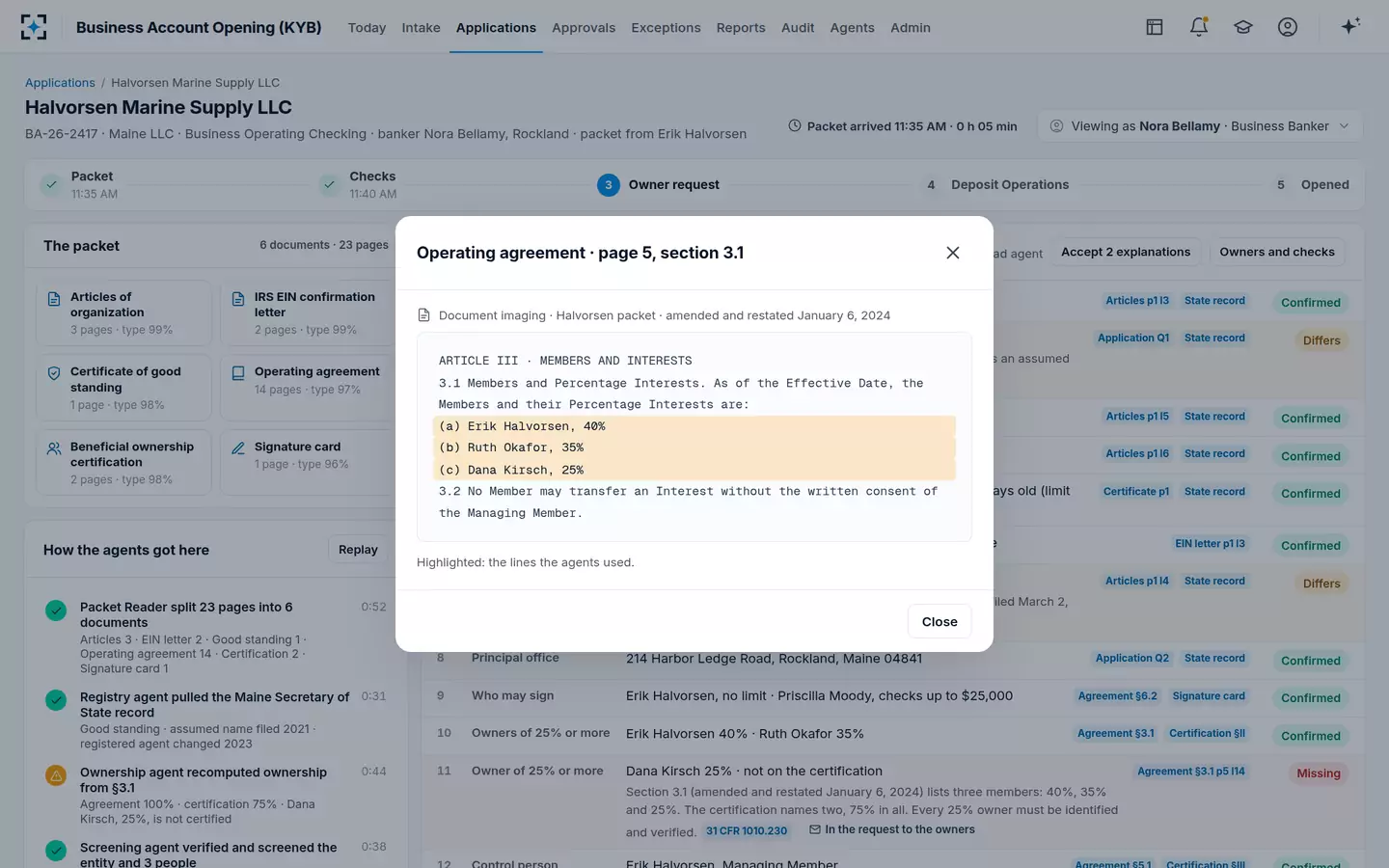
The signature card and the account resolution then turn the agreement into the bank's working instructions: who may sign, alone or jointly, and up to what amount. In the sample, a signer who owns nothing may sign checks up to $25,000. She is not on the certification, because she is neither an owner nor the controller, but the bank still verified and screened her as a signer under its own policy.
An incomplete business packet and a complete one, side by side
Incomplete: the account waits: Articles printed from the state site, no filing stamp
Complete: the account can open: Certified or state-stamped articles with the filing number
Incomplete: the account waits: EIN typed on the application only
Complete: the account can open: IRS CP 575 or Letter 147C, name matching the articles
Incomplete: the account waits: Certificate from last year
Complete: the account can open: Certificate inside the bank's freshness limit
Incomplete: the account waits: Certification naming owners who add up to 75%
Complete: the account can open: Certification naming every 25% owner, matching the operating agreement
Incomplete: the account waits: Left blank, or three names
Complete: the account can open: Exactly one individual, with title
Incomplete: the account waits: Licence for the person in the branch only
Complete: the account can open: ID or verifiable details for each owner, the controller and each signer
Incomplete: the account waits: Checks payable to a name the bank cannot tie to the entity
Complete: the account can open: Assumed-name filing that links the trade name to the legal name
How Business Account Opening (KYB) reads a packet in one pass
On the bank's side, Business Account Opening (KYB) turns the packet into a checklist the banker does not have to build by hand. A Packet Reader splits whatever arrives, from the branch scanner, an email or the online application, into documents and types each one; in the sample, six files and 23 pages were split in 52 seconds. A Registry agent compares the articles and the IRS letter with the state's filing; an Ownership agent recomputes ownership from the operating agreement and sets it against the certification.
The owner sees the result as one request. Instead of a call for the missing owner, another for her licence and a third for a new signature, the Outreach agent drafts a single message listing only what is missing, with a secure link for the personal details. The banker reads it before it goes. In the sample it asked for three things out of fourteen lines, and the missing owner answered from her phone two hours later.
What the owner receives: one request in Business Account Opening (KYB), only for what is missing
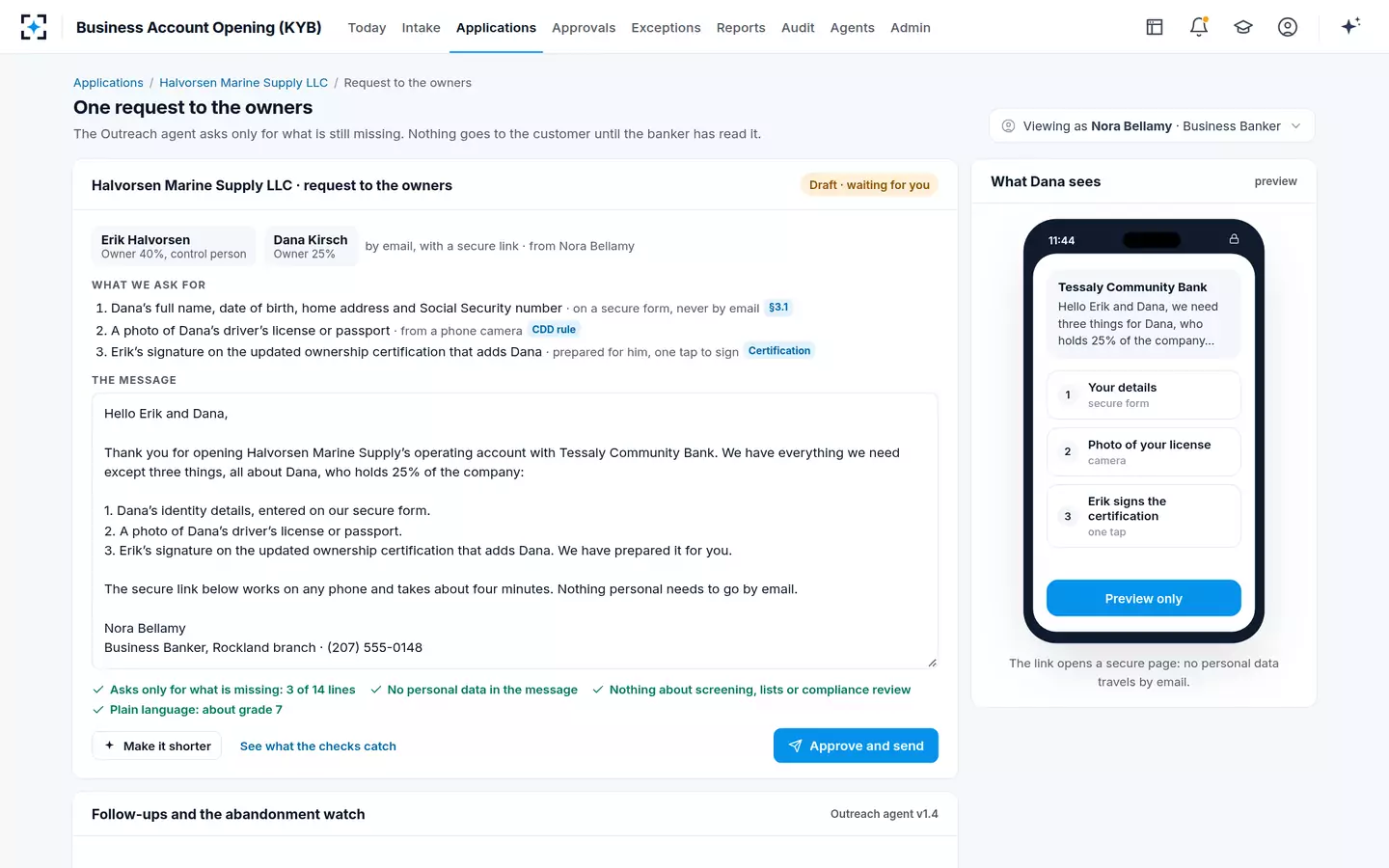
What the solution does not change is the list itself. The documents a bank requires by entity type are the bank's own policy, held as settings that its onboarding administrator proposes and its BSA officer approves. The time saved comes from reading and asking once, which how long it takes to open a business bank account measures on both the bank's clock and the owner's.
Questions people ask
Do I need a certificate of good standing for a brand-new LLC?
It depends on the bank. The CIP rule only requires documents that show the entity exists, and freshly filed articles already show that, so some banks do not ask for a certificate from an entity formed in the last few weeks. If the bank does ask, the certificate comes from the Secretary of State or equivalent office of the state where the business was formed.
What are KYB documents?
KYB, or know your business, documents are the papers a bank or payments company uses to verify a business customer: formation documents, a tax ID confirmation, proof of standing, ownership and control documents, and identification for owners and signers. In US banks they answer two rules, the Customer Identification Program rule (31 CFR 1020.220) and the beneficial ownership rule (31 CFR 1010.230).
Does every owner have to come to the bank in person?
No federal rule requires it. FinCEN's FAQ B.6 says the bank collects the owners' information from the person opening the account, and verification can be documentary or non-documentary. A bank may accept a photo of an owner's licence through a secure online form, as in the sample case on this page.
Can I use my home address as the business address?
Yes, if the business operates from there. For a business, the CIP rule asks for a principal place of business, local office or other physical location, so a home office qualifies. A registered agent's address usually does not, because the business does not operate from it.
What paperwork is needed to open a business bank account online?
The same documents as in a branch, uploaded instead of handed over: the rules do not change with the channel. Banks typically verify identity online through non-documentary checks or a photographed ID, and the CIP rule names opening an account without appearing in person as a situation the bank's procedures must address.
Do I need a new beneficial ownership certification for a second account at the same bank?
Often not. Under FinCEN's order FIN-2026-R001 of February 13, 2026, a bank may verify owners at the first account and rely on that information later, unless it knows of facts that call it into question or its own risk-based procedures require an update. A bank that relies on the earlier certification keeps a note of the customer's confirmation, verbal or written, that it is still accurate.