PEP enhanced due diligence is required in the US in one place only: a private banking account of $1 million or more held for a non-US person, where a senior foreign political figure is an owner, must receive enhanced scrutiny designed to detect the proceeds of foreign corruption. Outside that rule, the federal agencies said in 2020 that the CDD rule creates no requirement and no supervisory expectation of unique, additional steps for politically exposed persons, does not require PEP screening, and does not treat US public officials as PEPs at all. FATF and the EU go further and require enhanced measures for every foreign PEP. A US bank therefore decides most of its PEP policy itself, and should scale it to the risk each relationship presents. Botminds’ Enhanced Due Diligence (EDD) Review handles PEP files as one category of the bank’s EDD policy, with the depth the policy sets and a person signing each decision.
PEP enhanced due diligence: US rules against FATF and the EU
| United States | FATF standard | EU (from 10 July 2027) | |
|---|---|---|---|
| Who is covered by a binding rule | Senior foreign political figures who own a private banking account ($1M+, non-US person) | All foreign PEPs; domestic and international-organization PEPs where the relationship is higher risk | Politically exposed persons, without a foreign or domestic distinction; member states list their own prominent functions |
| Are domestic officials PEPs? | No: the agencies do not interpret the term to include US public officials | Yes, with measures applied when higher risk | Yes |
| Screening required? | Not by the CDD rule; required within private banking (ascertain whether an owner is a senior foreign political figure) | Risk-management systems to determine PEP status | Yes: determining PEP status is a customer due diligence measure (Art. 20) |
| Senior management approval | Not required by rule | Required to establish or continue the relationship | Required |
| Source of wealth and funds | Source of funds required for private banking accounts | “Reasonable measures” to establish both | “Adequate measures” to establish both |
| Enhanced ongoing monitoring | Enhanced scrutiny for foreign corruption proceeds in private banking | Required | Required |
Is PEP enhanced due diligence required in the US?
Only for senior foreign political figures in private banking. The private banking rule requires reasonable steps to ascertain whether any nominal or beneficial owner is a senior foreign political figure, and where one is, “enhanced scrutiny of such account that is reasonably designed to detect and report transactions that may involve the proceeds of foreign corruption” (31 CFR 1010.620(b)(2), (c)). Everything else in US PEP practice rests on the general risk-based CDD rule.
The five agencies said so explicitly on August 21, 2020, in a joint statement issued because banks had asked how to apply the risk-based approach to PEPs. The statement also rescinded the agencies’ January 2001 guidance on enhanced scrutiny for transactions that may involve the proceeds of foreign corruption.
“The CDD rule does not create a regulatory requirement, and there is no supervisory expectation, for banks to have unique, additional due diligence steps for customers who are considered PEPs.”
Federal Reserve, FDIC, FinCEN, NCUA and OCC, joint statement of August 21, 2020
The statement adds that “the CDD rule also does not require a bank to screen for or otherwise determine whether a customer or beneficial owner of a legal entity customer may be considered a PEP”, while a bank may choose to do so where the information is necessary to build the customer’s risk profile. It does not stop a bank from keeping practices it considers necessary to manage risk. It removes the claim that US rules require them.
What is a senior foreign political figure?
The US regulatory term, defined for private banking, and a subset of what the industry calls PEPs. It covers a current or former senior official in the executive, legislative, administrative, military or judicial branch of a foreign government, whether elected or not; a senior official of a major foreign political party; a senior executive of a foreign government-owned commercial enterprise; any entity formed by or for such a person; their immediate family; and a person “widely and publicly known (or is actually known by the relevant covered financial institution) to be a close associate” (31 CFR 1010.605(p)).
“Senior official or executive” means someone with substantial authority over policy, operations or the use of government-owned resources, and immediate family means spouses, parents, siblings, children and a spouse’s parents and siblings. The FFIEC reminds examiners that the PEP label “should not be confused with” the senior foreign political figure definition (FFIEC BSA/AML Manual, PEPs).
Three circles: who counts, and what each circle triggers in the US
Industry usage of “PEP”
Anyone entrusted with a prominent public function, domestic or foreign, with family and close associates
US rule: none. Bank policy decides.
PEP as US agencies read it
Foreign individuals with a prominent public function, family and close associates. Not US public officials.
US rule: risk-based CDD only. No unique steps expected.
Senior foreign political figure with a private banking account
$1M+ account for a non-US person, owned by a senior foreign political figure
US rule: enhanced scrutiny for proceeds of foreign corruption (1010.620(c)).
Are US politicians PEPs?
Not for US regulatory purposes. The 2020 statement says “The Agencies do not interpret the term ‘politically exposed persons’ to include U.S. public officials”, and a footnote extends the point to “U.S. federal, state, or local public officials”: the CDD rule creates no requirement or expectation of special steps for them either (joint statement, 2020). The FFIEC’s PEP section, updated on December 1, 2021 as one of four sections revised that day, is written entirely about foreign individuals (FDIC FIL-76-2021).
That is the sharpest difference from international standards. Under FATF Recommendation 12 a domestic PEP is a PEP, and an institution must take reasonable measures to determine whether a customer is one; enhanced measures apply when the relationship is higher risk (FATF Recommendations). A US bank with branches or affiliates abroad may need both standards at once.
Does a domestic PEP need EDD?
Under US rules, only if the bank’s own risk assessment rates the relationship high risk, in which case the customer goes through EDD like any other high-risk customer. Being a domestic official is not a reason in itself, and the statement goes further: PEPs “with a limited transaction volume, a low-dollar deposit account with the bank, known legitimate source(s) of funds, or access only to products or services that are subject to specific terms and payment schedules could reasonably be characterized as having lower customer risk profiles”, and that applies to foreign PEPs too.
Under FATF and in the EU, the answer is yes when the relationship is higher risk (FATF) or as a matter of course (EU). The EU regulation applies its PEP measures to politically exposed persons without a foreign or domestic distinction and has each member state publish a list of the functions it treats as prominent public functions (Regulation (EU) 2024/1624, Arts. 42–43). The UK’s regulations likewise make EDD mandatory for PEPs (MLR 2017, reg. 33).
Enhanced due diligence measures for PEPs, when the risk is real
When a PEP relationship is rated high risk, the international measures are a sound template even where they are not US law. FATF requires four things for foreign PEPs: systems to determine PEP status, “senior management approval for establishing (or continuing, for existing customers) such business relationships”, “reasonable measures to establish the source of wealth and source of funds”, and “enhanced ongoing monitoring of the business relationship”. The EU regulation’s Article 42 sets the same three measures for every PEP relationship.
The FFIEC describes what drives the risk: “the facts and circumstances specific to the customer relationship, such as transaction volume, type of activity, and geographic locations”. It adds that “not all bank-identified PEP customers pose the same risk, and not all bank-identified PEP customers are automatically higher risk”, and that banks managing the risk are “neither prohibited nor discouraged” from serving foreign PEPs (FFIEC BSA/AML Manual, PEPs). Source of wealth is where most PEP files are won or lost, and how to write the source of wealth narrative covers it in detail.
A PEP file is one category of the bank’s EDD policy, not a separate process
How long is someone a PEP?
US rules say “current or former” for senior foreign political figures and set no expiry. FATF’s guidance rejects fixed time limits: its recommendation “is consistent with a possible open ended approach (i.e., ‘once a PEP – could always remain a PEP’)”, and the handling of someone who has left office “should be based on an assessment of risk and not on prescribed time limits” (FATF Guidance on PEPs, 2013).
FATF lists the factors that keep a former official’s risk high: the informal influence the person could still exercise, the seniority of the position held, and whether the previous and current functions are linked. A bank’s policy can turn those into a review rule, such as re-assessing a former official’s rating at each review, rather than dropping the category after an arbitrary period. The EU regulation takes a middle course: firms must weigh the continuing risk of a person who has left office, and its recitals expect enhanced measures for at least 12 months afterwards (Regulation (EU) 2024/1624, Art. 45 and recital 94).
A PEP enhanced due diligence checklist for a US bank
A US policy that follows the rules and the risk, rather than the label, answers seven questions. The first two are regulatory; the rest are the bank’s choices, and each should be written down.
PEP enhanced due diligence checklist for a US bank
- Do we hold private banking accounts for non-US persons?
If so, ascertain senior foreign political figure status for every owner and apply enhanced scrutiny where one is found (1010.620).
- Do our foreign branches or affiliates follow FATF or EU rules?
Domestic PEPs, senior management approval and source of wealth may be law there.
- Do we screen for PEPs at all, and why?
The CDD rule does not require it. If we do, say what the result is used for in the risk profile.
- What makes a PEP relationship high risk here?
Seniority, country, product, transaction volume and source of funds, per the FFIEC and the 2020 statement.
- What does the EDD file contain for a high-risk PEP?
Source of wealth and funds, expected activity, adverse media and a recommendation, as for any high-risk file.
- Who approves?
A senior approver is good practice and an international requirement for foreign PEPs; name the role.
- When does a former official’s rating change?
By risk assessment at each review, not after a fixed number of years.
Screening is not diligence
Finding out that a customer or owner is politically exposed is screening; deciding what that means for the relationship is diligence. Screening ends with a match and a confirmation. Diligence starts there: source of wealth, expected activity, adverse media, a rating and a signed decision. Botminds’ PEP Screening handles the first part, confirming politically exposed persons and their associates and routing them to EDD; this solution builds the file they are routed into.
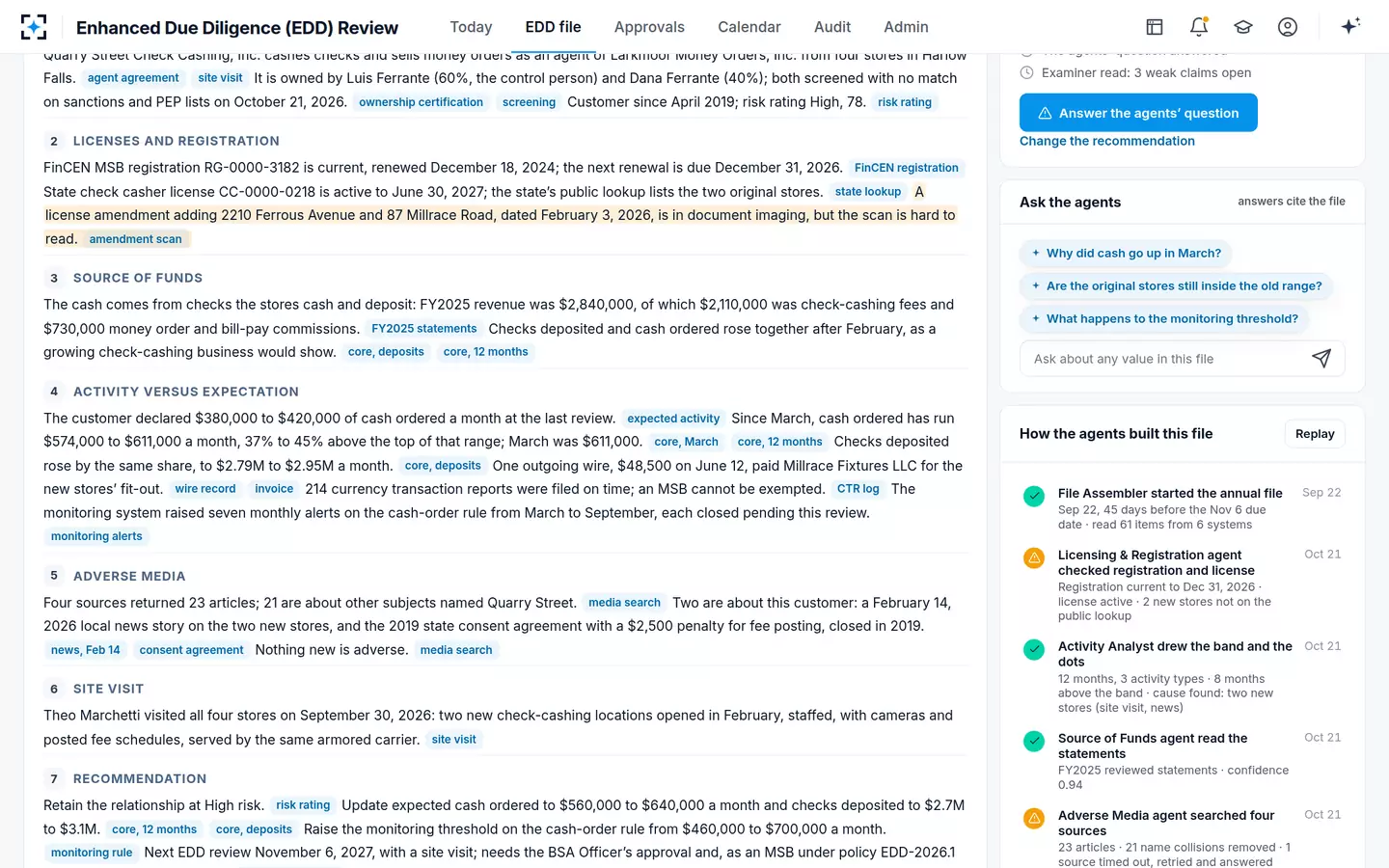
In the solution’s memo, the screening result is one cited sentence among many. In the fictional Quarry Street file, both owners, with their 60% and 40% stakes, were “screened with no match on sanctions and PEP lists on October 21, 2026”, with the ownership certification and the screening result as sources. Had either matched, the file would have needed the source of wealth work this page describes, at the depth the bank’s policy sets for that kind of PEP.
The screening result is one cited line; the diligence is the rest of the memo
Examiners judge whether the bank’s process is risk-based and followed, not whether each PEP got a fixed set of steps. How a reviewer can test that consistently across files is the subject of whether two reviewers reach the same call, and the US rule set beyond PEPs is in when enhanced due diligence is required.
Questions people ask
What are the EDD requirements for PEPs in the US?
For a senior foreign political figure who owns a private banking account of $1 million or more held for a non-US person, enhanced scrutiny designed to detect proceeds of foreign corruption, under 31 CFR 1010.620(c). For other PEPs, risk-based CDD: the 2020 joint statement says there is no requirement or supervisory expectation of unique additional steps.
Are US politicians considered PEPs?
No, for US regulatory purposes. The agencies do not interpret the term to include US public officials, whether federal, state or local. FATF and EU rules do treat domestic officials as PEPs, which matters for US banks with operations abroad.
Do US banks have to screen customers for PEP status?
The CDD rule does not require it, according to the 2020 statement. Private banking is the exception: a bank must take reasonable steps to find out whether any owner of a private banking account is a senior foreign political figure.
What enhanced due diligence measures apply to PEPs under FATF?
For foreign PEPs, and for domestic PEPs in higher-risk relationships: senior management approval to establish or continue the relationship, reasonable measures to establish source of wealth and source of funds, and enhanced ongoing monitoring. The same applies to family members and close associates.
Is a family member of a foreign official a senior foreign political figure?
Yes, under 31 CFR 1010.605(p), immediate family members are included: spouses, parents, siblings, children and a spouse’s parents and siblings. Widely and publicly known close associates are included too.
Is a PEP automatically high risk?
No. The FFIEC says not all bank-identified PEPs are automatically higher risk, and the 2020 statement gives examples of lower-risk PEP relationships, such as a low-dollar deposit account with known legitimate sources of funds.