Source of wealth corroboration means checking a client's account of how they became wealthy against evidence the client did not write: a court record for an inheritance, a registry or a buyer's filing for a business sale, audited accounts for a company's profits. A file is corroborated when each material part of the declared wealth ties to such evidence and whatever does not is stated in money and accepted, or chased, by someone with authority. Most files are judged instead on how complete the narrative reads, which is how a fluent story about an implausible fortune gets approved. Botminds' Source of Wealth Verification makes corroboration measurable: it rebuilds the wealth as streams, marks which are corroborated, tests each against a benchmark, and shows the unexplained amount in dollars before the BSA/AML Officer signs.
The regulators' tests below are quoted from MAS and FCA publications. Worked examples use MAS's own case studies and the solution's fictional sample client.
Five measures of source of wealth corroboration, with what passes and what fails
Traced share
How it is computedWealth explained by cited evidence ÷ declared net worth
Holds upEvery material stream traced; the remainder inside the firm's tolerance
Does notA total that "looks about right" with no stream-by-stream tie-out
Unexplained amount
How it is computedDeclared net worth − explained, in the reporting currency
Holds upStated in money, with the stream it belongs to and the document that would close it
Does not"Some documents outstanding"
Independence
How it is computedFor each material stream, the highest rung of evidence reached
Holds upA record made by a third party: court, registry, tax authority, auditor, custodian
Does notOnly the client's declaration and papers the client drafted
Plausibility
How it is computedEach event tested against an outside benchmark, with its source
Holds upBenchmark named, result within range, or the difference explained
Does notA benchmark chosen to fit the client's story
Age and relevance
How it is computedDate of each document against the event and the review cycle
Holds upEvidence dated to the event it proves; refreshed at review
Does notOld evidence for new wealth, or a demand for records no one still holds
What is source of wealth corroboration?
Corroboration is the step after collection: the firm has the client's account and documents, and now tests whether independent evidence supports them. MAS, which uses the word most, separates the two cleanly. For politically exposed persons, private banking and wealth management for high-net-worth clients, it expects firms to collect a base set of source of wealth information, seed money included where relevant, and then further documents or information that corroborate it independently (the full text is quoted in MAS source of wealth; MAS, AML/CFT Supervisory Expectations from Recent Inspections, October 2024). For banks' private banking business, MAS's guidelines put it more directly still: source of wealth information is to be corroborated independently, against documents or public information (Guidelines to MAS Notice 626, 8-6-4(a)).
The UK does not use "corroborate" in its regulations, but the same idea runs through them: enhanced measures may include "seeking additional independent, reliable sources to verify information provided". And the FCA's 2024 review found the gap between collecting and corroborating in practice. At one firm, "4 of their 8 customer files lacked adequate evidence of SOF and SOW"; at another, two high-risk files had been checked "with no customer outreach and by using internal systems only" (FCA, The treatment of politically exposed persons, July 2024).
Five measures that show whether a file holds up
A file's corroboration can be measured on five things, and none of them is the length of the narrative. Traced share and unexplained amount are arithmetic: what the evidence explains, against what the client declared. Independence is who made the evidence for each material stream. Plausibility is whether the story fits the world. Age is whether the evidence is from the event it claims to prove.
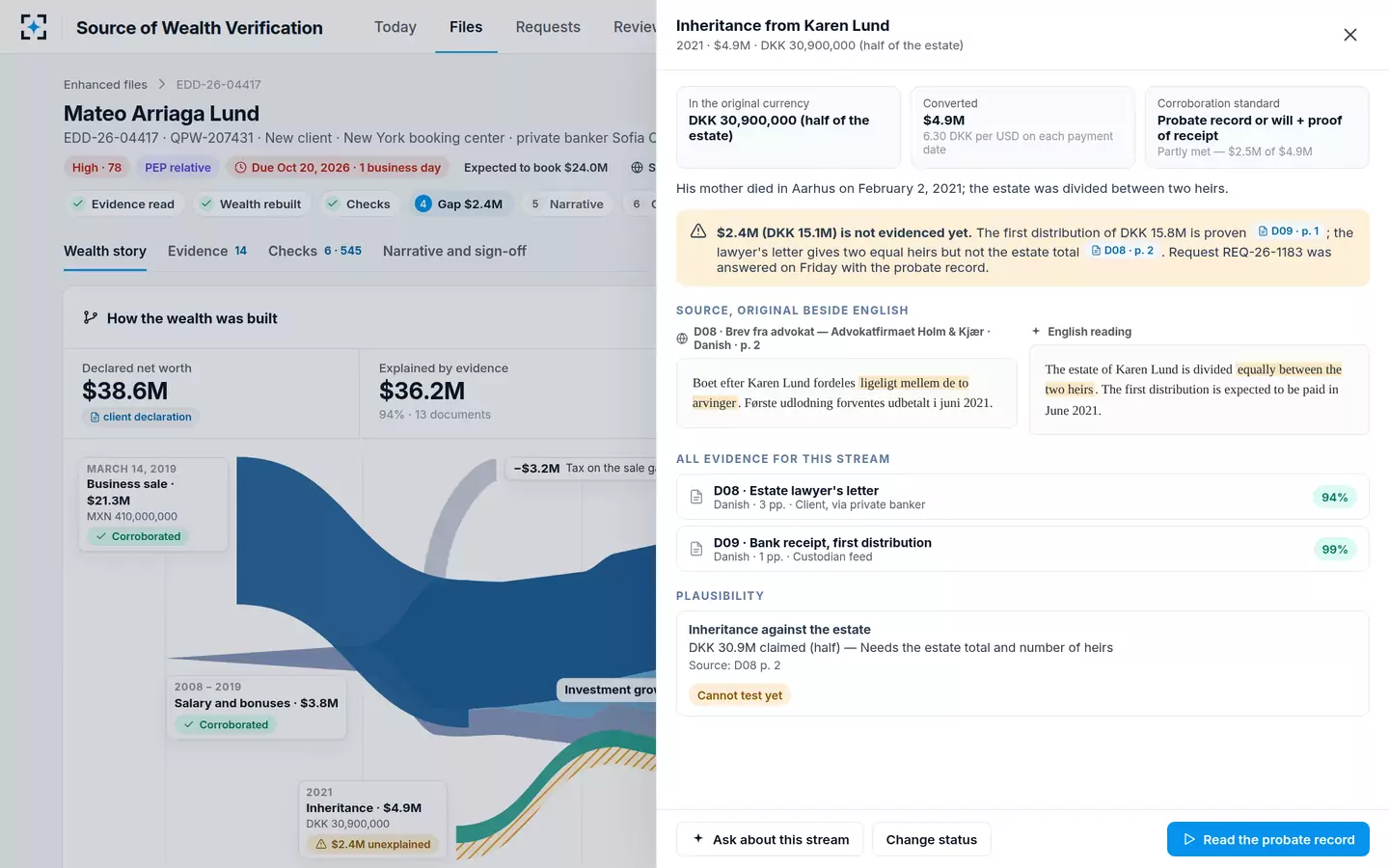
The point of measuring is that two reviewers can agree. "Adequately corroborated" invites a debate; "94% traced, $2.4 million of an inheritance unexplained, the probate record requested" does not. In the solution's sample file, the client declared $38.6 million. Before the last document arrived, $36.2 million, 94%, was explained by 13 documents, and $2.4 million of a Danish inheritance was hatched as unexplained.
Traced against declared, stream by stream, before the last document
How much unexplained wealth is acceptable?
No regulator sets a percentage. MAS sets a process instead: where a firm cannot corroborate material or higher-risk wealth, it "should assess whether the residual risks associated with not corroborating such source of wealth or source of funds is acceptable and whether additional risk mitigation measures should be applied", such as senior management approval and enhanced monitoring (8-5-7A). Its 2024 circular adds that where a firm cannot corroborate a significant part of a customer's wealth, it should escalate to senior management for approval before establishing the relationship.
So the acceptable amount is a firm's own setting, and the useful thing is to write it in money. The solution's fictional firm sets a gap tolerance of $100,000 or 0.5% of net worth, whichever is lower; above it the Gap agent drafts a request, and more than 10% of net worth unexplained after two requests goes to the Head of Financial Crime Compliance. On a $38.6 million client, 0.5% is $193,000, so the $100,000 limb applies. Those numbers are the sample firm's choices, not a standard; the principle is that the approver sees the open amount and decides on it.
What is plausibility in source of wealth?
Plausibility is whether the client's story could produce the wealth claimed, tested against outside facts: deal multiples for a business sale, pay ranges for a career, the size of an estate for an inheritance, market returns for growth. It catches files where every document is genuine and the story still does not add up. MAS made plausibility its headline expectation in 2024: firms "should apply rigor in assessing the plausibility of customers’ SOW and avoid overreliance on customers’ representations."
"assumptions and benchmarks should facilitate its assessment of the plausibility of the customer or beneficial owner’s source of wealth or source of funds, and should not be used to justify or support circumstances or explanations provided by the customer or beneficial owner if there are reasons that cast suspicion"
Guidelines to MAS Notice 626, paragraph 8-5-7 (last revised 1 July 2025)
That sentence is the trap in plausibility testing. A benchmark found after the fact to fit the client's number is not a test. The solution's Plausibility agent states its benchmark and its source with every result, and "explains, never decides". In the sample file it tested the business sale at 5.0 times 2018 EBITDA against a range of 4.2 to 7.8 times across 23 Mexican freight and logistics deals (plausible, 91%), the proceeds against the agreed price (99%), and chief executive pay of MXN 9.6 million against a peer range of MXN 7 to 12 million (88%).
Source of Wealth Verification: each plausibility test with its benchmark and source
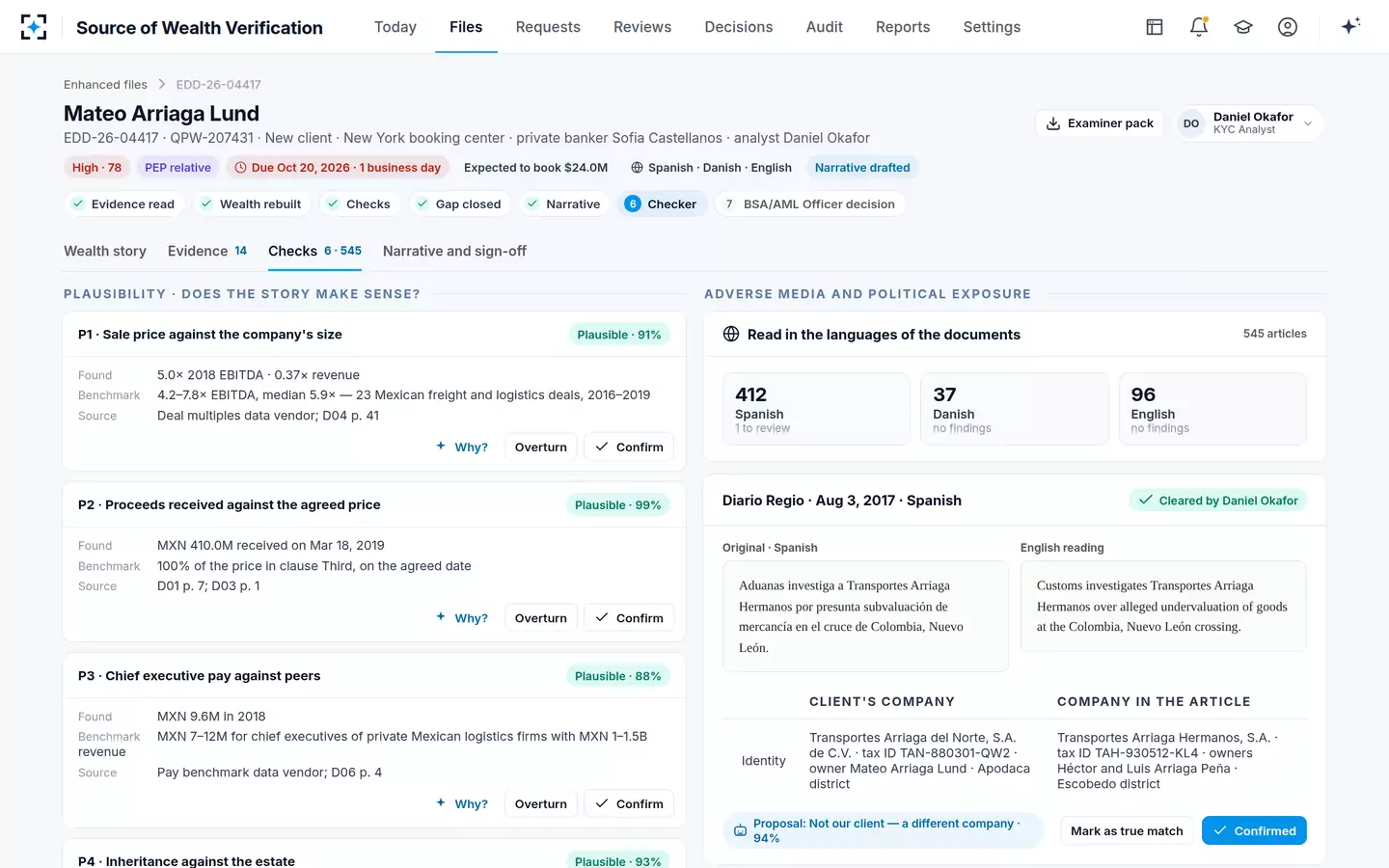
A worked plausibility test: the fortune profits could not have built
MAS's 2020 paper on private banking controls gives a case that needs no benchmark database, only arithmetic. A client "represented that his net worth of USD200m was derived from his business, which was represented to have an annual turnover of more than USD150m with a net profit margin of about 3% to 4%." The bank "accepted the customer’s representations and did not obtain any documentation or objective information to substantiate his net worth" (MAS, Effective AML/CFT Controls in Private Banking, September 2020).
Could the business have built the fortune? MAS's case, worked
| Step | Calculation | Result |
|---|---|---|
| 1. Annual profit at the low end | USD150m turnover × 3% margin | USD4.5m a year |
| 2. Annual profit at the high end | USD150m turnover × 4% margin | USD6.0m a year |
| 3. Years to accumulate USD200m from profit | USD200m ÷ USD4.5m to USD6.0m | about 33 to 44 years |
| 4. What that assumes | All profit kept, none taxed, none paid to other owners, nothing spent | Not plausible without other sources |
Two further cases in the same paper show the opposite failure: the documents existed and contradicted the story. One client's USD200 million came "mainly" from "a 50% stake in his family business", but the financial statements the bank obtained showed the business "had been loss making over the years", and "no further due diligence was conducted". Plausibility is not only a test against benchmarks; it is a test of the file against itself.
The same failure appears in a US order from August 2026. FinCEN's consent order against UBS Financial Services describes a customer whose ultimate owner's source of wealth included salary from Russian oil and gas companies and "a $40 million gift" from his brother, a Russian oligarch. The firm's due diligence had found reported connections between the brother and a laundering scheme, but "this reporting was not addressed when assessing the risk", and an internal memorandum concluded there was "no formal negative news" on him (FinCEN Consent Order No. 2026-02). A gift is only as corroborated as the giver's own wealth, which is why MAS asks firms to assess "the plausibility of the third party’s source of wealth".
Strength of evidence: relevance, independence, reputation, directness
Not every document corroborates equally, and the FCA has described a way to grade them. In its July 2024 review it highlighted, as good practice, one firm whose training set out "corroboration strength factors, i.e. relevance to the SOW, independence of the information, reputation of the source(s), directness (customer is directly linked to the economic activity) its comprehensiveness, as well as the levels provided by the corroborating materials (high / medium / low / no corroboration)".
Those factors map onto the independence measure. A buyer's published annual report reporting the acquisition is independent, reputable and direct. A news article naming the client as founder is independent but less direct. A client's own spreadsheet is none of these. The source of wealth documents guide ranks the common documents for each kind of wealth on a three-rung ladder; a file holds up when each material stream has reached the rung the firm's policy requires for it.
What the FCA found when it read firms' PEP files
10of 15
firms whose policies needed improvement to set out a risk-based approach, including source of funds and wealth
7
firms without practical, detailed guidance on how to perform source of funds and wealth checks
4of 8
customer files at one firm lacking adequate evidence of source of funds and wealth
Who checks the source of wealth narrative?
A second person who did not prepare the file checks it, and the check should be against the evidence, not the prose. In the solution, the narrative is written with a citation on every sentence, so the senior analyst who checks it can open each claim at its document and page, and return the file with a reason code such as "Sentence without a citation". The analyst who prepared a file can never check or approve it. Then the BSA/AML Officer decides, seeing net worth, the unexplained amount and the risk drivers; who signs what is set out in AML in wealth management: who signs the file.
The narrative itself is a craft of its own; Enhanced Due Diligence Review's guide on writing a source of wealth narrative covers it. What corroboration adds is that every sentence in the narrative can be checked, and the checker's job becomes confirming links rather than re-reading the evidence from scratch.
The unexplained amount, in dollars, with the one document that would close it
What did MAS find about corroboration?
In July 2025 MAS imposed composition penalties of S$27.45 million on nine financial institutions linked to Singapore's August 2023 money laundering case, and the finding common to all nine was about corroboration. All nine missed, or failed to follow up, discrepancies and red flags in documents they already held that should have cast doubt on what customers said about their wealth, and in some cases significant parts of a customer's wealth were never corroborated at all (MAS, 4 July 2025). The failure was not a missing form. It was documents in the file that contradicted the story and were not followed up. The penalties, firm by firm, and what MAS expects since, are in MAS source of wealth: what nine penalised firms missed.
Measuring corroboration across your own files
No regulator or independent study publishes a benchmark for how well corroborated a typical private bank's files are, so the measure has to be your own. The five measures turn a quality review into counts that can be compared month to month: the share of high-risk files where every material stream reached the required rung; the median and largest unexplained amounts at approval; the share of plausibility tests that named a source; the share of files approved with an open gap, and who approved them.
A practical start is a sample of recently approved high-risk files, re-scored on the five measures by someone outside the team that prepared them. The useful findings are the disagreements: a file the first reviewer called complete that shows 80% traced, or a gap that was accepted without anyone writing down its size. The solution scores every file this way as it is prepared, so the sample becomes the whole book. Its first-time setup tests the agents on 40 files the firm has already decided, which doubles as the first measurement. The Source of Wealth Verification page shows the full sample file.
Questions people ask
What does corroborate mean in AML?
To corroborate is to confirm information the client has given using a source independent of the client. In source of wealth checks it means testing the client's account of how they became wealthy against records such as registries, court records, tax filings or audited accounts, as MAS expects for politically exposed persons and private banking clients.
Is source of wealth corroboration required in the UK?
The UK regulations require firms to take "adequate measures to establish" source of wealth for politically exposed persons, and list seeking "additional independent, reliable sources" among enhanced measures. The FCA's FG25/3 scales the steps to risk: less intrusive for lower-risk cases, "more intrusive and exhaustive" for higher-risk ones.
Can public information corroborate source of wealth?
Yes, where it is credible. MAS lists "credible public information sources" among acceptable means, and its 2024 circular says firms may corroborate the account of clients "with prominent public profiles" against reliable public sources, which can spare the client a document request.
How do you corroborate wealth from many years ago?
With the best substitute available, documented: public records of the role or company, salary or industry benchmarks, and a conservative estimate with its basis written down. MAS accepted this approach in a 2020 case where a client's payslips from 1985 to 2012 no longer existed.
Who decides that a partly corroborated file is acceptable?
Someone with authority over the firm's risk, not the analyst. MAS expects senior management approval where a significant portion of wealth cannot be corroborated; in the solution's sample policy the BSA/AML Officer decides with the open amount shown, and larger gaps go to the Head of Financial Crime Compliance.