Source of wealth checks are the steps a bank or wealth manager takes to confirm how a high-risk client built their wealth: reading the client's documents, reconciling them to the declared net worth, testing the story against outside evidence, and asking for whatever is missing. The asking is where most checks go wrong. A request for "further supporting documents" sends the client back to guess, the reply rarely closes the gap, and a second and third request follow while the account sits unopened. Regulators now name this as a failure in its own right. Botminds' Source of Wealth Verification puts agents on the check that work the other way round: they size the unexplained amount in dollars, find the one document that would close it, and draft one request a person approves, so the client is asked once, precisely, or not at all.
Regulatory text below is quoted from MAS, the FCA and FINRA. The requests shown are from the solution's fictional sample data.
Source of Wealth Verification's agents ask once: from a sized gap to a closed one
Agent
Gap agent sizes the gapReconciles the evidenced streams to the declared net worth and states what is unexplained, in dollars and in the original currency, against the firm's tolerance.
Never: round a gap away or call a declaration evidence
Agent
Gap agent drafts one requestNames the one document that would close the gap, and an alternative if there is one; checks no document already on file does; explains why that document.
Never: contact the client
A person decides
Analyst approves the requestEdits or approves the draft; can cancel it with a reason if existing evidence is enough.
Never: send it
A person decides
Private banker sends itSends through the firm's client system, logged; the request carries status, not findings.
Never: approve it
Agent
Evidence agent reads the replyReads the document in its language, cites each figure to its page and recomputes the gap; asks the analyst before acting.
Never: treat a translation as the original
What is a source of wealth check?
A source of wealth check is the enhanced due diligence step that establishes, with evidence, how a client acquired their wealth, usually alongside a source of funds check on the money being deposited. It is required for politically exposed persons in the UK, the EU and Singapore, for higher-risk customers in Singapore, and in US private banking the rule asks for source of funds while firms' own risk-based programs often ask for more. The check has four parts: collecting the client's account and documents, reconciling them to the declared wealth, testing them against independent evidence, and closing or accepting what is left. The rules by jurisdiction are in source of wealth requirements; this page is about the last part, closing the gap, because that is where the client is asked for more.
Where source of wealth checks go wrong: the vague second request
A vague request costs a round trip and usually buys nothing. The analyst knows something is missing but not exactly what, so the request asks for "more information on the inheritance". The client sends what they think was meant, often the same lawyer's letter the file already holds. The analyst asks again, more specifically. Weeks pass, and the relationship manager is caught between a client who feels interrogated and a compliance team that cannot close the file.
MAS has now told firms in writing to stop it. Its circular of 25 May 2026 asks firms to "avoid excessive measures and process steps to establish customers’ SOW that are disproportionate to MAS’ requirements and international standards", and its annex lists the habits to drop.
"Avoid making multiple rounds of information requests that could unreasonably delay customer onboarding without clear risk-based justification."
Monetary Authority of Singapore, Circular AMLD 05/2026, Annex, 25 May 2026
The FCA saw the same risk in its 2024 review of politically exposed persons: "Firms without effective policies, controls and procedures may ask PEPs and RCAs for disproportionate amounts of information" (FCA, July 2024, paragraph 6.28). It did not find excessive initial checks, but it did find "a case of disproportionate ongoing EDD measures", information collected again at a review rather than at opening.
Three vague requests against one exact one
Three rounds: "Please provide further documents supporting your inheritance."
One request: The probate certificate and final estate accounts, or the bank statement showing the second distribution of DKK 15.1 million.
Three rounds: Not stated; the client guesses.
One request: Stated: the lawyer's letter proves two equal heirs and the first distribution, not the second.
Three rounds: Unknown until it arrives.
One request: $2.4 million, the whole open amount on the stream.
Three rounds: The documents already on file, then a second set, then a third.
One request: One document, from a court or a bank.
Three rounds: "Further documents requested" on the file, three times.
One request: Gap $2.4 million; request sent 13 October; record arrived 16 October; gap $0.
Sizing the gap in money before asking
A request can only be exact if the gap is. The first step is to rebuild the declared wealth as streams, mark each against its evidence, and subtract: what remains unexplained, in which stream, in money. In the sample file, the client declared $38.6 million and $36.2 million was evidenced. The remaining $2.4 million was not a general uncertainty; it was one payment, the second distribution of his mother's estate, DKK 15.1 million converted at the rate on its payment date.
The firm's tolerance then decides whether to ask at all. The fictional firm's setting is $100,000 or 0.5% of net worth, whichever is lower; below it, no request is drafted. That follows MAS's advice to "Consider whether existing information is already sufficient, if supplemented by alternative, reliable information or reasonable and relevant benchmarks to estimate the value of the customer’s wealth", and to "Consider whether there is a risk-based justification (i.e. customer’s specific risk profile and circumstances) before seeking additional information" (AMLD 05/2026, Annex).
One request for the one document that closes a gap
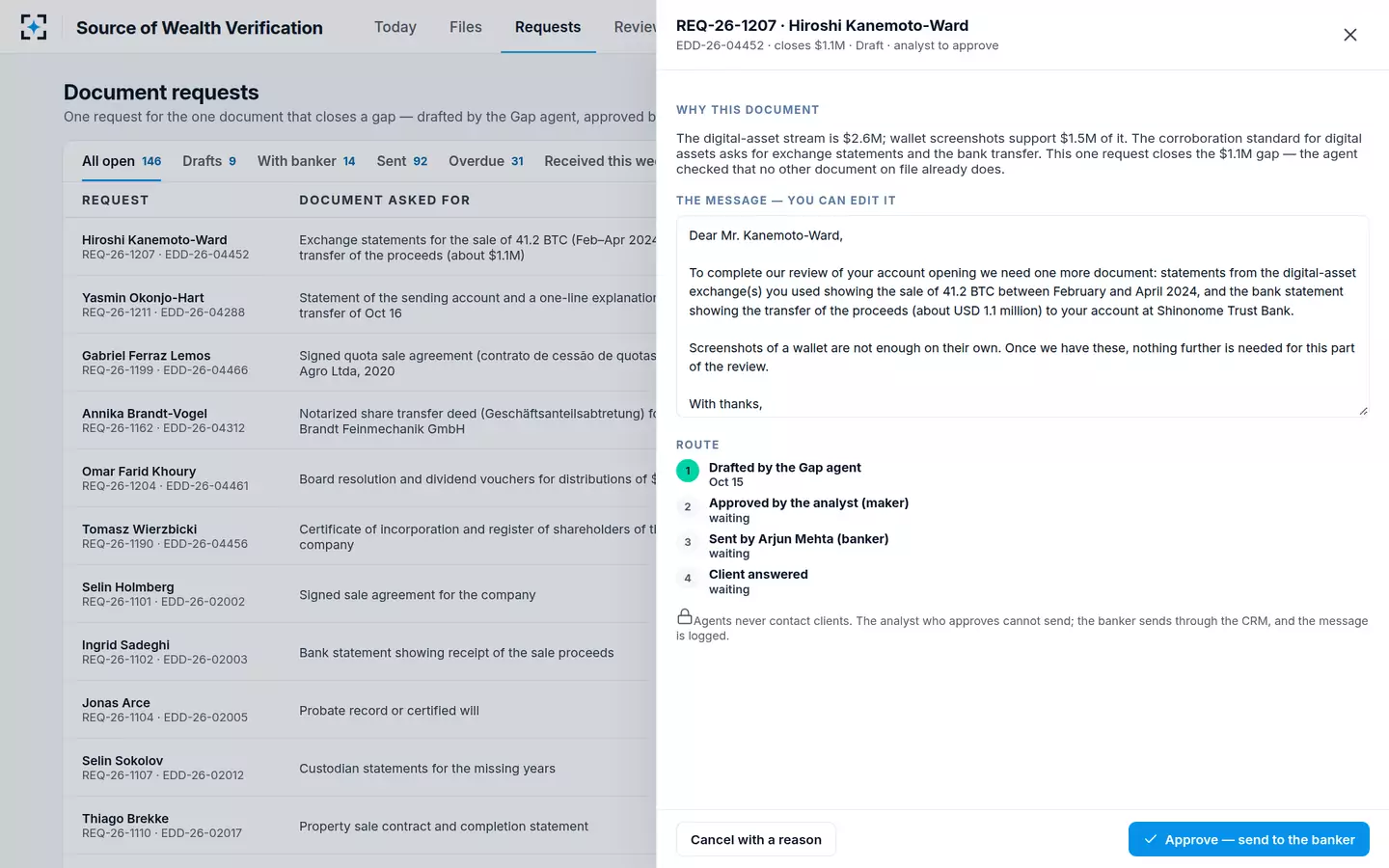
One request for one document, and why that document
The right document is the one that closes the gap at the rung of evidence the firm's standard requires, from the source most able to produce it quickly. For the sample inheritance, the lawyer's letter already proved the estate's division and the first payment; what was missing was proof of the second payment and of the estate's total. Two documents could close it: the probate record with final estate accounts, or the bank statement showing the second distribution. The request named both, so the client could send whichever was easier, and the probate record arrived three days after the request went out.
For the second sample client, $1.1 million of digital-asset gains was supported only by wallet screenshots. The fictional firm's standard for digital assets is exchange statements plus the bank transfer of the proceeds, with "wallet screenshots never alone". The request asked for exactly those two things for one sale, 41.2 bitcoin sold between February and April 2024, and told the client that once they arrived "nothing further is needed for this part of the review". A source of wealth documents ladder tells the agent which rung each kind of wealth needs; the gap tells it how much.
What a good document request says to the client
A request that closes a gap in one round has five parts, and each one removes a reason for a second round. The sample requests follow this shape; any firm can adopt it with or without software.
- The document, named exactly. "Statements from the exchanges you used showing the sale of 41.2 BTC between February and April 2024", not "evidence of your digital assets". Name the issuer where it matters: a court, a bank, an auditor.
- An acceptable alternative. If two documents would close the gap, name both and let the client choose the one they can get fastest, as the inheritance request did.
- Why it is needed, in one sentence. What the file already shows and what it does not: "your lawyer's letter confirms the first distribution; we need evidence of the second." Clients answer a reason better than a demand.
- What it closes. Tell the client that this document completes this part of the review. It sets an end point, and it commits the firm not to come back for the same stream without a new reason.
- How to send it. Through the relationship manager or the firm's secure channel, in its original language; the firm will read it as it is, and the client does not need to arrange a translation.
What the request leaves out matters as much. It says nothing about screening results, other sources the firm has checked, or why the client is rated high risk. That keeps the relationship manager, who sends it, on the right side of the firm's no-tipping-off rule, and keeps the client's attention on one document.
One morning of requests at the sample firm
9
requests drafted overnight by the Gap agent, none sent without an analyst's approval
146
document requests open across the firm's enhanced files
31
of them overdue with clients: the time the solution cannot remove
How many times can you ask a client for documents?
No rule sets a number, but regulators now expect each request to have a reason the firm can state. MAS's 2026 annex asks firms to avoid multiple rounds "without clear risk-based justification". The FCA's FG25/3, for lower-risk politically exposed persons, lets firms rely on what they already hold, such as transaction records or public information, and ask the client nothing more unless something looks wrong (FCA FG25/3). A second request is justified when the first reply raised something new; it is not justified because the first was imprecise.
The fictional firm's settings make the limit concrete: if more than 10% of net worth is still unexplained after two requests, the file stops going back to the client and goes to the Head of Financial Crime Compliance, who decides whether to accept, mitigate or refuse.
What if the client refuses to provide evidence?
Refusal is itself information, and the rules give the firm a route. FINRA counts among the red flags for suspicious activity a customer who will not name a legitimate source of funds, or whose information proves false or substantially wrong (FINRA Regulatory Notice 19-18, 6 May 2019). The US private-banking rule requires procedures for when due diligence cannot be performed, covering refusal, suspension, a suspicious activity report and closure (31 CFR 1010.620(d)).
MAS set the expectation for clients in its 2020 paper on private banking: firms should make clear that they have "zero tolerance for illegitimate funds" and that "To continue the relationship, clients should provide adequate information to enable the FI to robustly assess the legitimacy of their source of wealth and funds" (MAS, September 2020). Where a firm still cannot ascertain that the wealth is plausible and legitimate, its guidelines say it should consider whether to end the relationship and whether to file a suspicious transaction report (8-5-7C). Not every refusal is suspicious: a document may not exist, or may be held by someone the client cannot compel. The difference should be recorded with a reason code, and the decision made by the officer who owns it.
Can AI read source of wealth documents in other languages?
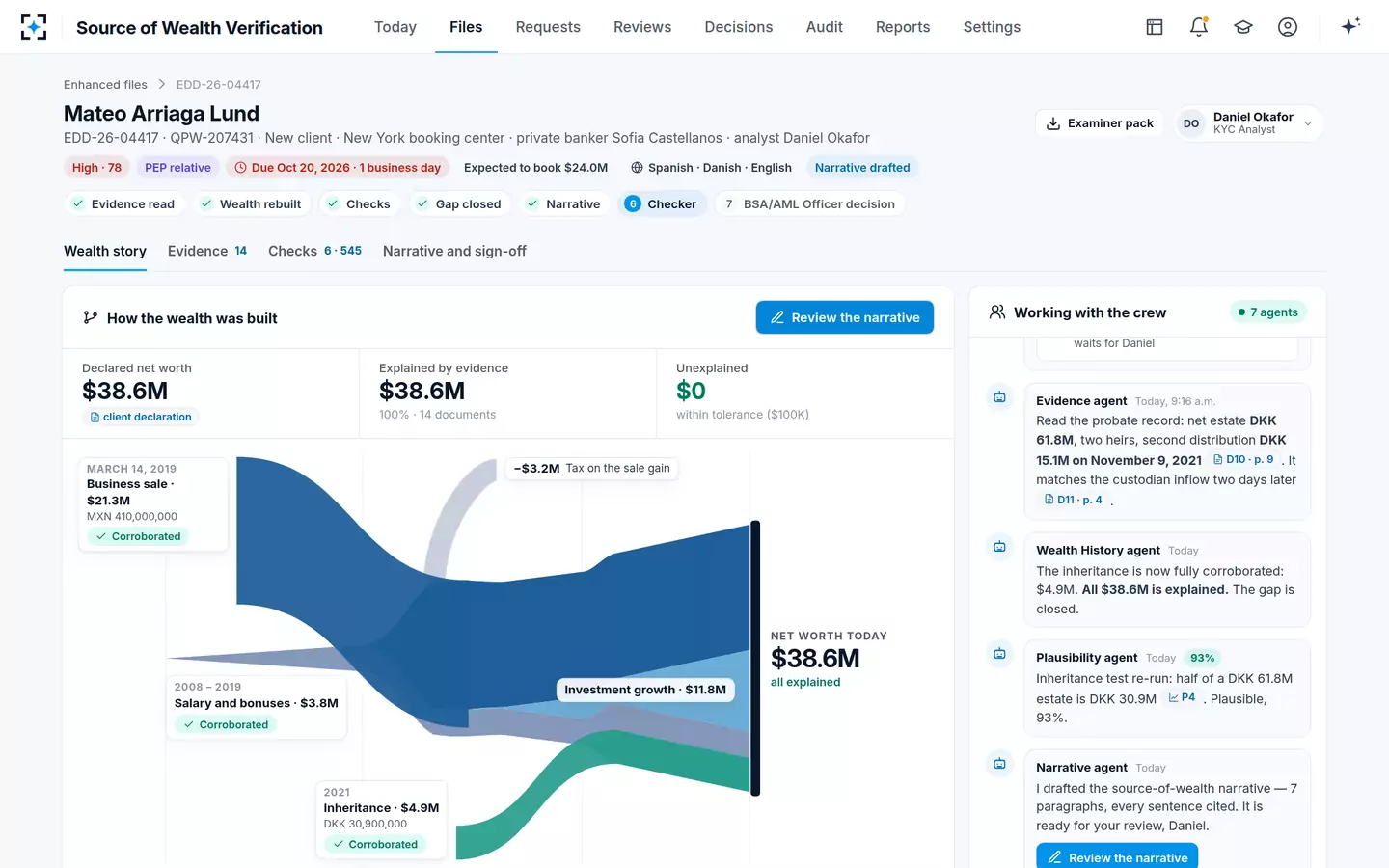
Yes, and reading them in the original is the safeguard rather than the risk. In the sample file, seven of fourteen documents are in Spanish and four in Danish. The solution's Evidence agent reads each in its original language and puts an English reading beside it, cites every amount, date and party to its page, and leaves the original on screen: it never treats a translation as the original. Below 85% confidence on a field, a person decides. The Adverse Media agent searches news in the language of each source document; in the sample it read 412 Spanish, 37 Danish and 96 English articles and resolved one Spanish name match with tax identifiers before anyone cleared it.
The reply read in Danish, the gap recomputed, and the next step left to a person
Where the agents stop and a person decides
An agent that asks good questions is useful; one that decides is a different product, and not this one. The solution's agents work to written limits, and the limits are where the regulator's expectations of judgement sit. The same split, agents reading and checking while people decide, governs account opening, where it is set out in agentic AI in client onboarding.
What each agent may do on a source of wealth check, and where it stops
| Agent | Does | Stops and asks a person when |
|---|---|---|
| Evidence | Reads and classifies each document in its language, with an English reading and page citations | A field is below 85% confidence; it never discards a document |
| Wealth History | Rebuilds wealth as dated streams at the rate on each date; reconciles to the declared net worth | A declared amount has no document: it stays unexplained, never assumed |
| Plausibility | Tests each event against a named benchmark and source | Always: it explains, a person confirms or overturns with a reason |
| Adverse Media | Searches in the languages of the documents; resolves name collisions with identifiers | A match may be true: it never clears one; the BSA/AML Officer sees it |
| Gap | Sizes the unexplained amount and drafts one request | Always: the analyst approves, the banker sends; it never contacts a client |
| Narrative | Drafts the source-of-wealth and source-of-funds narrative, every sentence cited | Always: it never submits; no figure without a source |
Source of wealth checks for high net worth clients: proportionate, not lighter
Checks for high-net-worth clients should be deeper on the material sources and lighter on everything else. MAS treats wealth management for high-net-worth customers as a category where independent corroboration is expected, and its 2026 annex tells firms to "Avoid attempting to corroborate every single piece of SOW information." The two fit together: a $38.6 million client's $21.3 million business sale deserves a registry extract and the buyer's filing; a $50,000 gift from a parent twenty years ago does not deserve a request at all. The five measures of corroboration show a reviewer which is which. The Source of Wealth Verification page follows the same file from the first document to the decision.
Questions people ask
What is a source of funds check?
The check that the money being deposited or transferred comes from a legitimate activity, such as a sale, salary or dividend. Regulators expect it to reach the activity that produced the money, not stop at the bank the money came from.
How long should a client have to provide documents?
No regulator sets a deadline; firms set their own. The solution's sample policy reminds the client after five days and marks the request overdue after ten, with a new-client file due in ten business days overall. What matters more is that the request is specific enough to be answered once.
Should the agent contact the client directly?
Not in this solution. The Gap agent drafts the request, the analyst approves it, and only the private banker sends it, through the firm's client system with the message logged. The person who approves a request can never send it.
Is it tipping off to ask a client for more documents?
A request for evidence of wealth is ordinary due diligence. What must not reach the client or the relationship manager is a suspicion or a report; in the solution, bankers see a file's status but never adverse-media findings, and a possible true match goes to the BSA/AML Officer.
What if the document the client sends is in a language no one at the firm reads?
The Evidence agent reads it in the original and places an English reading beside it, with each figure cited to its page and a confidence score. Fields below 85% confidence go to a person, and the original remains the authoritative document.