MAS source of wealth expectations are the most detailed any regulator has published, and they were sharpened by enforcement. On 4 July 2025 the Monetary Authority of Singapore imposed composition penalties of S$27.45 million on nine financial institutions, six banks, two capital markets firms and a trust company, with links to the people in Singapore's August 2023 money laundering case. MAS found failures in four areas, and source of wealth was the one where all nine fell short: none detected or adequately followed up the red flags in clients' own documents that should have cast doubt on their stated wealth. Around those penalties MAS has told firms both to corroborate harder, in 2024, and, in May 2026, to stop asking for documents that do not matter. Botminds' Source of Wealth Verification is built around that balance: its agents test each stream of wealth against independent evidence and benchmarks, size what is unexplained, and ask the client only for the document that would close it.
Firms and amounts below are as MAS named them in its release. The worked examples use the solution's fictional sample client.
S$27.45 million across nine institutions, as MAS imposed it
What did MAS fine banks for in 2025?
MAS fined the nine for breaches of its anti-money laundering notices in four areas: customer risk assessment, establishing and corroborating source of wealth, transaction monitoring, and follow-up after suspicious transaction reports. The examinations ran "from early 2023 to early 2025", and MAS was blunt about the cause: "most of the FIs had established AML/CFT policies and controls. The breaches arose out of poor or inconsistent implementation of these policies and controls" (MAS, 4 July 2025).
Four findings, and how many of the nine each touched
| Area | Institutions | What MAS found |
|---|---|---|
| Source of wealth | All nine | Discrepancies and red flags in clients' documents not detected or followed up; in some cases no corroboration of significant aspects |
| Transaction monitoring | Eight | Alerts their own systems raised on unusually large or inconsistent transactions not adequately reviewed |
| Customer risk assessment | Five | Policies that led to mis-rating clients' money laundering risk |
| After a suspicious transaction report | Two | Risk mitigation after filing not adequate or timely |
The source of wealth finding, read closely
The finding is two sentences, and each describes a different failure.
"All nine FIs did not detect or adequately follow up on significant discrepancies or red flags noted in information and documents that should have cast doubt on some customers’ purported SOW and which indicated increased risk of ML. In some cases, there was no corroboration of significant aspects of SOW."
Monetary Authority of Singapore, enforcement release, 4 July 2025
The first sentence is about documents the firms had. The red flags were "noted in information and documents", which means they were in the file. The failure was reading: a discrepancy between the client's account and a document, seen or unseen, and not followed up. The second sentence is about documents the firms never obtained: significant parts of a client's wealth accepted on the client's word. A file can fail either way, and the first is harder to catch in review, because a file with plenty of documents looks thorough.
Credit Suisse's penalty carried a second source-of-wealth finding unrelated to the 2023 case. For accounts held for certain US customers between November 2017 and October 2023, MAS found failures to "establish and corroborate SOW", alongside failures to obtain the aliases of persons acting for customers and to identify beneficial owners.
Who else was sanctioned: the people behind the files
MAS also acted against individuals, and the reasons it gave map the duties in a source-of-wealth file. Four people at Blue Ocean Invest, its chief executive, its chief operating officer and two relationship managers, one of them former, received prohibition orders of three to six years. The two senior managers had failed to develop and implement adequate controls "in multiple areas, such as SOW corroboration, customer risk assessment, customer name screening and ongoing reviews", and all four "failed to raise red flags when they were aware of information that should raise suspicion".
The individuals MAS acted against
4
prohibition orders, three to six years, all at one capital markets firm
5
named reprimands: three executives of a trust company, two former team heads at a bank
9
more relationship managers and supervisors reprimanded privately for more limited lapses
The trust company's case is the one every head of compliance should read. MAS reprimanded its senior managers because they "failed to ensure that TTCSPL’s policies provided sufficient practical guidance on how to establish customers’ SOW", and because, as members of its New Business Committee, they failed "to detect or adequately assess multiple deficiencies in customers’ SOW corroboration when approving the onboarding of higher risk customers". A policy that says "establish source of wealth" without saying how, and an approval committee that signs without checking the corroboration, are each a finding. MAS closed by reminding relationship managers and their supervisors that "they are part of the first line of defence". Who should sign what in such a file is set out in AML in wealth management: who signs the source of wealth file.
MAS source of wealth guidelines: what the supervisory expectations ask
MAS's expectations sit in four documents: Notice 626 and its guidelines, an October 2024 information paper on findings from recent inspections, and two circulars to all financial institutions, of July 2024 and May 2026. The information paper sets the structure. For politically exposed persons, private banking, and wealth management for high-net-worth customers, firms should obtain "(i) a base set of SOW information, including details on seed money where relevant; and (ii) additional documents and/or information to independently corroborate the SOW of the customer". For other higher-risk customers, the base set is required and corroboration depends on whether it would mitigate the risk (MAS, AML/CFT Supervisory Expectations from Recent Inspections, October 2024).
The same paper sets three principles, which the July 2024 circular had already given to wealth managers. Materiality: learn about the whole of the customer's wealth, focus corroboration on the material or higher-risk sources, and assess whether the residual risk of uncorroborated wealth is acceptable. Prudence: use more reliable corroborative evidence, such as audited statements over unaudited management accounts. Relevance: judge which documents are critical, since old ones may be hard to obtain and matter little. And it warns that where a firm cannot establish source of wealth that is higher risk or "a significant portion of a customer’s wealth, closer senior management oversight and enhanced monitoring are needed".
MAS 626 source of wealth: the notice and its guidelines
MAS Notice 626 is the binding text for banks. For politically exposed persons and their family members and close associates it requires the bank to establish, by appropriate and reasonable means, the source of wealth and the source of funds of the customer and of any beneficial owner (paragraph 8.3(b)), and applies the same measures to any customer the bank assesses as higher risk (8.7) (MAS Notice 626, last revised 30 June 2025). Breaches of the notice are offences; MAS's release notes a maximum fine of S$1 million per offence, which composition penalties settle.
The guidelines to the notice define the terms and set the evidence standard. Source of wealth is the origin of everything the customer owns, including seed money and gifts; a bank is expected to corroborate what it is told about both sources, focusing on what is material or higher risk; and in private banking, whatever the client's internal risk rating, source of wealth is to be checked independently against documents or public information (Guidelines to MAS Notice 626, 8-5-5 to 8-6-4). Where a bank cannot ascertain that a client's wealth is plausible and legitimate, it "should consider if there are grounds for terminating business relations with the customer and whether an STR should be filed" (8-5-7C). How these compare with the US, UK and EU rules is in source of wealth requirements.
Seed money: why MAS asks where the wealth began
Seed money is the first capital from which the rest of a client's wealth grew: the savings that funded a first company, an early inheritance, the proceeds of a first property. MAS's guidelines count the seed money behind later wealth as part of source of wealth, and its base set of information asks for that seed money where it is relevant (the declaration that starts there is in the source of wealth declaration template). It matters because a wealth story that starts in the middle, with a business already worth millions, has skipped the part where illicit money is most easily introduced. A declaration built as a dated history from that first capital is set out in the source of wealth declaration template.
How should firms treat red flags in source of wealth?
A red flag in a client's documents should trigger a recorded follow-up: more inquiry, independent due diligence, or a decision to exit or report. MAS's October 2024 paper says that where there are doubts about documents or representations, "further follow-up actions, such as conducting additional inquiry and independent due diligence on the customer, and/or taking additional risk mitigation measures (such as exiting the business relationship and/or filing an STR), should be triggered." It does not expect forensic examination of every document; it expects staff to notice the material discrepancies and firms to say who owns that.
Red flags MAS found, and the follow-up each should trigger
- The client's account disagrees with a corporate data report
Re-establish the facts from the independent source, and treat the client's version as unproven until the difference is explained.
- Shareholding dates differ between the client and a registry
Ask which is right, with a document; a later shareholding cannot have produced earlier wealth.
- A "sale" with a buyer who does not behave like one
In MAS's case, a web domain sold at a high price stayed in use and was marketed again at a fraction of it.
- Financial statements that do not fit the client
Accounting errors or anomalies against the firm's understanding of the business: test them, do not file them.
- Official documents with no official sign-off
No auditor or notary where one is expected. Obtain the certified version or treat the document as the client's own.
- Multiple nationalities, or a nationality acquired by investment
MAS says these are not higher risk by default, but expects adverse media searches in the native languages of countries associated with the client.
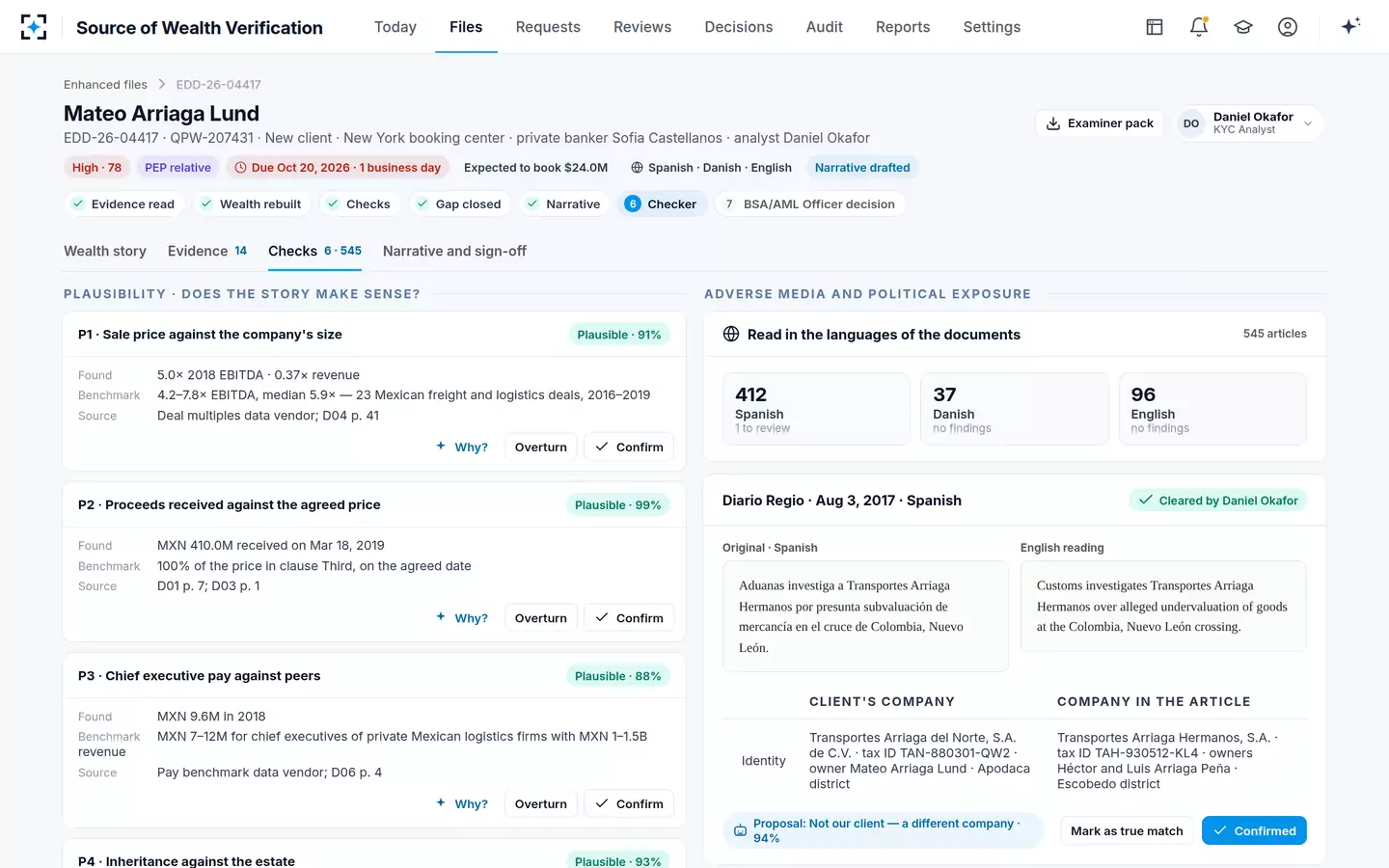
Source of Wealth Verification: plausibility and adverse media in the client's own languages
The 2026 turn: risk-proportionate source of wealth
On 25 May 2026 MAS issued a circular pulling in the other direction: firms had overcorrected. It asked them to keep source-of-wealth processes risk proportionate "so that Singapore’s AML/CFT regime does not create undue burden on legitimate businesses and investors", and gave an annex of things to avoid, from corroborating every piece of information to unnecessary requests for long-dated records (MAS Circular AMLD 05/2026). The principle repeats the July 2024 circular: "They should not apply a one-size-fits-all approach for all customers" (AMLD 08/2024).
Read with the 2025 penalties, the message is precise rather than mixed. Corroborate the material sources hard; do not corroborate the immaterial ones at all; and where there are red flags, escalate to senior management rather than asking the client for another round of paper. MAS also said a working group it co-leads under the Private Banking Industry Group is working on account-opening efficiency, and that it will publish more industry case studies. How an agent can ask for exactly one document, once, is in source of wealth checks.
From finding to control: what a file should show
Each part of MAS's finding has a visible counterpart in a well-built file. The undetected discrepancy is answered by checks that compare the client's account with independent sources and record the result, whatever it is. The missing corroboration is answered by a stream-by-stream view of what is evidenced and what is not, with the gap in money. The committee that approved without seeing the weakness is answered by putting that view in front of the approver.
Each MAS finding, the control that answers it, and what to show an examiner
| What MAS found | The control | What the file shows |
|---|---|---|
| Discrepancies in clients' documents not detected | Compare the client's account with independent sources for every material stream, and record the result even when it matches | The comparison, its source and its date, beside the stream |
| No corroboration of significant aspects of wealth | A written standard per kind of wealth, checked stream by stream | Each stream's status against its standard, and the unexplained amount in money |
| Policies without practical guidance on establishing wealth (trust company) | Evidence standards written per kind of wealth, with the independent source named | The policy version in force on the day the file was decided |
| A committee approving files with corroboration gaps | The approver sees the gap, the red flags and the checks before signing | The decision, its reason code, conditions and the approver's attestation |
| Staff aware of suspicious information who did not raise it | Escalations recorded; the person who owns the relationship cannot clear a finding | Who raised what, when, and who decided it |
| Adverse news missed across identities and languages | Searches in the languages associated with the client, matches resolved with identifiers | Articles screened per language, and how each match was resolved |
What the approver sees: wealth explained, and the part that is not
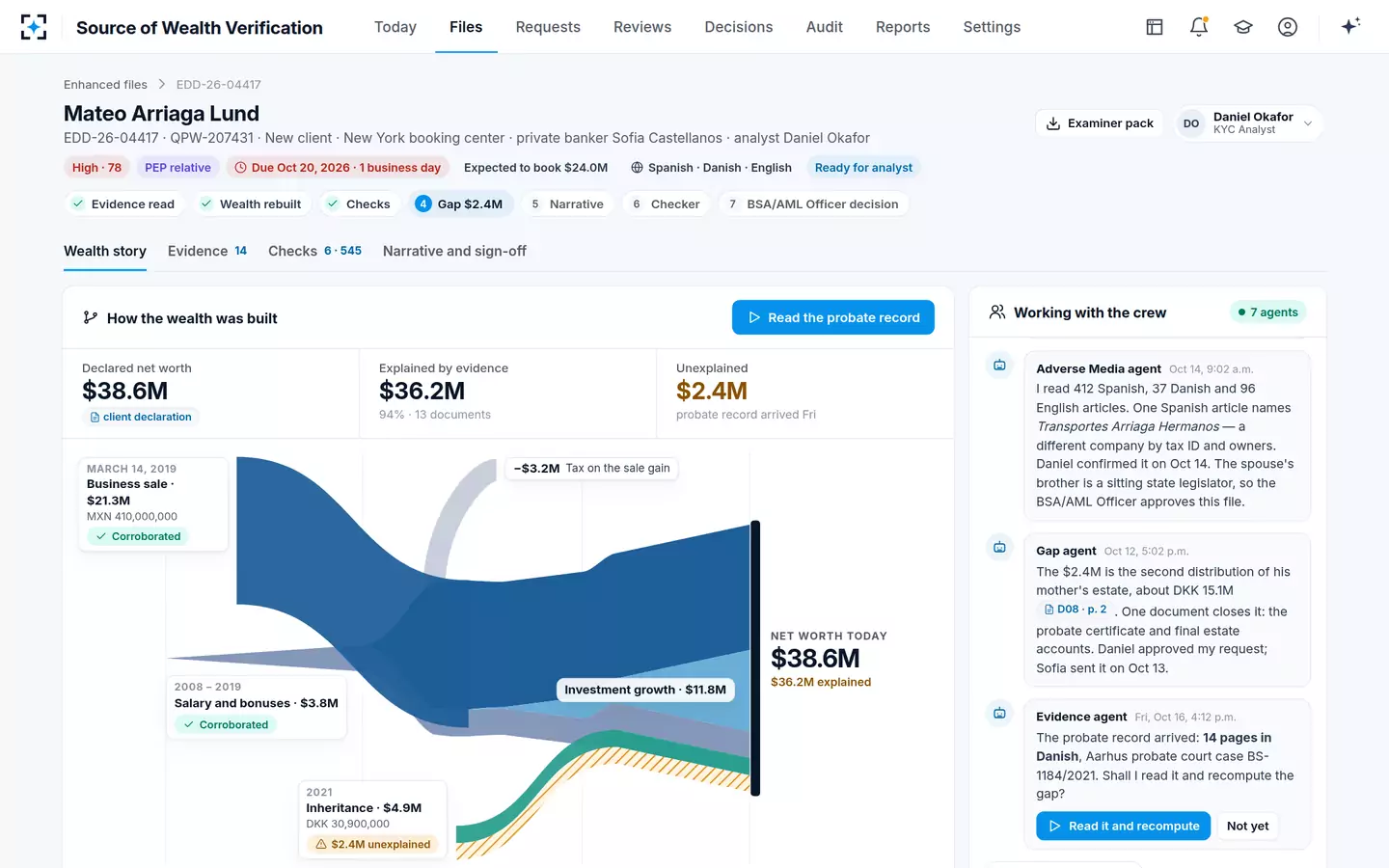
In the sample file, the client's declared $38.6 million is drawn as four streams; $36.2 million was explained by 13 documents, and $2.4 million of a Danish inheritance stayed hatched until the probate record arrived and was read. Nothing in that view depends on the analyst's prose. The Source of Wealth Verification page follows the same file to the BSA/AML Officer's decision.
Questions people ask
What is the MAS source of wealth circular?
MAS has issued two: Circular AMLD 08/2024 of 26 July 2024, "Establishing the Sources of Wealth of Customers", which set the materiality, prudence and relevance principles for wealth managers; and AMLD 05/2026 of 25 May 2026, on risk-proportionate source of wealth establishment, which lists excessive practices to avoid.
Which MAS paper covers source of wealth corroboration?
The October 2024 information paper, "AML/CFT Supervisory Expectations from Recent Inspections", section C. It sets the base set of information plus independent corroboration for politically exposed persons, private banking and high-net-worth wealth management, with worked principles for gifts, business ownership and dividend income.
Does MAS require source of wealth for every customer?
No. Notice 626 requires it for politically exposed persons and customers the bank assesses as higher risk, and the guidelines require independent corroboration for all private banking clients. MAS's 2026 circular warns against applying the same measures to every customer regardless of risk.
Were the July 2025 penalties only about source of wealth?
No. MAS found breaches in customer risk assessment, source of wealth, transaction monitoring and post-report follow-up. Source of wealth was the one area where all nine institutions fell short; transaction monitoring touched eight.
What is a composition penalty?
It is the amount paid when MAS compounds an offence rather than taking it further. MAS's release explains that each breach of its anti-money laundering notices is an offence with a maximum fine of S$1 million, and that these breaches were compounded under section 176(1A) of the MAS Act 1970 and section 177(1) of the Financial Services and Markets Act 2022.