A source of wealth checklist is the list of steps and evidence an analyst works through on a high-risk client's file: the declaration, the documents for each source of wealth, the independent corroboration, the source of funds, the screening, the narrative, the sign-offs. The checklist itself is easy to write. What makes it work is the policy behind each line: which evidence counts for an inheritance, how much unexplained wealth is tolerable, which clients get the file at all. Regulators have fined firms whose checklists said "enhanced" without saying what enhanced meant. Botminds' Source of Wealth Verification runs every enhanced file against a checklist, and the firm's answers to those policy questions are its settings. This page lists the eight inputs a firm should have ready before changing its source of wealth process, with or without software.
Rule texts are quoted from US, UK, EU and Singapore sources. Settings shown are the solution's fictional sample firm's.
Eight inputs to prepare before a source of wealth process goes live
- A corroboration standard for each kind of wealth
Business sale, inheritance, salary, property, investments, gifts, digital assets: the documents required and the independent source behind each.
- The triggers that open an enhanced file
By rule (private banking accounts, PEPs, high-risk countries) and by your risk score, with the threshold written as a number.
- A gap tolerance in money
How much unexplained wealth an analyst may leave without a request, and the rule for larger amounts.
- The escalation and cannot-complete routes
Who accepts residual risk; when the firm refuses, suspends, reports or closes.
- Named approvers for each decision
Who is senior management for which clients, and who checks; no one in two seats on one file.
- Review cycles and event triggers
Months between reviews by risk tier, and the inflows, news or status changes that open one early.
- Retention and residency rules
How long evidence is kept after the relationship ends, and where it is stored for each booking centre.
- A sample of past decided files
Closed high-risk files with their outcomes, to test the process and the settings before any live client.
Source of wealth checklist: why a list fails without standards behind it
A checklist that says what to do without saying what counts is the most common gap regulators find. The FSA's 2012 notice against Coutts described exactly this. Its written procedures included a table setting the verification standard for high-risk customers, but the table "stated only that due diligence should be enhanced for high risk customers, but it did not give any guidance to the private banker ... about the types of evidence to gather over and above the standard requirements". The checklist private bankers completed did not "contain any guidance regarding how the private banker should establish the customer’s source of wealth" (FSA Final Notice, Coutts & Company, 23 March 2012).
Policies without practical guidance, found three times in three regimes
57%
of Coutts' PEP and high-risk files opened in the period had insufficient enhanced due diligence (35 of 61)
7of 15
firms in the FCA's 2024 review without practical, detailed guidance for source of funds and wealth checks
S$1.8m
penalty on a trust company whose policies lacked "sufficient practical guidance" on establishing source of wealth
Twelve years later MAS made the same finding in Singapore. It reprimanded senior managers of a trust company whose policies gave staff too little practical guidance on how to establish a customer's source of wealth (MAS, 4 July 2025). In the UK, the FCA's 2024 review found seven of fifteen firms "did not have practical and detailed guidance to ensure they performed the SOF and SOW checks in line with a risk-based and proportionate approach". The lesson for a go-live is simple: write the standard before the checklist.
What corroboration standards should a firm write down?
One per kind of wealth, each naming the documents required and the independent source that corroborates them, scaled to materiality. MAS's 2024 circular gives the three principles to write them by: materiality, spending corroboration on the larger or riskier sources; prudence, preferring audited accounts and documents from independent third parties such as tax accountants; and relevance, accepting that some old documents are not needed (MAS Circular AMLD 08/2024). It also warns against writing one standard for every customer.
Source of Wealth Verification: corroboration standards and thresholds as settings
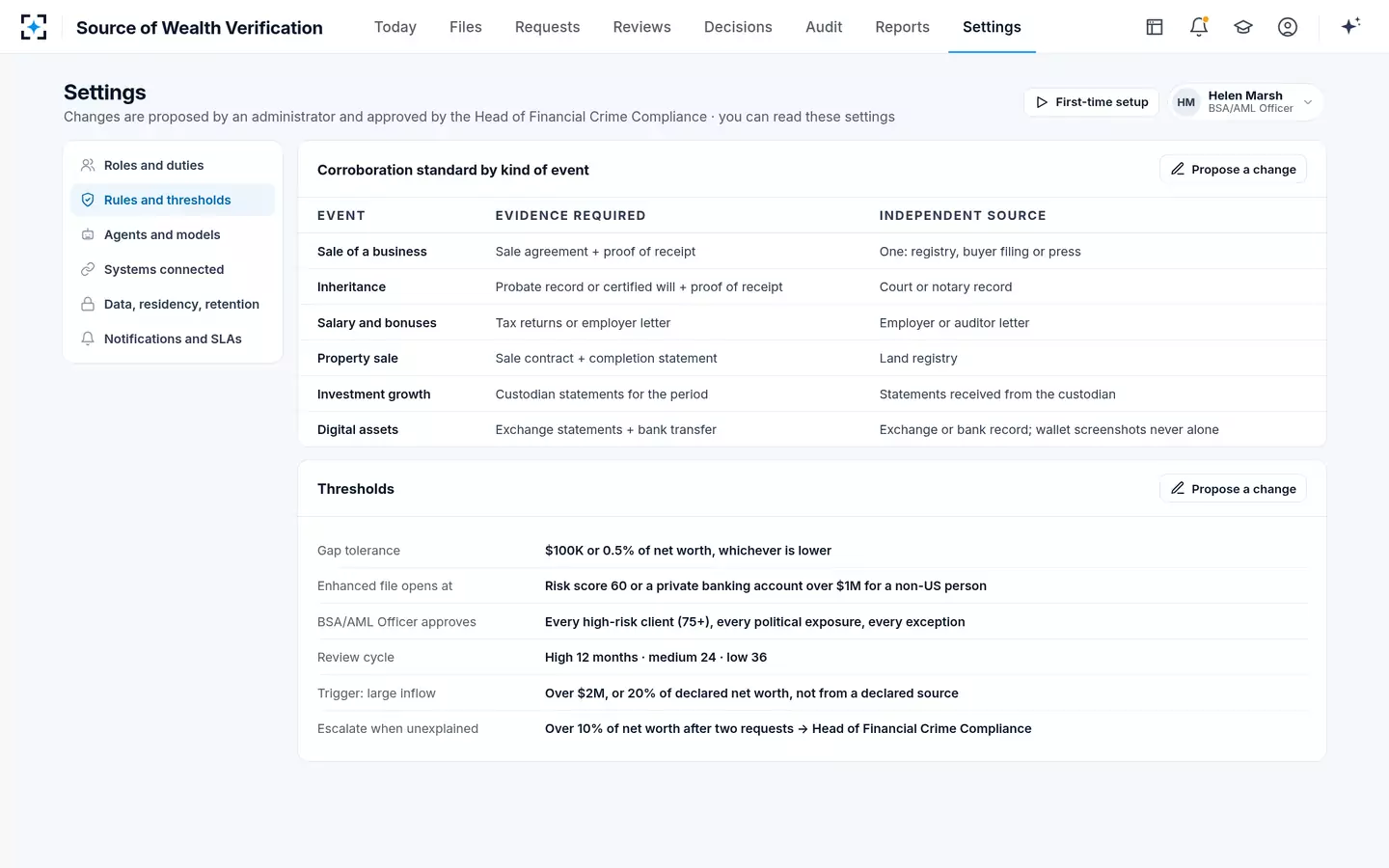
The sample firm's standards show the shape. A business sale needs the sale agreement and proof of receipt, plus one independent source: a registry, the buyer's filing, or the press. An inheritance needs the probate record or a certified will and proof of receipt, corroborated by a court or notary record. Digital assets need exchange statements and the bank transfer, and "wallet screenshots never alone". The source of wealth documents guide ranks the evidence for each kind of wealth.
What thresholds trigger an enhanced file?
Some triggers come from the rules and some from the firm's risk model; both should be written as conditions a system can test. The rule-based ones are specific. In the US, a private banking account is one requiring a minimum aggregate deposit of at least $1,000,000 for one or more non-US owners, managed through a liaison officer (31 CFR 1010.605(m)). In the UK, EU and Singapore, a politically exposed person, family member or close associate triggers source of wealth and funds measures. From July 2027, the EU adds a wealth-based trigger: higher-risk relationships handling at least EUR 5 million for a client with total assets of at least EUR 50 million (AMLR Article 34(5)).
Trigger, threshold and who sets it
| Trigger | Threshold | Set by |
|---|---|---|
| US private banking account | Not less than $1,000,000 minimum aggregate deposit; non-US owner; liaison officer | 31 CFR 1010.605(m) |
| Politically exposed person, family or close associate | Each regime's own definition and lists | UK MLR reg 35; EU AMLR Art 42; MAS Notice 626 para 8 |
| High-risk country | FATF call-for-action list (UK reg 33); FATF countermeasures (MAS 8.6(a)) | Rule, updated as FATF lists change |
| Very wealthy client, higher risk (EU, from July 2027) | EUR 50M total assets and EUR 5M handled through personalised services | AMLR Art 34(5) |
| Firm's risk rating | A score, e.g. 60 at the sample firm | The firm's risk model |
| Event during the relationship | e.g. inflow over $2M or 20% of declared net worth from an undeclared source | The firm's policy |
Gap tolerance, escalation and the cannot-complete route
Three numbers and one route turn "residual risk" into a procedure. The gap tolerance is the unexplained amount below which no request is sent; the sample firm's is $100,000 or 0.5% of net worth, whichever is lower. The escalation threshold is the amount above which the file leaves the analyst and approver: the sample firm sends anything over 10% of net worth still unexplained after two requests to its Head of Financial Crime Compliance. MAS's 2024 circular expects that where a firm cannot corroborate a significant part of a customer's wealth, senior management approves before the relationship starts.
The cannot-complete route is a legal requirement in US private banking: the program must include procedures for when due diligence cannot be performed: when to refuse the account, suspend activity, file a suspicious activity report or close the account (31 CFR 1010.620(d)). Write down who decides each of those outcomes. Who should hold each signature is set out in AML in wealth management: who signs.
"where an FI is unable to corroborate a significant portion of a customer’s wealth, the FI should escalate the case to its senior management for approval before establishing business relations with the customer"
MAS Circular AMLD 08/2024, paragraph 5(a), 26 July 2024
Source of wealth questionnaire: what the client is asked first
The questionnaire is the first input every file receives, so it belongs on the go-live list. It should ask for the client's wealth as a dated history, from the first capital to today, with each step naming the evidence that will prove it, rather than a set of boxes for asset types. MAS's base set of information asks for the seed money where it is relevant. The source of wealth declaration template sets out a version built that way. Before go-live, check that your questionnaire's fields map onto your corroboration standards: if the standard for an inheritance needs the date of death and the number of heirs, the questionnaire should ask for both.
How long should source of wealth evidence be kept?
At least five years after the relationship ends in the UK, the EU and Singapore; in the US, the private-banking rule sets no period of its own and the general record rules apply. The UK regulations require customer due diligence records to be kept for five years from when the firm knows or has reason to believe the business relationship has ended, and then require the firm to "delete any personal data" unless an exception applies (MLR 2017, regulation 40). The EU rule's period is "5 years commencing on the date of the termination of the business relationship" (AMLR Article 77). MAS Notice 626 requires "at least 5 years following the termination of such business relations" for due diligence information and analysis (paragraph 12.3). A US broker-dealer's identity verification records under its customer identification program run for five years after the account closes (31 CFR 1023.220).
Two practical points follow. Retention starts when the relationship ends, so a client of twenty years needs evidence from year one kept for twenty-five. And the UK's deletion duty means "keep everything forever" is not a safe default. The sample firm keeps data in its booking centre's region and for five years after the relationship ends.
What past files are needed to test a new process?
A sample of high-risk files the firm has already decided, with their evidence and their outcomes, including some it declined and some with a gap it accepted. Running the new process on them answers the questions a pilot cannot: does it reach the same decisions, does it find gaps the original file missed, does it ask for documents the original never needed? The solution's first-time setup tests the agents on 40 files the firm already decided before any live client, and every later change to a threshold is re-tested on past decided files before it goes live.
Choose the files for difficulty, not convenience: foreign-language evidence, inheritances and gifts, a politically exposed person, a digital-asset stream, at least one decline. Score each on the five corroboration measures before and after; the differences are the evidence for the go-live decision.
From settings to the first live file
The go-live order matters more than its length: settings first, tested on the past, approved by the person who owns the policy, then live. The sample firm's sequence is below; the same order applies to a manual process.
From written settings to the first live file in Source of Wealth Verification
A person decides
Administrator proposes the settingsCorroboration standards, gap tolerance, triggers, review cycles, approvers and retention, entered from the firm's policy.
Never: approve their own change
A person decides
Head of Financial Crime Compliance approvesSigns off each setting with the policy version it implements.
Agent
Agents run on 40 decided filesRead the evidence, rebuild each wealth history, test it and size the gaps, as they would on a live file.
Never: decide; they score and draft as on a live file
A person decides
Team compares with the original decisionsReviews every difference: gaps the original file missed, requests it never needed, decisions that would change.
A person decides
Head of Financial Crime Compliance approves go-liveGoing live needs this approval; the first live files run with maker, checker and approver as usual.
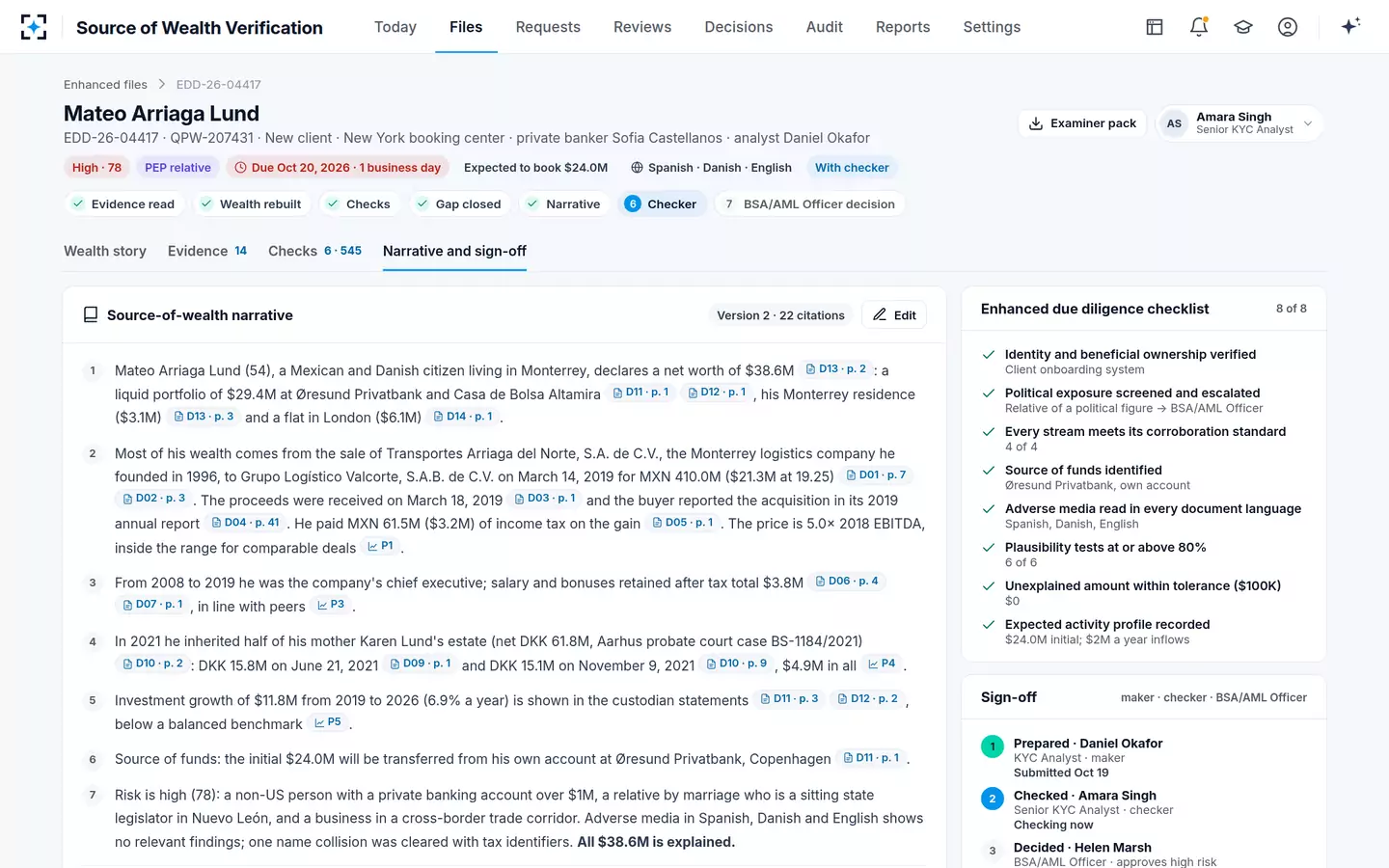
The checklist on a live file: eight lines, each tied to a setting
Questions people ask
What should a source of wealth checklist include?
The client's declaration; documents for each material source of wealth to the firm's standard; independent corroboration of the material sources; the source of funds for the initial deposit; screening and adverse media; plausibility tests; the unexplained amount against tolerance; the narrative; and the maker, checker and approver sign-offs.
How often should source of wealth be reviewed?
By risk tier, and on events. From July 2027 the EU caps the gap between updates at one year for higher-risk customers under enhanced measures and five years for others. The solution's sample firm reviews high-risk clients every 12 months, medium every 24 and low every 36, and opens a review early on large inflows, adverse media or a change in political exposure.
Do we need software to run a source of wealth checklist?
No. The eight inputs on this page are policy, and a firm can run them on paper. Software helps when volume, languages and the size of each file make the mechanical work, reading, re-keying and drafting, the bottleneck; pricing one past file line by line shows whether it is, and the Source of Wealth Verification page shows the work on a full sample file.
Who should own the source of wealth standards?
The head of financial crime compliance or the equivalent officer, with changes approved by a second person and tested before they apply. MAS's 2024 information paper asks senior management to exercise close oversight of gap assessments against its expectations and of the follow-up.
Should the checklist be the same for every client?
The lines can be, the depth should not. MAS's 2026 circular tells firms to avoid "a one-size-fits-all approach to establishing a customer’s SOW", and FCA FG25/3 scales the steps from less intrusive for lower-risk clients to more exhaustive for higher-risk ones.