Source of wealth requirements differ by jurisdiction more than most procedures admit. In the United States, the private-banking rule under section 312 of the USA PATRIOT Act requires firms to ascertain the source of funds, not wealth, for accounts of at least $1 million held for non-US persons. In the United Kingdom, the Money Laundering Regulations 2017 require firms to establish both source of wealth and source of funds for politically exposed persons and some high-risk countries. The EU's new single rulebook does the same for politically exposed persons from 10 July 2027. Singapore's MAS requires both for politically exposed persons and any higher-risk customer, and expects independent corroboration in private banking. A firm with clients booked in New York, London and Singapore therefore runs one file to three standards at once. Botminds' Source of Wealth Verification is built for that file: it holds the firm's standards as settings and shows, for each client, which evidence the strictest applicable rule needs.
Every rule below is quoted from the regulator's or legislator's own text, as published on 28 October 2026.
Source of wealth requirements in four rulebooks, side by side
United States
31 CFR 1010.620 (USA PATRIOT Act s. 312)
Who it coversPrivate banking accounts: $1M minimum, non-US owners, a liaison officer. Banks, broker-dealers, futures firms, mutual funds; investment advisers from 1 Jan 2028
What must be establishedSource(s) of funds, purpose and expected use; owners; senior foreign political figures
Standard"Reasonable steps"; enhanced scrutiny for proceeds of foreign corruption
United Kingdom
Money Laundering Regulations 2017, regs 33 and 35; FCA FG25/3
Who it coversPEPs, their family and close associates; customers in FATF call-for-action countries; other high-risk cases
What must be establishedSource of wealth and source of funds
Standard"Adequate measures", scaled to risk under FG25/3
European Union
Regulation (EU) 2024/1624, Arts 34 and 42, from 10 July 2027
Who it coversPEPs; other higher-risk relationships; very wealthy clients served personally
What must be establishedSource of wealth and funds for PEPs; may be required for other high risk; more on source of funds above EUR 50M
Standard"Adequate measures"; AMLA guidelines due by 10 July 2027
Singapore
MAS Notice 626 paras 8.3 and 8.7, with its Guidelines
Who it coversPEPs and any customer the bank assesses as higher risk; all private banking
What must be establishedSource of wealth and source of funds of the customer and beneficial owners
Standard"Appropriate and reasonable means"; independent corroboration for private banking
Which rules set source of wealth requirements, and which only ask for funds?
Three of the four regimes name source of wealth in their rule text; the United States names only source of funds. That difference is deliberate. FinCEN's 2002 proposal for the private-banking rule would have asked for owners' lines of business and sources of wealth; its January 2006 final rule dropped the words because the statute does not use them, while noting that due diligence will often still look at both (the preamble's own words are quoted in source of wealth vs source of funds; 71 FR 496). The difference in vocabulary is unpacked in source of wealth vs source of funds; this page is about scope, triggers and dates.
The regimes also differ in who is caught. The US rule is narrow: one kind of account, at listed kinds of institution. The UK, EU and Singapore rules are wide: they follow the customer's risk, so any firm subject to them must apply source-of-wealth measures wherever a client is a politically exposed person or otherwise high risk, whatever the account type.
What is section 312? The US private banking rule
Section 312 of the USA PATRIOT Act requires special due diligence for correspondent accounts and for private banking accounts held for non-US persons; FinCEN implements the private-banking half at 31 CFR 1010.620. A covered institution must maintain a due diligence program "reasonably designed to detect and report any known or suspected money laundering or suspicious activity conducted through or involving any private banking account that is established, maintained, administered, or managed in the United States" (1010.620(a)). The program is part of the firm's anti-money laundering program, not a separate one.
The rule applies to the institutions FinCEN lists for it: banks required to have an anti-money laundering program, registered broker-dealers, futures commission merchants and introducing brokers, and mutual funds (1010.605(e)(1)). Registered investment advisers are not on that list today. They will be from 1 January 2028, as below.
Private banking account definition: three tests, all of which must be met
An account is a private banking account under US rules only if it meets all three tests in 31 CFR 1010.605(m). It "Requires a minimum aggregate deposit of funds or other assets of not less than $1,000,000"; it "Is established on behalf of or for the benefit of one or more non-U.S. persons who are direct or beneficial owners of the account"; and it "Is assigned to, or is administered or managed by, in whole or in part, an officer, employee, or agent of a covered financial institution acting as a liaison" between the firm and the owner. "Any combination of accounts" counts, so a relationship split across several accounts can still meet the $1 million test.
The definition leaves out much of what a wealth manager would call private banking: US persons, relationships without a required minimum, accounts with no dedicated relationship officer. The 2020 interagency statement on politically exposed persons acknowledged the gap, noting that "some banks have wealth management accounts that fall outside of the definition of “private banking account” but may still pose a higher risk of illicit financial activity", and that the usual customer due diligence and suspicious activity rules still apply to them (joint statement, 21 August 2020).
31 CFR 1010.620, clause by clause
The rule has four minimum requirements and two special ones, and every one of them is about funds, owners and conduct rather than wealth.
What 31 CFR 1010.620 requires, in its own words
| Clause | The rule says | What it means for the file |
|---|---|---|
| (b)(1) | "Ascertain the identity of all nominal and beneficial owners of a private banking account" | Every owner, not only the account holder, enters the file |
| (b)(2) | "Ascertain whether any person identified under paragraph (b)(1) … is a senior foreign political figure" | Screening of every owner for political exposure |
| (b)(3) | "Ascertain the source(s) of funds deposited into a private banking account and the purpose and expected use of the account" | Source of funds, purpose and expected activity, recorded at opening |
| (b)(4) | "Review the activity of the account to ensure that it is consistent with the information obtained about the client's source of funds" | Monitoring against the declared sources and expected use |
| (c) | "enhanced scrutiny … reasonably designed to detect and report transactions that may involve the proceeds of foreign corruption" | Applies where a senior foreign political figure is an owner |
| (d) | Procedures for when due diligence cannot be performed, "including when the covered financial institution should refuse to open the account, suspend transaction activity, file a suspicious activity report, or close the account" | A written route for the file that cannot be completed |
Clause (d) is the one most procedures under-write. It requires the firm to decide in advance what happens to a file it cannot complete, and who decides; who signs the source of wealth file covers that chain. For broker-dealers, the SEC's examinations division says its fiscal 2027 reviews will look at whether firms are "conducting ongoing customer due diligence" (SEC, FY2027 examination priorities, 23 October 2026).
Does the investment adviser AML rule apply yet?
No. FinCEN's anti-money laundering rule for registered investment advisers and exempt reporting advisers, published on 4 September 2024, now takes effect on 1 January 2028. FinCEN moved the date by a final rule of 31 December 2025, extending it "from January 1, 2026, until January 1, 2028" (91 FR 36, 2 January 2026). When it applies, advisers must "implement special due diligence measures for correspondent and private banking accounts", and FinCEN said the private-banking test is met "where an investment adviser manages more than the minimum aggregate deposit of funds for a customer (which may be a private fund or another type of customer)" (89 FR 72156).
FinCEN gave itself the two years partly to review the rule and to "ensure the IA AML Rule is effectively tailored" to advisers' business models; commenters asked specifically for guidance on "the application of the Section 312 special due diligence requirements". Separately, on 10 April 2026 FinCEN proposed to "fundamentally reform" the anti-money laundering program rules for all financial institutions; that is a proposal, not a rule. An adviser planning for 2028 should design its private-banking file now and expect the details to move.
The dates a global source of wealth procedure has to carry
2006
US private-banking due diligence rule in force for new accounts (5 July)
31 CFR 1010.620(e)
2026
MAS circular on risk-proportionate source of wealth establishment (25 May)
AMLD 05/2026
2027
EU Regulation 2024/1624 applies, including Article 42 on PEPs (10 July)
Art 90
2028
US investment advisers come under the AML rule, including private-banking due diligence (1 January)
91 FR 36
Source of wealth requirements in the UK: the regulations and FG25/3
In the UK, the requirement sits in two regulations. For politically exposed persons, their family members and known close associates, regulation 35(5)(b) requires firms to "take adequate measures to establish the source of wealth and source of funds which are involved in the proposed business relationship or transactions with that person", in addition to senior management approval and enhanced ongoing monitoring (MLR 2017, reg 35). For a business relationship with a person established in a country on the FATF's call-for-action list, regulation 33(3A)(c) requires "obtaining information on the source of funds and source of wealth of the customer and of the customer’s beneficial owner" (reg 33). Regulation 33 also lists private banking among the product risk factors firms must weigh.
How much evidence is "adequate" is the FCA's guidance, now FG25/3, which replaced FG17/6 in July 2025. It scales the work to risk. In lower-risk cases a firm may "only use information already available to the institution (such as transaction records or publicly available information) and do not make further inquiries of the individual unless anomalies arise", but "It is necessary to seek source of wealth information." In higher-risk cases it expects deeper and more thorough steps to establish both sources (FCA FG25/3). The PEP obligations continue for at least 12 months after a person leaves office (reg 35(9)). How senior management approval works under FG25/3 is covered in PEP Screening's guide to PEP senior management approval.
The EU from 10 July 2027: Articles 34 and 42
The EU's Anti-Money Laundering Regulation replaces national transpositions with one directly applicable text, and it applies "from 10 July 2027" (Regulation (EU) 2024/1624, Article 90). For politically exposed persons, Article 42(1)(b) requires firms to "take adequate measures to establish the source of wealth and source of funds that are involved in business relationships or occasional transactions with politically exposed persons". For other higher-risk cases, Article 34(4) lists measures enhanced due diligence "may include", among them "obtaining additional information on the source of funds, and source of wealth of the customer and of the beneficial owners".
Article 34(5) is new and aimed squarely at wealth management. Where a higher-risk relationship involves handling "assets with a value of at least EUR 5 000 000" through personalised services for a customer holding "total assets with a value of at least EUR 50 000 000", excluding the private residence, credit and financial institutions must apply further measures, including "obtaining additional information on that customer’s source of funds". The new EU authority, AMLA, must issue guidelines by 10 July 2027 on how to establish whether a customer reaches EUR 50 million. Article 26 caps the time between updates of customer information at one year for higher-risk customers under enhanced measures.
Singapore: MAS Notice 626 and its guidelines
MAS Notice 626, for banks, requires that for a politically exposed person, family member or close associate the bank "establish, by appropriate and reasonable means, the source of wealth and source of funds of the customer and any beneficial owner of the customer" (paragraph 8.3(b)), and extends the same measures to any customer the bank assesses as presenting a higher risk (8.7) (MAS Notice 626, last revised 30 June 2025). Domestic and international-organisation politically exposed persons may be treated on a risk basis unless the relationship is higher risk (8.4).
The guidelines to the notice turn this into an evidence standard. A bank "should corroborate the information regarding source of wealth and source of funds", focusing on the sources "more material and/or present a higher risk", and for private banking, "regardless of the bank’s internal risk classification of the customer", source of wealth information "should be independently corroborated against documentary evidence or public information sources" (Guidelines to MAS Notice 626, 8-5-7 and 8-6-4). That is the strictest of the four standards, and the one a global private bank's procedure usually ends up written to. What MAS found when it inspected, and fined, is in MAS source of wealth.
When is source of wealth required for a PEP?
In the UK, EU and Singapore, for every politically exposed person, family member and close associate, at a depth that varies with risk; in the US, only through the private-banking rule's enhanced scrutiny of senior foreign political figures, and otherwise by the firm's own risk assessment. The US agencies said in 2020 that the term does not, in their reading, cover US public officials, and that the customer due diligence rule creates no requirement "for banks to have unique, additional due diligence steps for PEPs".
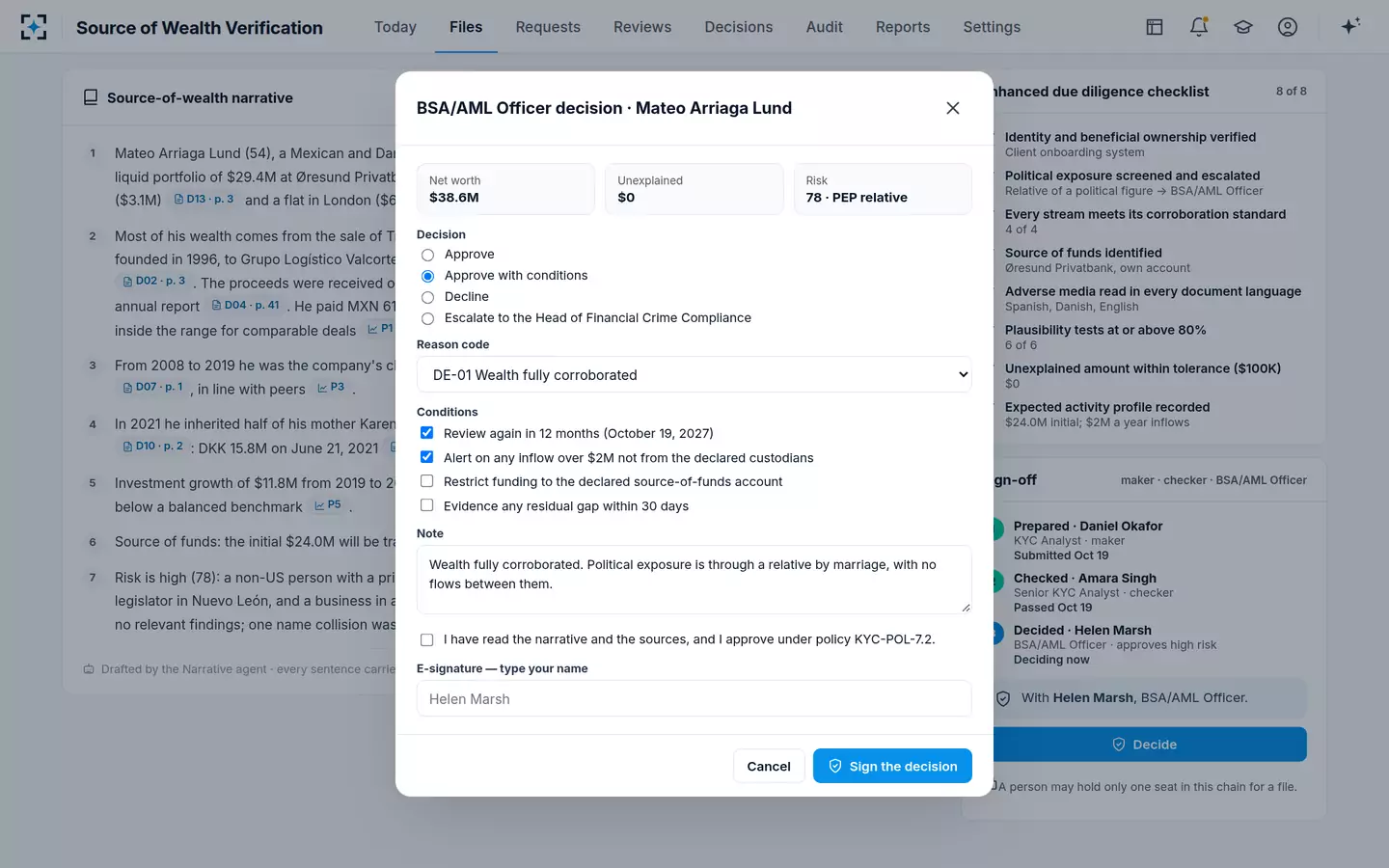
The definitions of who is caught also differ, and the solution's sample client shows how. His wife's brother holds elected office in a Mexican state. The US definition of a senior foreign political figure's immediate family reaches in-laws: a spouse's parents, brothers and sisters (1010.605(p)), though whether a state legislator is a "senior official" with "substantial authority over policy" is a judgement the firm has to make. The UK regulations define a PEP's family as a spouse or partner, children and their spouses, and parents: a brother-in-law is not on that list. The sample firm's policy sends any political exposure to its BSA/AML Officer, whichever rule it falls under.
One file, decided by the BSA/AML Officer with the political exposure stated
Writing one procedure to the strictest rule that applies
A firm with clients across these regimes needs one procedure with per-client triggers, not four procedures. The strictest elements stack: the US rule's narrow trigger and its refuse-or-close route; the UK and EU requirement to establish both wealth and funds for politically exposed persons; Singapore's expectation of independent corroboration in private banking; the EU's one-year ceiling between updates for higher-risk clients. A client booked in New York who is resident in Singapore and holds a London account will meet several of these at once.
Building one source of wealth procedure for several jurisdictions
- List every trigger by rule
Private banking account under 1010.605(m); PEP, family or associate under each regime's own definition; high-risk country; higher-risk rating; very wealthy clients under AMLR Article 34(5).
- Set what must be established per trigger
Funds only, or wealth and funds. Write it per trigger, not per booking centre.
- Write the evidence standard per kind of wealth
At the strictest level that applies: for private banking, independent corroboration of material sources.
- Set the gap tolerance and who accepts residual risk
In money, with the approver named. MAS expects senior management where a significant portion cannot be corroborated.
- Write the cannot-complete route
Refuse, suspend, report or close, as 1010.620(d) requires, and who decides.
- Set review cycles to the shortest ceiling
The EU caps higher-risk updates at one year from July 2027.
- Date every rule in the procedure
EU from 10 July 2027; US advisers from 1 January 2028; UK wording amended 30 June 2026.
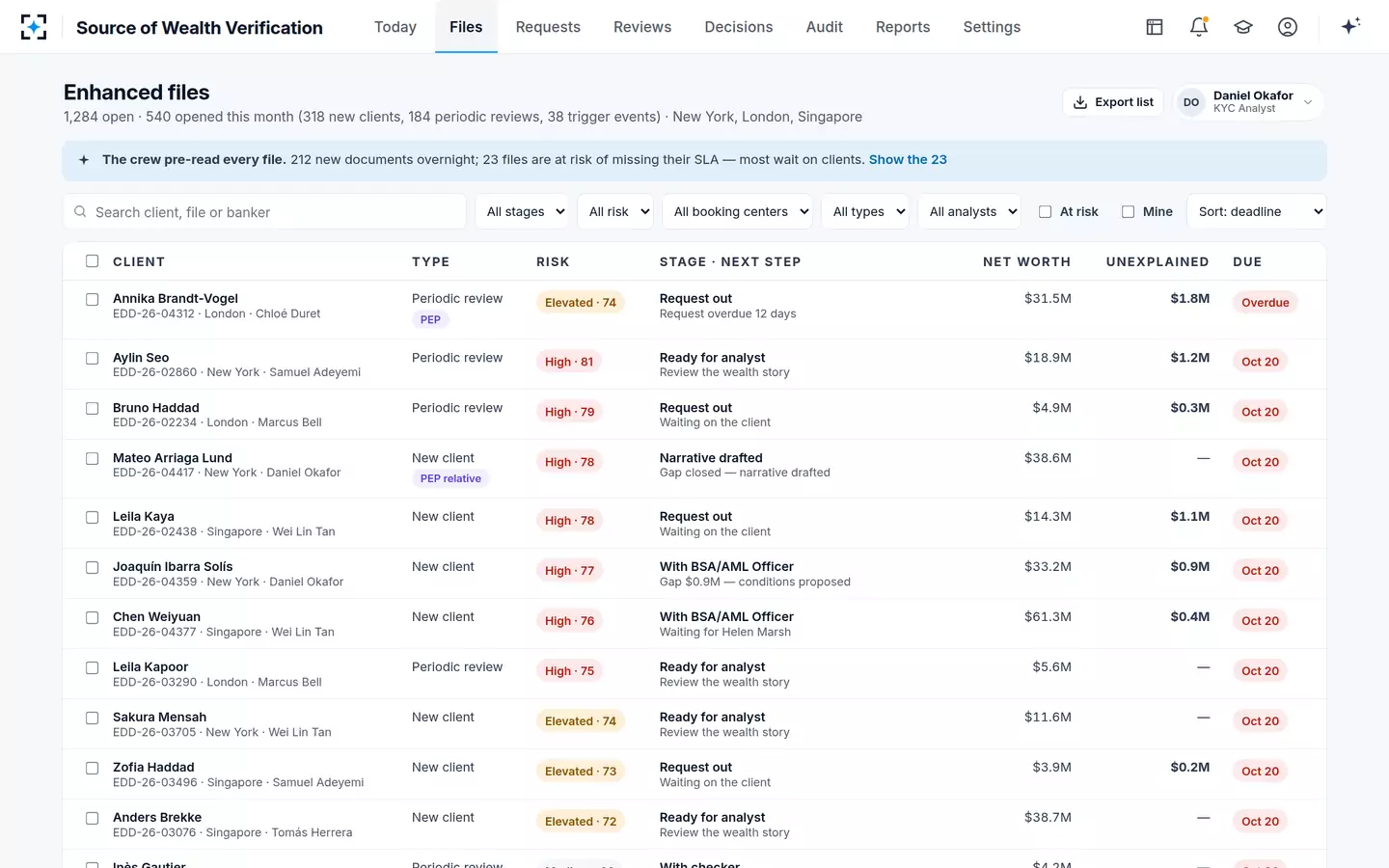
In Source of Wealth Verification, those choices are settings: the corroboration standard for each kind of wealth, the gap tolerance, when an enhanced file opens, review cycles and triggers, each changed by an administrator and approved by the Head of Financial Crime Compliance. The fictional firm's files run across New York, London and Singapore booking centres from one queue.
Enhanced files from three booking centres in one queue
Questions people ask
Is source of wealth a legal requirement in the US?
Not in those words. 31 CFR 1010.620 requires source of funds for private banking accounts of non-US persons, and FinCEN removed "sources of wealth" from the rule text in 2006, while noting that due diligence may often include a review of sources of wealth. Firms' own risk-based programs commonly ask for it in higher-risk cases.
Does 1010.620 apply to US citizens' accounts?
No. A private banking account under 1010.605(m) must be held on behalf of or for the benefit of one or more non-US persons. Wealth accounts for US persons fall under the general customer due diligence and suspicious activity rules, which the 2020 interagency statement said still apply.
When do EU source of wealth rules change?
Regulation (EU) 2024/1624 applies from 10 July 2027. From then, Article 42 requires source of wealth and funds for politically exposed persons across the EU in one text, and Article 34(5) adds measures for higher-risk relationships with clients holding at least EUR 50 million.
What is the difference between FG17/6 and FG25/3?
FG25/3, published in July 2025, replaced FG17/6 as the FCA's guidance on politically exposed persons. It keeps the risk-based approach to source of wealth and funds, starts UK politically exposed persons at lower risk as the regulations now require, and allows sign-off at a lower level of seniority in lower-risk cases.
Do MAS source of wealth rules apply to wealth managers that are not banks?
Yes. MAS's July 2025 enforcement release lists parallel notices for merchant banks (Notice 1014), capital markets intermediaries (SFA04-N02) and licensed trust companies (TCA-N03), and penalised firms under each. MAS's 2024 and 2026 circulars on source of wealth were addressed to all financial institutions.