A source of wealth declaration template is the form a private bank or wealth manager gives a high-risk client to set out, in their own words, how they acquired their wealth. Most templates are a list of boxes: employment income, business sale, inheritance, investments, other, each with an amount. That shape collects the client's assets and loses their history, which is the thing the firm has to verify. A better template asks for a dated timeline that starts with the first capital, the seed money, and runs to today's net worth, with each step naming the document that will prove it. Then the declaration becomes a plan for the file rather than a summary of it. Botminds' Source of Wealth Verification starts every enhanced file from the client's declaration and treats it as exactly that: a hypothesis, never evidence, to be tested stream by stream.
The template on this page is our own and its example is fictional. Regulatory text is quoted from MAS, the FCA, FinCEN and FINRA.
A declared wealth history from seed money to today, each step with its planned evidence
- Seed money1992–96
- Building the business1997–2015
- Sale of 70%2016–21
- Last 30% sold2022–26
What is a source of wealth declaration?
A source of wealth declaration is the client's own account of how they came to own what they own, usually signed, given to the firm at onboarding and at reviews. Regulators treat it as the starting point, not the answer. MAS calls it the base set of source of wealth information and wants the seed money in it where relevant, then corroborated it independently for politically exposed persons, private banking and wealth management clients (MAS, AML/CFT Supervisory Expectations from Recent Inspections, October 2024). The FCA's definition of what it describes is short: how the customer came to have all of their wealth.
"Minimally obtaining a base set of SOW information from the customer, including details on seed money. FIs should document and make a reasonable assessment of the customer’s representations."
MAS, AML/CFT Supervisory Expectations from Recent Inspections, October 2024, section C
The phrase that matters is "make a reasonable assessment of the customer’s representations". A declaration is something to be assessed. The solution's Wealth History agent has the rule written into its limits: "A declaration is never corroboration".
Why a list of asset boxes fails as a declaration
A list of boxes tells the firm what the client owns and roughly where it came from, but not when, in what order, or from what starting point, and those are the facts that can be checked. MAS's guidelines are explicit that source of wealth is about how the customer and any beneficial owner acquired the wealth, not a list of what they own (Guidelines to MAS Notice 626, 8-5-5).
Two ways to ask the same client about their wealth
A box per asset type: Amounts under employment, business, inheritance, investments, other.
A dated history: Each event that added wealth, in order, from the first capital to today.
A box per asset type: Order, dates, the starting point, and whether the parts can add up.
A dated history: Little that matters; the client may still leave an event out.
A box per asset type: Whether each box has a document.
A dated history: Whether each step had the means to happen, given the steps before it.
A box per asset type: None: the analyst must work out which documents to ask for.
A dated history: Each row names its evidence and who holds it.
A box per asset type: A new set of boxes, hard to compare with the old.
A dated history: New rows added to the same history; changes stand out.
A history is testable in a way a list is not. If a client says a company was founded in 1992 with savings and sold in 2016 for $18 million, the firm can ask whether the savings were plausible, whether the company's accounts show a business worth that, and whether the buyer's records agree. MAS's 2020 paper on private banking described this as good practice: for owners of a car distributorship founded more than 30 years earlier, a bank obtained the company's financial statements, researched market share and vehicle sales over the period, validated profit assumptions against industry benchmarks, and "Documented the BOs’ journey to wealth based on detailed calculations" (MAS, September 2020).
What is seed money in source of wealth?
Seed money is the capital that generated the rest of the wealth: the savings, loan, gift or inheritance that funded the first business or the first investment. MAS's guidelines include it in the definition: source of wealth covers everything the customer owns, including the seed money that later wealth grew from and any gifts or other assets received (the definitions are compared in source of wealth vs source of funds). Starting a declaration there matters because a history that begins with a business already worth millions has skipped the step where illicit money is easiest to introduce and hardest to see later.
Seed money is also where the evidence is thinnest, because it is oldest. The firm needs a plausible account, not necessarily a document from 1992: a loan from parents can be supported by the parents' circumstances, a first salary by public records of the role. MAS's 2024 circular accepts that some old documents can no longer be found easily, and asks firms to focus corroboration on the material and higher-risk sources. A small, plausible seed with a well-evidenced history after it is a stronger file than a large, unexplained one.
The template: a dated timeline, step by step
The template below has six parts. Part C, the history, is the core; the others tie it to today's assets and to the money arriving. It works as a form, a guided interview, or a document a relationship manager completes with the client and the client signs.
A source of wealth declaration template in six parts
A
Summary
Declared net worth today, in one currency, with the date; how much is liquid; where it is held.
B
Seed money
The first capital: amount, year, where it came from (savings, a loan, a gift, an inheritance) and who can confirm it.
C
The history, step by step
One row per event that added or removed wealth: date, event, amount in the original currency, the evidence that will prove it, and who holds that evidence.
D
Today, reconciled
What is owned now, where, and which step of the history paid for it. The total should equal Part A.
E
Source of funds for this account
The amount to be deposited, the account it will come from, and the step in Part C that filled that account.
F
Declaration and update
The client confirms the history is complete and accurate, and agrees to tell the firm of material changes.
Part C, filled in: the history of the fictional declarant
| Date | Event | Amount | Evidence that will prove it | Held by |
|---|---|---|---|---|
| 1992 | Savings from employment, plus a loan from parents | USD 60,000 | Loan agreement; bank statement showing the first deposit into the company | Declarant; former bank |
| 1992–2016 | Salary and dividends from the distribution company | USD 4.1 million after tax | Tax returns; audited company accounts | Declarant; tax authority; auditor |
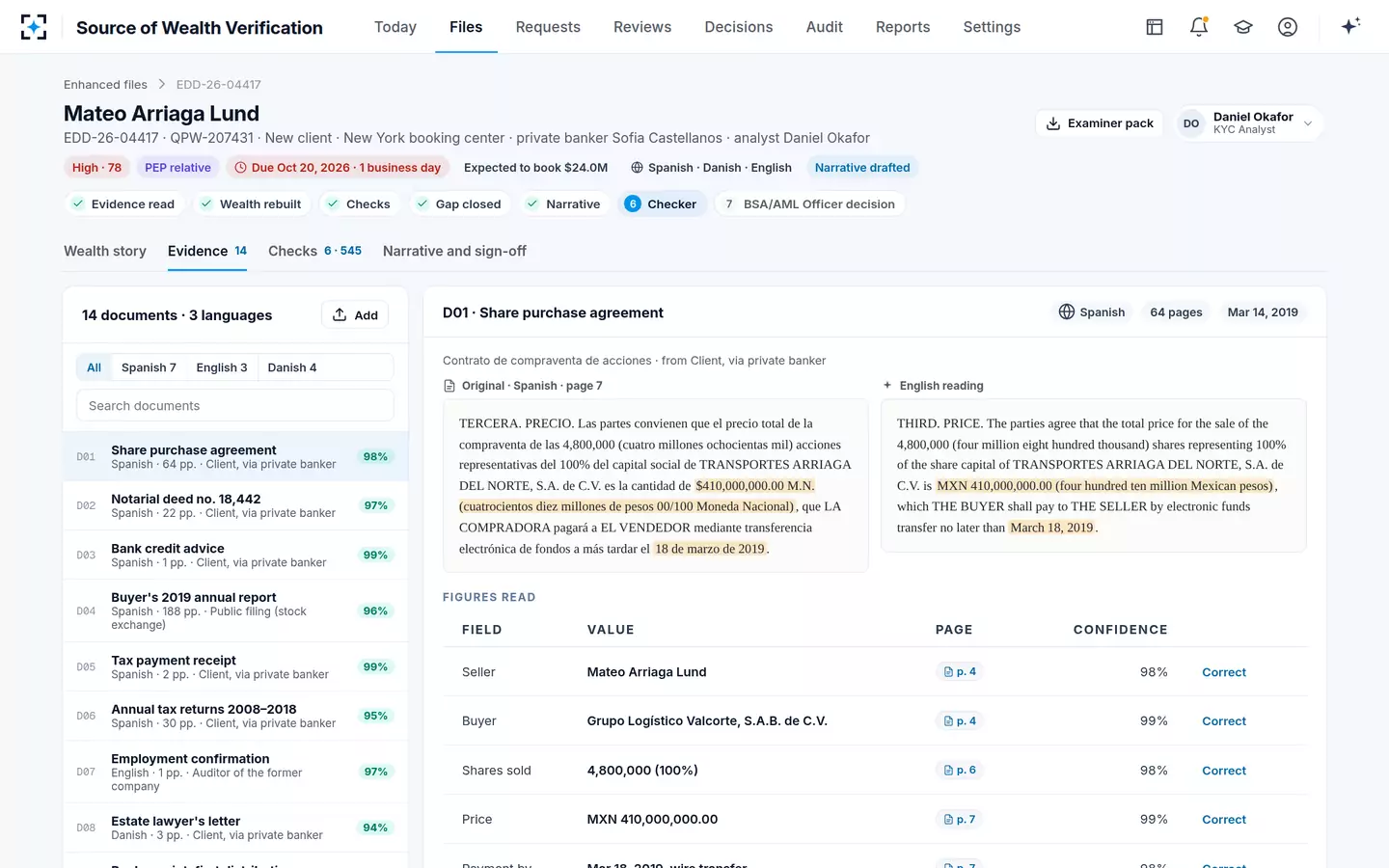
| 2016 | Sale of 70% of the company to a listed buyer | USD 18.0 million | Share purchase agreement; bank advice for the proceeds; buyer's annual report | Declarant; bank; buyer's public filing |
| 2016–2026 | Investment growth on the proceeds | USD 6.5 million | Statements sent by the custodian | Custodian |
| 2022 | Sale of the remaining 30% | USD 7.2 million | Sale agreement; bank advice; registry extract | Declarant; bank; corporate registry |
| 2016–2026 | Less: tax on the sales, property purchase | (USD 4.8 million) | Tax assessments; conveyancing documents | Tax authority; land registry |
How detailed should a source of wealth declaration be?
Detailed enough to name each material event with a date, an amount and its evidence; no more. Materiality is the regulators' test both ways. MAS wants firms to "Obtain information on customer’s entire body of wealth" and then to concentrate on the material and higher-risk sources. The FCA, for lower-risk politically exposed persons, wants firms to "minimise the amount of information they collect" while still asking about source of wealth (FCA FG25/3). In practice, a history of five to ten rows covers most clients; a client who has been wealthy for a long time or made money in several countries will need more.
Two details make the difference in review. Amounts should be in the original currency with the date, because that is how the evidence will show them; the firm converts. And each row should say who holds the evidence, which tells the firm whether to ask the client or look it up. MAS's 2024 circular notes that firms may use "credible public sources" to support their assessment "without having to rely on customers to provide corroborative evidence".
Should the client sign the declaration?
Usually yes, though none of the rules quoted here requires a signature. A signed declaration fixes what the client said, when, which gives the firm a baseline for later comparison and makes a misstatement clearly the client's. FINRA lists among suspicious-activity red flags that a customer's information "is false, misleading or substantially incorrect" (FINRA Regulatory Notice 19-18); a signed history is what shows that it was.
A signature does not make the declaration evidence. MAS's 2020 paper put it in one line, listing as a principle that it is "Inappropriate to rely solely on clients’ representations", and the case it criticised most was a bank that took a customer's word for his net worth without a single document or independent fact to support it (MAS, September 2020). The client signs Part F; the file still has to prove Part C.
Testing the declaration against the evidence
Testing a declaration means turning each row into a stream, attaching its evidence, and reconciling the streams to the declared total. Each row is then corroborated, partly corroborated with the open amount stated, or unexplained. In the solution's sample file, the client declared $38.6 million in four streams: a 2019 business sale, salary from 2008 to 2019, a 2021 inheritance and investment growth, less tax on the sale. Thirteen documents explained $36.2 million; $2.4 million of the inheritance waited for a Danish probate record, which closed it.
Source of Wealth Verification: the declared total, drawn as the streams that built it
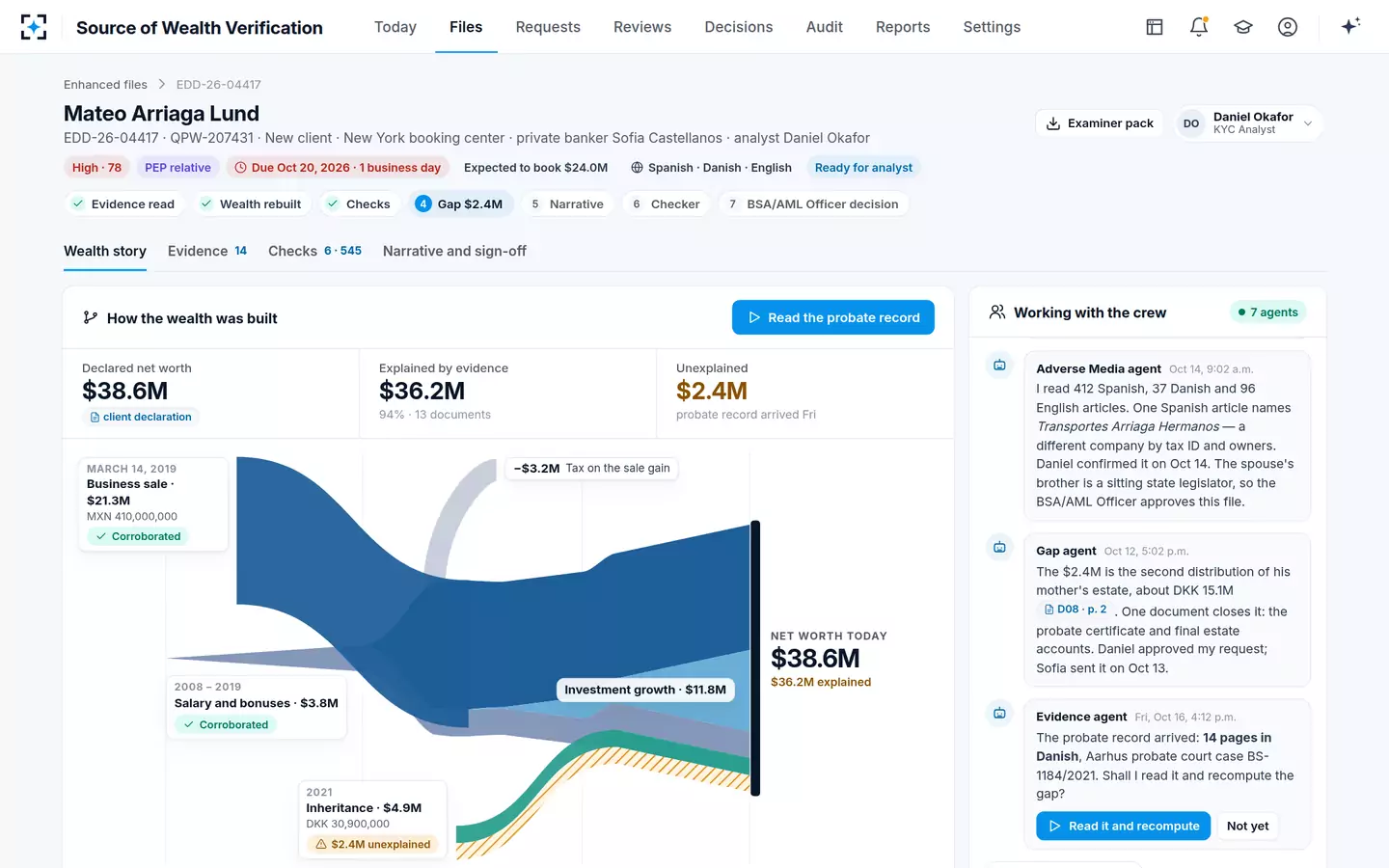
Testing also catches what the declaration leaves out. A custodian statement showing inflows no row explains, or a registry showing a company the history never mentions, is a gap in the declaration rather than in the evidence, and the right response is to ask about the event, not for more documents. The source of wealth documents guide covers the evidence for each kind of row, and corroboration how to measure whether the file holds up.
Each row's evidence, read in its own language and cited to the page
When the declaration goes stale
A declaration describes a moment, and a client's life moves on. FinCEN's August 2026 consent order against UBS Financial Services describes a client onboarded in 2008 whose recorded source of wealth was "an inherited retirement account and his employment as a professor" in the US. He moved to Russia in 2013 and joined a government-supported university, did not tell the firm, and remained rated low risk, so he had no periodic reviews: the firm "did not identify the change in Customer 2’s domicile and source of wealth for more than eight years" (FinCEN Consent Order No. 2026-02). The same order notes a client who opened two accounts four months apart and in between "purportedly doubled his annual income and liquid assets from $500,000 to $900,000 and increased his net worth fourfold from $10 million to $40 million".
A timeline declaration makes both problems easier to see: a new review adds rows to the same history, and a jump with no new row is visible at once. The EU will require updates at least yearly for higher-risk customers from July 2027 (AMLR Article 26), and MAS lists among the risk factors for clients with several nationalities "Material discrepancies between customer’s declaration at onboarding and information noted after business relations have been established". The solution reviews high-risk clients every 12 months in its sample policy and opens a review early when an inflow over $2 million, or 20% of declared net worth, arrives from a source the declaration does not mention. More on the checks that follow is in source of wealth checks, and the full sample file is on the Source of Wealth Verification page.
Questions people ask
What is the difference between a source of wealth declaration and a source of funds declaration?
A source of wealth declaration covers how the client acquired everything they own; a source of funds declaration covers the money for this account and the activity that produced it. The template above includes both, in Parts C and E, so the incoming funds can be traced to a step in the history.
Can the relationship manager fill in the declaration for the client?
They can help, and a guided interview often gives a better history than a blank form. The client should confirm and sign the result, and the relationship manager's notes should not replace the client's own account; the firm then tests both against the evidence.
What if the client does not know the seed money amount?
An estimate with its basis is better than a blank: "about USD 60,000 of savings from five years' salary" can be tested against public information about the role. MAS accepts reasonable benchmarks and estimates where their basis is documented, provided they assess plausibility rather than justify the client's story.
Is there an official source of wealth declaration form?
None of the rules or guidance quoted on this page prescribes a standard form; firms design their own. The regulators define what it must establish, the client's entire body of wealth including seed money, and leave the format to the firm.
How often should the declaration be refreshed?
At each periodic review and whenever the client's circumstances change materially. From July 2027 the EU caps the interval at one year for higher-risk customers under enhanced measures and five years for others.