Private markets for wealth clients reach individual investors through feeder funds, interval funds, tender offer funds and non-traded BDCs and REITs, and every one of those arrives at the wealth firm as a subscription to check. The SEC counts 139 interval funds in 2025, up from 58 in 2020 (SEC, October 2026), and 24.3 million US households met the accredited-investor financial tests in 2022 (SEC data). More products and more eligible clients mean more closes for the same alternatives desk, which is why firms look for new ways to run it. The safest way to decide is a pilot on the firm's own past files: take the subscription packages from one recent close, run the new process on them, and compare what it finds with what actually happened. Botminds' Alternative Investment Subscription Processing is offered on exactly those terms: run on a sample of your own past packages, scored against your own outcomes, before it touches a live close.
A pilot scorecard for one past close
How to count it: For each package, the problems your desk actually raised (from fix requests, returns and principal holds), and how many the new process found before writing to anyone.
Pass bar: Every one, or a written reason for each miss
How to count it: Findings the desk did not raise, each confirmed or rejected by a reviewer who did not see the tool’s reasoning first.
Pass bar: Counted and reviewed; none waved through
How to count it: Findings a reviewer rejects as wrong. Each costs an advisor’s time if it reaches them.
Pass bar: Set before the pilot, and every one explained
How to count it: Pass or fail compared with the desk’s decision, line by line through the arithmetic, with agreement and kappa.
Pass bar: No pass where your reviewers failed the file
How to count it: Rounds the desk needed, against requests the new process would have sent: one complete request per subscription is the aim.
Pass bar: One round for the packages that needed fixing
How to count it: Packages that would have reached the administrator with nothing to return, judged against the administrator’s actual returns.
Pass bar: The solution’s design target is 95%
How to count it: Elapsed working time, separating the tool’s time from the time people spent deciding.
Pass bar: The design target is one business day
How to count it: Every suitability call, exception and transmission: who decided, with what evidence, and whether the trail shows it.
Pass bar: All of them, each with a reason and a signer
How do wealth firms offer private markets?
Wealth firms offer private markets through a handful of wrappers, and each brings its own subscription work. Private funds reach clients through feeders: a qualified-purchaser feeder for clients with $5 million or more in investments and, in some funds, an accredited-investor feeder for the rest, each with its own booklet and its own eligibility test. Registered vehicles, interval funds and tender offer funds, take subscriptions continuously and are open to a wider range of investors, but bring liquidity terms the client must understand. Non-traded BDCs and REITs add prospectus suitability standards and the firm's concentration limits.
The SEC describes the growth of interval funds as "driven in large part by demand for registered vehicles that provide access to private market assets, including private credit, private equity, and other alternative asset classes that have traditionally been available only through private funds". Behind each wrapper the wealth firm's work is the same five checks: eligibility, suitability and concentration, documents, signatures and funding. What changes is the rule each check applies, which is why a desk that adds funds without adding rules adds errors. How the liquidity terms differ by wrapper is set out in interval fund vs evergreen fund.
What checks does an alts desk need?
It needs the five checks on every subscription, a principal's signed decision on suitability, two people before anything reaches a fund administrator, and a file that shows all of it. For broker-dealers recommending private placements, FINRA expects a reasonable investigation of every security recommended, reminds members that "the presence of 'red flags' should alert the broker to the need for further inquiry", and confirms that Reg BI applies to such recommendations to retail customers (FINRA Regulatory Notice 23-08). Among effective practices in its 2026 report, FINRA lists "conducting and documenting reviews of material aspects of the offering" (FINRA, 2026 Annual Regulatory Oversight Report).
The SEC's examiners will look at the same ground from the adviser side, prioritising illiquid, hard-to-trade and unusual products (SEC Division of Examinations, FY2027 priorities). A pilot should therefore test not only whether a new process finds problems, but whether its decisions and evidence would satisfy a reviewer reading them later.
What Alternative Investment Subscription Processing is designed to reach
95%
of subscriptions in good order at the fund administrator on the first pass
Design target
100%
of investors’ eligibility recomputed from evidence and kept on file
Design target
1day
from package received to in good order
Design target
8
agents; people decide every subscription
The solution as built
How do you test a new subscription process?
Test it on the past, where the right answers are known. A recent close already holds everything a pilot needs: the packages as they arrived, the fix requests the desk sent and the replies, the principal's decisions, the administrator's acceptances and returns, and the dates. Run the new process on the packages as they first arrived and compare its output with that history. A vendor's sample proves the screens work; your own close proves the checking works on your funds, your clients and your rules.
A replay also avoids the two risks of testing on a live close. Nothing it gets wrong reaches an advisor or a fund, and nobody has to choose between trusting the new process and re-doing its work by hand under deadline. The cost is a few weeks of reviewers' time, most of it in the final comparison.
A four-week pilot on one past close
- Gather the close and your rulesWeek 1
- Set the rules as settings; set pass barsWeek 2
- Run; reviewers check findings blindWeek 3
- Score, read the misses, decideWeek 4
Choose the close the pilot runs on
Choose a close that was hard. A recent one, so the booklets and rules have not changed; large enough to matter, ideally 30 or more subscriptions; and with the mix the desk actually sees: individuals, joint investors, IRAs, trusts and LLCs, foreign-language statements, a few packages the administrator returned and a few the principal held. A close where everything went smoothly will score well and teach nothing.
The sample close in the solution shows the kind of mix to look for. Its 46 fictional subscriptions included a qualified-purchaser claim that counted the investor's home, an LLC formed to make the investment, a trust signed by one trustee where the deed named two, a CPA letter older than the firm's 90-day policy, a German bank statement, an IRA that would have breached the firm's concentration limit and a client with a home purchase due inside the fund's term. Each is a test of a different check. A pilot close should include problems like those, and the firm should know in advance which packages contain them.
What should a pilot of the subscription desk measure?
It should measure whether the process finds what matters, says nothing false, decides nothing it should not, and saves time; in that order. The scorecard above turns that into eight counts. The first two are the heart of it: of the problems your desk found, how many did the process find before writing to anyone; and of the problems it found that your desk did not, how many does a reviewer confirm. Confirmed extra findings are the pilot's most valuable output, because each one is a problem that reached a fund, or nearly did.
Eligibility deserves its own comparison. Put the process's qualified-purchaser and accredited-investor decisions beside the desk's, line by line through the arithmetic, and compute agreement and Cohen's kappa, which discounts the agreement two raters would reach by chance (Cohen, 1960). Where they differ, the difference usually points at a rule the firm has never written down, as qualified purchaser requirements: when two reviewers disagree explains.
Set the pass bars before the pilot starts
Write the pass bars down before running anything, and have the head of alternatives and the supervising principal sign them. A bar set after seeing results gets set where the results are. Some bars should be absolute: no subscription passed on eligibility that your reviewers failed on evidence; no message that asks a client for something the fund's rules do not require; no decision that belongs to a person made by the process. Others are thresholds the firm chooses: how many false flags a close may carry, how close to one round of fixes the packages that needed fixing should come.
Read every miss, not just the count. A missed problem caused by a rule the firm had not given the process is a configuration task; one caused by a document it could not read is a capability question; one where the desk itself was wrong is a finding about the desk. All three are useful, and only the second is the vendor's to answer.
What the desk would open each morning of a live close
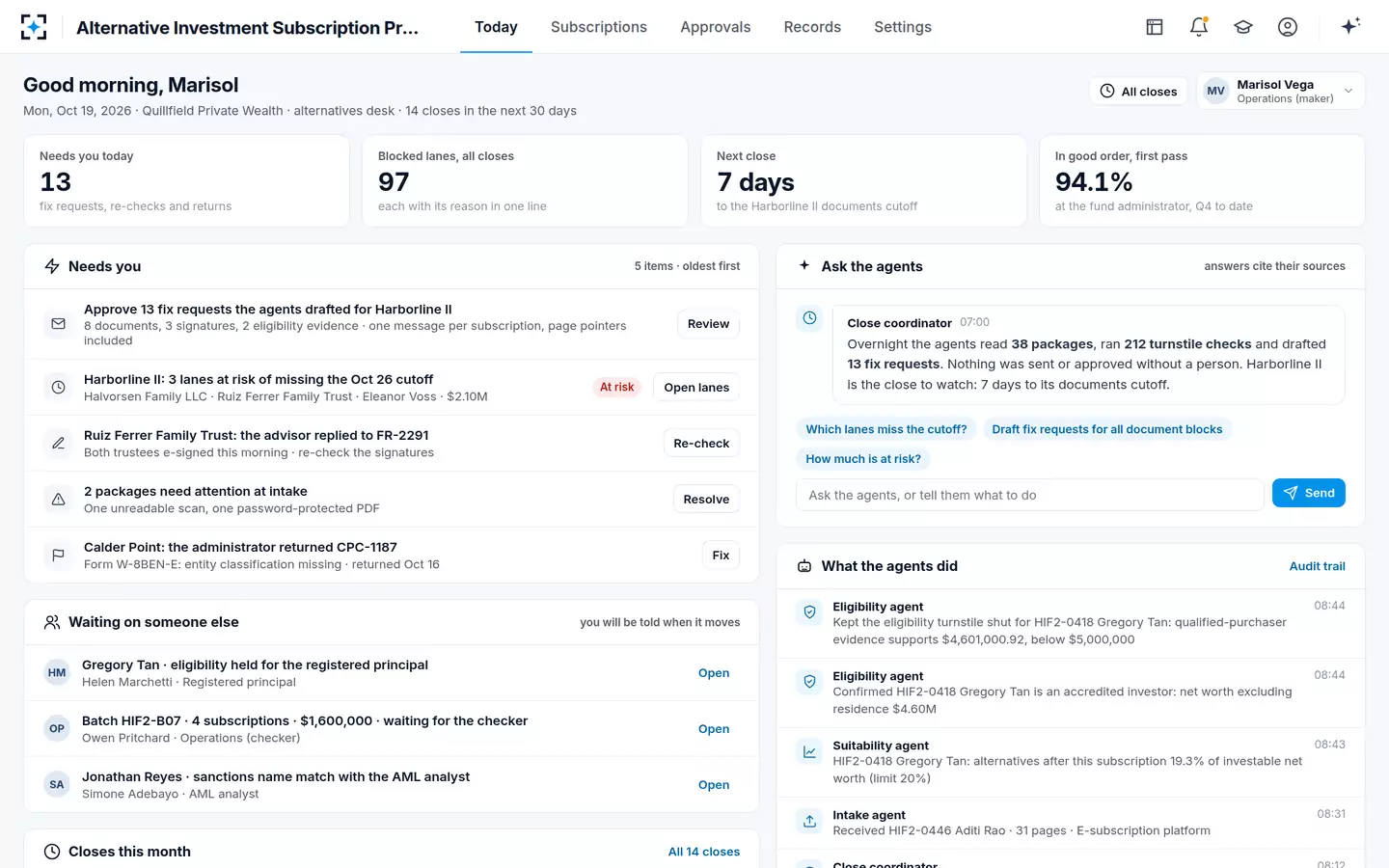
Run it beside the desk on the next live close, not instead of it
If the replay passes, the next step is a live close run in parallel: the process drafts, flags and forecasts; the desk decides and sends as it does today, using the drafts where they help. In Alternative Investment Subscription Processing that is how it always runs in any case. Agents never send to a fund administrator, approve suitability, release a reserve or clear a sanctions match; operations approves every fix request, a registered principal signs every suitability decision, and a maker and a different checker send every batch. Running in parallel only changes how much the desk relies on the drafts.
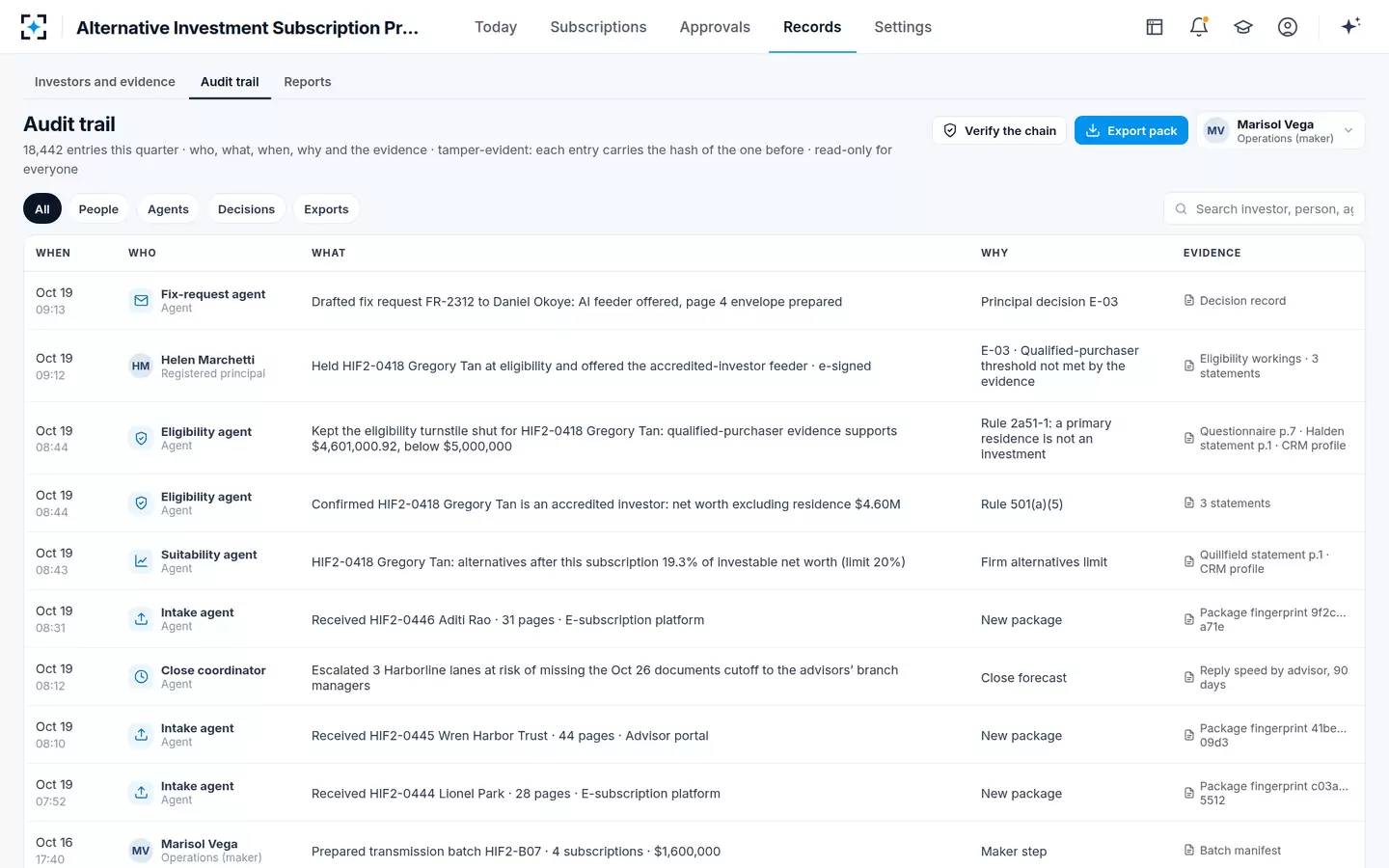
The audit trail is what lets a firm widen that reliance with evidence. Every action by a person or an agent is logged with who, what, when, why and the evidence, and each entry carries the hash of the one before, so the chain can be verified. Internal audit can read a close afterwards without asking anyone what happened.
Every action, by people and agents, with the reason and the evidence
What you bring, and what happens after the pilot
A pilot needs four things from the firm, all of which it already has. The fund booklets and offering documents for the close. The firm's eligibility, suitability and concentration policies, including the unwritten ones the reviewers apply, which the pilot will surface. A sample of past subscription packages, as they first arrived. And the outcomes: fix requests, administrator returns and principal decisions. The solution's rules are then set from your policies, each with its source and version; a change needs a reason and a principal's signature.
What to bring to a one-close pilot
- One recent close, 30 or more subscriptions
The packages as first received, including those the administrator returned and those the principal held.
- The fund documents for that close
The booklet version then current, the offering document, the close calendar and the administrator’s requirements.
- Your written rules, and the unwritten ones
Eligibility evidence and age, concentration limits, second-principal thresholds, how you treat trusts and entities.
- The outcomes, as the answer key
Every fix request and reply, every return and its reason, every principal decision.
- Two reviewers’ time
To confirm or reject findings blind, and to compare eligibility decisions line by line.
- Signed pass bars
Agreed by the head of alternatives and the supervising principal before anything runs.
Questions people ask
What are private markets for wealth clients?
They are private equity, private credit, real estate and similar investments packaged for individual investors: feeders into private funds for accredited investors and qualified purchasers, and registered vehicles such as interval funds and non-traded BDCs and REITs. Each wrapper has its own eligibility, liquidity and suitability rules, which the wealth firm checks at subscription.
How long should a subscription process pilot take?
About four weeks for one close of 30 or more subscriptions: a week to gather files and rules, a week to set them up and agree pass bars, a week to run and have reviewers check findings blind, and a week to score and decide. Most of the reviewers' time goes into the comparison, which is the part worth doing carefully.
Why pilot on past files instead of a live close?
Because the right answers are already known and nothing can reach an advisor or a fund by mistake. A past close shows what the desk found, what the administrator returned and what the principal decided, so every finding can be scored against an outcome.
What does private markets wealth management involve for operations?
More funds, closes and eligibility tests on the same desk, with private credit and other illiquid products named in the SEC's FY2027 examination priorities. The operational core is unchanged: prove eligibility, check suitability and concentration, complete the documents, confirm signers' authority and match the cash, with a person signing each decision.
What if the pilot finds problems the desk missed?
Treat each confirmed one as a finding about the close, not only about the tool: an investor admitted on weak evidence, or a signer without authority, may need follow-up with the fund. Agree before the pilot who reviews such findings and how they are escalated, so a useful result does not become an awkward one.