A 404a5 fee disclosure is the participant fee notice that ERISA regulation 29 CFR 2550.404a-5 requires the administrator of a participant-directed 401(k) or similar plan to give each participant "on or before the date on which a participant or beneficiary can first direct his or her investments and at least annually thereafter" (29 CFR 2550.404a-5). It must explain the plan's administrative fees and individual fees and show, for every investment on the menu, "the total annual operating expenses of the investment expressed as a percentage (i.e., expense ratio)". That makes it the single best source for what staying in the plan costs, and the first document an advisor needs before recommending a rollover. Botminds' IRA Rollover Analysis starts there: a Fee Reader agent reads the notice, cites every fee to its page and line, and weights fund expenses to what the client actually holds.
The notice is long, formatted differently by every recordkeeper, and easy to misread. Below is one, annotated: a fictional plan, the Halden Bay Logistics 401(k), with each part labelled by the paragraph of the rule that requires it and what a rollover analysis should take from it.
One 404a5 fee disclosure, annotated: four parts, and what a rollover needs from each
Part 1 · General plan information (c)(1)
- How and when you may give investment instructions
- Limits on transfers between funds
- The plan's designated investment alternatives
- Self-directed brokerage window: available
What to take for a rollover
Skim. Note any brokerage window: its fees sit in Part 3 and are easy to miss.
Part 2 · Administrative expenses (c)(2)
- Plan administrative fee: 0.08% a year, deducted quarterly, pro rata
- Recordkeeping: $30.00 a quarter per account
- Some administrative costs are paid from fund expenses (revenue sharing)
What to take for a rollover
Extract every line. Note the basis (pro rata or per account): a flat fee is a large share of a small balance and a small share of a large one.
Part 3 · Individual expenses (c)(3)
- Loan origination $75; loan maintenance $25 a year
- Qualified domestic relations order $400
- Brokerage window $50 a year
- Distribution processing $0
What to take for a rollover
Extract the ones this client uses or will trigger, such as a distribution fee on the rollover itself.
Part 4 · Investment comparison chart (d)(1)–(2)
- Each fund: type, 1-, 5- and 10-year returns, a benchmark
- Total annual operating expenses as a percentage and per $1,000
- Shareholder-type fees and trading restrictions
- Fixed-return option: current rate and any guaranteed minimum
What to take for a rollover
The heart of it. Take the expense ratio of each fund the client holds, and any redemption fee or restriction that bites on a transfer out.
What is a 404(a)(5) disclosure?
It is the plan-and-investment fee notice for participants, named after the regulation that requires it, which sits under ERISA section 404(a), the fiduciary duty provision. The regulation's starting point is that when a plan lets participants choose their investments, the administrator must make sure they get "sufficient information regarding the plan, including fees and expenses, and regarding designated investment alternatives, including fees and expenses attendant thereto, to make informed decisions". It covers participant-directed individual account plans; it excludes SEP and SIMPLE IRA arrangements.
The notice has two halves. Plan-related information, in paragraph (c), covers how to give instructions and what the plan charges for administration and for individual services. Investment-related information, in paragraph (d), covers each designated investment alternative: what it is, how it performed, what it costs, and where to read more. The regulation lets a plan administrator rely in good faith on figures its service providers supply, so the numbers in the notice usually come from the recordkeeper.
401(k) fee disclosure requirements: what the rule makes the plan send, and when
Three documents, on three clocks. The annual notice covers parts (c)(1) to (c)(3) and the investment chart in (d)(1) and (d)(2); "at least annually" means "at least once in any 14-month period". A statement at least quarterly shows "the dollar amount of the fees and expenses" for administration and individual services "actually charged" to the account in the preceding quarter, and says when some administrative costs were paid out of fund expenses instead, "through revenue sharing arrangements, Rule 12b-1 fees, sub-transfer agent fees". And a change notice must reach participants "at least 30 days, but not more than 90 days, in advance" of a change to the plan information or fees.
The 404a5 fee disclosure runs on three clocks
14months
longest gap between annual notices
3months
statement of fees actually charged, in dollars
30–90days
advance notice of a change in plan fees
$1,000
each fund's cost also shown per $1,000 invested
The investment chart is the most prescriptive part. For each fund whose return is not fixed, the plan must show the 1-, 5- and 10-year average annual total return against a broad-based benchmark; each "shareholder-type fee" charged directly against the investment, such as sales loads, redemption fees and surrender charges; the expense ratio; and that same expense for "a one-year period expressed as a dollar amount for a $1,000 investment". For a fixed-return option, it must show the rate and term, or the current rate and "the minimum rate guaranteed under the contract, if any". The chart must be in "a chart or similar format that is designed to facilitate a comparison", and a plan that accurately completes DOL's model chart is deemed to comply.
Where the rollover's numbers are: three sections, read three ways
A rollover comparison needs three numbers from the notice and one from the quarterly statement. From Part 2, the plan's administrative fees and how they are allocated. From Part 3, the individual fees this client pays or will trigger. From Part 4, the expense ratio of each fund the client actually holds, plus any shareholder-type fee or restriction that applies to money leaving. And from the statement, the dollars actually charged last quarter, which is the best check that the percentages were read correctly.
Each has a common misreading. A recordkeeping fee quoted per quarter gets entered as a yearly figure, cutting it by three quarters. A plan fee charged pro rata gets treated as a flat fee, or the reverse. Revenue sharing gets counted twice, once inside the fund's expense ratio and again as a plan fee. And a fixed-return option, often a stable value fund, is treated as cash when it may carry a book-value guarantee that no IRA can replicate. That last one is not a fee error but a lost feature; the plan features a rollover best interest file weighs takes it up.
A fee read from its line: page 3, line 3.2 of a participant fee disclosure in IRA Rollover Analysis
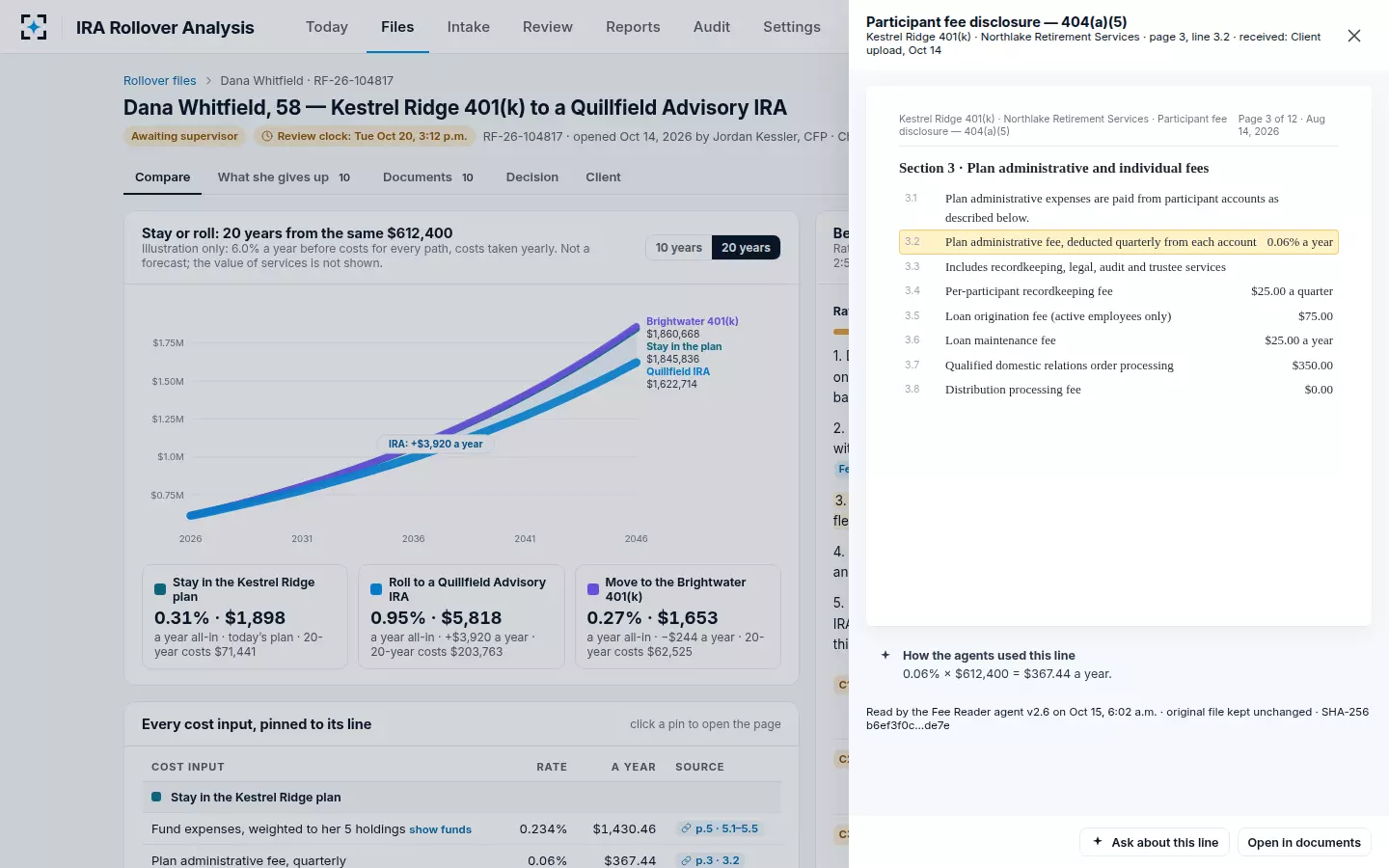
The recordkeeping fee on line 3.4 is $25.00 a quarter. Read as a yearly figure, it would understate the cost of staying by $75 a year.
How to find 401(k) fees the notice does not print as a percentage
Look in three more places. First the quarterly statement, which must show the administrative and individual fees in dollars as actually deducted. Second, the website address the notice must give for each fund, which must lead to its objectives, strategies and risks, turnover, current performance and "fee and expense information". Third, the documents the plan must furnish on request: prospectuses, shareholder reports, unit values and, for plan-asset investments, the list of holdings.
Some fees are never itemized for participants at all. Revenue sharing paid out of fund expenses is disclosed only as an explanation that it happened, and the fees the employer negotiated with service providers are in a different document, the service provider's disclosure under ERISA section 408(b)(2), which goes to the employer, not to participants. For a rollover, that matters less than it sounds: what the participant pays is in the expense ratios and the account deductions, and those are in the notice and the statement.
How to calculate 401(k) fees for one participant's holdings
Weight each fund's expense ratio by the client's balance in it, then add the plan and individual fees in dollars. Never average the menu: a 401(k) lineup of a cheap index fund and an expensive active one averages to a middle figure that describes no one. The worked example below takes a fictional participant in the Halden Bay plan with $240,000 in four funds.
How to calculate 401(k) fees for one balance: weight to holdings, then add the plan fees
| Line | Balance or basis | Rate | A year |
|---|---|---|---|
| Target date 2035 trust | $120,000 | 0.12% | $144.00 |
| S&P 500 index trust | $60,000 | 0.03% | $18.00 |
| Mid cap growth fund | $36,000 | 0.68% | $244.80 |
| Stable value fund | $24,000 | 0.38% | $91.20 |
| Fund expenses, weighted to holdings | $240,000 | 0.2075% | $498.00 |
| Plan administrative fee, pro rata (Part 2) | $240,000 | 0.08% | $192.00 |
| Recordkeeping, per account (Part 2) | $30 a quarter | 0.05% | $120.00 |
| All-in cost of staying | $240,000 | 0.34% | $810.00 |
The weighted figure is what a rollover comparison should put against the IRA's all-in cost, which needs the same treatment: the advisory fee at the tier the balance falls in, plus the weighted expenses of the funds or model the IRA would hold. SEC staff ask for exactly this breadth: the total potential costs of an account, from account fees and transaction costs to the internal expenses of the funds it holds (SEC staff bulletin, March 30, 2022; staff views, not a rule).
404a5 vs 408b2: which disclosure answers which question?
The 404a5 notice goes to participants and describes what they pay; the 408b2 disclosure goes to the employer and describes what service providers are paid. Under 29 CFR 2550.408b-2(c), a covered service provider "must disclose the following information to a responsible plan fiduciary, in writing", meaning a fiduciary "with authority to cause the covered plan to enter into, or extend or renew, the contract or arrangement", and must do so "reasonably in advance" of the contract (29 CFR 2550.408b-2). Plan sponsors use it to judge whether fees are reasonable; participants rarely see it.
404a5 vs 408b2: two fee disclosures, two readers
| 404(a)(5) participant notice | 408(b)(2) service provider disclosure | |
|---|---|---|
| Who receives it | Each participant and beneficiary who directs investments | The responsible plan fiduciary, usually the employer |
| Who sends it | The plan administrator | The covered service provider |
| When | Before first investment, then at least every 14 months; quarterly statement | Reasonably in advance of the contract and of renewals |
| What it shows | Plan, individual and fund fees; fund returns and benchmarks | Services, fiduciary status, direct and indirect compensation |
| Use in a rollover | The cost of staying, from the client's own plan | Background only; ask the client for the 404a5 |
What the 404a5 notice leaves out of a rollover comparison
It prices the plan; it does not price the alternatives, and it does not say what the plan offers that an IRA would not. A rollover analysis needs the IRA's fee schedule and model expenses, the new employer's plan notice if that plan accepts roll-ins, and the plan rules, usually the summary plan description, for withdrawal options, loans and any age-55 separation provisions. SEC staff add that a professional evaluating a move out of an employer's plan needs the existing plan's information and costs, and should "take all reasonable efforts to obtain such information, which may include requesting the information from the retail investor or the investor's agent".
The scale is the reason firms automate the reading. DOL's Form 5500 data count about 724,700 401(k)-type plans and 81.6 million active participants in 2023 (DOL, Private Pension Plan Bulletin, 2023 data). Each plan's recordkeeper formats its notice its own way, so a rollover desk sees a different layout on almost every file.
Ten documents in one rollover file, and every value the agents read from them
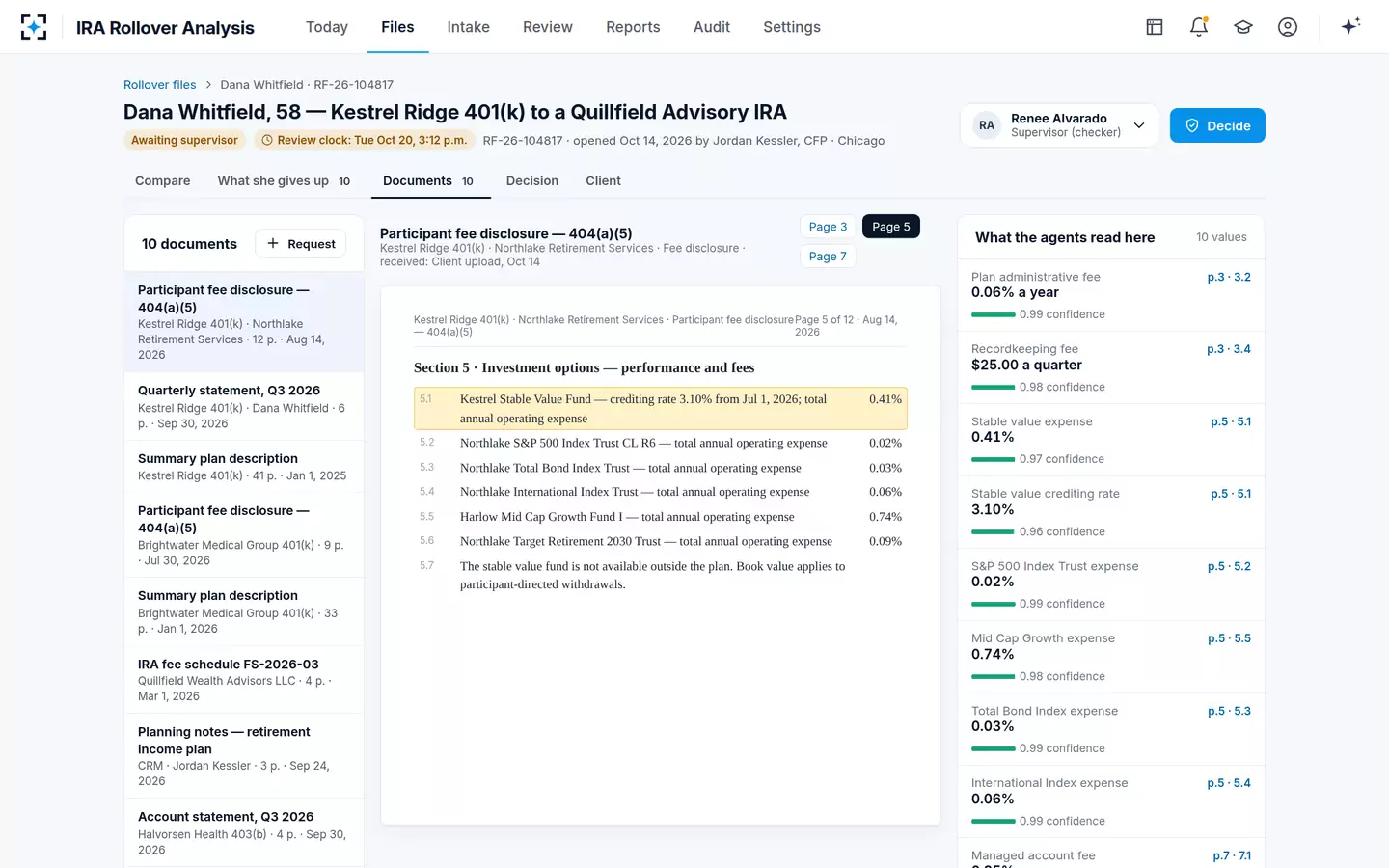
Reading the notice at scale: what IRA Rollover Analysis does with it
In IRA Rollover Analysis, an Intake agent finds the notice in the client's upload, the plan document library or a request to the recordkeeper, with reminders on day 3 and day 7 of a ten-business-day window. The Fee Reader agent then reads it and the statement, extracts each fee with its page, line and a confidence score, and weights fund expenses to the client's holdings. A value under 0.90 confidence waits for a retirement specialist. If the notice never arrives, an estimate from the plan's Form 5500 filing can be used only when it is labelled as an estimate and a specialist has confirmed it, and such a file needs two approvals.
The product's own estimate is that gathering, re-keying and weighting fees take about an hour of a two-and-a-half-hour rollover file when done by hand; that is our estimate, not a measured result. The more important gain is that every figure in the rationale can be traced back to the line it came from when a supervisor or an examiner asks.
Reading a 404a5 fee disclosure for a rollover: eight checks
- Check the date
A notice older than 14 months is out of date; ask for the current one.
- Take every Part 2 fee, with its basis
Percentage or flat, pro rata or per account, quarterly or yearly.
- Take only the Part 3 fees this client triggers
Include any distribution or rollover processing fee.
- Weight fund expenses to the client's holdings
From the latest statement, never a menu average.
- Note shareholder-type fees and restrictions
Redemption fees, equity wash rules or other limits on money leaving.
- Flag any fixed-return or stable value option
Record the current rate, any guaranteed minimum and whether it is available outside the plan.
- Reconcile with the quarterly statement
The dollars actually charged should match the rates you read.
- Cite the page and line
So the supervisor, the client and an examiner can check every figure.
Questions people ask
How often is the 404a-5 notice sent?
Before a participant can first direct investments, and then at least once in any 14-month period. A statement of fees actually charged goes out at least quarterly, and changes to plan fees need 30 to 90 days' advance notice.
Does a 401(k) have to disclose fees?
Yes, if participants direct their own investments. The 404a-5 regulation requires the administrator to disclose administrative and individual fees and each fund's expense ratio, and to show a fund's yearly cost for a $1,000 investment.
Where do I find my 401(k) fee disclosure?
Usually on the recordkeeper's participant website or with the annual plan mailing; the regulation allows the plan information part to sit inside the summary plan description or a benefit statement. If you cannot find it, ask the plan administrator, whose contact details must appear on the investment comparison chart.
What is a good expense ratio in a 401(k)?
The regulation sets no benchmark for a good one, and the right comparison is the actual alternative: the IRA's all-in cost or the new plan's. The notice shows each fund's expense ratio and its cost per $1,000, which is enough to compare like with like.
Is the 404a5 notice the same as the 408b2 disclosure?
No. The 404a5 notice goes to participants and shows what they pay. The 408b2 disclosure goes from service providers to the plan's responsible fiduciary, usually the employer, and shows what the providers are paid and what services they give.
Do SEP and SIMPLE IRAs get a 404a5 notice?
No. The regulation's definition of a covered individual account plan excludes simplified employee pensions and SIMPLE retirement accounts, so the disclosure duty does not apply to them.