A rollover rationale form is the written record of why moving a client's retirement money is in the client's best interest: the paths compared, what each costs, what the client gives up, and the reasons that tip the decision. Under PTE 2020-02 those reasons must be "specific", documented and given to the client before the rollover (PTE 2020-02, Sections II(b)(3) and II(c)(3)), and the commonest way a form fails is a reason that would fit anyone. Software can now draft these forms in seconds, which makes the failure easier, not harder: a fluent generic sentence reads well. Botminds' IRA Rollover Analysis therefore pairs its drafting agent with a Rationale Critic that argues against every draft, starting with a swap test: would this sentence be just as true of another client?
This guide is for supervisors and compliance officers choosing how rationales get written and checked. It covers what belongs on the form, what regulators have said about generic reasons, the checks a critic should run, and where such a tool fits and does not. The examples come from a fictional firm's rollover files.
The same rollover rationale, before and after a critic argued with it
First draft: "An IRA will give you more investment choices and greater flexibility to meet your goals."
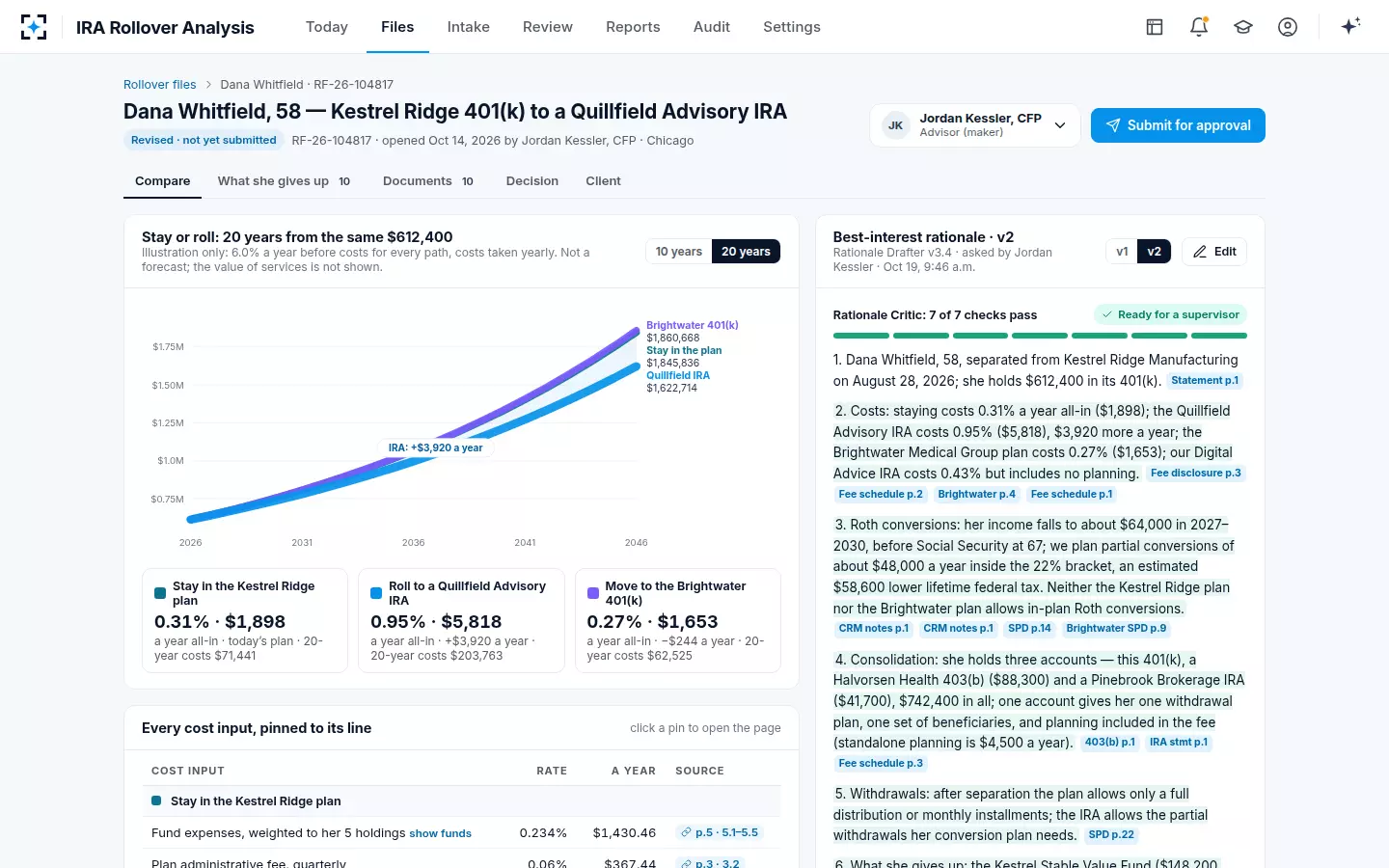
After the critic's notes: Partial Roth conversions of about $48,000 a year in 2027–2030, inside the 22% bracket, which neither her plan nor the new employer's plan allows in-plan.
First draft: Yes: true of 1,288 of the firm's 1,612 September files.
After the critic's notes: No: true of 0 of 20 comparable files.
First draft: Plan and IRA only. The new employer's plan, which accepts roll-ins at 0.27%, missing.
After the critic's notes: Stay 0.31%, new employer's plan 0.27%, digital IRA 0.43%, advisory IRA 0.95%, each in dollars.
First draft: Not mentioned.
After the critic's notes: Stable value fund at book value, the Rule of 55 until 59½: named, explained and accepted.
First draft: Six; the key sentence has none.
After the critic's notes: Seventeen, each opening its page and line.
First draft: 4 of 7 checks passed; sent back with reason code SB-02.
After the critic's notes: 7 of 7; approved with reason code AP-01.
What belongs on a rollover rationale form?
Six things, whatever the firm calls the form. The client's situation in facts, not adjectives: age, balance, plans held, when they left, what they need. Each reasonable path priced all-in in percent and dollars: staying in the plan, the new employer's plan if it takes roll-ins, and the firm's own options, including any cheaper one. What the client keeps or gives up on each path. The reasons this client should take the recommended path anyway. How the firm is paid and what conflicts that creates. And the evidence for every figure, so a supervisor can check it.
The cost and alternatives parts come from the securities side as much as from the exemption. SEC staff expect cost to be weighed on every account recommendation, all of it, from account fees to the funds' own expenses, and they doubt a rollover recommendation can have a reasonable basis if leaving the money in the employer's plan was possible and not considered (SEC staff bulletin, March 30, 2022; staff views, not a rule). A form without the plan's own costs on it cannot show that.
What makes a rollover rationale specific?
A reason is specific when it depends on this client's facts and would be false for most other clients. "Lower costs" is not specific if the IRA costs more. "More investment choices" is not specific for anyone, and the SEC said so when it adopted Regulation Best Interest: "we caution broker-dealers not to rely on, for example, an IRA having 'more investment options' as the basis for recommending a rollover" (SEC Release 34-86031, June 5, 2019). The Commission asked instead for options to be weighed "in light of the retail customer's current situation and needs".
Specific reasons usually come from three places: a plan feature the client needs and the plan lacks (partial withdrawals, Roth conversions, a particular investment); a planning goal that the recommended account serves and the others do not (consolidating several accounts, a withdrawal plan, a tax strategy); or a service the client will use and pay for, priced against what it costs elsewhere. Each can be checked against a document. A reason that cannot be checked against anything is the one to rewrite.
A reason that would be true of almost every client is not a reason for this client. The test is not how it reads but how many other files it would fit.
Can a rollover reason be generic? What regulators found
Not if the firm wants it to count. FINRA's 2026 Annual Regulatory Oversight Report lists, among Reg BI findings on account recommendations, firms that required representatives to document a rationale but then did nothing when the rationale was generic or insufficient, and procedures not reasonably designed for rollover recommendations at all (FINRA, 2026 oversight report, Reg BI and Form CRS). Among effective practices, the same report describes surveillance that picks out rollover and account-type recommendations automatically.
Examiners keep looking. The SEC Division of Examinations' fiscal 2027 priorities, published October 23, 2026, name "account and rollover recommendations" first among its Reg BI focus areas and add "processes for reviewing reasonably available alternatives" (SEC, FY2027 examination priorities). A pile of identical rationales is easy to find when someone reads them together, which is exactly what an examiner with a sample of files does. The wider Reg BI question, when a written basis is expected though not required, is in the SEC Reg BI documentation obligation; the rollover form is the narrower, required document.
The swap test: would this sentence fit another client?
The swap test makes "specific" measurable. Take each reason in the draft and test it against comparable files, clients with similar balances, ages and plans. If the sentence would be just as true for them, it is not a reason for this client. In IRA Rollover Analysis, the critic tests each draft against 20 comparable files, and under the sample firm's setting a reason must fail for at least 19 of them to count as specific.
The swap test on two drafts: how many other files each reason fits
The test has a sensible limit. Some true statements are shared by many clients and still belong on the form, such as the fee each path costs. The swap test applies to the reasons, the sentences that say why this client should move, not to the facts that support them. And it does not judge whether the recommendation is right; it judges whether the form explains it in this client's terms. A supervisor still decides.
Seven checks a critic should run before a supervisor reads the draft
The swap test is one of seven. Together they turn the questions a careful supervisor asks into checks that run on every draft, so the supervisor's time goes on judgment rather than on finding what is missing.
Seven checks the Rationale Critic runs on every rollover rationale
- Swap test
Each reason tested against 20 comparable files; it must fail for at least 19 of them.
- Costs in dollars and percent
Every path priced all-in both ways, from cited fee lines.
- Every reasonable alternative
Staying, the new employer's plan if it accepts roll-ins, and the firm's other options, including cheaper ones.
- Every flagged service
Each material difference the client gives up is named and addressed.
- Every fact cited
Each figure and claim opens the page and line it came from.
- No promise
No projected return stated as an expectation; illustrations labelled as illustrations.
- Conflicts disclosed
How the firm and advisor are paid on the recommended account, in plain words.
What PTE 2020-02 and Reg BI ask for, checked on a first draft in IRA Rollover Analysis
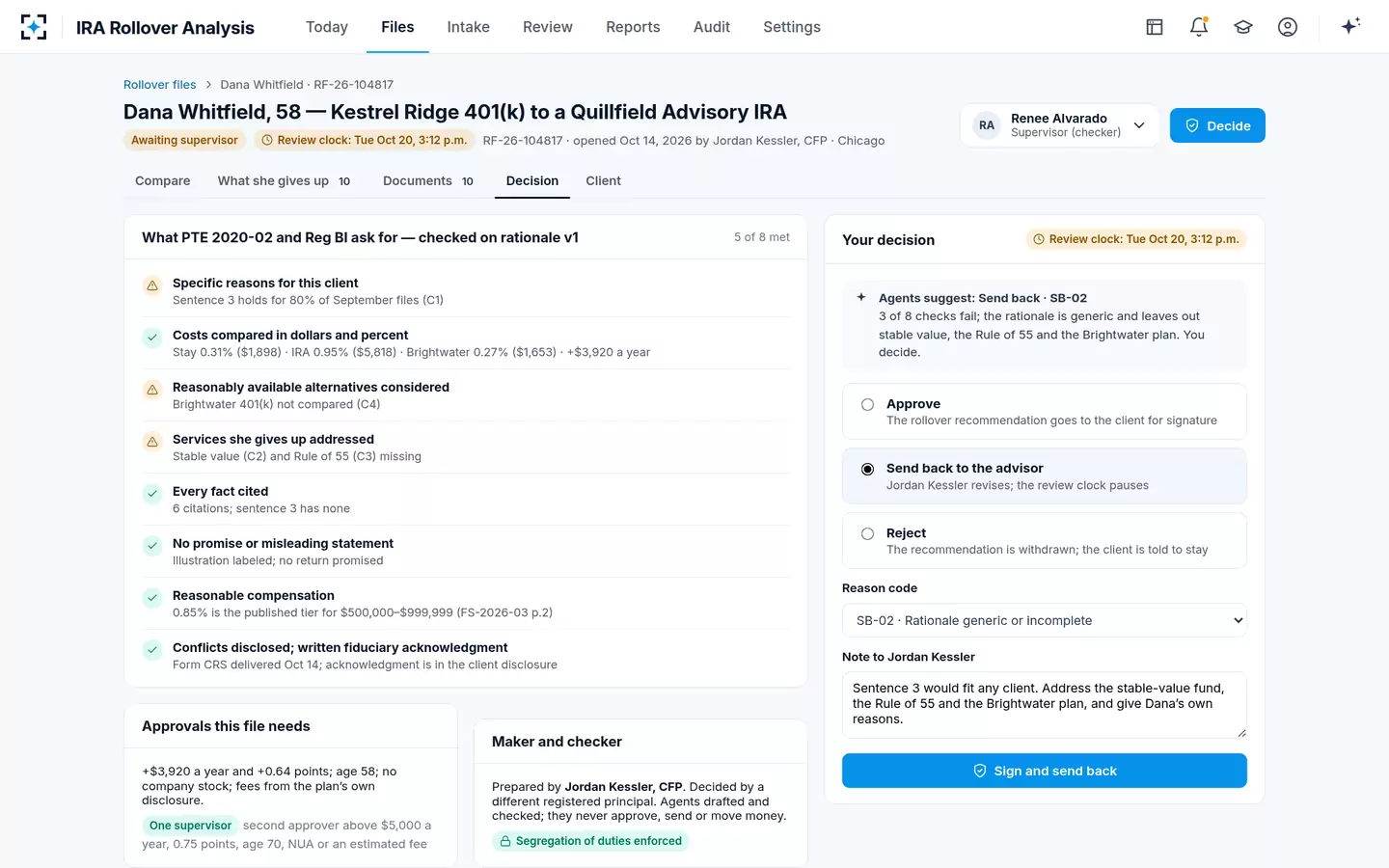
Her note to the advisor: 'Sentence 3 would fit any client. Address the stable-value fund, the Rule of 55 and the Brightwater plan, and give Dana's own reasons.'
One draft, before and after: the sample file
The sample client is 58, left her employer in August 2026 with $612,400 in its 401(k), and now works part-time for an employer whose plan accepts roll-ins. Her advisor recommends the firm's advisory IRA at 0.95% a year, against 0.31% to stay and 0.27% in the new plan: $3,920 a year more than staying. The first draft gives "more investment choices and greater flexibility" as its reason, leaves out the new employer's plan and says nothing about the stable value fund or the Rule of 55. The critic passes it on four of seven checks and the supervisor sends it back.
The advisor answers in plain words: cite her Roth conversion plan and the consolidation of her three accounts, and answer the critic's notes. The drafting agent reads his planning notes and her other statements and writes version 2: partial conversions of about $48,000 a year in 2027–2030 inside the 22% bracket, which neither plan allows in-plan; three accounts, $742,400 in all, brought into one with one withdrawal plan and planning included in the fee; and what she gives up, stated and accepted. Eight sentences, 17 citations, 0 of 20 comparable files. Whether a planning service is worth $3,920 a year to her is still a judgment, and now it is one a supervisor and an examiner can see being made.
Version 2 of the rationale, with the critic passing all seven checks
What to look for in a rollover rationale tool
A drafting tool is easy to demonstrate and hard to evaluate, because a well-written draft looks right. Evaluate the checker, not the writer. Ask to see the tool argue against a generic draft from your own files and say which comparable files the reason would fit. Ask where each fee came from, and open the page. Ask what happens when a fee is unreadable or the plan never sends its disclosure. Ask who can switch the checks off, and what record that leaves. And ask what the tool cannot do.
One night's checking in the sample firm
61
rationales and client disclosures drafted overnight
11
drafts questioned by the critic before any supervisor saw them
2
with reasons that would fit any client
6
with an alternative missing
FINRA's rules apply to what a tool writes as they apply to what a person writes. In its 2024 notice on generative AI, FINRA said its rules and guidance are meant to apply whatever the technology (FINRA Regulatory Notice 24-09), which means a drafted rationale is the firm's communication and the firm's responsibility. The tool should make the human decision easier to make and easier to see; it should not make it.
Where the critic fits, and where it does not
It fits where volume and sameness are the risk: many files, a few templates, supervisors approving at speed. It checks what can be checked against documents and other files, and it records what it found, so the retrospective review can count overrides. In IRA Rollover Analysis the critic never approves, cannot be switched off for a file, and an approval past one of its notes takes a separate reason code that the review reports.
It does not decide whether a recommendation is right, give tax or legal advice, or replace the plan documents: without the fee disclosure and plan rules, it can only say what is missing. Setup starts with the firm's own rollover policy, IRA pricing and reason codes, and ends with the agents re-running 20 already-decided files so the firm can compare their findings with its supervisors' decisions. The features clients give up are worked through in the IRA rollover best interest guide.
Questions people ask
Is there a required rollover recommendation form?
Neither PTE 2020-02 nor the SEC's rules prescribe one. The exemption requires the specific reasons to be documented and given to the investor before the rollover, and SEC staff expect costs and alternatives to be considered; each firm designs its own form to show both.
What is a rollover recommendation summary?
Usually the client-facing version of the rationale: the paths compared in percent and dollars, what the client gives up, the reasons for the recommendation and how the firm is paid. Under PTE 2020-02 the documented reasons must reach the client before the rollover, and this summary is a common way to deliver them.
Can the client's preference be the reason for a rollover?
Not on its own. SEC staff say a preference should be considered but that a firm "would not satisfy the standards based on the retail investor's preference alone"; if the client directs an account against the recommendation, staff suggest documenting the basis.
Should the rationale mention the new employer's plan?
If the client has one that accepts roll-ins, yes. FINRA has long listed rolling to the new employer's plan as one of a departing participant's options. In the sample firm, a missing alternative was the commonest gap the critic found in one night's drafts, six of eleven.
Do AI-drafted rationales need different supervision?
The rules are the same: FINRA describes its rules as technologically neutral, and the SEC's 2027 priorities ask whether firms using what it calls "super intelligence" still meet existing obligations. The difference is practical: a tool can produce identical sentences at scale, so the check for sameness has to scale with it.
How many reasons should a rollover rationale give?
As many as are true and specific, usually two or three. In the sample file the approved version gives two, a Roth conversion plan and consolidation of three accounts, and spends the rest of its eight sentences on costs, alternatives and what the client gives up.