A rollover analyzer tool compares what a client's retirement money costs, and what the client gets, if it stays in an employer plan, moves to a new employer's plan or rolls to an IRA, and records why a recommendation was made. Firms do this in one of three ways: a calculator that prices the paths from figures the advisor types in; a spreadsheet or form template that the advisor fills from the plan's PDFs and signs; or software agents that read the plan's documents, price each path from cited lines, draft the reasons and route the file to a supervisor. All three can produce a cost comparison. They differ in where the numbers come from, whether the reasons are specific, and what is left for the annual review. Botminds' IRA Rollover Analysis is the third kind; this guide sets out all three so a firm can choose.
The choice is worth making carefully. Taxpayers reported $682.4 billion of rollovers into IRAs for tax year 2023 (IRS Statistics of Income, June 2026), and the SEC's fiscal 2027 examination priorities name "account and rollover recommendations" among the broker-dealer practices examiners will test (SEC, October 23, 2026).
Three rollover analyzer approaches, and what each leaves in the file
Calculator: Typed in by the advisor, often one blended figure per path
Template: Re-keyed from the plan's PDF into the template, line by line
Agents: Read from the plan's fee disclosure and statement, each cited to page and line
Calculator: Usually plan versus IRA
Template: Whatever the template has columns for
Agents: Stay, the new employer's plan if it accepts roll-ins, and each of the firm's IRA programs
Calculator: Not covered
Template: A checkbox list, filled from memory
Agents: Flagged from the plans' own rules, path by path
Calculator: Not covered
Template: Free text, often from a template sentence
Agents: Drafted from the costs, the flags and the advisor's notes; argued with before review
Calculator: A printout
Template: A PDF, checked for completeness
Agents: The file, the critic's findings and every source one click away
Calculator: Whatever was saved
Template: A folder of PDFs to sample
Agents: Every file re-checked on closing, findings counted
What is a rollover analyzer?
In practice the term covers any tool a firm uses to support a rollover recommendation, from a web form that compares two expense figures to a system that produces the whole file. What the rules care about is the output. For a firm relying on PTE 2020-02, that is documented "specific reasons" that the rollover is in the investor's best interest, given to the investor before the rollover (PTE 2020-02, Sections II(b)(3) and II(c)(3)). For a broker-dealer or adviser, it is a reasonable basis for the recommendation that took account of the plan the client would leave; SEC staff say evaluating a move out of a plan means getting information about the existing plan and its costs (SEC staff bulletin, March 30, 2022; staff views, not a rule).
A tool can help with both or with one. A calculator helps with costs. Reasons, delivery, supervision and the annual review happen somewhere else, and the question for a buyer is where, and how much of it is done by hand.
What should a rollover analyzer include?
Five things, if it is going to carry the file rather than a single number: the plan's actual fees, read from its participant fee disclosure and weighted to the client's holdings; every path the client can take, priced all-in in dollars and percent; the plan-only features the client would give up; reasons specific to this client, with their evidence; and a record a supervisor and the annual review can check later. The first four are what the client needs to see. The fifth is what the firm needs to prove it.
The fee data is the foundation. The plan's notice must show each fund's expense ratio and the plan's administrative and individual fees at least once every 14 months (29 CFR 2550.404a-5), so the numbers exist for every participant-directed plan. The work is getting the notice and reading it correctly, every time, for a different recordkeeper's layout on each file.
How do firms document rollovers today?
Mostly with templates and judgment, and regulators have described the weak spots. The SEC's 2023 risk alert on Reg BI recalled that the Commission had said firms may wish to document their evaluation for "significant investment decisions, such as rollovers", and found firms whose surveillance had not been reconsidered for "recommendations of rollovers, account recommendations, and implicit hold recommendations" (SEC Division of Examinations risk alert, January 30, 2023). It also described systems that let professionals evaluate costs or alternatives without requiring their use, and files kept locally rather than centrally.
FINRA's 2026 oversight report adds firms that asked for a written rationale but did not follow up when it was generic (FINRA, 2026 oversight report). The pattern across both: the tool existed, the form existed, and nothing made the analysis specific or checked that it was. The rollover system itself leans one way, too: GAO found in 2013 that the way rollovers work steers savers toward IRAs (GAO-13-30).
Approach 1: the calculator
A calculator is quick, cheap and good at one thing: showing how a fee difference compounds. Its weakness is its inputs. It prices whatever the advisor types, usually a blended percentage for each path, and it has no way to know whether the plan figure came from the client's notice, a guess or last year's document. It does not cover what the client gives up, and it writes no reasons. Used alone, it supports the cost part of a recommendation and leaves the rest of the file to someone else.
Approach 2: the spreadsheet template and the PDF
A template is the most common way firms make the analysis consistent. It asks for the plan's fees line by line, lists the features to consider and leaves space for the reasons, and the advisor signs it. It gets the structure right. Its costs are time and drift: every fee is re-keyed from a PDF, the features checklist is answered from memory, and the reasons box fills with sentences that worked last time. A supervisor reviewing a stack of completed templates checks that the boxes are filled; seeing that forty files give the same reason takes reading them side by side, which a busy review rarely does.
The template also leaves the annual review where it was. Its output is a set of documents, so the retrospective review must sample them and re-check the arithmetic by hand, which is slow work against a six-month deadline, as covered in the PTE 2020-02 retrospective review.
Approach 3: agents that build the file
The third approach moves the reading, re-keying and first drafting to software agents and keeps every decision with people. In IRA Rollover Analysis, an Intake agent gathers the plan documents and chases what is missing; a Fee Reader extracts every fee with its page and line; a Cost agent prices each path with deterministic arithmetic; a Services agent flags what the client keeps or gives up; a Rationale Drafter writes the reasons and the client disclosure; and a Rationale Critic argues against the draft before a supervisor sees it. The advisor submits, a different registered principal decides, the client signs, and a Review and Evidence agent re-checks every closed file.
A supervisor's morning in IRA Rollover Analysis: what needs her and what the agents did overnight
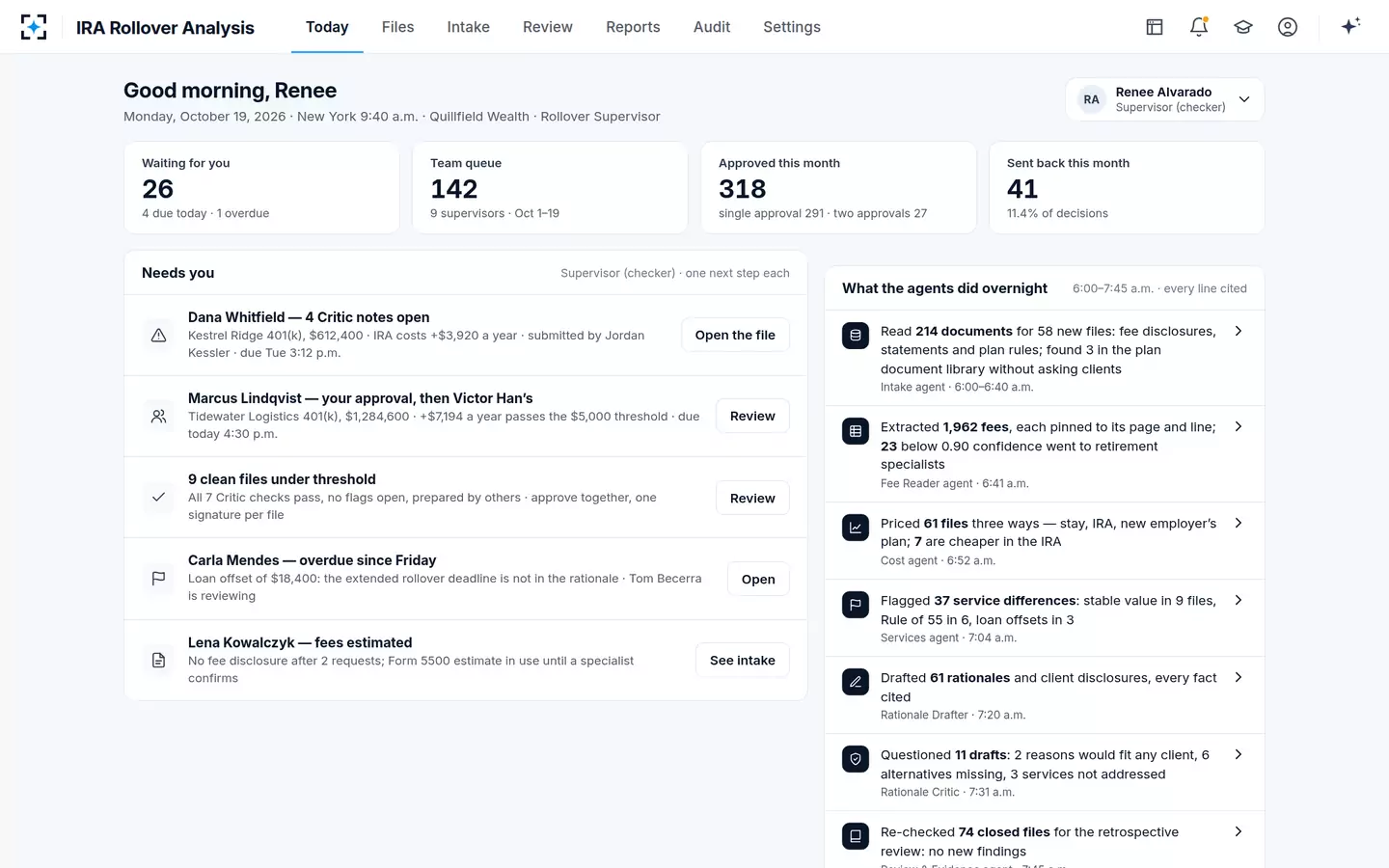
Twenty-three fee values below 0.90 confidence went to retirement specialists instead of into the arithmetic.
When is a rollover analyzer required?
No rule requires a particular tool. What is required is the analysis and, for a firm relying on PTE 2020-02, the written specific reasons, the fiduciary acknowledgment, delivery before the rollover and the annual review. A broker-dealer must also have written policies and procedures reasonably designed to achieve compliance with Regulation Best Interest, including for rollover recommendations. A tool becomes necessary in practice when volume makes the analysis impossible to do well by hand, or when supervisors cannot see from the file whether it was done.
The scale a rollover process has to handle
$682.4B
rolled into IRAs in tax year 2023
5.86M
taxpayers reporting an IRA rollover that year
81.6M
active participants in 401(k)-type plans in 2023
6months
to finish and certify each annual review
What each approach costs in advisor and supervisor time
We know of no regulator or independent study that publishes the time a rollover file takes, so measure your own: time ten files from the first document request to the supervisor's decision, by step. The estimate below is ours, for one file done by hand and with agents, and it shows where the time goes rather than a promise of what any firm will save.
Where an advisor's time on one rollover file goes, by hand and with agents
By hand, about 2.5 hours
- Gathering documents · 24%
- Re-keying and weighting fees · 16%
- Pricing the paths · 14%
- What the client gives up · 14%
- Writing the reasons · 20%
- Answering a send-back · 12%
With agents, about 15 minutes
- Checking documents · 20%
- Checking the pricing · 20%
- Checking what is given up · 12%
- Reviewing the draft · 40%
- Answering a send-back · 8%
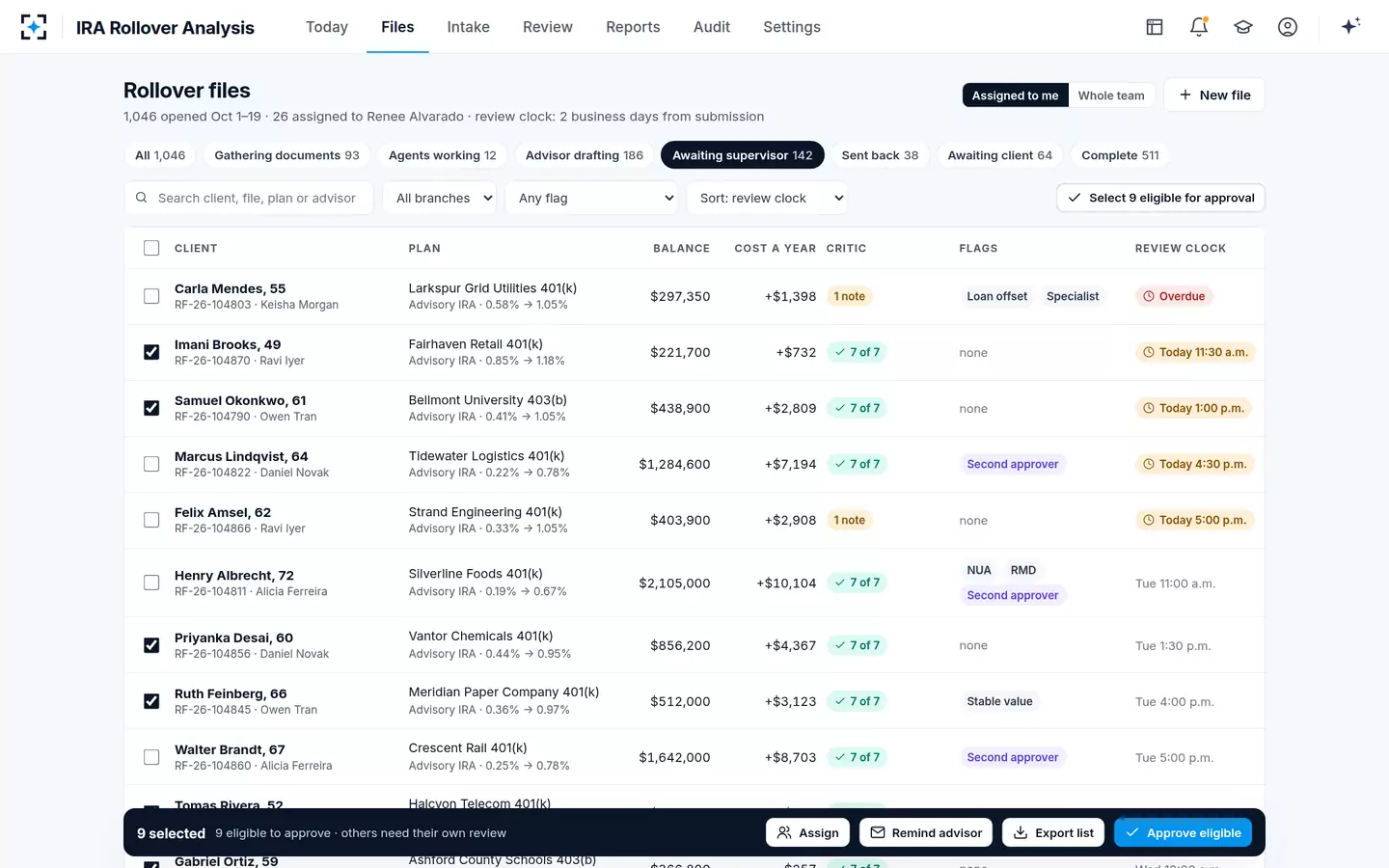
The more interesting shift is in the supervisor's time. With a template, review time goes on checking that the file is complete. With agents and a critic, completeness is checked before the file arrives, and the supervisor's time goes on the judgment: is this reason true, is it enough, does the client understand what she gives up. In the sample firm, one month's decisions show 318 approvals and 41 send-backs, 11.4% of decisions.
The rollover queue in IRA Rollover Analysis: clocks, critic results and flags on every file
Questions to ask in a rollover analyzer demonstration
Nine questions for any rollover analyzer tool, asked on your own files
- Where did this fee come from?
Open the plan's notice at the line. If the answer is "the advisor entered it", that is approach 1 or 2.
- What happens when the notice is missing?
Who chases it, and how is an estimate labelled and confirmed?
- Are fund expenses weighted to the client's holdings?
A menu average describes no one.
- Which paths does it price?
Including the new employer's plan and the firm's own cheaper IRA.
- How does it find what the client gives up?
From the plan's rules, or from a checklist answered by memory?
- How does it know a reason is specific?
Ask it to test a generic sentence from one of your files.
- Who can approve, and who cannot?
A different principal than the preparer; no approval right for software.
- What does the annual review get?
Every file re-checked, or a folder to sample?
- What does it not do?
Tax and legal advice, fiduciary-status decisions, the client conversation.
Where IRA Rollover Analysis fits, and where it does not
It fits a firm with a steady flow of rollover recommendations, supervisors who approve them, and an annual review to certify: it builds the file, puts the critic in front of the supervisor and leaves every file ready for the review. It works on the documents a rollover already runs on: the plan's fee disclosure, statements and plan rules; the new employer's plan documents; the firm's IRA programs and fee schedule; CRM notes; e-signature, custodian and archive. It sits beside those systems; it does not replace the recordkeeper, the custodian or the CRM.
It does not fit an anonymous what-if on a website, because it works from a client's documents; it does not decide whether advice is fiduciary advice, give tax or legal advice, or approve anything. Going live starts with the firm's own rollover policy, IRA programs and fee schedule, reason codes and a sample of past rollover files, and ends with the agents re-running 20 decided files so the firm can compare their findings with its supervisors' decisions before relying on them. The thresholds, clocks and checks are firm settings that only the administrator edits, with compliance approving each change. The signatures each file collects are mapped in PTE 2020-02 requirements, signer by signer.
Questions people ask
Is a rollover analyzer required by FINRA or the SEC?
No rule names a tool. The SEC and FINRA expect a reasonable basis for each rollover recommendation and procedures reasonably designed to achieve it, and PTE 2020-02 requires documented specific reasons; a tool is one way to meet them consistently.
Can a rollover analyzer replace the advisor's judgment?
No, and it should not try. The tool can gather, price, flag and draft; the advisor submits the recommendation and a registered principal decides. SEC staff also say a client's stated preference alone does not satisfy the standard, so someone has to weigh the facts.
What if the plan's fee disclosure cannot be found?
Ask the client and the recordkeeper; SEC staff say a professional should make all reasonable efforts to obtain the plan information. In IRA Rollover Analysis an estimate from the plan's Form 5500 filing can stand in only when labelled as estimated and confirmed by a specialist, and the file then needs two approvals.
Does a rollover analyzer work for IRA-to-IRA moves and account changes?
It should. PTE 2020-02's specific-reasons condition also covers recommendations to move from one IRA to another and from one type of account to another, such as commission-based to fee-based, so the same file structure applies.
How long does it take to set up?
Measure it by the inputs, not the software: the rollover policy, IRA fee schedules, reason codes, thresholds and a sample of past files. The test before go-live in IRA Rollover Analysis is the agents re-running 20 decided files for comparison with the supervisors' decisions.