The PTE 2020-02 retrospective review is the exemption's annual self-examination. A firm relying on PTE 2020-02 must conduct a review, "at least annually", that is "reasonably designed to assist the Financial Institution in detecting and preventing violations of, and achieving compliance with, the Impartial Conduct Standards and the policies and procedures governing compliance with the exemption"; reduce its methodology and results to a written report; have a Senior Executive Officer certify it; complete all of that within six months of the end of the period; and keep it for six years (PTE 2020-02, Section II(d), as republished by DOL on March 20, 2026). Most firms meet it by sampling files after the year ends. Botminds' IRA Rollover Analysis takes the other route the text allows: an agent replays every rollover file against the conditions on the day it closes, compliance tests the agent's work by hand, and the officer certifies a report built from the whole year.
The review condition survived the 2026 vacatur untouched; the exemption, in its original 2020 form, is still in force, as our status guide explains. What follows is what the review must produce, what a replay of a closed file actually tests, and what changes when the review reads everything instead of a sample. The examples come from a fictional firm's 2026 review in IRA Rollover Analysis.
What one year's PTE 2020-02 retrospective review produces, replayed file by file
January 1 to December 31, 2026
The firm picks the period; the exemption asks for at least one review a year.
13,402 closed files, every one
Re-checked by agents on the day each file closed; 14,820 opened in the year.
Seven rationale checks, the cost arithmetic, signed versus approved
Mapped to the Impartial Conduct Standards and to the firm's own rollover policy.
360 files tested by hand, 98.6% agreement
A compliance analyst samples 40 files a month to test the agents' work.
47 findings, 8 still open
Each with its files, its cause and its remediation.
Quarterly drafts; annual report due June 30, 2027
Certified by the chief compliance officer as Senior Executive Officer.
Report, certification and supporting data for six years
Produced to DOL within 10 business days of a request.
What is the PTE 2020-02 retrospective review?
It is a condition of the exemption, not a best practice: a firm that skips it cannot rely on PTE 2020-02 for the rollovers and other advice the review should have covered. The review has two objects. The first is the Impartial Conduct Standards in Section II(a): advice in the investor's best interest, no more than reasonable compensation, best execution, and no materially misleading statements. The second is the firm's own written policies and procedures for complying with the exemption, which Section II(c) requires, including the documented specific reasons for every rollover recommendation.
The output has three parts. A written report sets out "the methodology and results" and goes to a Senior Executive Officer. The officer then certifies three things: that he or she has reviewed the report; that the firm has policies and procedures "prudently designed to achieve compliance" with the exemption's conditions; and that the firm has a prudent process to modify those policies as business, regulatory and legislative changes dictate, and to test their effectiveness periodically. The certification is about the system as well as the year's files, which is why a review that only lists exceptions, without saying what changed in the procedures, leaves the officer with a thin basis.
When is the PTE 2020-02 retrospective review due, and how long is it kept?
Six months after the period ends. The text reads: "The review, report and certification are completed no later than six months following the end of the period covered by the review." For a calendar-year review of 2026, that is June 30, 2027. The firm chooses the period, but each period can be no longer than a year, because the review must happen "at least annually".
The firm keeps "the report, certification, and supporting data for a period of six years" and makes them available to the Department of Labor within 10 business days of a request. Supporting data is the part most often lost: the sample selection, the work papers, the files reviewed and the evidence for each finding. Section IV adds a general six-year record requirement for everything that demonstrates compliance with the exemption.
The same six-month deadline, used two different ways
- Year of rollovers, unreviewed12 months
- Pull sample, test files, write report5 months
- Certify1 mo
- Year of rollovers, each replayed on closing12 months
- Assemble report from logged findings6 weeks
- Certify, two weeks
Who certifies the retrospective review?
A Senior Executive Officer, which the exemption defines narrowly: "the chief compliance officer, the chief executive officer, president, chief financial officer, or one of the three most senior officers of the Financial Institution" (Section V(l)). A head of retirement business who is not among those officers cannot sign it, and neither can a committee. In the sample firm, the chief compliance officer signs a quarterly interim report and the annual report.
The certification is personal and it is specific. An officer who certifies that the firm's procedures are "prudently designed" and that it tests their effectiveness should be able to point to the test. A review that replays every file gives that officer an exception rate per condition, per branch and per advisor, not an impression from 40 files.
Can the retrospective review be a sample?
Yes. The exemption asks for a review "reasonably designed" to detect and prevent violations, and it does not set a method or a sample size. It does require the report to state the methodology, so a sample has to be defended as reasonable: how many files, chosen how, from which risk groups, and why that is enough. Nothing in the text requires reading every file, and nothing in it prevents doing so.
The weakness of a sample is arithmetic. In the fictional firm, 13,402 rollover files closed in 2026 by late October, and the replay found 47 problems. A review that tested 40 files a month, 400 by the same date, covers about 3% of the files. If problems are spread evenly, it should expect to find one or two of the 47 and leave the rest in the book. Those one or two would show that problems exist; they would not say which clients received a late acknowledgment or an uncompared alternative, and those are the files the self-correction rule needs.
How many of 47 problems a review can expect to reach
What does a replay of a closed rollover file test?
A replay re-runs the file's checks on the file as it closed, against the conditions and the firm's policy, and records each difference. It answers three questions an annual sample usually answers loosely. Were the reasons specific to this client, cited and given to the client before the money moved? Were the numbers right: each fee read from the right line of the plan's disclosure, the arithmetic recomputed, the alternatives priced? And did what the client signed match what the supervisor approved?
The third question catches a failure no review of the rationale alone can see: a disclosure regenerated after approval, a transfer released before the signature, a client acknowledgment signed nine business days after approval against a five-day clock. In the sample firm, late client acknowledgments were the largest group, 14 of the 47 findings, and the fix was a process change: the reminder rule moved to day 3.
What a PTE 2020-02 retrospective review should test on each rollover file
- Specific reasons, documented
Section II(c)(3). Would the stated reasons fit another client? Are they this client's facts?
- Reasons given to the investor before the rollover
Section II(b)(3). Compare the delivery time with the transfer release time.
- Fiduciary acknowledgment and services-and-conflicts description delivered first
Section II(b)(1) and (2), before the transaction.
- The costs right
Each fee against its line in the plan's disclosure; the arithmetic recomputed; estimates labelled and confirmed.
- The alternatives considered
Leaving the assets in the plan, where possible, and any new employer's plan that accepts roll-ins; SEC staff expect the first.
- Compensation within reasonable limits
Section II(a)(2): the fee tier charged against the published schedule.
- No materially misleading statement
Section II(a)(3): no promised return; illustrations labelled.
- Signed matches approved
The version the client signed is the version the principal approved.
Why the review has to feed the self-correction rule
Because self-correction has a clock. Section II(e) says a violation of the exemption's conditions does not cause a non-exempt prohibited transaction if the investor suffered no loss or was made whole, the firm corrects the violation "no later than 90 days after the Financial Institution learned of the violation or reasonably should have learned of the violation", notifies DOL by email within 30 days of the correction, and sets out the violation and correction in the written report of the retrospective review.
The phrase "reasonably should have learned" is the hinge. A file that sat in the book for a year before an annual sample happened to reach it may well fall outside the window. A replay on the day the file closes turns the 90 days into a working deadline: in the sample firm, a wrong cost input found on closing is corrected, the client is sent a revised letter, and the finding and its correction are already in the report when the officer reads it.
The 2026 retrospective review in IRA Rollover Analysis: every file, findings and certification
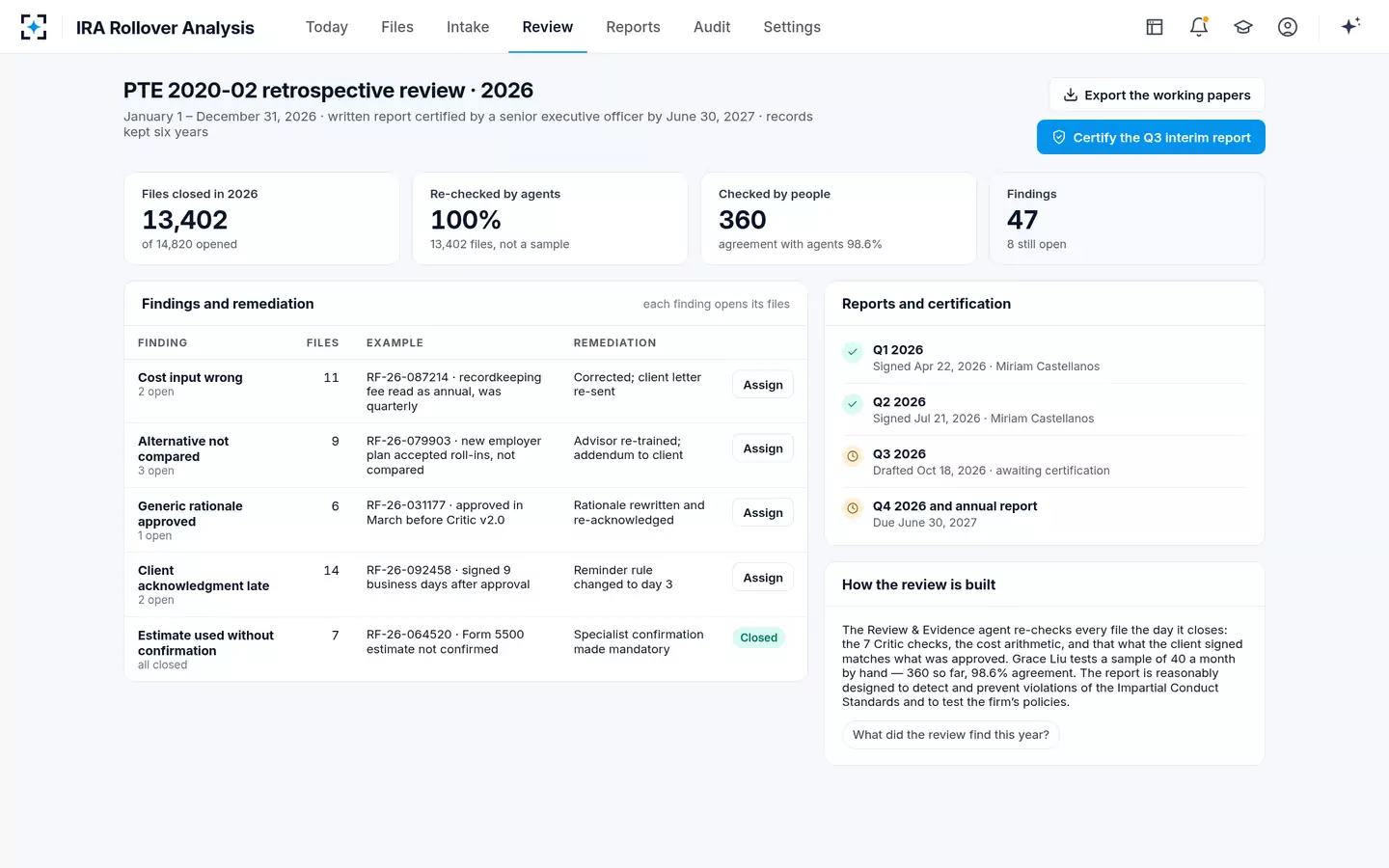
Grace Liu, the compliance analyst, tests 40 replayed files a month by hand. That is the check on the agents: 360 files so far, 98.6% agreement.
What did the replay find in the sample year?
Mostly process failures, not bad advice. Of the 47 findings, 14 were late client acknowledgments, 11 wrong cost inputs, 9 alternatives not compared, 7 estimated fees used before a specialist confirmed them, and 6 generic rationales approved, one of them in March, before the current version of the drafting check. Each group pointed to a control: the reminder schedule, the way a quarterly recordkeeping fee was read as annual, a new employer's plan that accepted roll-ins and was not priced.
One sample year of rollovers, replayed: what the report rests on
13,402
files closed and replayed in 2026, to late October
47
findings, grouped into five causes
8
findings still open, each assigned
98.6%
agreement between agents and a hand check of 360 files
The 98.6% figure deserves its own line in the report. A review done by agents is itself a procedure, and the officer is certifying that procedures are tested. The hand sample is that test: if agreement fell, the methodology section would say so and the replay's findings would be re-read by people. The same reasoning shapes how firms should evaluate any automated review, discussed in three ways to analyze a rollover.
How to build the written report the Senior Executive Officer certifies
Build it in the order the certification reads. First the methodology: the period, the population, whether every file was tested or a sample (and how the sample was drawn), the conditions tested and how each test works. Then the results: exceptions by condition and cause, with counts and examples. Then corrections: each violation corrected under Section II(e), with dates, so the self-correction notice and the report agree. Then changes: what was modified in the policies and procedures because of the findings, and how their effectiveness was tested.
Examiners will read it alongside the rest of the rollover program. The SEC Division of Examinations names "account and rollover recommendations" in its fiscal 2027 priorities (SEC, October 23, 2026), and FINRA's 2026 report records firms that collected a written rationale but did nothing when it was generic (FINRA, 2026 oversight report). A retrospective report that counts generic rationales approved, and shows the change made, answers both.
Every step of every rollover file on the record, for the report and for an exam
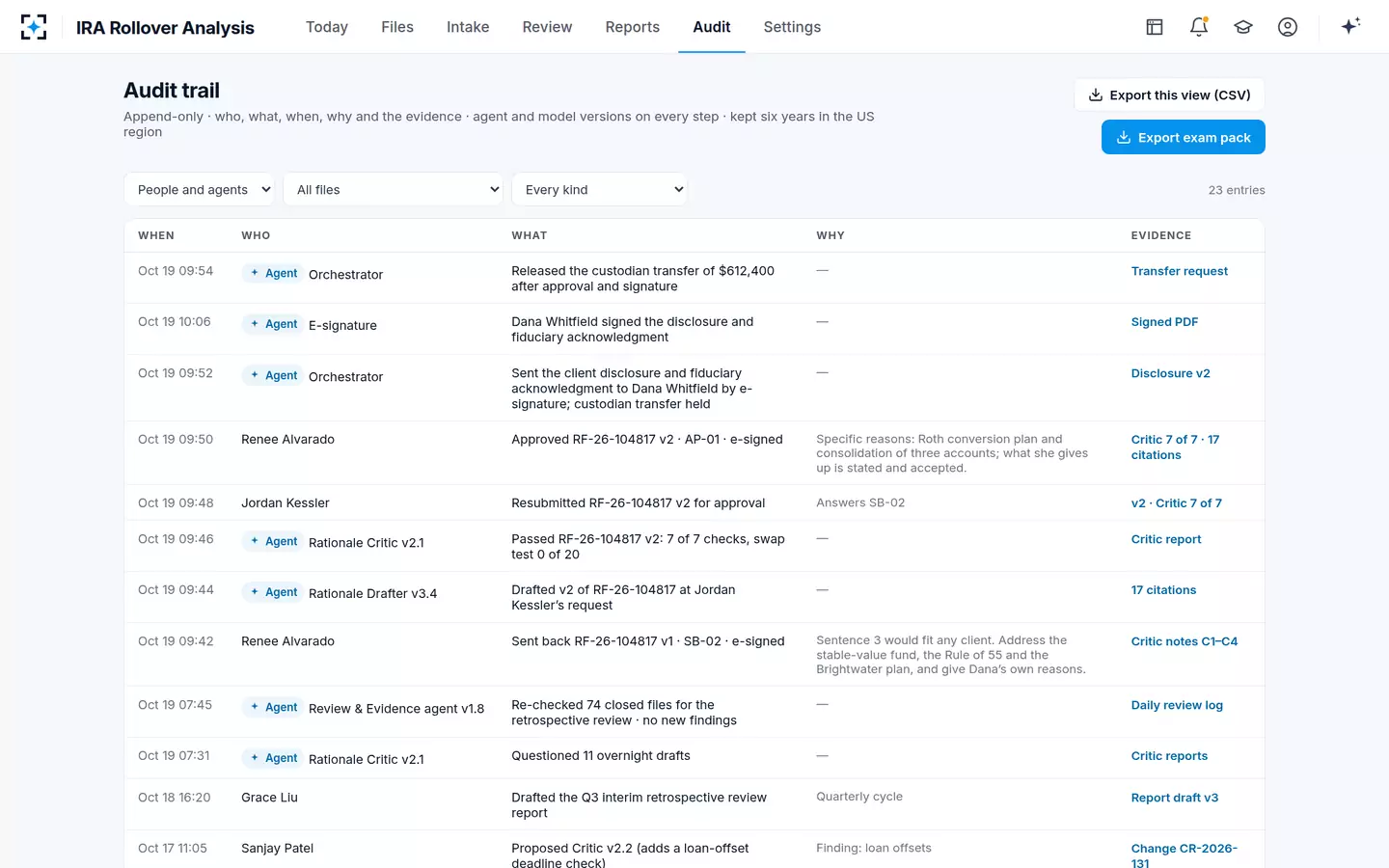
Where IRA Rollover Analysis does the replay, and where people decide
In IRA Rollover Analysis, the Review and Evidence agent re-checks each file the day it closes: the seven checks the Rationale Critic ran before approval, the cost arithmetic from the cited lines, and the match between what the client signed and what was approved. It groups findings, drafts the quarterly and annual report, and assembles the evidence for any file or period an examiner asks for, with a manifest of file fingerprints. It never certifies.
People keep the judgments the exemption gives them. A compliance analyst tests a monthly sample of the agent's work and assigns remediation; a supervisor fixes or re-approves a file; the chief compliance officer, as Senior Executive Officer, reads the report and signs. The replay changes when problems are found and how many, not who answers for them. The rationale checks it repeats are described in the rollover rationale critic.
Questions people ask
How often must the PTE 2020-02 retrospective review be done?
At least annually. The review, the written report and the Senior Executive Officer's certification must all be complete within six months of the end of the period reviewed, so a calendar-2026 review is due by June 30, 2027.
Is there a PTE 2020-02 retrospective review template?
The exemption prescribes no form. It fixes the contents instead: the methodology and results in a written report, and a certification of three statements by a Senior Executive Officer. Build the report in that order, with self-corrected violations listed, since Section II(e) requires them to appear in it.
Does the review have to be independent?
The exemption does not require an independent reviewer. It requires a review "reasonably designed" to detect and prevent violations and a certification by a Senior Executive Officer. Keeping the review apart from the people who approved the files makes its findings easier to defend.
What happens if the review finds a violation?
The firm can self-correct under Section II(e) if the investor had no loss or was made whole, the correction happens within 90 days of when the firm learned or should have learned of it, DOL is told by email within 30 days of the correction, and the violation and correction appear in the review's written report.
Does the retrospective review cover only rollovers?
No. It covers compliance with the Impartial Conduct Standards and the exemption's policies for all fiduciary advice the firm provides under PTE 2020-02, which includes advice on investing within a plan or IRA. Rollovers are usually its largest and most closely examined part.
How long must the retrospective review be kept?
Six years, including the report, the certification and the supporting data, and they must be produced to DOL within 10 business days of a request.