The SEC Reg BI documentation obligation is mostly a recordkeeping obligation: Exchange Act Rule 17a-3(a)(35) requires a broker-dealer to keep a record of all information collected from and provided to each retail customer under Reg BI, and Rule 17a-4(e)(5) sets how long. What Reg BI does not require is a written basis for every recommendation; the SEC said so when it adopted the rule in 2019. Yet most firms ask representatives to write a rationale anyway, and FINRA's 2026 oversight report criticises firms that collect those rationales without following up the generic ones. That is where supervision fails quietly: one note at a time, a copied phrase looks harmless; across a branch, it is a finding. Botminds' Reg BI Compliance Review reads every retail recommendation's written rationale overnight, groups the near-identical ones and traces where they came from, so a supervising principal sees the pattern rather than the ticket.
The patterns on this page come from the solution's fictional sample broker-dealer, Quillfield Securities, on one night of 4,812 retail recommendations. Regulators' words are quoted from the SEC's adopting release, rules and orders and from FINRA's published reports.
Six copied rationales covered 151 of one night's recommendations
Does Reg BI require documentation of each recommendation?
No. The SEC's 2019 adopting release says it directly: "While the Care Obligation does not require broker-dealers to document the basis for a recommendation, broker-dealers may choose to take a risk based approach when deciding whether or not to document certain recommendations." It gives the contexts where documenting makes sense, "such as the recommendation of a complex product, or where a recommendation" may "seem inconsistent with a retail customer's investment objectives on its face," and where the basis "is not evident from the recommendation itself."
"Documentation by itself will not cure a recommendation in circumstances in which a broker-dealer could not have reasonably believed the recommendation was in the best interest of the retail customer at the time the recommendation was made."
SEC, Regulation Best Interest adopting release, Release No. 34-86031, June 2019
The two sentences together describe the trap. A firm is free not to write rationales, but if it writes them, they become evidence, and evidence can cut both ways. A rationale that says nothing specific does not prove the care obligation was met; a rationale that contradicts the profile proves it was not. Neither one fixes a recommendation that was wrong at the time it was made.
What records does Reg BI require? Rules 17a-3(a)(35) and 17a-4(e)(5)
What Reg BI does require is a record of the exchange with the customer. Rule 17a-3(a)(35) applies "For each retail customer to whom a recommendation of any securities transaction or investment strategy involving securities is or will be provided," and requires "A record of all information collected from and provided to the retail customer pursuant to § 240.15l-1, as well as the identity of each natural person who is an associated person, if any, responsible for the account." Rule 17a-4(e)(5) says how long: at least six years, counted from the account's closing or from the date the information was collected, provided, replaced or updated, whichever comes first.
What the SEC requires a broker-dealer to keep for Reg BI, and what it leaves to the firm
| Record | Required? | Where it comes from |
|---|---|---|
| Information collected from the retail customer under Reg BI, such as the investment profile | Yes | Rule 17a-3(a)(35)(i) |
| Information provided to the customer under Reg BI, such as disclosures of capacity, fees and conflicts | Yes | Rule 17a-3(a)(35)(i) |
| Who was responsible for the account | Yes | Rule 17a-3(a)(35)(i) |
| How long to keep them | At least six years after account closure or after the information was collected, provided, replaced or updated, whichever is earlier | Rule 17a-4(e)(5) |
| The basis for each recommendation | No; the SEC suggests a risk-based approach | Adopting release, 2019 |
| Alternatives considered | No; staff say it may be hard to show compliance without it | SEC staff bulletin, 2023 |
| Rollover reasons for retirement accounts relying on the Labor Department exemption | Yes, under that exemption, not under Reg BI | PTE 2020-02 |
The SEC estimated in 2019 that keeping these records would cost broker-dealers an ongoing 5,520,800 hours a year in aggregate, most of it in retaining updated account documents and recording oral disclosures. It did not estimate the cost of writing or reading a rationale for every recommendation, because it did not require one. How that burden lands on firms of different sizes is worked through in Reg BI compliance at 12 reps and at 2,000.
When is Reg BI documentation expected anyway?
Wherever the firm will later need to show its reasoning, which in practice means complex products, recommendations that look odd against the profile, conflicted recommendations, account types and rollovers. SEC staff wrote in their 2023 bulletin on care obligations: "Although there is no requirement of such documentation, in the staff's view, it may be difficult for a firm to demonstrate compliance with its obligations to retail investors, or periodically assess the adequacy and effectiveness of its written policies and procedures, without documenting the basis for certain recommendations."
The examiners' complaint is not that firms skipped documentation but that they asked for it without saying what it should contain. The SEC's January 2023 risk alert described procedures that "Directed financial professionals to document the basis for their recommendations but did not give instructions as to when documentation is necessary or appropriate or the specific information to be gathered, which may make it difficult for the firm to review for compliance with Regulation Best Interest." A rationale form with one free-text box and no guidance produces exactly the notes that follow.
Rollovers are the exception where documentation is required, but by a different rulebook: firms relying on the Labor Department's PTE 2020-02 must document the specific reasons a rollover is in the retirement investor's best interest. What that file must hold, and how the annual review re-reads it, is in the PTE 2020-02 retrospective review.
What is a generic rationale?
A generic rationale is a written reason that would be just as true of any other customer: it names no fact from this customer's profile, no alternative, no cost and no reason for this product over another. "Client seeks growth and income." "Diversification." "Per client request." Each can be honest and still tell a reviewer nothing about whether the recommendation was in the customer's best interest.
Real files show how generic reasons sit beside recommendations that did not fit. The SEC's November 2024 order against Lion Street Financial reproduced the stated purposes on its L Bond forms, written for customers whose concentration in a speculative, illiquid bond the SEC found was not in their best interest. A risk acknowledgment, present in every one of the six purposes the SEC quoted, recorded that the customer had been told; it said nothing about why the product fitted.
Stated purposes on L Bond forms, against the customers they were written for
| Customer | Share of liquid net worth in L Bonds | Stated purpose on the form |
|---|---|---|
| 78, retired, income $66,000 | 33% | "Client is needing additional income to help cover the expense of cancer treatments. Client understands the risks." |
| Married couple, 83 and 80, retired | 23% | "Clients want more predictable monthly income. Clients aware of all risks." |
| 58, homemaker, liquid net worth $74,000 | 40% | "Client wanting to generate income. Aware of all risks." |
| 66, retired, retirement savings | 33% | "[C]lient wants a predictable amount of income from this investment and understands risks involved." |
What did FINRA find about rationales?
FINRA's 2026 Annual Regulatory Oversight Report, published in December 2025, lists among Reg BI findings firms "requiring documentation of rationale, but not following up on generic or insufficient rationales" (FINRA, Reg BI and Form CRS). The finding sits under account recommendations, beside "not following up on red flags such as identified patterns of account switches." Its annuities section, as an effective practice, describes exchange rationales that "are not generic or insufficient."
FINRA's April 2026 action against Cambridge Investment Research shows what "not following up" costs. Supervisory staff escalated concerns from June 2020 about the volume of alerts on one representative's early sales of unit investment trusts "but also the vague rationales he provided to justify those recommendations." The supervisors did not question his stated reasons. When the firm finally investigated, in 2023, 184 customers had paid at least $389,200.62 in costs they would not have incurred by holding to maturity; the firm repaid them and FINRA fined it $200,000 (FINRA, June 2026).
Thirty-seven identical notes: why the risk is the pattern
A generic rationale is easy to miss one at a time and impossible to miss in aggregate. A principal reading a ticket sees five ordinary words. The same principal cannot see that the same five words are on 36 other tickets from the same branch that night, written by four advisors, for annuities, structured notes and A-share funds alike. Only a view of the whole night shows that.
Every rationale a dot: copied reasons show up as tight clusters
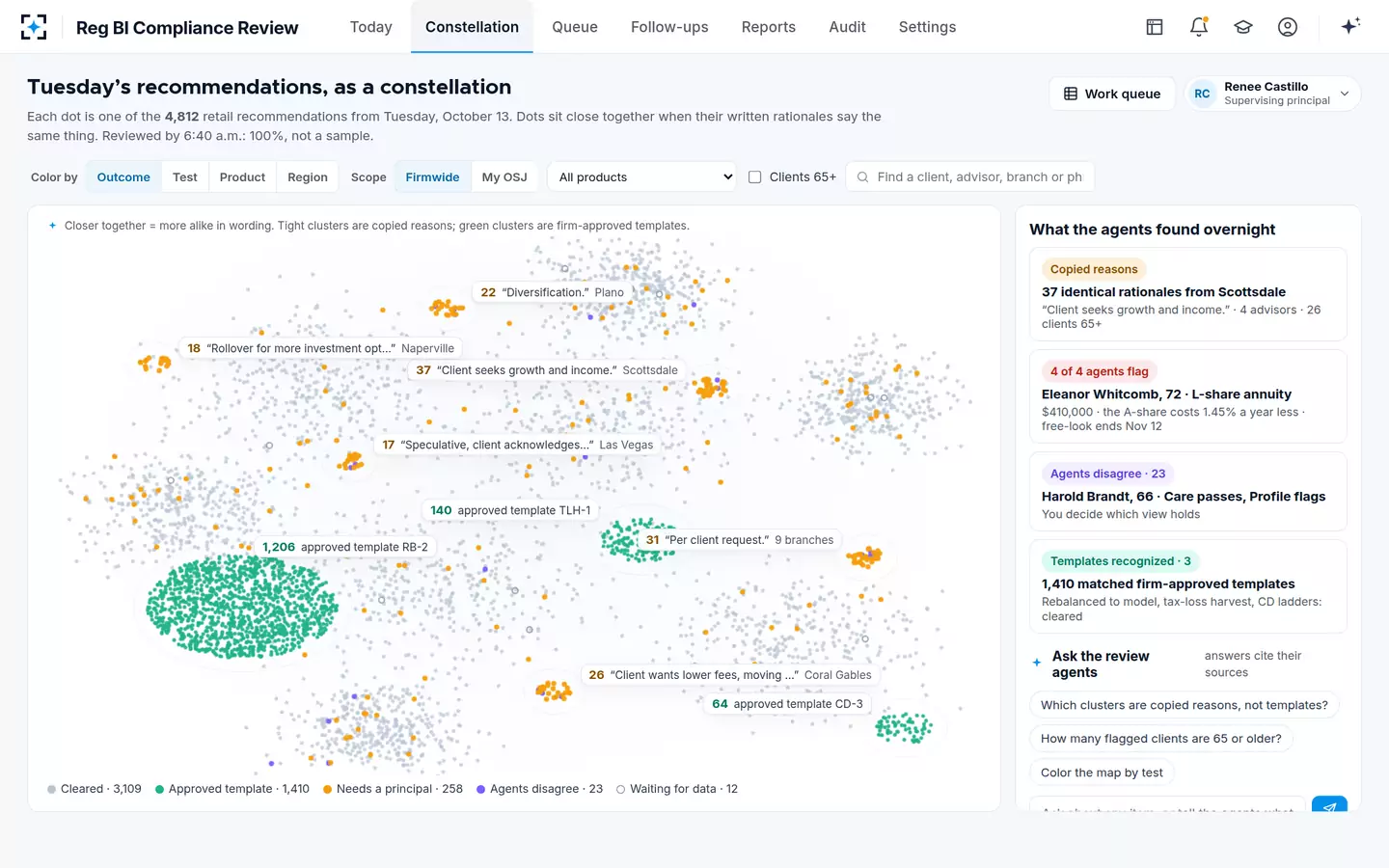
In the sample, the Rationale agent traced the Scottsdale phrase to a document on the branch's shared drive, a list of six "approved" phrases that was never a firm template, last changed on June 30, 2026. It then looked back: from July 1 to October 2, before the overnight review went live, the same phrase appeared on 186 earlier recommendations that sampling never read, six of them long-horizon purchases of L-share annuities or C-share funds now past the free-look date. Those six went to the chief compliance officer as possible restitution, an estimated $48,210 in all.
One cluster: four advisors, one branch file, one follow-up for all 37
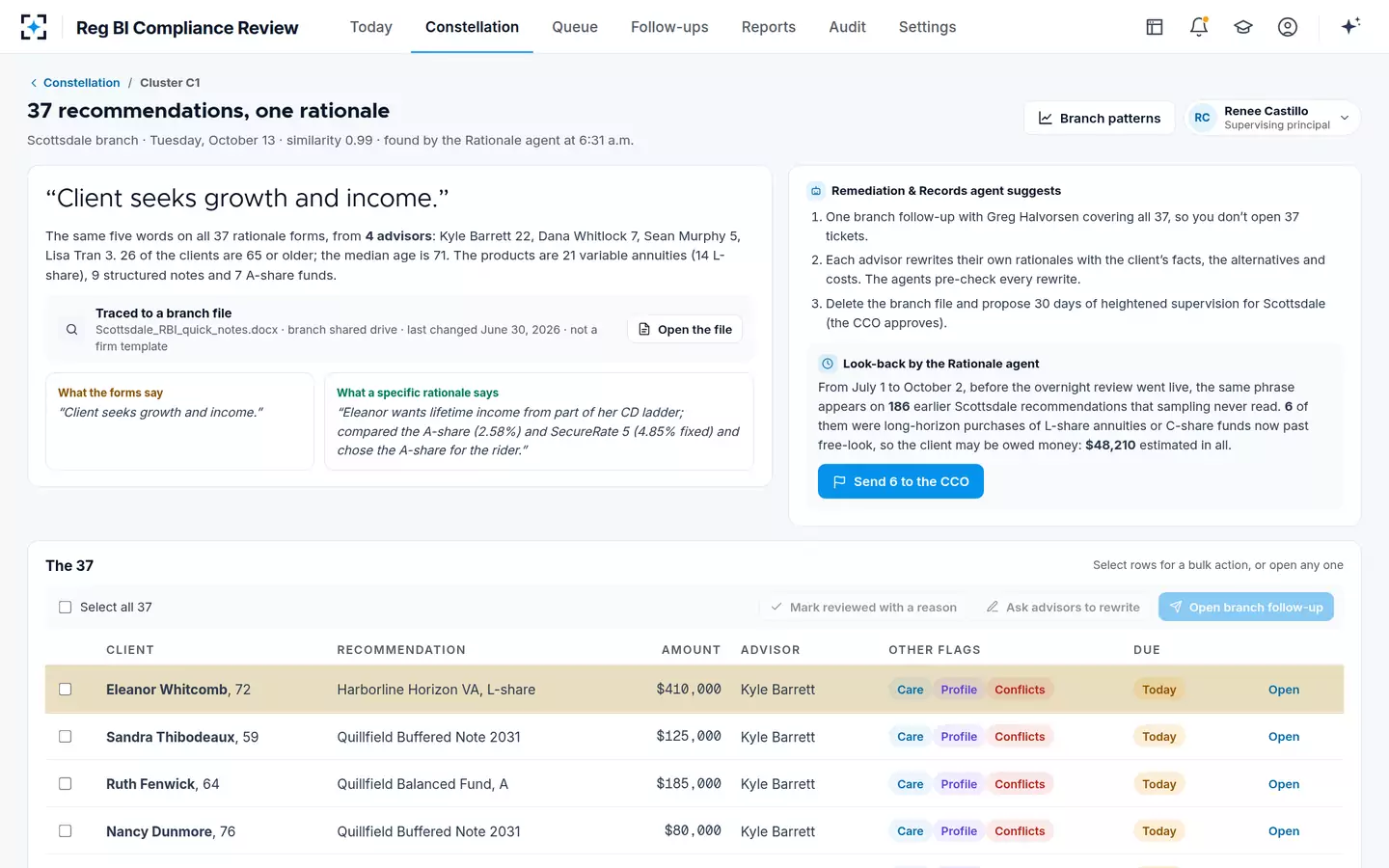
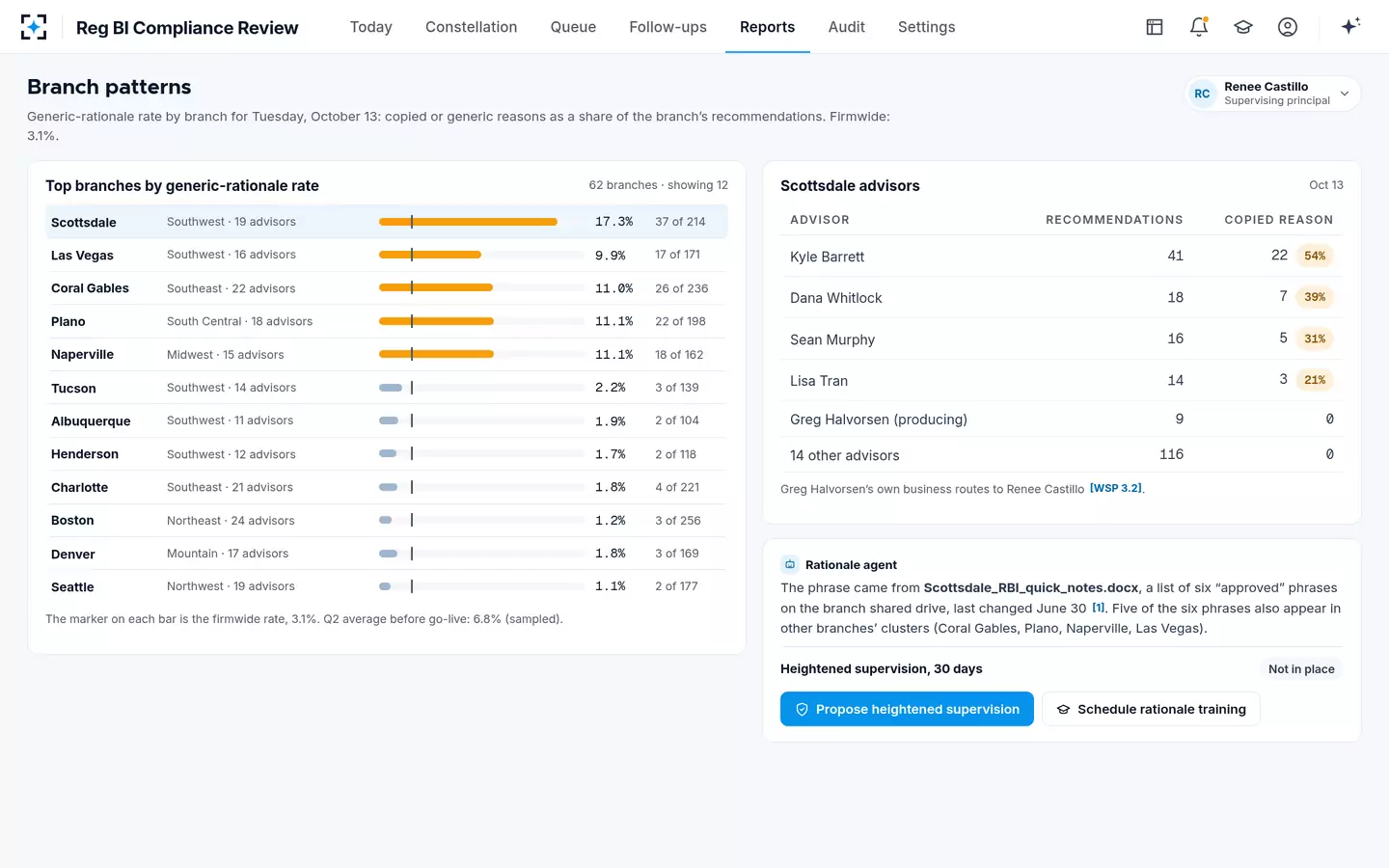
The branch view turns the pattern into a supervision question. Scottsdale's copied-rationale rate that night was 17.3%, 37 of 214 recommendations, against 3.1% firmwide; one advisor's was 54%. Before the overnight review, the firm's sampled average for the second quarter had been 6.8%. A branch manager can act on those numbers; a principal reading one ticket at a time never sees them.
Can firms use rationale templates?
Yes, for recommendations whose reason really is the same for every customer, and as long as the template is the firm's, approved and recognisable. Rebalancing an account back to its agreed model, harvesting a tax loss, rolling a maturing CD into the next rung of a ladder: the reason is standard because the recommendation is. The sample firm's three approved templates covered 1,410 recommendations in one night, and the review recognises and clears them rather than flagging them as copies.
What a template cannot do is stand in for the customer-specific test on a recommendation that needs one. A variable annuity, a structured note, a switch, a rollover, a complex product for an older customer: each needs a rationale that names the customer's facts and the alternatives weighed. The difference between a firm template and a branch's "quick notes" file is also a control question, because an unapproved list of phrases spreads faster than any training.
What a specific Reg BI rationale names, in a sentence or two
- The customer's objective, in their terms
Lifetime income from part of the CD money, not "growth and income".
- The fact that decided it
Horizon, liquidity need, tax position or a life event, with where it is recorded.
- The alternatives weighed, with their costs
At least the same-objective alternatives on the firm's shelf, and the same product's cheaper class.
- Why this product or class over those
The feature the customer needs that the cheaper alternatives lack, or the reason cost was outweighed.
- Anything on the face of it that looks wrong
Concentration, age, a complex product, a switch soon after a purchase, and why it is nonetheless in the customer's interest.
A rationale that names those things also makes the reviewer's job fast: the supervising principal checks the stated facts against the file instead of reconstructing the reasoning. In Reg BI Compliance Review the Rationale agent never rewrites what an advisor wrote; it marks what is missing, and the advisor's reply is checked against the original findings before the principal sees it. The test those notes are read against is set out in the Reg BI care obligation; the review itself starts at Reg BI Compliance Review.
Copied reasons by branch, with the file they came from
Questions people ask
What are the Reg BI documentation requirements?
Rule 17a-3(a)(35) requires a record of all information collected from and provided to each retail customer under Reg BI and the identity of the associated person responsible for the account; Rule 17a-4(e)(5) requires keeping it at least six years after the earlier of account closure or the date the information was collected, provided, replaced or updated. The basis for each recommendation is not a required record.
Is a Reg BI rationale form required?
No rule requires one. Many firms use them because the SEC suggests documenting complex products and recommendations that look inconsistent with the customer's objectives, and because staff say compliance is hard to demonstrate without it. If a firm requires rationales, its procedures should say when, what to include, and who reads them.
Does a written rationale protect a firm in an exam?
Only if it is specific and true. The SEC said in 2019 that documentation "by itself will not cure" a recommendation that could not reasonably have been believed to be in the customer's best interest; a generic rationale on such a recommendation adds a supervision finding to the care finding.
How do you find generic rationales at scale?
By comparing every rationale with every other, not by reading them one by one. Near-identical wording across many recommendations, very short reasons, reasons that contradict the profile and phrases that trace back to an unapproved source are the four signals; the sample firm flags rationales under 12 words and clusters of five or more at a similarity of at least 0.92.
Do hold recommendations need documentation?
Not under Reg BI itself. Explicit hold recommendations, and implicit holds where the firm has agreed to monitor the account, are covered by the care obligation, and the same risk-based approach to documentation applies to them as to purchases and sales.