A Reg BI checklist is a list of the questions Regulation Best Interest asks of each recommendation, or of a firm's procedures, answered yes or no: is the profile current, were costs considered, were reasonably available alternatives reviewed, were conflicts addressed, is the rationale documented. It is useful for making sure nothing is skipped. It is not evidence that the recommendation was in the customer's best interest, because a box can be ticked whether or not the thing it names happened, and SEC and FINRA cases since 2020 include files where the forms were complete and the facts were wrong. The fix is to pair every box with a check that can fail. Botminds' Reg BI Compliance Review was built that way: instead of asking whether the representative ticked "alternatives considered," its agents re-price the alternatives on the firm's shelf, compare the rationale with the profile and with every other rationale that night, and show the supervising principal where the file and the facts disagree.
The worked ticket on this page comes from the solution's fictional sample broker-dealer, Quillfield Securities; the checklist column is our illustration of how a typical form could record it.
Five ticked boxes on one annuity recommendation, and what the evidence behind each shows
What the checklist records: Yes: profile reviewed, updated March 2026.
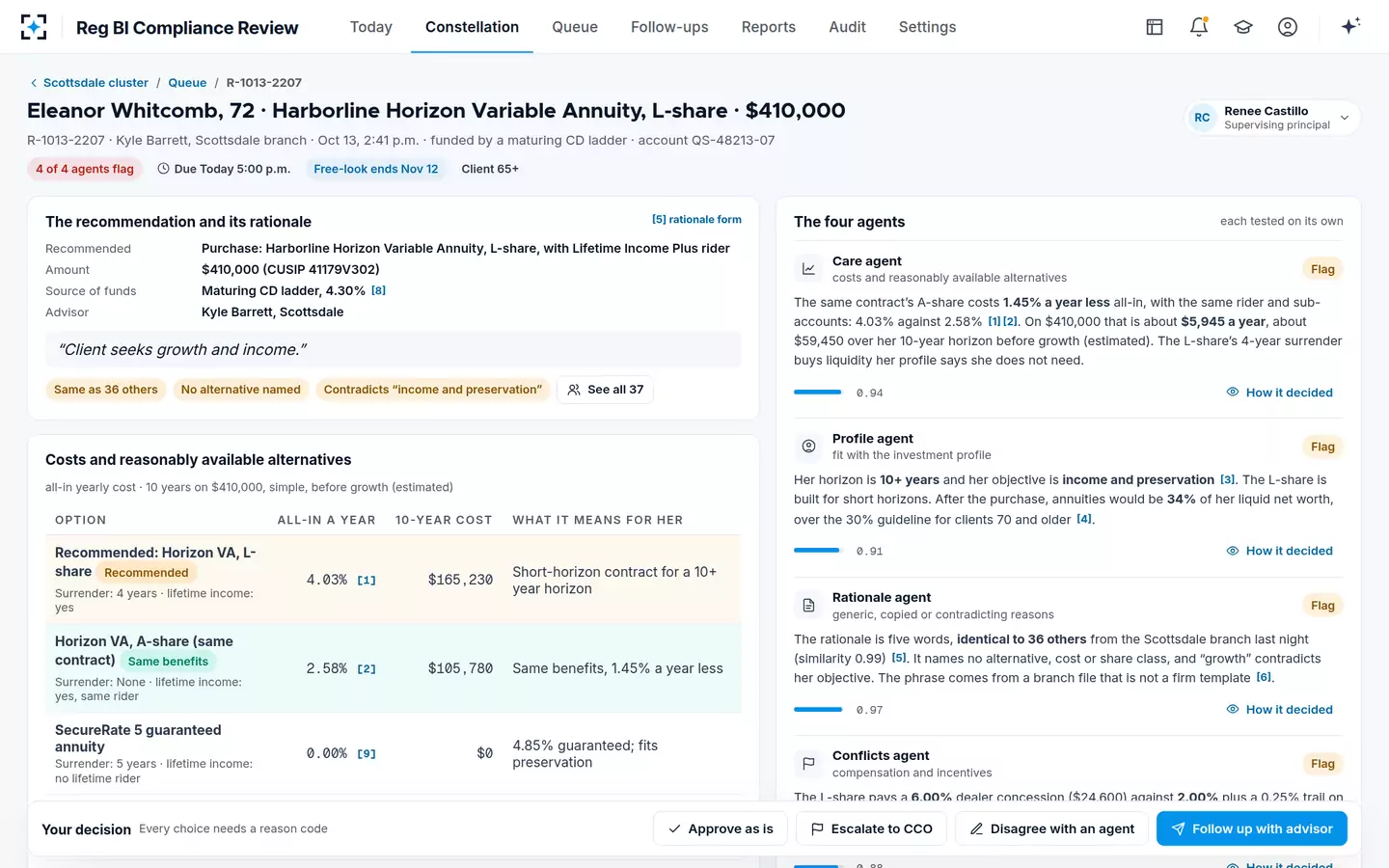
What a check that can fail finds: Objective income and preservation, horizon 10+ years, low liquidity need. The recommended L-share is a short-surrender contract.
What the checklist records: Yes.
What a check that can fail finds: The same contract's A-share, same rider and funds, costs 1.45% a year less: about $59,450 over her ten-year horizon on $410,000.
What the checklist records: Yes.
What a check that can fail finds: The written rationale names no alternative at all.
What the checklist records: Yes: "Client seeks growth and income."
What a check that can fail finds: Identical to 36 other rationales from the same branch that night, and "growth" contradicts her stated objective.
What the checklist records: Yes: reviewed.
What a check that can fail finds: Annuities would be 34% of liquid net worth, above the firm's 30% guideline at 70 and older; the L-share pays a 6.00% concession against 2.00%.
What should a Reg BI checklist include?
A ticket-level Reg BI checklist should follow the care obligation's three tests and the conflict obligation: the product is understood and could suit some retail customers; the customer's profile is current and complete; the recommendation fits that profile; costs were weighed over the customer's horizon; reasonably available alternatives were considered; the representative's compensation was not the reason; and, over recent activity, the series of trades is not excessive. Each item needs the evidence it rests on, recorded beside it.
A firm-level checklist asks different questions: whether procedures exist for each obligation. FINRA's own Reg BI and Form CRS Firm Checklist, which FINRA says it last updated on February 10, 2026, is of this kind: 22 questions on Reg BI, from "Do you consider costs when making a recommendation?" to "Have you implemented training to ensure that APs are aware of Reg BI's requirements?", and eight on Form CRS. FINRA is careful about what it proves: the tool is "not a substitute for any rule," and using it "does not guarantee compliance with or create any safe harbor." A firm that has answered all 22 has a map of its procedures, not evidence that its recommendations meet them.
Why did the SEC criticise Reg BI policies?
Because many of them told representatives what to consider without saying how, and built tools nobody had to use. The SEC Division of Examinations' January 2023 risk alert listed policies that "Directed financial professionals to consider costs without providing any guidance as to how to do so," and systems that were optional.
"Created systems that allowed financial professionals to evaluate costs or reasonably available alternatives but did not mandate their use (or, in some instances, firms could not determine whether or not financial professionals used the systems (e.g., because they lacked supervisory review documentation))."
SEC Division of Examinations, risk alert on Regulation Best Interest, 30 January 2023
A checklist item that says "alternatives considered" is the same weakness in a smaller box. It records the representative's statement that the comparison happened. It does not record the comparison, so a supervisor cannot tell a careful representative from a quick one, and an examiner cannot tell the firm's file from its policy. FINRA's 2026 report lists, as an effective practice, "using worksheets, in paper or electronic form, to compare costs and reasonably available alternatives" (FINRA, Reg BI and Form CRS): a worksheet holds the numbers, which a tick does not.
A box ticked is not a test passed
The enforcement record has a recurring scene: the forms were complete and the facts were wrong. In the SEC's August 2025 order against Emerson Equity, a representative would complete the paperwork for his customers, "including checking all boxes on the Investor Suitability Questionnaire attesting to the customer's high-risk tolerance, liquidity needs, investment goals, and investment experience." Ten questionnaires stated that the customers had "Extensive (10+ years)" of experience in every listed asset class, including options, venture capital and commodities; at least four had very little investment experience. The questionnaire even ended with a checkbox in which the customer acknowledged "this is a high-risk investment and is meant to be held long-term." Every form would have passed a completeness check.
When the paperwork passed and the recommendation did not
| Case | What the form or policy said | What was true |
|---|---|---|
| Emerson Equity, SEC, August 2025 | Questionnaires: extensive experience in every asset class; high risk tolerance | At least four customers had very little experience; 10 customers put 16% to 72% of liquid net worth into L Bonds |
| Western International, SEC, July 2024 | Updated account and options forms showed more aggressive objectives and higher risk tolerance | The representative updated them with false information, or had customers sign them, after compliance raised concerns about his trading |
| Lion Street Financial, SEC, November 2024 | Policy: paperwork "completed in full", questionable items followed up | L Bond paperwork had errors, blanks and inconsistencies the firm did not resolve |
| Arkadios Capital, FINRA, February 2026 | Representatives cautioned to consider holding periods for daily-reset ETFs | No system to check whether they did; 47 recommendations to 36 customers went undetected |
| Cambridge Investment Research, FINRA, April 2026 | Procedures for variable annuity exchanges | No report or alert on representatives' exchange rates; 22 inappropriate exchanges cost 14 customers $129,938.79 in surrender fees |
The Western case shows the worst version: the forms were changed to make the file pass. The SEC found that the representative "either updated his customers account opening and options eligibility forms with information that was false or directed the customers to complete the updated forms" with inaccurate information, in response to the compliance department's concerns. A checklist that asks "is the risk tolerance consistent with the strategy?" would have been answered yes. A check that compared the new profile with the old one, and the date of the change with the date of the compliance inquiry, would have failed.
Five checks that can fail
A check can fail when it compares the file with something the representative did not write. Each of the five below does that, and each maps to a box on the usual checklist. They are what Reg BI Compliance Review's agents run overnight on every retail recommendation in the sample firm; a firm without agents can run the same checks by hand on a sample, more slowly.
Five Reg BI checks that can fail, and the box each one replaces
- Re-price the alternatives instead of ticking "costs considered"
Compute the all-in yearly cost and the cost over the customer's horizon for the recommendation and the same-objective alternatives on the shelf, from the fee tables. Flag a same-feature alternative cheaper by more than the firm's threshold (0.25% a year in the sample firm).
- Read the rationale against the profile instead of ticking "rationale documented"
Does it name the customer's facts and an alternative, and does it contradict the stated objective, horizon or liquidity need? The sample firm flags rationales under 12 words.
- Compare the rationale with every other one that night instead of reading it alone
Near-identical wording across many recommendations is a copied reason, unless it matches a firm-approved template.
- Check the profile's age and history instead of ticking "profile current"
When was it last updated, against the firm's limit (36 months in the sample firm), and did it change shortly before a recommendation it now supports?
- Compute concentration and payout instead of ticking "reviewed"
Product type as a share of liquid net worth after the purchase, against the firm's guideline, and the representative's pay on the recommendation against the nearest alternative.
The checks that can fail, on one recommendation
The Reg BI account type recommendation checklist
Account recommendations need their own items, because the cost comparison runs over years and the alternatives are account types, not products. SEC staff's 2022 bulletin on account recommendations lists the investor characteristics to consider beyond the usual profile: the customer's "anticipated investment strategy (e.g., buy and hold versus more frequent trading); level of financial sophistication; preference for making their own investment decisions or relying on advice from a financial professional; and the need or desire for account monitoring or ongoing account management." It lists the account characteristics too: the services and products provided, "the projected costs to the retail investor; alternative account types available; and whether the account offers the services requested by the retail investor."
One item a checklist must not accept is the customer's preference on its own. The staff answer the question directly: if a retail investor expresses a preference for an account type, "you would not satisfy the standards based on the retail investor's preference alone." A box marked "client requested advisory account" is the start of the file, not the end. Account recommendations that move retirement plan money also bring the Labor Department's documentation requirements, and a rollover form needs its own test; the rollover rationale form guide shows one.
What should a Reg BI checklist ask about complex products and older customers?
More than the standard items, because that is where regulators look first. The SEC's fiscal 2027 examination priorities, published on 23 October 2026, say examinations "will focus on those recommended products that are complex or have heightened risk factors," and will assess recommendations "made to older and vulnerable investors and those saving for retirement or college" (SEC, FY2027 priorities). The SEC staff's 2023 care bulletin asks firms to apply "heightened scrutiny" to complex or risky products, and names examples: inverse or leveraged exchange-traded products, investments traded on margin, derivatives, crypto asset securities, penny stocks, private placements, asset-backed securities, volatility-linked products and reverse-convertible notes (SEC staff bulletin on care obligations).
For those recommendations a checklist should add three items, each with its evidence: whether a less complex, less risky or cheaper alternative could meet the same objective; whether the customer has an objective consistent with the product's design and can withstand its risk of loss; and who, above the representative, reviewed the reasoning. The sample firm turns the third into a rule rather than a box: any complex product for a client aged 65 or older always goes to a person, and is never cleared automatically. Every case in the table above involved a complex, illiquid or high-risk product or strategy, and several involved customers at or near retirement.
How to tell a valid file from an accurate one
A valid file has every field filled and every box ticked; an accurate one has fields that are true and boxes backed by evidence that would survive a second reader. The difference can be measured. Take a month of closed recommendations, run checks that can fail on each one, and count how many files that passed the checklist fail a check. That rate, not the checklist completion rate, is the number that tells a chief compliance officer whether supervision is working.
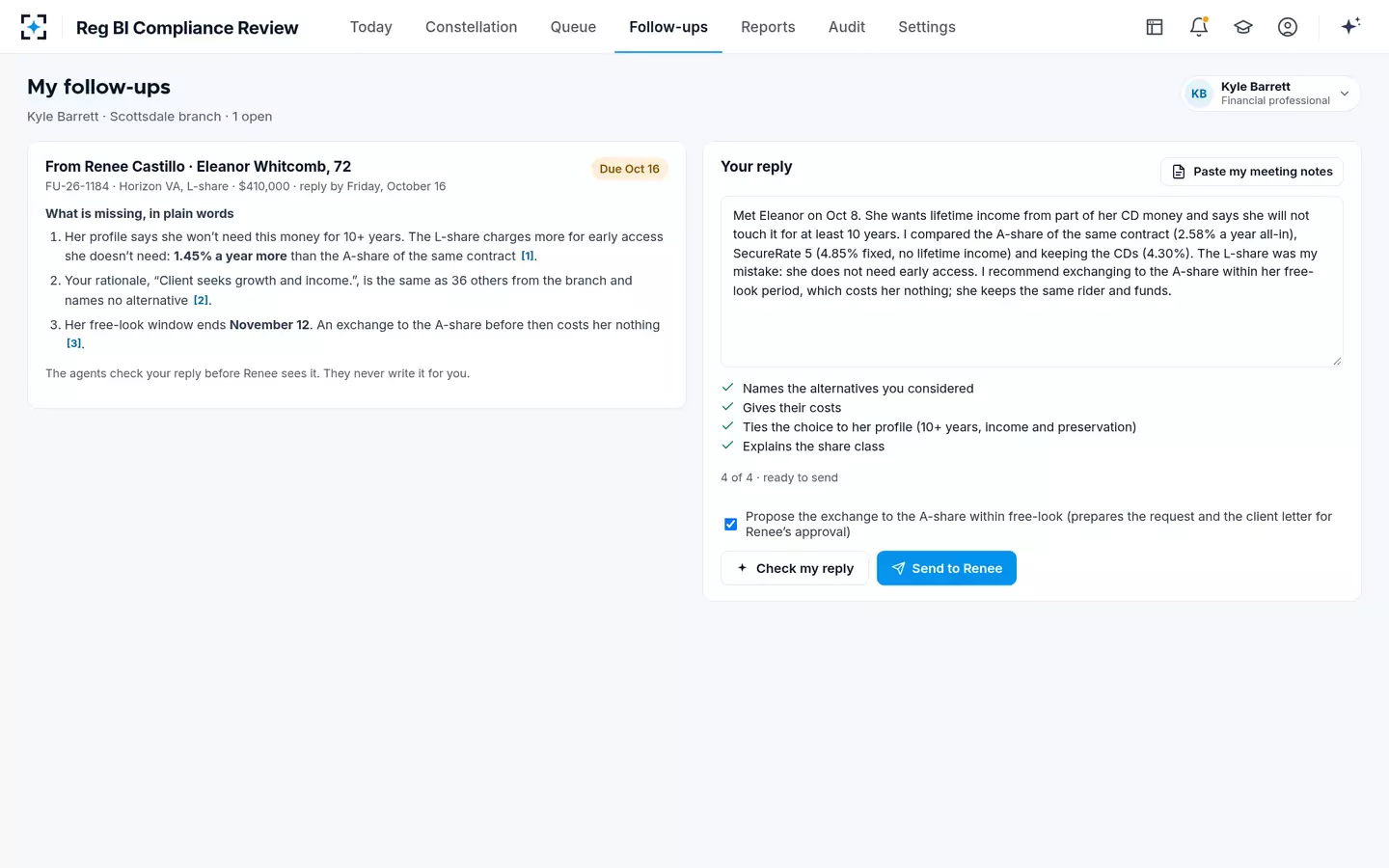
The checks also change what the representative is asked for. In the sample firm, the advisor whose ticket is shown above did not get a request to "complete the checklist"; he got three specific items: her profile says ten years, so explain the L-share against the A-share; your rationale is the same as 36 others and names no alternative; her free-look window ends on November 12. His reply named the alternatives and their costs, tied the choice to her horizon and proposed an exchange, and the agents checked it against each finding before the principal saw it.
Instead of a checklist, the advisor sees what is missing
A checklist still has a place: it tells a new representative what the firm expects and gives a supervisor a consistent order to read in. It stops being a control the moment it is treated as the evidence. The care obligation behind the boxes is set out in the Reg BI care obligation, the shelf behind "alternatives considered" in reasonably available alternatives, and the review that runs the checks in Reg BI Compliance Review.
Questions people ask
Is there an official FINRA Reg BI checklist?
Yes. FINRA publishes a Reg BI and Form CRS Firm Checklist, last updated on February 10, 2026, with 22 Reg BI and eight Form CRS questions about a firm's procedures. FINRA says it is not a substitute for the rule and that using it does not guarantee compliance or create a safe harbor.
What is a standardized Reg BI checklist?
Usually a firm's one-page form completed for each recommendation, covering profile, costs, alternatives, conflicts and rationale. Standardisation helps consistency; it also makes it easy to tick every item the same way, which is why each item should carry the figure or fact behind it.
Does completing a checklist satisfy the Reg BI compliance obligation?
No. The compliance obligation requires written procedures "reasonably designed to achieve compliance" that the firm establishes, maintains and enforces. A checklist can be part of those procedures, but the SEC has criticised tools that existed without being required or checked, and firms are judged on whether recommendations actually met the standard.
How often should a Reg BI checklist be tested?
Whenever the firm's products, systems or procedures change, and periodically on closed files. Running checks that can fail on a month of past recommendations shows whether files that passed the checklist would pass a real test; a large gap means the checklist is measuring completion, not compliance.
Who should sign off a Reg BI checklist?
The representative completes it, but the review belongs to a registered principal: FINRA Rule 3110 requires principal review of transactions, evidenced in writing. A principal's sign-off should rest on the evidence behind each item, such as the cost comparison and the profile, not on the representative's ticks.