Reg BI reasonably available alternatives are the other investments, strategies or account types a broker-dealer can make available that would meet the same retail customer's objective, and the care obligation expects the firm to weigh them before it recommends anything. The rule text never uses the phrase; it comes from the SEC's 2019 adopting release and the staff's 2023 bulletin on care obligations, which says the Commission expects "a reasonable process for establishing and understanding" the scope of alternatives to consider. In practice that means a shelf defined per objective and profile, consulted before the sale and checked after it. Botminds' Reg BI Compliance Review tests every retail recommendation against the firm's own shelf overnight and shows the supervising principal the alternatives and their costs side by side; this guide shows what has to exist first for that test to mean anything.
The examples come from the solution's fictional sample broker-dealer, Quillfield Securities, and one of its recommendations: $410,000 from a maturing CD ladder into a variable annuity L-share for a 72-year-old client. Staff bulletins quoted here are statements of SEC staff views, not rules.
One profile's shelf: from what the firm can offer to the comparable few
1 · What the firm can offer
Which investments and strategies can this firm's professionals make available for the objective "income, with a lifetime guarantee if needed"?
- Variable annuities, every share class
- Fixed and fixed indexed annuities
- Income funds and conservative model portfolios
- CDs and Treasuries
- Structured notes
- Non-traded REITs
2 · Narrowed by this profile
Age 72, moderately conservative, income and preservation, horizon 10+ years, low liquidity need.
- Out: structured notes and non-traded REITs (loss potential and illiquidity against a moderately conservative profile)
- In: annuities, conservative portfolios, CDs
3 · The comparable few, priced
Same objective, different risks, rewards and costs, set side by side before anything is recommended.
- Variable annuity L-share: 4.03% a year
- Same contract, A-share: 2.58% a year
- Five-year guaranteed annuity: 4.85% fixed, no lifetime rider
- Conservative income portfolio: 1.32% a year
- Keep the CD ladder: 4.30% yield
What are reasonably available alternatives under Reg BI?
They are the comparison the care obligation needs before a recommendation can be called the customer's best interest. A broker-dealer does not have to find the single best product in the market, or recommend the cheapest; it has to consider what it could reasonably offer this customer for this objective and have a reason for its choice. In the staff bulletin's words, it "would be difficult for firms and their financial professionals to form a reasonable basis to believe a recommendation or advice is in the retail investor's best interest without considering alternatives that are reasonably available to achieve the investor's investment objectives."
Two things follow for a supervisor. The alternatives are the firm's, not the market's: what the firm's professionals can make available, shaped by its business model and customer base. And they are per customer: a product on the shelf is not an alternative for a customer whose profile it does not fit. Both are design decisions the firm has to write down, because a review cannot test against a shelf nobody defined.
Why the shelf has to exist before the recommendation
SEC staff expect the comparison to shape the recommendation, not to justify it afterwards. The bulletin says consideration of alternatives "should begin early in the process of formulating a recommendation or providing advice rather than as a retroactive exercise undertaken after the firm or financial professional has already decided what to recommend." FINRA's 2026 oversight report lists the same thing as an effective practice: "advising that reasonably available alternatives be considered before a recommendation has been formulated."
The staff describe the process as a funnel. It "should begin by considering a broader array of investments or investments strategies that are generally consistent with the retail investor's investment profile, and then narrowing to a smaller universe." The narrowing is driven by the profile: "if the retail investor has a high need for liquidity, the financial professional should consider excluding investments with longer time horizons and limited or no secondary market." The staff also warn against the reverse order, picking a product and then hunting for look-alikes to call alternatives; the comparison should begin with "the types of products that would achieve exposure" to the objective.
A shelf built that way is a firm-level object: for each common objective (growth, income, preservation, tax advantage, lifetime income), the product types that can meet it and the profile facts that exclude each. A representative uses it to build the recommendation. A reviewer uses the same object to test it, which is why it has to be written before either of them starts.
How many alternatives must be considered?
Enough to support a reasonable belief that the choice is in the customer's best interest; the staff give no number. At a firm with an open architecture, a representative "does not have to evaluate every possible alternative available through the firm," but "would still need to evaluate a range of potential alternatives sufficient to have a reasonable basis." At a firm with a limited menu, the representative "generally should be familiar with each of those investments," and the firm "cannot rely on a limited menu to justify recommending an investment" that is not in the customer's best interest.
The limited-menu answer has a sharp edge. Picking the least bad option from a short list is not enough: the staff say one possible outcome of the process "is that the firm or financial professional may conclude that no investment or investment strategy they offer is in the retail investor's best interest," in which case recommending any of them would fail the care obligation. A shelf design therefore needs a defined way to say "nothing here fits," and supervision needs a way to see when representatives never say it.
Are share classes of one fund alternatives?
Not on their own. The staff bulletin uses the mutual fund case as its example: comparing the share classes of a single fund is unlikely to count as considering reasonably available alternatives, and the evaluation should instead start with other investments and investment types the firm can offer for the same objective. The same-product comparison still matters for cost. It is simply not the whole comparison.
The sample annuity shows both halves. The same-contract A-share, with the same rider and funds, costs 1.45% a year less than the L-share; that is the share-class comparison, and it is the sharpest cost finding in the file. But the staff's broader comparison asks other questions too. A five-year guaranteed annuity pays 4.85% fixed with no annual fee and fits "preservation", but has no lifetime income rider. A conservative income portfolio costs 1.32% a year and stays liquid but guarantees nothing. Keeping the CD ladder yields 4.30%, insured. The alternatives do not have to be identical: the staff say their features "do not need to be an exact match so long as the risks, rewards and costs associated with the alternatives are consistent with the retail investor's investment profile."
Ten years of cost on $410,000: the comparable few are not close
What did the SEC and FINRA find about alternatives in exams?
Examiners keep finding the instruction without the process. The SEC's January 2023 risk alert on Reg BI exams described policies that "Directed financial professionals to consider reasonably available alternatives without providing any guidance as to how to do so," and gave the missing pieces in a parenthesis: "establishing the scope of alternatives to consider or systems to use for considering reasonably available alternatives in formulating a recommendation." That parenthesis is the shelf. FINRA's 2026 report found, in annuities, "insufficient consideration of reasonably available alternatives" (FINRA, annuities).
The pressure has not eased. The SEC Division of Examinations' fiscal 2027 priorities, published 23 October 2026, list "(3) processes for reviewing reasonably available alternatives" among the Reg BI areas it will examine, alongside account and rollover recommendations and the care obligation's "consideration of costs" (SEC, FY2027 priorities). The products it names include variable and registered index-linked annuities, private placements, structured products and alternative investments: exactly the products where like-for-like alternatives are hardest to define.
An alternatives policy examiners criticised, and one the staff describe
What the risk alert found: Consider reasonably available alternatives, with no guidance on how to do so.
What the staff bulletin describes: Guidance that "defines the scope of alternatives that should be considered and the factors that should be weighed."
What the risk alert found: No scope of alternatives set by the firm, so each representative drew their own.
What the staff bulletin describes: Start broad with what the firm can make available, then narrow by the customer's profile.
What the risk alert found: Consider costs, with no word on which costs or how to weigh them.
What the staff bulletin describes: Weigh costs, benefits, risks and fit with the profile for each alternative.
What the risk alert found: Systems that could compare costs and alternatives, but whose use was not required.
What the staff bulletin describes: A reasonable process tailored to the firm's business model and offerings.
What the risk alert found: Firms that could not tell whether representatives used the systems at all.
What the staff bulletin describes: A written note of the alternatives weighed where the choice looks inconsistent with the profile or conflicted.
Reasonably available alternatives in account type recommendations
The same logic applies when the recommendation is an account rather than a product. SEC staff's 2022 bulletin on account recommendations says a dually licensed professional must make the best-interest evaluation "taking into consideration the spectrum of accounts you offer," brokerage and advisory alike, and that a recommendation cannot rest on the firm's limited product menu or the professional's licensing.
Here the alternatives are priced over the life of the holding, not per trade. The care bulletin's example is blunt: "a retail investor whose objective is to buy and hold a long-term investment may be better off paying a one-time commission to a broker-dealer for the purchase of that investment rather than paying an ongoing advisory fee merely to hold the same investment." A shelf of account types per objective, with the expected all-in cost of each over the customer's horizon, makes that comparison testable. Rollovers out of workplace plans add the plan itself as an alternative, which IRA Rollover Analysis covers in its own series.
How do you document alternatives considered?
Write down the alternatives actually weighed, their costs, and the profile fact that decided between them. The rule does not require the note; SEC staff say documentation of alternatives "can be particularly important where a recommendation may seem inconsistent with a retail investor's investment objectives on its face and/or poses conflicts of interest for the firm or the financial professional." The sample annuity is both: a short-surrender product for a long-horizon client, paying a 6.00% concession against 2.00% on the cheaper class. Why the documentation question matters across a whole book of recommendations is the subject of the SEC Reg BI documentation obligation.
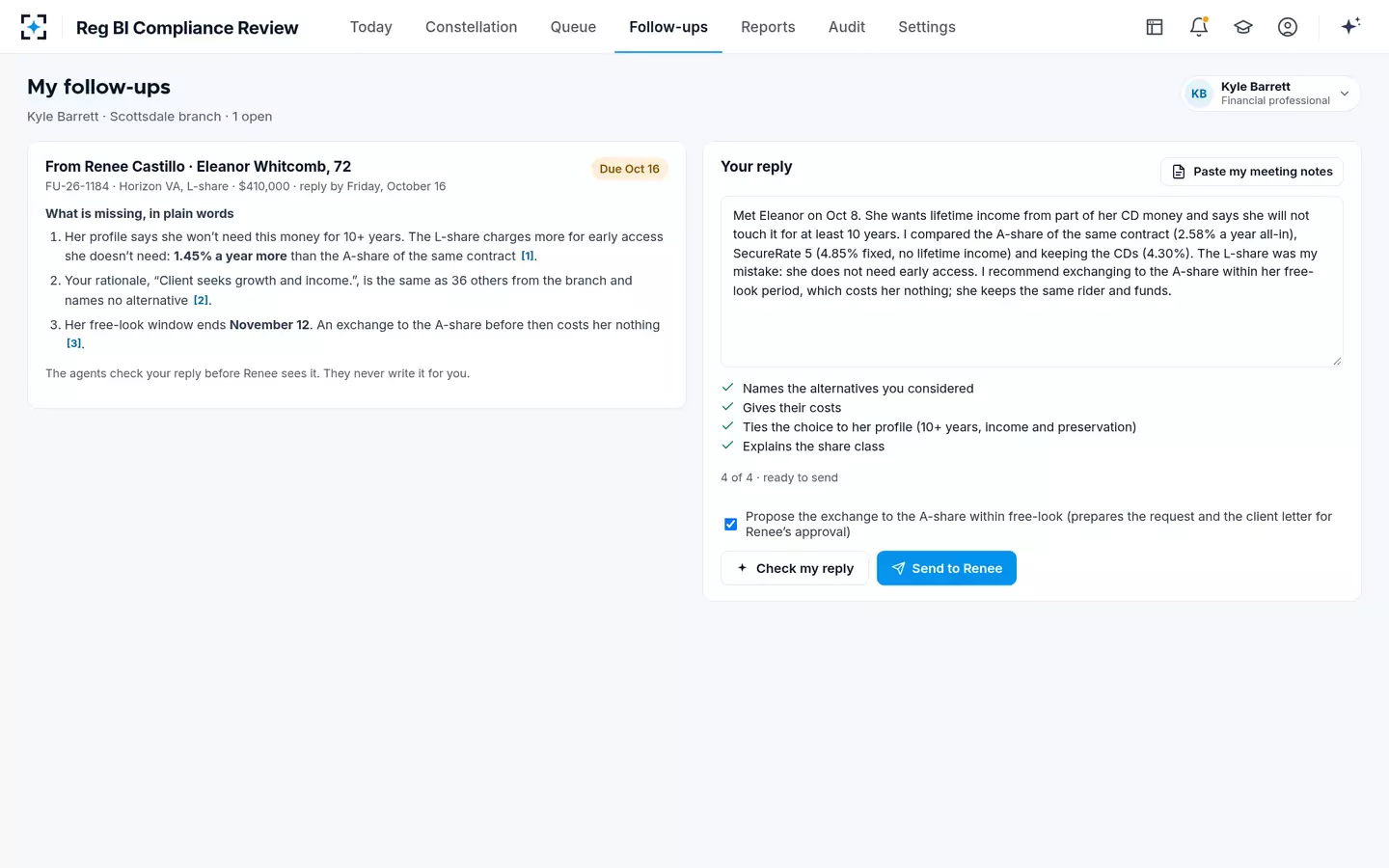
A good alternatives note is short. In the sample firm, the advisor's corrected reply reads like this: he met the client, she wants lifetime income from part of her CD money and will not touch it for at least ten years; he compared the same contract's A-share at 2.58%, the guaranteed annuity at 4.85% fixed with no lifetime income, and keeping the CDs at 4.30%; the L-share was his mistake because she does not need early access. Four facts, three alternatives, one reason. FINRA's 2026 report notes firms "updating client relationship management (CRM) tools to automatically compare recommended products" as an effective practice; a comparison generated before the meeting is how such notes become routine.
The advisor's reply names the alternatives and their costs
What a supervisor can test once the shelf exists
Once the shelf is written down, alternatives stop being a matter of opinion and become three checks a reviewer or an agent can run on every recommendation. Was a same-objective alternative on the shelf materially cheaper with the same features? If so, does the file name a profile fact that justifies the difference? And did the representative consider anything outside the chosen product family at all? In Reg BI Compliance Review those checks are settings the firm's chief compliance officer approves: the Care agent flags a same-feature alternative at least 0.25% a year cheaper over the client's horizon, cites the prospectus page for every figure, and never treats cheapest as best.
Building a reasonably available alternatives shelf a supervisor can test
- List the objectives your representatives actually serve
Growth, income, preservation, tax advantage, lifetime income, short-term saving. Each gets its own shelf.
- For each, name the product and account types that can meet it
What your firm can make available, not the market. An open-architecture firm names categories; a limited-menu firm names products.
- Write the profile facts that exclude each type
High liquidity need excludes long lock-ups; short horizon excludes long surrender schedules; low risk tolerance excludes products that can lose principal.
- Price each type the same way
All-in yearly cost and cost over the customer's horizon, from prospectus fee tables and the firm's own schedules, including exit costs.
- Set the comparison before the meeting, not after
Generate the narrowed, priced shelf when the representative starts a recommendation, so the note records a choice rather than a defence.
- Define what a material difference is
A cost gap, a risk gap or a missing feature that triggers a reason in the file. The sample firm uses 0.25% a year for same-feature alternatives.
- Allow "nothing on the shelf fits"
A form with no such option teaches representatives that something always fits.
- Test it on last month's recommendations
Before relying on it, run the shelf over closed files and read the exceptions. If it flags nothing, it is not testing anything.
The order matters. A firm that buys a comparison tool before defining its shelf ends up testing representatives against a vendor's product universe rather than its own, which is neither what the staff describe nor what the firm can defend. The care test this shelf feeds is set out in the Reg BI care obligation, and the full overnight review starts from Reg BI Compliance Review.
Questions people ask
What is a reasonable range of alternatives?
One wide enough to support a reasonable belief that the recommendation is in the customer's best interest, given the firm's business and the customer's profile. SEC staff say a professional at an open-architecture firm need not evaluate every possible alternative, but must evaluate a range sufficient for that belief; a professional at a limited-menu firm should know each product on the menu.
Do reasonably available alternatives have to be identical products?
No. SEC staff say products that are not identical can still be comparable, and that their features need not match exactly so long as the risks, rewards and costs fit the customer's profile. For an annuity with a lifetime income rider, a guaranteed annuity without one is a real alternative to discuss, even though it is a different product.
Does Reg BI require recommending the cheapest alternative?
No. The SEC said in 2019 that a broker-dealer is not required to recommend the single best or the least expensive option. If it recommends something more costly or risky than an alternative that fits, it needs a reasonable basis grounded in the customer's profile, such as a feature the customer needs.
Has anyone been sanctioned for not considering alternatives?
The SEC staff bulletin cites settled adviser cases from 2021 and 2022 in which firms bought money market funds that paid them revenue sharing while lower-cost funds with similar strategies were available, among them Rothschild Investment Corp. (September 2021) and O.N. Investment Management (January 2022). These are fiduciary-duty cases under the Advisers Act; the Reg BI cases covered in this series turn more on product understanding and fit.
Do alternatives apply to recommendations to hold?
Where a firm provides ongoing monitoring, SEC staff say the consideration of alternatives may continue "throughout the investment period," not only before the purchase. Without an agreement to monitor, Reg BI imposes no duty to revisit a holding.