VCOC stands for venture capital operating company: a fund that, under the Labor Department's plan asset regulation, counts as an "operating company" because at least 50% of its assets, valued at cost, are invested in operating companies over which it holds management rights, and because it actually exercises those rights. A VCOC can take any amount of pension money without its portfolio becoming ERISA plan assets. A fund that is not a VCOC, or a real estate operating company, stays outside ERISA only by keeping benefit plan investors below 25% of each class of its equity. The choice between the two routes is made by counsel when the fund is structured, but it decides what the onboarding desk has to check on every booklet, which is where Botminds' LP Onboarding does its work.
The rules here are quoted from 29 CFR 2510.3-101 and ERISA section 3(42). Where a sample is used, it is fictional: Quillfield Capital's funds, as they appear in the solution.
The VCOC test in four numbers
50%
of assets, valued at cost, in venture capital investments, on the initial valuation date or within each annual valuation period
90days
the longest an annual valuation period may last; it starts no later than the anniversary of the initial valuation date
12
months of VCOC status each passing test buys, provided management rights are actually exercised
10years
the longest a distribution period can extend VCOC status once half the investments have been returned
What does VCOC mean?
VCOC means venture capital operating company, a category in the Labor Department's 1986 plan asset regulation under which a fund that works alongside its portfolio companies' management is treated like an operating business rather than a pool of capital. The regulation defines an operating company as one "primarily engaged, directly or through a majority owned subsidiary or subsidiaries, in the production or sale of a product or service other than the investment of capital", and then deems a VCOC and a real estate operating company to be operating companies too (29 CFR 2510.3-101(c)(1)).
The consequence is the whole point. A plan that invests in an operating company owns its shares, not an undivided interest in the company's assets, so the company's managers do not become the plan's fiduciaries. A fund that qualifies as a VCOC gets the same treatment, whatever its benefit-plan share.
What is the VCOC exemption, in the regulation's words?
The VCOC exemption has two limbs, and a fund must meet both. The asset limb: on its initial valuation date, or at any time within an annual valuation period, "at least 50 percent of its assets (other than short-term investments pending long-term commitment or distribution to investors), valued at cost, are invested in venture capital investments" or derivative investments. The conduct limb: during the following 12 months, the entity "in the ordinary course of its business, actually exercises management rights" over one or more of the operating companies it invests in (29 CFR 2510.3-101(d)(1)).
A venture capital investment is an investment in an operating company "as to which the investor has or obtains management rights". A derivative investment is one whose management rights ended when the company went public, or one received in exchange for a venture capital investment in an IPO or a merger made for independent business reasons. It stops counting at the later of ten years from the original investment or 30 months after it became derivative (29 CFR 2510.3-101(d)(3) and (d)(4)).
VCOC or the 25% test: four questions in order
1Is the interest a publicly offered security, or issued by a registered investment company?
YesOutside the look-through rule. The plan owns only its interest.
NoGo on.
2After every acquisition, do benefit plan investors hold under 25% of each class, with the manager and its affiliates left out?
YesOutside, on the 25% route. Re-test at each subscription and transfer.
NoGo on: the fund needs an operating-company route.
3Is at least 50% of its assets, at cost, in operating companies where it holds management rights, and does it actually use them?
YesA venture capital operating company (VCOC), for the next 12 months. Re-test each annual valuation period.
NoGo on.
4Is at least 50% of its assets, at cost, in real estate it manages or develops, and is it engaged directly in that work?
YesA real estate operating company (REOC), on the same annual cycle.
NoIts assets are plan assets: limit plan money, or run the fund as an ERISA fiduciary.
What are VCOC management rights?
Management rights are "contractual rights directly between the investor and an operating company to substantially participate in, or substantially influence the conduct of, the management of the operating company" (29 CFR 2510.3-101(d)(3)(ii)). Three words carry the test. The rights must be contractual, not merely the voting power that comes with shares. They must run directly between the fund and the company, not through another investor. And they must be substantial: the right to participate in or influence management, typically a board seat or observer seat, consultation rights with senior management, and access to information.
Having the rights is not enough; the fund must use them. The regulation's examples are generous on how much use is required. A fund whose managers routinely consult with only one portfolio company where it holds management rights, while relying on co-investors to advise the others, is still a VCOC: "the mere fact that V does not participate in or influence the management of all its portfolio companies does not affect its characterization" (29 CFR 2510.3-101(j)(5)).
What is a VCOC letter?
A VCOC letter, also called a management rights letter, is the contract between the fund and a portfolio company that creates the management rights the regulation requires. The regulation does not use the phrase; it asks for "contractual rights directly between the investor and an operating company", and a short letter agreement signed at each investment is how funds usually create them. Because the asset limb is measured at cost, each investment either counts toward the 50% because a letter is in place, or does not.
The letter is evidence for the conduct limb too, but only of rights, not of their use. A fund that wants to show in an annual valuation period that it "actually exercises" those rights needs its own record: board minutes, the consultation calendar, the notes of meetings with management. A letter with no visits behind it proves half the test.
Does a fund need VCOC if benefit plans stay under 25%?
No. Either route keeps the fund's assets from being plan assets: the regulation lets a fund out if it is an operating company "or" if equity participation by benefit plan investors "is not significant", and ERISA section 3(42) defines not significant as under 25% of each class immediately after the most recent acquisition (29 U.S.C. 1002(42)). A fund can therefore take the 25% route and cap plan money, or be structured as a VCOC if it expects pension commitments above the cap and invests in a way that can meet the test.
Two routes outside ERISA, and what each asks of the fund
The 25% route: The benefit-plan share of each class, with the manager and its affiliates left out.
The VCOC route: The fund’s portfolio: 50% at cost in investments with management rights, and their actual use.
The 25% route: Immediately after every acquisition of an interest: each subscription, each transfer.
The VCOC route: On the initial valuation date, then in each annual valuation period of up to 90 days.
The 25% route: Yes: benefit plan investors must stay under 25% of each class.
The VCOC route: None, while the fund qualifies.
The 25% route: The onboarding desk, on every booklet and every transfer.
The VCOC route: The deal team and counsel, at each investment and each annual period.
The 25% route: The fund holds plan assets from that acquisition until a later one brings it back under 25%.
The VCOC route: No VCOC status for the next period; the fund falls back on the 25% test, if it can meet it.
The 25% route: Funds of funds, credit and hedge funds, any fund that cannot or will not take management rights.
The VCOC route: Venture and buyout funds that sit on boards; some lenders with strong covenants.
Which test do real estate funds use?
A real estate fund uses the real estate operating company test if it can, or the 25% test if it cannot. A REOC must have at least 50% of its assets, valued at cost, "invested in real estate which is managed or developed and with respect to which such entity has the right to substantially participate directly in the management or development activities", and must be "engaged directly in real estate management or development activities" in the ordinary course of business (29 CFR 2510.3-101(e)).
The regulation's examples draw the line clearly. A fund owning properties on long-term leases, where the tenant handles substantially all management and maintenance, is not a REOC: assuming "the risks of ownership of income-producing real property" is not management. A fund owning shopping centres let on short leases to many merchants, using independent contractors it supervises and can dismiss, is a REOC, even without employees of its own (29 CFR 2510.3-101(j)(7) and (j)(8)). A net-lease fund therefore usually takes the 25% route, and its onboarding desk carries the same per-booklet test as a credit fund.
What happens if a VCOC fund misses its annual valuation period?
It loses VCOC status for the following 12 months, because status lasts only "for the 12 month period following the expiration of an annual valuation period" in which the fund passed. The annual valuation period is "a preestablished annual period, not exceeding 90 days in duration, which begins no later than the anniversary of an entity's initial valuation date", and once set it "may not be changed except for good cause unrelated to a determination" (29 CFR 2510.3-101(d)(5)(ii)).
A VCOC's first three years: status is earned one valuation period at a time
- Initial valuation datefirst deal
- VCOC status, if 50% metto the end of the first annual period
- Valuation periodup to 90 days
- Status for 12 monthsif 50% met and rights used
- Valuation periodsame window
- Status for 12 monthsor fall back on 25%
Two features of the calendar trip funds up. VCOC status starts only on the initial valuation date, so the fund's first long-term investment must itself be a qualifying venture capital investment, and before that date the fund has no VCOC status to rely on; counsel decides how plans are protected between the first close and the first deal. And at the end of a fund's life, a distribution period keeps the status while the fund winds down, from a date after it has returned at least half of its highest investments at cost until it makes a "new portfolio investment" or ten years pass (29 CFR 2510.3-101(d)(2)).
What a VCOC fund should hold before each annual valuation period
- The fixed dates of the annual valuation period, set in advance.
Changing them needs good cause unrelated to the result.
- A cost-basis schedule of every investment, with short-term holdings separated.
The 50% test is at cost, not fair value, and excludes cash pending investment.
- A signed management rights letter for every investment counted.
Rights must run directly between the fund and the operating company.
- Evidence the rights were used in the past 12 months.
Board and observer attendance, consultation notes, at least one company where the fund substantially participated.
- A list of derivative investments and the dates they stop counting.
The later of ten years from the original investment or 30 months after it became derivative.
- The fallback: each class’s benefit-plan share.
If the VCOC test fails, the 25% test is the only route left, and it needs the onboarding desk’s numbers.
What the onboarding desk does under each route
On the 25% route, the onboarding desk is the control. Every booklet's ERISA page moves a number that must stay under 25% in each class, so each one must be read, cross-checked against the investor type and added to a live calculation before the GP accepts it. That is the work LP Onboarding automates: the Benefit-plan agent recomputes the 25% test of the plan asset regulation after every booklet and stops a package that would cross, for the CFO to decide.
The 25% limit as a setting in LP Onboarding, per class and per vehicle
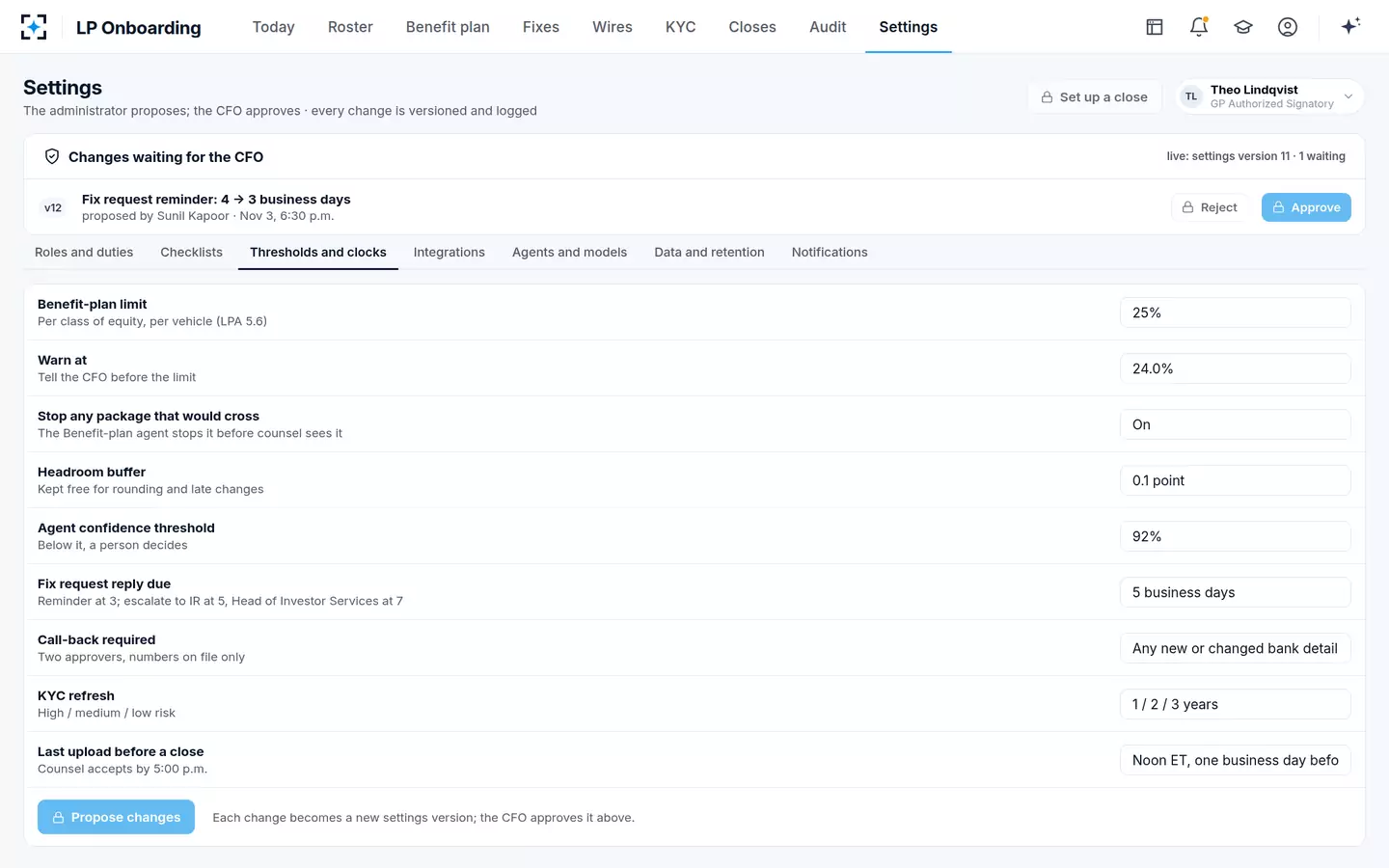
On the VCOC route, the desk's job changes but does not vanish. The ERISA page still identifies which investors are plans, which matters for the plans' own reporting and for the representations the fund gives them. It still feeds the fallback, because a fund that fails its annual valuation period needs to know, that day, whether its classes are under 25%. And a VCOC fund's parallel vehicles and feeders are separate entities: a feeder that holds only an interest in the main fund is not itself an operating company merely because the main fund is a VCOC, and may need its own 25% test. In LP Onboarding the stop is a setting, so a VCOC fund can keep the calculation running as a warning without stopping booklets.
The booklet's ERISA page, read in LP Onboarding and cited to the page
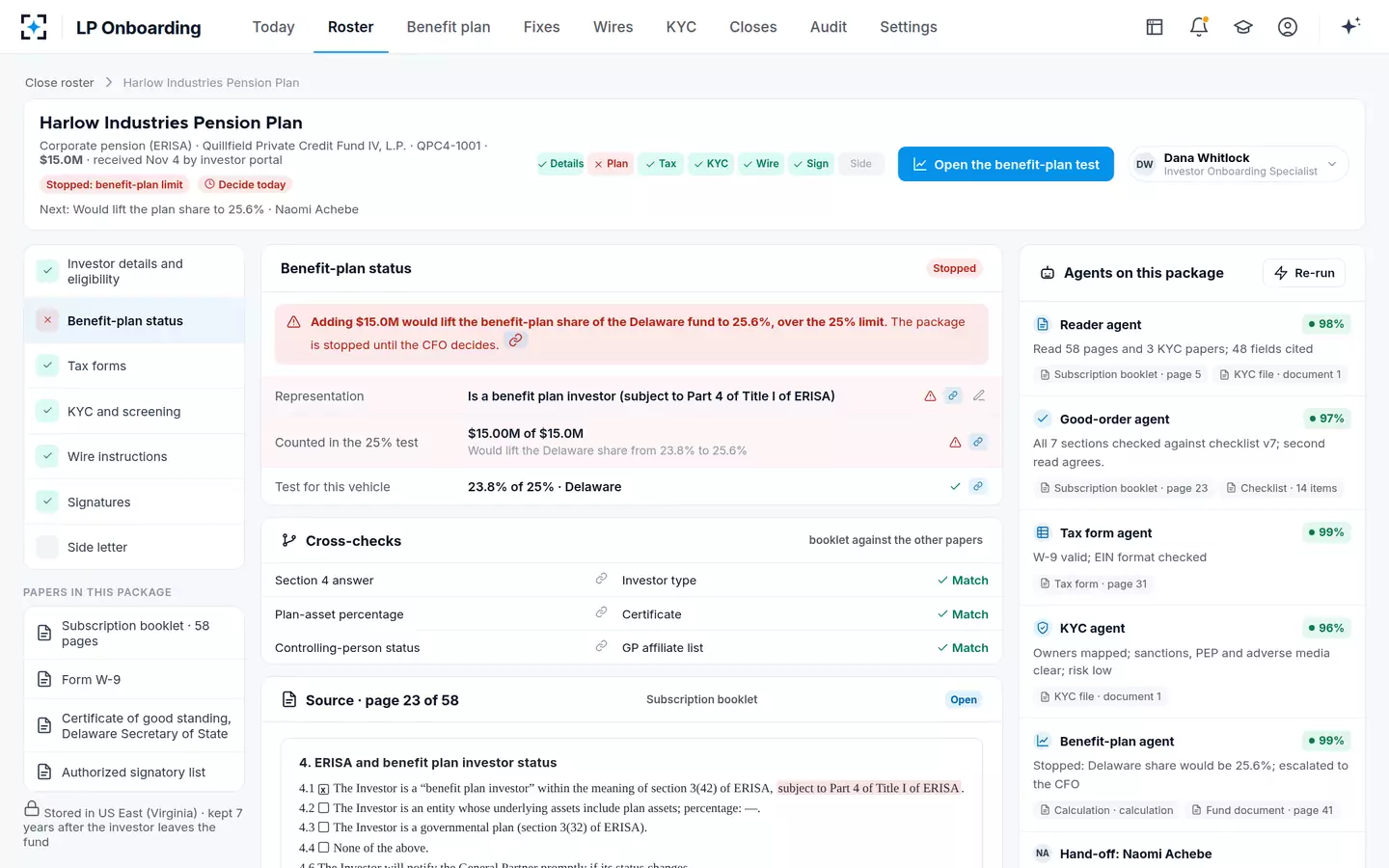
How the calculation works booklet by booklet is set out in the ERISA 25% plan asset rule, and the entities that hold plan assets themselves, such as funds of funds, are treated in passthrough subscription documents. To see the test on your own funds, start from LP Onboarding.
Questions people ask
Is a private credit fund a VCOC?
It can be. The regulation's example of a fund investing in its portfolio companies' debt says debt will not prevent VCOC status, provided the fund actually obtains the right to substantially participate in or influence management, through covenants stronger than an established company's private placement would carry, and actually exercises it. A lender holding ordinary covenants does not qualify and usually takes the 25% route.
Does a feeder fund share the main fund's VCOC status?
Not automatically. The test applies entity by entity, and a feeder whose only asset is an interest in the main fund is not, on its own facts, investing in operating companies with management rights. Counsel decides how each feeder and parallel fund is protected, often by the 25% test.
Can a fund rely on VCOC before it makes its first investment?
No. VCOC status begins on the initial valuation date, which is the later of a date the fund designates and the first date it makes an investment that is not a short-term investment pending long-term commitment. Until then there is no VCOC status, which is why the first investment must itself qualify.
Are VCOC management rights the same as a board seat?
A board seat is the usual way to hold them, but the test is broader: contractual rights directly with the company to substantially participate in, or substantially influence, its management. Consultation rights with senior management and information rights, written into a letter agreement and actually used, are common alternatives.
Does a VCOC fund still have to ask investors about ERISA status?
In practice, yes. The fund needs to know which investors are benefit plans for the representations it gives them, and it needs each class's benefit-plan share as a fallback in case a valuation period fails. The question is cheap to ask and expensive to reconstruct.