Investor onboarding automation tools are the software a private fund, its administrator or its manager uses to take limited partners from a subscription booklet to admission: collecting booklets, checking them, screening investors, validating tax forms and moving accepted investors into the register. The newer kind uses AI agents for the work in between, and the question a buyer should ask is not how much it automates but which tasks it takes and which it must leave alone. Of the 23 tasks in a close, reading, cross-checking, recomputing the ERISA 25% test and drafting fix requests can move to agents; the decisions the rules attach to a person, such as the AML officer's clearance, counsel's acceptance and the GP's countersignature, cannot. Botminds' LP Onboarding gives investor services eight AI agents built on that division, and nothing in it accepts, decides, signs or sends without a named person.
The grid below uses the solution's own design and its fictional sample close, Quillfield Private Credit Fund IV's 84-investor first close. Regulators' statements are quoted from their own publications.
23 tasks in a fund close, divided between LP Onboarding's agents and the people who decide
Log each booklet and match it to the investor and vehicle
WhoIntake agent
Agent does it
Spot new versions and duplicates; ask for a rescan of an unreadable page
WhoIntake agent
Agent does it
Read every section in its original language, citing each field to its page
WhoReader agent
Agent does it
Check each section against the checklist for the investor type
WhoGood-order agent
Agent does it
Cross-check the booklet against the KYC file, tax forms and side letter, twice
WhoGood-order agent
Agent does it
Map ownership to every 25% owner and the control person
WhoKYC agent
Agent does it
Screen sanctions, PEP and adverse media for investors and owners
WhoKYC agent
Agent does it
Validate W-9, W-8 and CRS forms: signature, dates, status, GIIN
WhoTax form agent
Agent does it
Recompute the 25% benefit-plan test per vehicle after every booklet
WhoBenefit-plan agent
Agent does it
Call back on a new bank account, to a number already on file
WhoCall-back agent
Agent does it
Draft fix requests and reminders with the exact page
WhoClose planner agent
Agent does it
Forecast who makes the close, around bank holidays
WhoClose planner agent
Agent does it
Record every step with who, what, when, why and the evidence
WhoAll agents
Agent does it
Clear or decline a screening hit; rate a high-risk file
WhoChief AML officer, on the agent’s draft
Agent prepares, person decides
Accept, scale or decline a commitment that would cross 25%
WhoFund CFO, on the agent’s options; counsel confirms
Agent prepares, person decides
Approve a change of bank details
WhoSpecialist as maker, AML officer as checker, on the call recording
Agent prepares, person decides
Send any message to an investor
WhoInvestor relations, on the agent’s draft
Agent prepares, person decides
Roll an investor to a later close
WhoInvestor relations, on the agent’s proposal
Agent prepares, person decides
Correct a tax form
WhoThe investor; the agent only flags it
Person only
Mark a package ready
WhoInvestor onboarding specialist (maker)
Person only
Rule on a side-letter term
WhoFund counsel
Person only
Accept a package
WhoFund counsel (checker)
Person only
Countersign
WhoGP authorised signatory
Person only
What do investor onboarding automation tools do?
At minimum, it collects subscription documents, tracks each investor's status against a checklist and hands accepted investors to the administrator's register. A common starting point is an e-subscription portal: an investor fills in the booklet online, the portal enforces required fields, and the fund sees a dashboard of who is complete. That solves legibility and missing signatures. It does not, by itself, read a scanned trust deed in German, notice that a W-8 contradicts the KYC file, or recompute the fund's benefit-plan share.
The useful distinction for a buyer is between a platform that collects and one that checks. A collecting platform improves the inputs; a checking platform does the reviewer's reading and comparing, and needs to show its work, because its findings are what people will decide on. LP Onboarding is the second kind. It works beside the investor portal the fund already uses, taking booklets in from the portal, the placement-agent inbox and email, and sending fix requests back out as drafts.
Which onboarding tasks can AI agents take on?
The tasks that are reading, comparing, arithmetic or drafting, where a person can check the output against a source. In the grid that is 13 of the 23. Each produces something checkable: a field with its page, a match or a mismatch between two papers, a percentage with its inputs, a draft with the finding behind it. Field research on generative AI in customer support found issues resolved per hour rose by 15% on average, with the largest gains for less experienced staff (Brynjolfsson, Li and Raymond, Quarterly Journal of Economics, 2025); in onboarding, the comparable gain is the junior reviewer who starts from a cited list of gaps instead of a blank booklet.
Where the 23 tasks of a close land
Tasks in a close · 23
- Agent does it · 13 · 56.5%
- Agent prepares, person decides · 5 · 21.7%
- Person only · 5 · 21.7%
What agents should not take is just as specific: any decision that carries legal responsibility, any message to an investor, and any change to where money goes. The line is not about difficulty. Recomputing a 25% test across 41 investors with look-through is harder than approving a fix request, but the arithmetic can be checked and the approval cannot be delegated.
What stays with the AML officer?
Every judgement about risk: clearing or declining a screening hit, rating a high-risk file, approving a politically exposed investor and approving a change of bank details as the second person. FinCEN's adviser rule, effective 1 January 2028, lets an adviser delegate the operation of its AML/CFT programme, even to a fund administrator, while the adviser stays fully responsible and legally liable for it (FinCEN, 89 FR 72156). Responsibility that cannot be delegated to an administrator cannot be delegated to software either.
In the sample close the KYC agent screened 84 investors and 211 beneficial owners before dawn, found two hits, and drafted a risk rating with reasons for each. It never clears a hit, and every high-risk file goes to the chief AML officer, who sees the ownership chain, the originals in their own language and the screening results before deciding.
Who approves messages to investors?
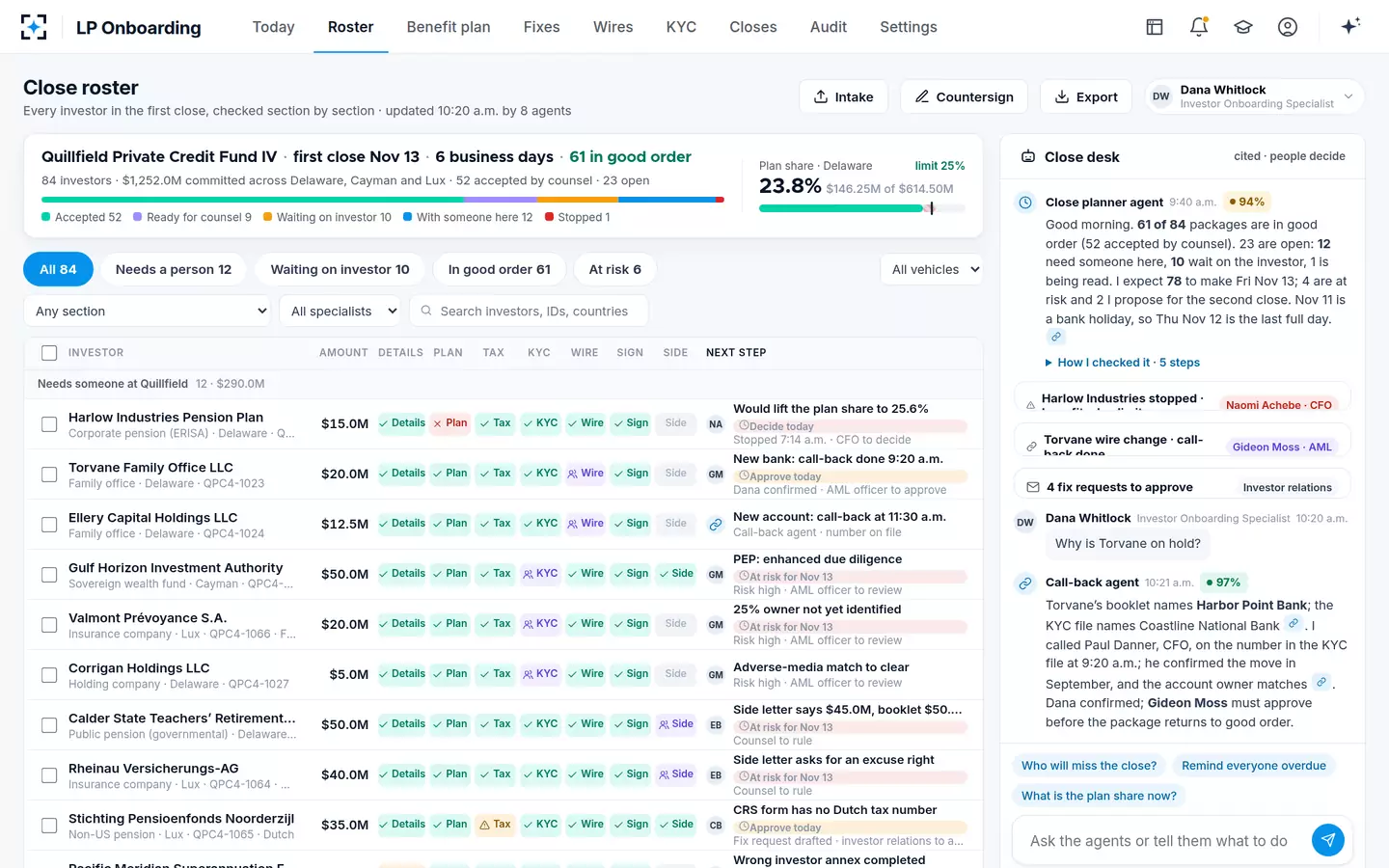
Investor relations, every time. A fix request is the fund speaking to its investor, often in the investor's own language, about a problem with its money or its paperwork; a wrong or duplicated message costs goodwill a close needs. In the sample close the Close planner drafted a fix request for every open gap, with the exact page and what to send back, in Dutch for a Dutch pension fund with English one click away, and the investor relations manager approves, edits or rejects each one. The agent never sends.
Can AI countersign for the GP?
No, and a platform that offers to is offering the wrong thing. The countersignature is the GP accepting a contract on the fund's behalf; it belongs to the authorised signatory under the LPA. What a platform can do is make the signatory's batch safe: in the sample close only packages counsel has accepted appear, each passing six checks, and the signature applies with a release condition at the close so counsel can still withdraw a package before then.
How is a bank-detail change verified if an agent places the call?
The agent may place the call; it may not choose the number, lead the answer or approve the result. Business email compromise, the fraud of changed payment instructions, cost $3,046,598,558 in 2025 by the FBI's count, and its report notes losses of over $30 million to BEC scams involving AI (FBI IC3, 2025). A call-back defeats it only if the number comes from before the change, which is why the sample Call-back agent dials only contacts already in the KYC file, never a number from the booklet, and asks the investor to read out the new details rather than reading them out first.
The call is recorded and transcribed, the account owner is checked with an account validation service, and nothing changes until two people approve: the specialist as maker, the AML officer as checker. An agent placing the call adds consistency, the same questions in the same order every time, and a record; it removes no approval.
What regulators say about controls on automated processes
Regulators have not banned agents in investor servicing; they have said what must surround them. The SEC's September 2026 proposal on transfer agents, still a proposal, asks three things of any firm that adopts AI or automation in this work: controls around it, an accurate account of what the system can do, and real oversight of the automated steps (SEC, Transfer Agent Rules (proposed), 91 FR 56946, 4 September 2026). The SEC transfer agent proposal reads the rest of the release.
FINRA's 2026 oversight report lists the risks of AI agents for broker-dealers, which include the placement agents that carry many booklets: agents acting on their own without a person validating and approving the step, agents going beyond the authority the user has or meant to give, and auditability, where multi-step reasoning makes outcomes "difficult to trace or explain" (FINRA, 2026 Annual Regulatory Oversight Report). The SEC's Division of Examinations, in its priorities for fiscal 2027, says registrants are increasingly building what it calls "super intelligence (SI)" into their businesses, and that it is intensifying its efforts to understand how (SEC, FY2027 examination priorities).
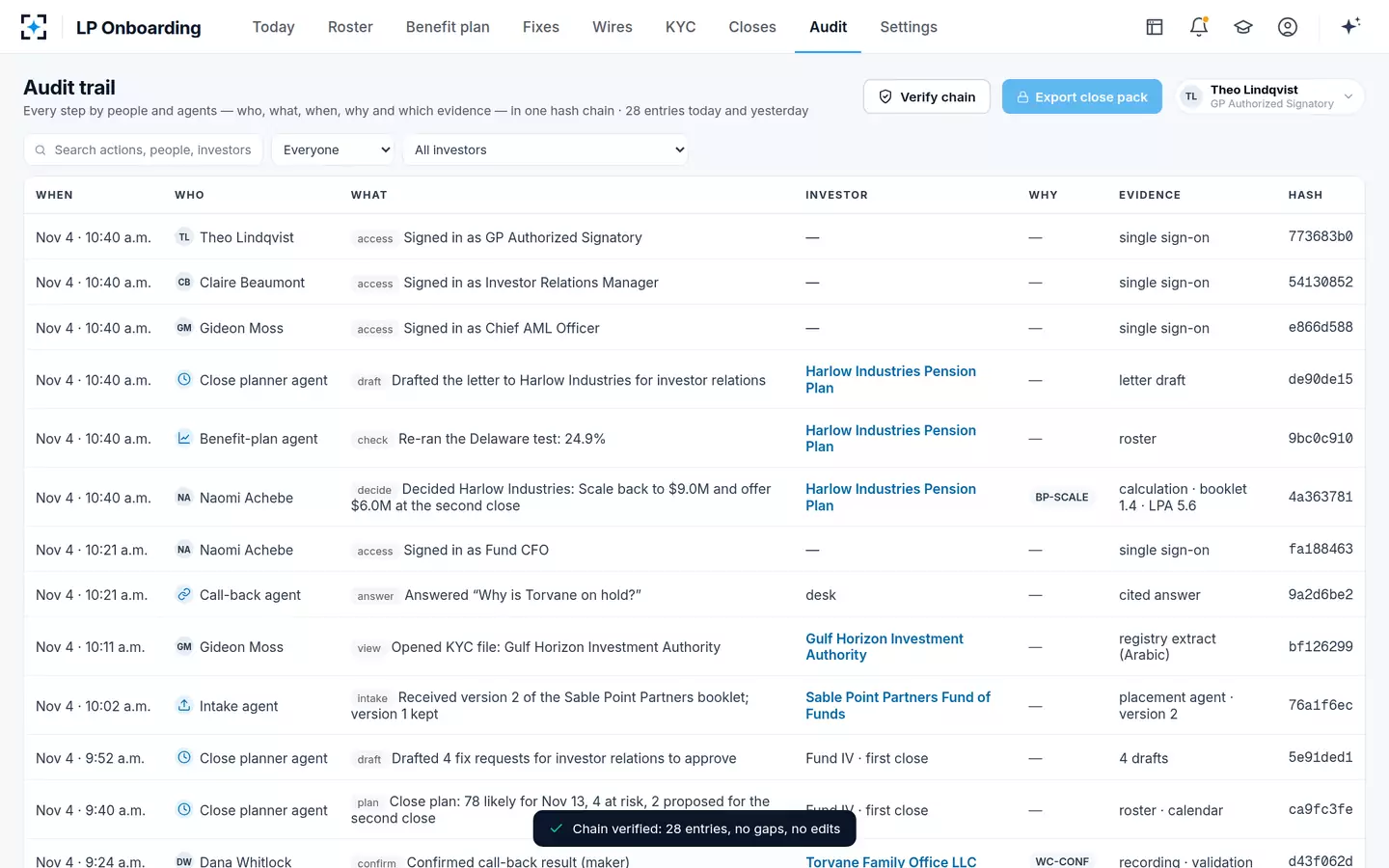
Each risk maps to a design answer a buyer can check. Autonomy: no agent accepts, decides, signs or sends. Scope: each agent has written limits, such as "dials only numbers on file". Auditability: every step on one audit trail with its evidence. Accurate representations: the platform's description of what it does should match the grid above, line by line.
One audit trail for people and agents in LP Onboarding
What to ask of any investor onboarding automation tool before you buy
Ask questions whose answers can be demonstrated on your own documents, not described in a slide. The checklist below is the one we would use on any vendor, ourselves included.
Ten questions for an investor onboarding automation tool
- Does every finding cite the page it came from, and open it?
Without it, a reviewer cannot check the agent, and an examiner cannot check the reviewer.
- Does it compare papers, or only check that each is present?
Ask it to find a W-8 that contradicts the KYC file in one of your past booklets.
- Does it recompute the 25% benefit-plan test per class and vehicle, with look-through?
And leave the GP and its affiliates out of both sides.
- Can any agent accept, clear, sign or send?
The answer should be no, enforced by the system rather than by policy.
- Can one person be both maker and checker?
The settings should refuse it.
- Where does the call-back number come from?
Only from records that predate the change.
- What happens below a confidence threshold?
A named person decides; the threshold is a setting you control.
- Does it read papers in their original language and keep the original beside the translation?
Registry extracts and trust deeds rarely arrive in English.
- Is every step, by people and agents, on one audit trail you can export?
With reason codes and the evidence each decision rested on.
- Will it run on a close you have already finished?
The only fair test: you know the right answers.
The last question matters most, and how to run an investor onboarding software pilot on your last close sets out the method. What the work costs today, and which parts of that cost software actually lowers, is in LP onboarding software and the cost of checking one subscription.
Where LP Onboarding fits, and where it does not
LP Onboarding fits funds and administrators that run closes with many investors, more than one vehicle, papers in several languages and a benefit-plan limit to keep. It sits between the systems a close already uses: the investor portal for booklets, the KYC file and screening service for owners and lists, the recorded verification line for call-backs, e-signature for the countersignature, and the administrator's register for accepted investors and wire data.
What the platform leaves with each seat
Today
Reads every page of every booklet two or three times.
With agents
Starts from named gaps with pages; fixes what can be fixed in house.
Still theirs: Marks packages ready
Today
Assembles each high-risk file from inboxes.
With agents
Decides on a drafted rating with the originals and screening beside it.
Still theirs: Clears KYC; approves wire changes
Today
Learns of a 25% problem from a spreadsheet, late.
With agents
Gets the calculation, headroom and options the moment a booklet would cross.
Still theirs: Decides limit questions
Today
Accepts on an email saying a package is ready.
With agents
Accepts only what a specialist marked ready, with every closed gap shown.
Still theirs: Accepts packages; rules on side letters
It does not replace the investor portal, the administrator's register or the fund's screening data provider; it works with them. It gives no tax advice and corrects no tax form. It does not make a legal judgement on a side letter or accept a package. And it does not make a booklet clearer: if investors keep completing the wrong annex, the fix is in the booklet. Where those are the problems, a different tool or a redrafted booklet is the better buy. To see the division of work on your own documents, start from LP Onboarding.
The close roster in LP Onboarding, with the agents' answers beside it
Questions people ask
Is an onboarding automation tool the same as an investor portal?
Not necessarily. A portal collects booklets and shows status; a checking platform reads and compares what was collected. LP Onboarding works with the fund's existing portal, taking e-subscription booklets in and sending fix requests out as drafts for investor relations to approve.
Can AI agents do investor KYC for a private fund?
They can do the mapping, screening and drafting; they should not make the decision. FinCEN's adviser AML rule, effective 1 January 2028, permits delegation of programme operations while the adviser remains fully responsible and legally liable, so the clearance stays with the AML officer.
How do AI agents handle documents in other languages?
In LP Onboarding the Reader agent reads each page in its original language and keeps the original beside the English, with every field cited to its page; the sample close includes French, German, Dutch, Japanese, Korean and Arabic papers. Fix requests can be drafted in the investor's language for investor relations to approve.
What confidence level should an onboarding agent need before acting alone?
It should never act alone on a decision, whatever its confidence. For the checking work, the threshold is a setting: in the sample fund it is 92%, and below it a person decides. The right level is the one at which your own past closes show no misses you would not accept.
Does an onboarding platform need to be approved by a regulator?
No regulator approves onboarding software. Regulators examine the firm's controls, including over automated processes; the SEC's 2026 transfer agent proposal speaks of "effective oversight of automated processes", and FINRA lists autonomy, scope and auditability as AI-agent risks.