The investor onboarding process for a private fund runs from the moment a subscription booklet arrives to the moment the general partner countersigns it: intake, a first read, KYC and sanctions screening, tax-form checks, the ERISA benefit-plan test, verification of wire instructions, fund counsel's acceptance and the countersignature. Seven seats touch every package, and most of the elapsed time is spent waiting between them, because each seat can only start when the one before has finished and said so. Botminds' LP Onboarding was built for that relay: its agents do the reading, cross-checking and drafting at every step, and each hand-off ends in a recorded decision by the person whose job it is, instead of an email that says a package is ready.
The close used as an example throughout is fictional sample data: Quillfield Private Credit Fund IV, with 84 investors and $1,252.0 million committed for a first close on Friday, 13 November. On Wednesday morning, six business days out, 61 packages are in good order and 52 have been accepted by counsel.
The rules that fix who must decide
2028
year FinCEN’s adviser AML rule takes effect: 1 January, after a delay published 2 January 2026
3officers
a Cayman fund must name as natural persons: AMLCO, MLRO and deputy MLRO
47%
of private funds advised by US registered advisers are domiciled abroad, 32% in the Cayman Islands
What is the investor onboarding process for a private fund?
It is the sequence of checks a fund runs before admitting a limited partner, each owned by a different person. The order varies, but the substance does not: receive and log the booklet against the right investor and vehicle; read it; identify and screen the investor and its owners; validate the tax form; test the investor's effect on the fund's ERISA benefit-plan share; verify where the money will go; have counsel accept the package; and countersign.
Three things make it slow. The checks depend on each other, so a gap found late sends the package back through earlier seats. Several seats belong to different organisations: an administrator in Cayman or Ireland, outside counsel, a placement agent, the investor's own operations team. And the close date is fixed, so every day lost in a hand-off is a day taken from the investor's time to fix what is found.
Seven seats in one close, and what each one keeps
Today
Reads every booklet page by page, two or three passes each, and keeps a private list of who is missing what.
With agents
Opens a roster where each gap is already named with its page, fixes what can be fixed in house and marks a package ready.
Still theirs: Marks each package ready, as maker
Today
Chases screening hits and bank changes across inboxes in the last days before the close.
With agents
Sees each politically exposed person, adverse-media match and wire change with the ownership chain, originals and call recording.
Still theirs: Clears KYC; approves wire changes, as checker
Today
Learns about a benefit-plan problem from a spreadsheet, often after counsel has seen the package.
With agents
Gets the calculation, the headroom and the options the moment a booklet would cross 25%.
Still theirs: Decides every limit question with a reason
Today
Finds out afterwards that someone wrote to her investor about a missing form.
With agents
Approves, edits or rejects every message before it goes, in the investor’s language where that helps.
Still theirs: Approves every message; decides any roll
Today
Accepts packages on the strength of an email that says they are ready.
With agents
Accepts only what a specialist marked ready, seeing every gap closed and why.
Still theirs: Accepts each package, as checker
Today
Runs its own checklist in parallel and sends its own requests to the same investor.
With agents
Receives accepted investors and verified wire data for the register after countersignature.
Still theirs: Keeps the investor register
Today
Signs a batch assembled by email, trusting each package was checked.
With agents
Signs only counsel-accepted packages, each passing six checks, with release at the close.
Still theirs: Countersigns
Seven seats and the hand-offs between them
Each seat waits on a specific signal from another, and the signal is where time goes. The specialist waits on the investor for a missing page. The AML officer waits on the specialist to say the KYC papers are complete enough to judge. The CFO waits to hear that a booklet would move the benefit-plan share. Counsel waits on all of them, and the signatory waits on counsel.
One package through LP Onboarding: agents prepare, people decide
Agent
Intake agentTakes the booklet from the portal, placement-agent inbox or email; matches it to the investor and vehicle; spots new versions
Never: Guess which investor a document belongs to
Agent
Reader and Good-order agentsRead every section in its original language, cite each field to its page, cross-check against the KYC file, tax forms and side letter, with a second independent read
Never: Waive a checklist item
Agent
KYC, Tax form, Benefit-plan and Call-back agentsMap owners and screen; validate the form; recompute the 25% test; verify a new bank account on a number already on file
Never: Clear a hit, correct a form, scale a commitment or approve a change
A person decides
Specialist (maker)Fixes what can be fixed in house and marks the package ready
A person decides
AML officer, CFO, investor relationsClear KYC and wire changes; decide limit questions; approve every message to the investor
A person decides
Fund counsel (checker)Accepts the package, or sends it back with a reason
A person decides
GP signatoryCountersigns only accepted packages, released at the close
The design choice that matters is not speed of reading but who is allowed to wait for what. When reading and cross-checking happen on arrival, the specialist's first look is at a list of named gaps, and the AML officer's first look is at a drafted risk rating with the originals. The remaining waits are the ones the rules require: a decision by a named person.
Who checks an LP's KYC — the GP or the administrator?
Usually the administrator does the work and the fund, through its manager and its designated officers, keeps the responsibility. Treasury's 2024 assessment of the investment adviser sector says fund administrators' services include "handling subscriptions and redemptions", that many "also conduct due diligence on potential investors", and that many are independent firms based outside the United States, the Cayman Islands and Ireland being popular jurisdictions (Treasury, 2024 Investment Adviser Risk Assessment).
For a US adviser, a federal obligation is coming. FinCEN's final rule of September 2024 requires registered and exempt reporting advisers to run AML/CFT programmes, and a FinCEN final rule of 2 January 2026 moved its effective date to 1 January 2028 (FinCEN, 2 January 2026; what the rule asks and costs is in the investment adviser AML rule). The 2024 rule expressly lets an adviser hand the work to "a third-party provider, including a fund administrator" (FinCEN, 89 FR 72156), a choice weighed in AML outsourcing to a fund administrator. In the 2024 rulemaking FinCEN estimated the rule's paperwork at about $408 million up front and about $278 million a year thereafter, which gives a sense of how much of this work is about to be formalised.
Cayman funds already work this way. A fund doing business in or from the Cayman Islands must designate a natural person, at managerial level, as its AML compliance officer, money laundering reporting officer and deputy (CIMA), and may then delegate the work to its administrator or rely on it.
Who is liable if the administrator's KYC is wrong?
The fund remains liable under every regime a typical private fund touches. Delegating the work does not delegate the responsibility, which is why the fund's own seats must see the administrator's output, not only its certificate that the work was done.
Delegating investor KYC to the administrator: three regimes, one answer
What the fund may do: Delegate contractually some or all of its AML/CFT programme to a third-party provider, including a fund administrator.
Who stays responsible: The adviser stays fully responsible and legally liable for the programme, and must be able to show examiners that it complies.
What the fund may do: Rely on a third party to apply customer due diligence measures, if the conditions of regulation 39 are met.
Who stays responsible: The firm stays liable if the measures are not applied, whoever was meant to apply them.
What the fund may do: Designate its AML officers, then delegate their functions or the procedures to the administrator, or rely on it.
Who stays responsible: Ultimate responsibility “remains with the Mutual Funds and Mutual Fund Administrators”, in CIMA’s guidance for that sector.
CIMA's notice on fund AML officers sets out what it expects of a reliance arrangement: a formal agreement setting out each party's responsibilities, a risk assessment of the person relied on before relying on it, and a review of its policies and procedures, tested from time to time (CIMA). A fund that can show those three things, and can show its own AML officer looked at the high-risk files, has a defensible file. One that holds only the administrator's sign-off does not. How the investor KYC itself should be run is covered in investor KYC for funds.
Who approves a politically exposed investor?
Senior management does, under the UK regulations, and most fund AML policies elsewhere follow the same rule. Regulation 35 of the UK Money Laundering Regulations requires senior management approval to establish or continue a relationship with a politically exposed person, measures to establish source of wealth and source of funds, and enhanced ongoing monitoring (MLR 2017, regulation 35(5)). What counts as senior management, and how the approval should be evidenced, is worked through in PEP senior management approval.
In a fund, that means the PEP decision cannot sit with the specialist who reads the booklet or with the administrator's analyst who ran the screening. In the sample close, the KYC agent screened 84 investors and 211 beneficial owners against OFAC, EU, UK and UN lists, politically-exposed-person data and adverse media, and found two hits. One was a sovereign wealth fund in the Cayman feeder with a minister of state on its board. The agent drafted a high risk rating with its reasons and the board list from the Arabic registry extract, shown beside its English translation; the chief AML officer decides. CIMA's sector guidance says mutual funds and their administrators "should be especially careful when dealing with investors who are PEPs of a foreign jurisdiction" (CIMA, February 2024).
Who signs off a change to an investor's bank details?
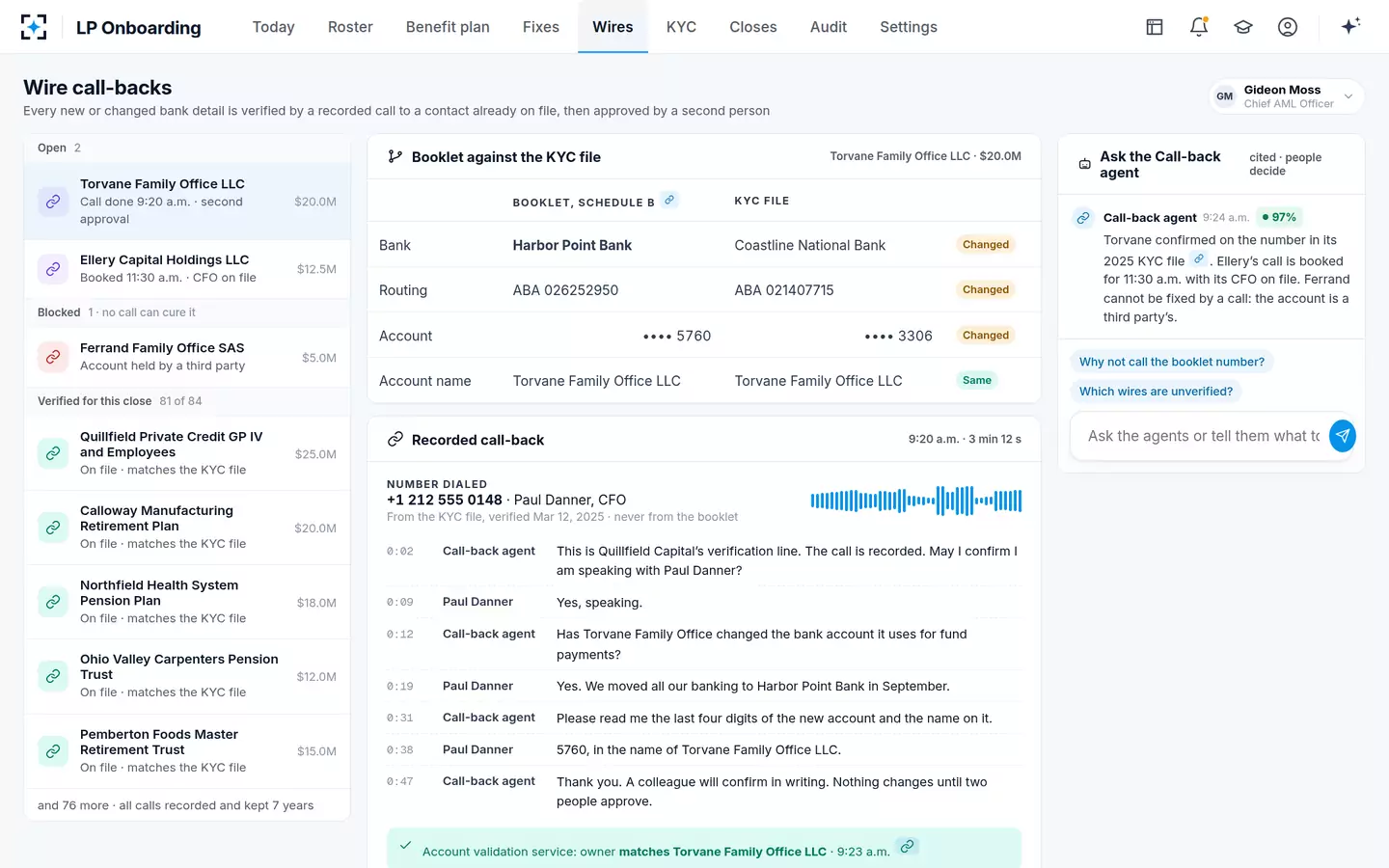
Two people should, after a call to a number the fund already holds. A changed bank account in a subscription booklet is the most valuable target in the whole process: it decides where distributions and redemption proceeds will go for the life of the fund. The FBI's 2025 Internet Crime Report counts $3,046,598,558 lost to business email compromise in a single year, the category that covers payment instructions changed by a fraudster (FBI IC3, 2025).
The SEC's 2024 order against a large transfer agent shows how it happens inside an investor-servicing firm. In one incident a threat actor took over an existing email thread with a client and posed as one of its employees; the SEC found the firm's failures cost clients more than $6.6 million (SEC press release 2024-101; the case is taken step by step in the change of bank details on a fund redemption). The lesson for onboarding is that an instruction arriving in a familiar thread proves nothing, and a phone number sent with the change proves less.
A new bank account, confirmed on the number already on file
Why fund counsel accepts packages last
Counsel accepts last because acceptance is the legal judgement that the package, as a whole, admits this investor on these terms: the representations are complete and consistent, the side letter matches the booklet, and nothing found by the other seats is still open. Counsel cannot make that judgement on a package whose KYC is undecided or whose bank account is unverified, so every earlier wait lands on counsel's desk at once.
The structural fix is to give counsel fewer, better packages, not to ask counsel to read faster. In the sample close the specialist marks a package ready only when all seven sections are in good order, and counsel sees every gap that was closed and why. The system refuses any role setting that would let one person both mark a package ready and accept it. On Wednesday morning, 52 packages had been accepted, nine were with counsel and 23 could not yet be signed, each with its reason.
What can the GP countersign before KYC clears?
Nothing that admits the investor. The fund's AML procedures decide exactly when identity must be verified, but the guidance points one way. CIMA's mutual fund guidance says the time allowed depends on "the practicalities of obtaining evidence before commitments are entered into between parties and before money passes" (CIMA, February 2024), and a countersignature is exactly that commitment.
A GP can still sign early without admitting anyone early. In the sample close the signatory signs counsel-accepted packages as a batch, with a release condition: the signature takes effect at the close on Friday, and counsel can still withdraw a package before then. Each package in the batch has passed six checks, including KYC cleared and wire instructions verified, so the signature never runs ahead of the AML officer's decision.
Where LP Onboarding takes the waiting out of a close
Most of a close's waiting disappears when the reading is done before anyone asks for it. The timeline below shows the sample close's last six business days, planned backward from Friday around the Veterans Day bank holiday on Wednesday 11 November: investor uploads close at noon on Thursday so counsel has until 5 p.m. to accept, and the signatory releases at the close.
The last six business days of a first close, planned back from the date
- Fix and re-sendThu Nov 5 – Thu Nov 12
- Read, cross-check, mark readyon arrival, every day
- Clear hits, approve wires, decide limitsdecisions as they arise
- Accept ready packagesNov 5 – Nov 12
- Last acceptancesThu to 5 p.m.
- Sign accepted batchesrelease at the close
- CloseFri
The four at risk show which waits remain: two side-letter rulings for counsel and two KYC files that need documents from outside the investor. No software removes those. It can make sure they are known on Wednesday rather than discovered on Thursday afternoon, and that each one is in front of the person who must decide it. What every investor must pass on the closing day itself is the test the whole relay is working toward.
The specialist's morning in LP Onboarding: what needs her, and what the agents did since dawn
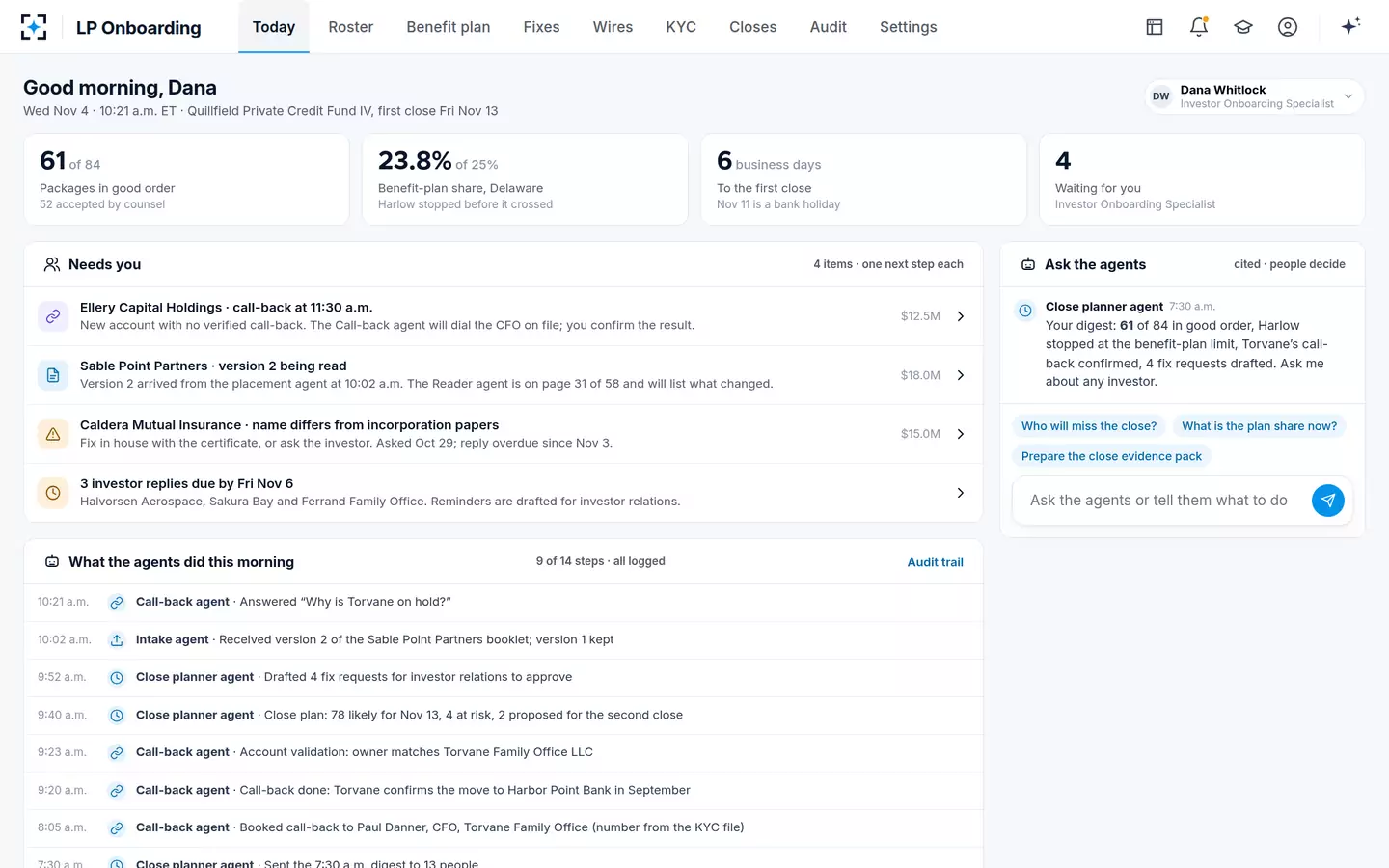
The people who keep the decisions, and how agents divide the rest of the work, are set out task by task in which close tasks move to AI agents. To see the relay on your own past packages, start from LP Onboarding.
Questions people ask
How long does investor onboarding take for a private fund?
No regulator or independent study publishes a typical duration. The working constraint is the close: everything must be finished, accepted and countersigned by the closing date, so the useful measure is how many business days before the close each investor's package reached good order. In the sample raise, uploads close at noon one business day before the close so counsel can accept by 5 p.m.
Does the GP or the fund administrator own investor KYC?
The fund owns it; the administrator usually performs it. FinCEN's adviser rule, effective 1 January 2028, lets an adviser delegate to a fund administrator while remaining fully responsible, and the UK and Cayman rules keep liability with the firm that relies on another.
Does every investor need a call-back on its wire instructions?
Not every investor, but every new or changed bank account should get one, on a number the fund already holds. In the sample close the call-back covers any new or changed bank detail and needs two approvers. Business email compromise cost $3.05 billion in 2025 by the FBI's count.
What is a maker-checker control in fund onboarding?
It means the person who prepares a decision is never the person who approves it. In LP Onboarding the specialist marks a package ready and counsel accepts it, and the specialist confirms a wire call-back while the AML officer approves it; settings refuse any role change that would let one person do both.
Can the administrator write to investors directly about missing documents?
It often does, which is how investors end up with two requests for the same page. In the sample close, every fix request is drafted with the exact page and waits for the investor relations manager to approve, edit or reject it, so the investor hears from the fund once.