Subscription documents in private equity are the papers a limited partner signs to buy into a fund: the subscription agreement, an investor questionnaire, tax forms, anti-money-laundering papers and wire instructions, usually bound together as one subscription booklet of several dozen pages. The investor's signature is an offer; the general partner's countersignature accepts it. Getting the booklet right first time is hard because each page carries a representation the fund relies on for a legal exemption or a tax position, and the close date does not move while a page goes back and forth. Botminds' LP Onboarding exists for that work: its agents read every booklet section by section, check it against the investor's KYC file and tax forms, and name each gap with its page before fund counsel sees the package.
The examples on this page come from fictional sample data: Quillfield Capital's Private Credit Fund IV, preparing an 84-investor first close across a Delaware fund, a Cayman feeder and a Luxembourg SCSp. The rules come from the statutes, regulations and regulators' own texts, linked where they appear.
Four numbers a booklet has to get right
100
beneficial owners at most in a 3(c)(1) fund; the questionnaire is how it counts them
$5M
in investments makes a natural person a qualified purchaser for a 3(c)(7) fund
25%
benefit-plan share of any class at which a fund’s assets become ERISA plan assets
3years
a Form W-8 stays valid: to the end of the third calendar year after signing
What are subscription documents in private equity?
Subscription documents are the contract by which an investor commits capital to a private fund and the evidence the fund needs to admit that investor lawfully. The subscription agreement is the offer: a commitment amount, an agreement to be bound by the limited partnership agreement, and a page of representations. The rest of the booklet is proof that those representations are true.
That proof matters because a private fund lives on exemptions. It sells without registering under the Securities Act because its investors are of a kind the private-offering rules allow. It avoids registering as an investment company because it has no more than 100 beneficial owners under section 3(c)(1), or because every owner is a qualified purchaser under section 3(c)(7). It keeps the general partner out of ERISA's fiduciary rules because benefit plan investors stay under 25% of each class. Each exemption is tested on facts the investor supplies, and the booklet is where the fund collects them.
So a booklet is not paperwork that surrounds the deal; it is the deal's legal footing. A missing signature is an incomplete offer. A wrong answer on the investor-status page can put a 3(c)(1) fund over its holder count, and a wrong answer on the ERISA page can turn the fund's portfolio into plan assets. That is why counsel reads it, and why a fund closes only on packages counsel has accepted.
What is in a private equity subscription booklet, section by section
A private equity subscription booklet usually has seven working sections, whatever order the fund's counsel puts them in. Each one answers a different question, and each question belongs to a different rule. The table below sets them out the way a reviewer should hold them in mind: not as pages, but as proofs.
Seven sections of a subscription booklet, and what each one proves
| Section | What the investor gives | What the fund proves with it | Rule behind it |
|---|---|---|---|
| Investor details and eligibility | Legal name, type, domicile, commitment; accredited investor and qualified purchaser answers | That the investor may be admitted, and how it counts toward the holder limit | Securities Act Rule 501(a); Investment Company Act §3(c)(1), §3(c)(7) and §2(a)(51) |
| Benefit-plan status | Whether it is a benefit plan investor, or an entity holding plan assets, and to what percentage | That benefit plan investors stay under 25% of each class after the subscription | ERISA §3(42); 29 CFR 2510.3-101(f) |
| Tax forms | Form W-9, W-8BEN-E or W-8IMY, and CRS self-certification | The investor’s tax status for withholding and for FATCA and CRS reporting | Treasury Regulations §1.1441-1 and §1.1471-3; local CRS rules |
| KYC and screening | Identity papers, registry extracts, ownership chart, controlling persons | Who the investor is and who owns or controls it | The fund’s AML programme; 31 CFR 1010.230 where it applies; CIMA rules for Cayman funds |
| Wire instructions | Bank, account, account name for distributions and redemptions | That money will go to an account in the investor’s own name | The fund’s payment controls |
| Signatures | Signature page, authorised signatory list, trust deed or board resolution | That the person who signed could bind the investor | The investor’s own governing documents |
| Side letter | Any negotiated terms, and the investor’s election rights | That the booklet and the side letter describe the same deal | The LPA and the side letter themselves |
Read that way, two features of a booklet stand out. First, the sections are not independent: the investor type on page 2 decides which tax form is valid, which KYC papers are needed and whether the ERISA page can be answered "not applicable". Second, some answers change the fund rather than the investor. A $15 million pension commitment does not only need its own pages to be complete; it moves the fund's benefit-plan share, which is why the ERISA 25% plan asset rule has to be recalculated after every subscription.
Which booklet pages come back most often?
No regulator or independent study publishes which subscription booklet pages are returned most often, or what share of booklets arrive in good order on the first pass. Fund administrators and software vendors quote figures, but none is a measurement anyone outside can check. The honest answer is to count your own: take the last close, list every fix request your team sent, and mark each one with the section it concerned.
In the sample close, the five fix requests waiting for investor relations on one morning show the usual mix. Two concern signature authority: an endowment's W-9 signed by a person who is not on its authorised signatory list, and a family trust's booklet signed by one of two trustees when its trust deed needs both. One is a wrong annex: an Australian superannuation fund completed the US investor section instead of the non-US annex. One is a tax-form gap: a Dutch pension fund's CRS self-certification without its Dutch tax identification number. The fifth is not an investor error at all, but a letter about a scaled-back commitment.
Fix requests, each tied to the page that caused it
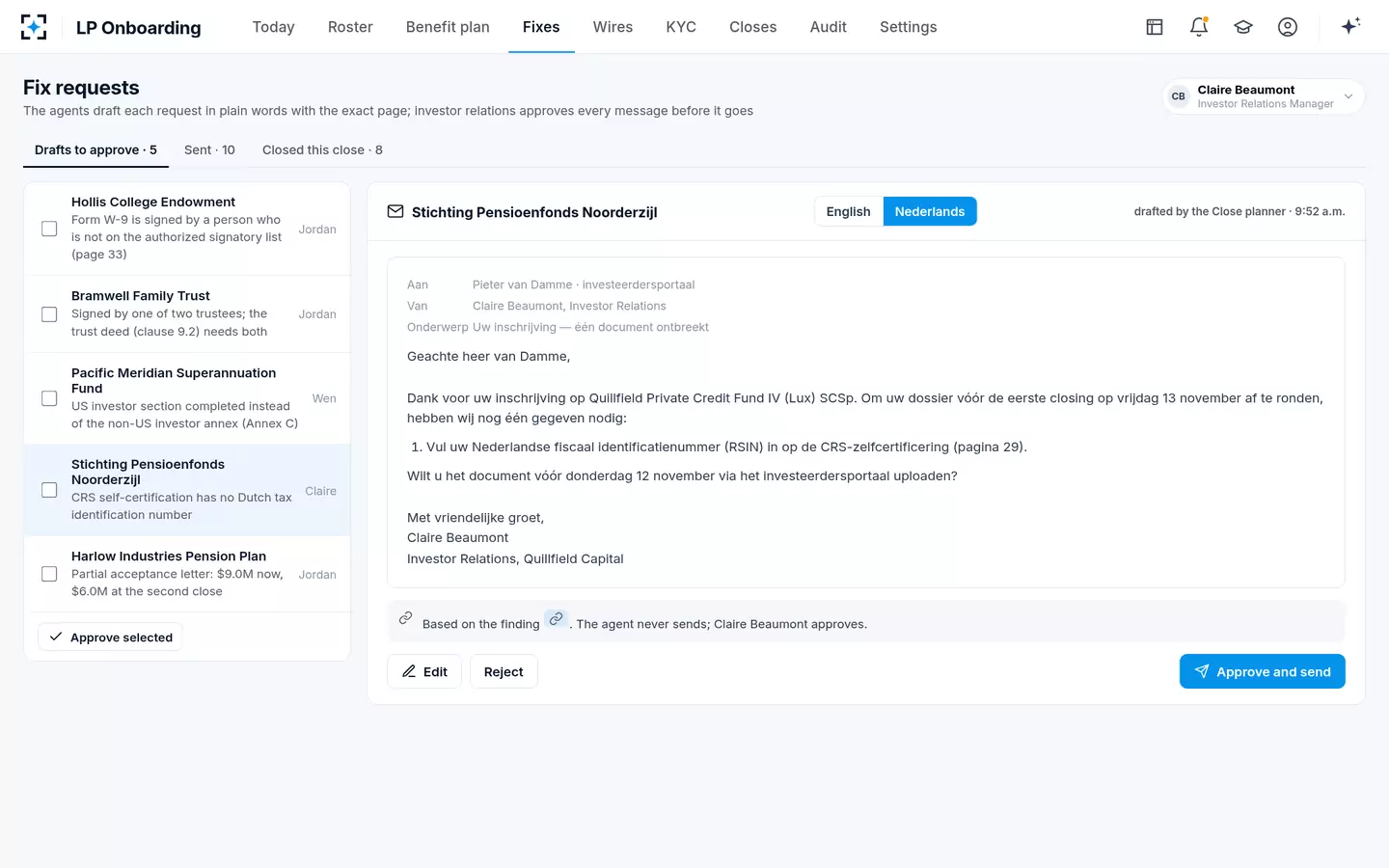
A tally like that is more useful than an industry average, because it tells you where your own booklet is unclear. If half the returns are signature authority, the fix is an instruction page and a signatory checklist sent with the booklet, not a faster reviewer. If the wrong-annex return recurs, the booklet's routing ("non-US investors complete Annex C") is too easy to miss.
Why does a fund ask for a W-9 or W-8 with the booklet?
A fund asks for a tax form with the booklet because, as a withholding agent and as a financial institution under FATCA and the Common Reporting Standard, it must document each investor's tax status before it pays or reports anything. A US investor gives Form W-9; a foreign entity investing for itself gives Form W-8BEN-E; a foreign intermediary or flow-through entity, such as a foreign partnership investing for its own partners, gives Form W-8IMY.
The W-8 is the one with a clock. Under the Treasury regulations a withholding certificate stays valid until the end of the third calendar year after the year it was signed, or until a change in circumstances makes it incorrect, whichever comes first (26 CFR 1.1441-1(e)(4)(ii)). A W-8BEN-E signed in 2023 for a fund that closed that year runs out on 31 December 2026, so an investor returning for a 2027 close needs a new one. When circumstances change, the FATCA rules give a withholding agent 90 days from the date the form became invalid to obtain a new one (26 CFR 1.1471-3).
Non-US feeders add their own timing. Since 1 January 2026, the Cayman Islands' amended CRS regulations require a Cayman financial institution to collect a valid self-certification for a new account "on or before the date a Financial Account is opened", with only an exceptional-circumstances fallback (Cayman CRS (Amendment) Regulations, 2025, new regulation 7(3)). For a Cayman feeder, an investor admitted at the close with no valid self-certification is a breach on the day it happens, not a follow-up item. The checks each W-8 in a booklet should pass, field by field and against the KYC file, are traced in W-9 validation and W-8 checks.
What the investor-status pages prove: 3(c)(1), 3(c)(7) and accredited
The investor-status pages prove that admitting this investor keeps the fund inside its exemptions. Three different tests sit on those pages, and investors routinely confuse them.
The first is the private-offering test. Most funds sell under Regulation D and ask each investor to confirm it is an accredited investor under the categories of Rule 501(a). In a Rule 506(c) offering the fund must also take reasonable steps to verify that status, which is its own discipline: verification of accredited investor status covers the letters, the documents and the high-minimum route.
The second is the investment-company test, and it depends on the fund. A 3(c)(1) fund may have no more than 100 beneficial owners, and the statute counts a company as one owner unless it holds 10% or more of the fund's voting securities and is itself an investment company or a fund relying on 3(c)(1) or 3(c)(7), in which case its own holders are counted (15 U.S.C. 80a-3(c)(1)(A)). A 3(c)(7) fund admits only qualified purchasers: for a natural person, at least $5,000,000 in investments; for most companies, at least $25,000,000 owned and invested on a discretionary basis (15 U.S.C. 80a-2(a)(51)(A)). Trusts and family vehicles have their own routes, set out in the qualified purchaser requirements.
The third is the ERISA test: is the investor a benefit plan investor, or an entity whose assets include plan assets, and to what percentage? That answer does not decide whether this investor may come in. It decides whether the fund can take all of its money.
Three status questions on one booklet, and what a wrong answer costs
What the page asks: Which Rule 501(a) category the investor falls in; in a 506(c) offering, the evidence of it.
What a wrong answer does: Puts the private-offering exemption at risk for the offering, not only for this investor.
What the page asks: How many beneficial owners the investor counts as, or whether it is a qualified purchaser.
What a wrong answer does: Can take the fund over 100 owners, or admit a non-qualified purchaser to a 3(c)(7) fund.
What the page asks: Whether the investor is subject to Part 4 of Title I of ERISA or section 4975, or holds plan assets, and its percentage.
What a wrong answer does: Can lift any class to 25% or more, making the fund’s underlying assets plan assets and its managers ERISA fiduciaries.
Who has to sign the subscription agreement for a trust or a fund?
The person who signs must be able to bind the investor under the investor's own governing documents, and the booklet should prove it with the document that gives that power. For a company, that is a board resolution or an authorised signatory list; for a trust, the trust deed, which often requires every trustee, or a named number of them, to act together; for a fund of funds or a feeder, the general partner or manager of the investing vehicle, acting under its own LPA.
Authority is checked twice, because the tax form has a signer too. The sample endowment's booklet passed its signature page, but its W-9 was signed by a person missing from the signatory list in the KYC file. Neither page was blank. The problem was only visible by laying one paper beside another, which is the kind of gap a subscription booklet can hide while passing the checklist.
The KYC section asks a related but different question: not who may sign, but who owns and controls the investor. Where the US customer due diligence rule applies, a legal-entity customer's beneficial owners are each individual who owns 25% or more of its equity, plus one individual with significant responsibility to control it (31 CFR 1010.230). The signer and the control person are often different people, and a booklet that names one should not be read as naming both.
Can subscription documents be signed electronically?
Yes, in the United States, as a matter of federal law. The E-SIGN Act provides that a signature or contract in interstate or foreign commerce may not be denied legal effect solely because it is electronic, though it does not oblige anyone to accept electronic signatures (15 U.S.C. 7001(a) and (b)). Whether a given fund accepts them is therefore a question for its LPA and booklet instructions, and for the investor's own rules on who may sign and how.
The tax forms follow their own rule. The IRS instructions for Form W-8IMY, revised in October 2021, point to final regulations permitting electronic signatures on withholding certificates (IRS, Instructions for Form W-8IMY). An electronic signature changes how a page is signed, not what it must prove: a correctly e-signed booklet from the wrong trustee is still signed by the wrong trustee.
Filling the booklet in order of risk, not page order
The fastest way to a booklet that passes first time is to fill it in the order of what can stop the close, not the order of the pages. An investor that completes the signature pages first and the investor-status pages last has done the easy part well and left the decisive part to the end. The checklist below is the order we would give an investor's operations team, with the reason for each step.
Fill a subscription booklet in the order the close will test it
- Settle the investor type and the vehicle first.
It decides which annex, which tax form and which KYC papers apply. A superannuation fund in the US investor section is the classic return.
- Answer the investor-status pages next: accredited, qualified purchaser, 3(c)(1) count.
A fund-of-funds holding 10% or more of a 3(c)(1) fund is counted through to its own holders; say so on the page.
- Answer the ERISA page precisely, with the plan-asset percentage if you are an entity.
“Not applicable” is the most expensive wrong answer: it moves the fund’s 25% share.
- Choose and complete the right tax form, signed by someone who can sign.
W-9, W-8BEN-E or W-8IMY; check a returning investor’s W-8 has not run past its three-year life.
- Assemble the KYC papers to match the ownership chart.
Every 25% owner and the control person, with registry extracts in the original language.
- Give wire instructions in the investor’s own name, and expect a call-back.
A new or changed bank account should be confirmed on a number the fund already holds, never one sent with the change.
- Sign last, by the right people, with the authority document attached.
Trust deed, board resolution or signatory list: the reviewer will ask for it either way.
The order also tells a fund how to review. A reviewer who starts with the investor type and status catches the errors that change everything downstream, and can stop before reading forty pages of a package that is in the wrong annex. A reviewer who starts on page 1 and reads to the end catches the same errors, but later, after the time is spent.
How LP Onboarding reads a booklet before counsel does
LP Onboarding reads the booklet the way the order above suggests: by section, with every answer tied to its page and checked against the other papers. In the sample close, a pension plan's 58-page booklet arrived through the investor portal at 7:12 a.m. The Reader agent found the answer to section 4 on page 23 (a benefit plan investor subject to Part 4 of Title I of ERISA) and showed the page beside the finding. The cross-checks matched that answer to the investor type, the plan-asset percentage to its certificate and the investor's controlling-person status to the GP affiliate list.
One booklet in LP Onboarding, section by section, each answer cited to its page
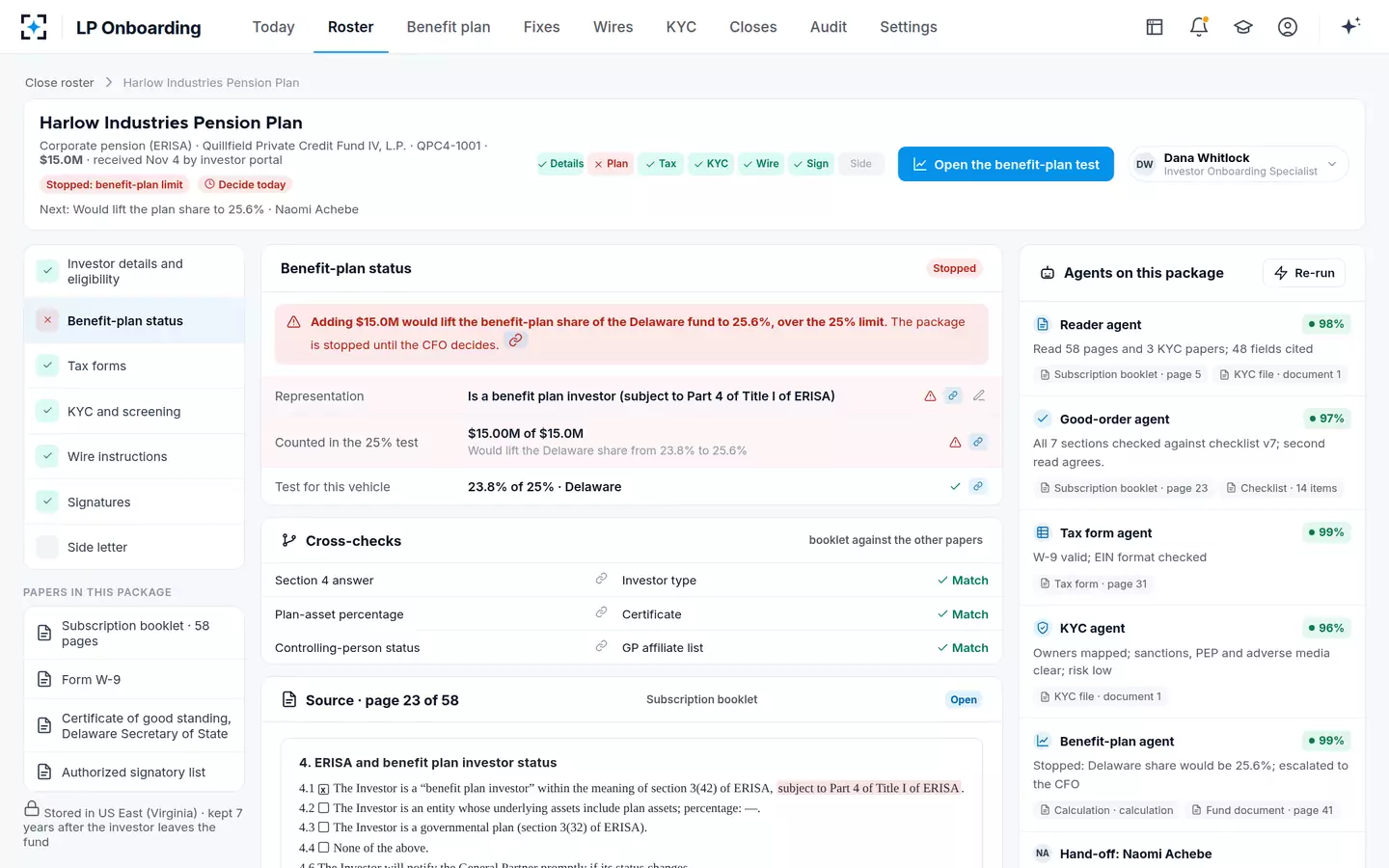
Every section of that booklet was complete, and it still could not go to counsel. That is the point of reading booklets as proofs rather than as forms: the Benefit-plan agent recomputed the fund's 25% test with the new commitment, found it would cross, and stopped the package for the CFO to decide. The agents read, cross-check and draft fix requests; they never accept a package, waive a checklist item or write to an investor without investor relations' approval. A specialist marks a package ready, fund counsel accepts it, and only accepted packages reach the GP's countersignature. Who waits on whom between those seats is where most closes lose their time.
To see the section-by-section review and the fix requests on a sample of your own past booklets, start from LP Onboarding.
Questions people ask
What is a subscription agreement in private equity?
It is the investor's signed offer to buy an interest in the fund for a stated commitment, with representations about who the investor is and an agreement to be bound by the limited partnership agreement. The general partner accepts it by countersigning, and booklets commonly let the GP accept a subscription in whole or in part. Until that countersignature, the investor is not a partner.
Is a subscription booklet the same as subscription documents?
In practice, yes: "subscription booklet" is the bound set of subscription documents a fund sends out, usually the agreement, the investor questionnaire, the ERISA and tax pages, the AML papers checklist and the signature pages. Some funds send the tax forms and the KYC request separately, but the fund reviews them as one package.
Do returning investors have to fill in a new booklet for each fund?
Yes, because each fund is a new contract and the facts may have changed, but much can be carried forward. In the sample close, 41 of the 46 investors who were also in the previous fund started from their last good package, prefilled, re-signing only what changed. Tax forms are the trap: a W-8 lapses at the end of the third calendar year after signing.
Who reviews subscription documents: the GP, the administrator or counsel?
Usually all three. Treasury's 2024 risk assessment notes that fund administrators' services include "handling subscriptions and redemptions" and that many also conduct due diligence on potential investors (Treasury, 2024 Investment Adviser Risk Assessment). Fund counsel reviews the legal representations and accepts the package, and the GP signs.
What happens if a booklet arrives after the close?
The investor is normally admitted at a later close if the fund holds one, often paying an equalisation amount so it bears its share of investments already made. In the sample raise, the Close planner proposes rolling two investors with no reply after two reminders to the second close; investor relations decides any roll.