W9 validation is the check a fund, transfer agent or other payor runs on a US investor's Form W-9 before relying on it: that the name on line 1 is the taxpayer's, that the tax classification and any exemption codes fit together, that the taxpayer identification number (TIN) matches IRS records, and that the Part II certification is signed and dated. The IRS's minimum is short: a valid W-9 "must contain the payee's name and TIN and be signed and dated under penalties of perjury by the payee or a person authorized to sign for the payee" (IRS, Instructions for the Requester of Form W-9). A W-8 for a non-US investor needs more, and both need reading against the rest of the investor's file. Botminds' FATCA/CRS Self-Certification does that reading with seven agents and leaves every decision to a person; this guide traces one form through it, step by step.
The trace uses the solution's sample data on a fictional fund manager, Quillfield Capital, and a fictional Jersey investor, Kestrel Ridge Investments Ltd. The time figures are Botminds' own estimates of the work by hand and with the solution, not measured results.
Where the business days go before an entity investor hears what to fix
- Logging1 d
- Reading the local template1.5 d
- Own-rules checks1 d
- Side by side with the file2 d
- Letter and approval2.5 d
- Agents, then people0.9 d
What is W-9 validation?
It is the check that a W-9 can be relied on for backup withholding, information reporting and FATCA: right form, right person, right number, consistent claims, signed. The stakes are concrete. A payor must withhold 24% of reportable payments to a payee without a correct TIN or certification, and the IRS warns that a payor who does not collect backup withholding as required "may become liable for any uncollected amount" (IRS, Instructions for the Requester of Form W-9).
The TIN check is the one a payor can make against the source. The IRS offers TIN matching e-services to payors who file information returns, to validate name and TIN combinations before filing; a verified match can generally be relied on as reasonable cause against penalties. Everything else on the W-9 is checked against the form's own rules and the investor's file. In a partnership, the W-9 also feeds section 1446 withholding and the partner tax file, which the K-1 series covers in the partner file: W-9s, W-8s and section 1446.
What does a W-9 validation tool check?
Twelve things, most of them on the form and a few in the file. The checklist follows the current revision of the form (March 2024) and the IRS's instructions to requesters.
Twelve checks on a Form W-9
- Current revision
Rev. March 2024 added line 3b for flow-through entities with foreign owners.
- Line 1 is the taxpayer’s name
The name should match the name on the tax return; a disregarded entity gives its owner’s name.
- One box on line 3a
Exactly one federal tax classification, and for an LLC the letter of its classification.
- Line 3b, for partnerships, trusts and estates
Required if they have foreign partners, owners or beneficiaries and give the form to a partnership, trust or estate they hold an interest in.
- Exemption codes consistent with the classification
A requester may rely on them unless they are not valid or are inconsistent with each other.
- A TIN in Part I
An SSN, ITIN or EIN as the classification requires; “applied for” only with the awaiting-TIN rules.
- The name and TIN match IRS records
Through IRS TIN matching, for payors who file information returns.
- Part II signed and dated
For interest, dividend and broker accounts opened after 1983, unsigned means backup withholding.
- Item 2 crossed out if the IRS has said so
A payee notified of backup withholding for underreporting must strike it.
- A US person
A foreign person may not provide a Form W-9.
- Electronic forms meet the system rules
An electronic signature under penalties of perjury, with the same information as the paper form.
- Nothing in the file contradicts it
A foreign address, a W-8 on another account, a CRS form claiming residence elsewhere.
The exemption check is the one tools most often skip. The requester instructions say a payor may rely on a claimed exempt payee code "unless you have actual knowledge that the exempt payee code and/or classification selected are not valid, or if they are inconsistent with each other" (IRS, requester instructions). An individual who enters a corporation's exemption code has given the fund a form it cannot rely on, however good the TIN.
Does a W-9 expire?
Not on a calendar. Unlike the W-8 series, whose forms generally lapse at the end of the third calendar year after signing, the IRS's W-9 materials set no fixed validity period. What ends a W-9 is a change: the form's own instructions say the payee "must furnish a new Form W-9 if the name or TIN changes for the account", and must give updated information if it is no longer an exempt payee (IRS, Form W-9).
Two other events end reliance in practice. A notice from the IRS that the name and TIN on an information return do not match its records can require the payor to send a "B" notice to the payee asking for a corrected TIN. And information in the fund's own file can make the form unreliable, a foreign address for an investor certifying US status, for example, which is why a W-9 belongs in the same cross-check as the W-8s and CRS forms.
One form, traced: from the inbox to the approved letter
The trace follows two forms from one investor, because the contradiction that matters only appears with both. Kestrel Ridge's W-8BEN-E arrived through the investor portal on 14 October, on the October 2021 revision, eight pages. Its CRS self-certification arrived by email the next day, on a Spanish template.
Seven agents propose and cite; three people decide
Agent
Intake agentIdentifies each form and its revision, matches it to account TA-0071946, keeps every version, and asks for a rescan when a page cannot be read.
Never: Guesses an account
Agent
Form readerReads every field in the form’s own language and pins it to its page and line; a second, independent read runs on every field.
Never: Fills a blank
Agent
Form rules agentChecks each form against its own rules: revision, parts, signature, signer capacity, GIIN on the IRS list, TIN format, treaty and LOB, chapter 3 and 4 status, expiry.
Never: Corrects a form
Agent
Cross-check agentSets the W-8BEN-E, the CRS form and the KYC file side by side and explains each contradiction with its sources.
Never: Decides which form is right
A person decides
Tax operations analystReads the map, asks the agents why, and prepares the resolution: one cure letter, reason code PR-CURE.
A person decides
Tax operations checkerSees who prepared it, the sources and the letter in both languages, and approves with reason code CU-ONE.
Agent
Cure agentSends the approved letter through the investor portal and runs the 90-day clock, reminders and escalation.
Never: Sends without approval or applies a fallback
Each form passed its own rules: the GIIN was on the IRS FFI list and the Jersey TIN had the right shape. The cross-check found three contradictions: sponsored FFI on the W-8BEN-E against passive NFE on the CRS form; a Madrid mailing address and Spanish phone in the KYC file against a Jersey-only residence claim; and a blank Part 3 on the CRS form against an ownership register naming two owners resident in Spain. A W-9 traced the same way runs through the same agents, with the TIN, classification, exemption and certification checks in place of status and GIIN.
With the agents, most of the remaining time is people deciding
By hand · about 8 business days
- Logging and reading · 31%
- Rule checks and cross-check · 38%
- Letter and approval · 31%
With the solution · under 1 business day
- Agents: intake to cross-check · 44%
- People: prepare and approve · 56%
Can AI read a W-8BEN-E?
It can read the fields; the question is what it does when it is unsure, and who checks it. A W-8BEN-E is a structured form with numbered lines, which makes it easier to read than most documents, but the hard parts are the ones that need judgement: which Part the status on line 5 requires, whether a treaty claim is complete, whether a handwritten capacity is an authorised one. The IRS's standard does not change because a machine read the form: the requester still has to review it for completeness and accuracy against the claims it makes, and may not rely on it if other information in its records contradicts it (IRS, requester instructions).
So the design questions to ask of any reading tool are about its limits. Does it pin every value to the page and line it came from, so a checker can see the source? Does it leave a blank blank, or fill it from somewhere else? Does it say when it is not sure? In FATCA/CRS Self-Certification the form reader never fills a blank, every value opens its passage, and any field below 90% confidence goes to an analyst with both readings. For forms completed online, HMRC's manual adds a requirement on the institution that applies whoever reads them: it "must have systems in place to ensure that the information provided is that of the Account Holder" (HMRC IEIM403140).
Can it read a CRS form in another language?
Yes, and it should show its work. The solution's sample settings switch on 48 local CRS templates in 14 languages, and the form reader reads each in its original language, keeping the original beside the English. Kestrel Ridge's entity type came from "Parte 2, casilla 3(b)" of the Spanish template, "Entidad No Financiera Pasiva (complete la Parte 3)", shown next to the English reading.
The Spanish original beside the English, with the second read recorded
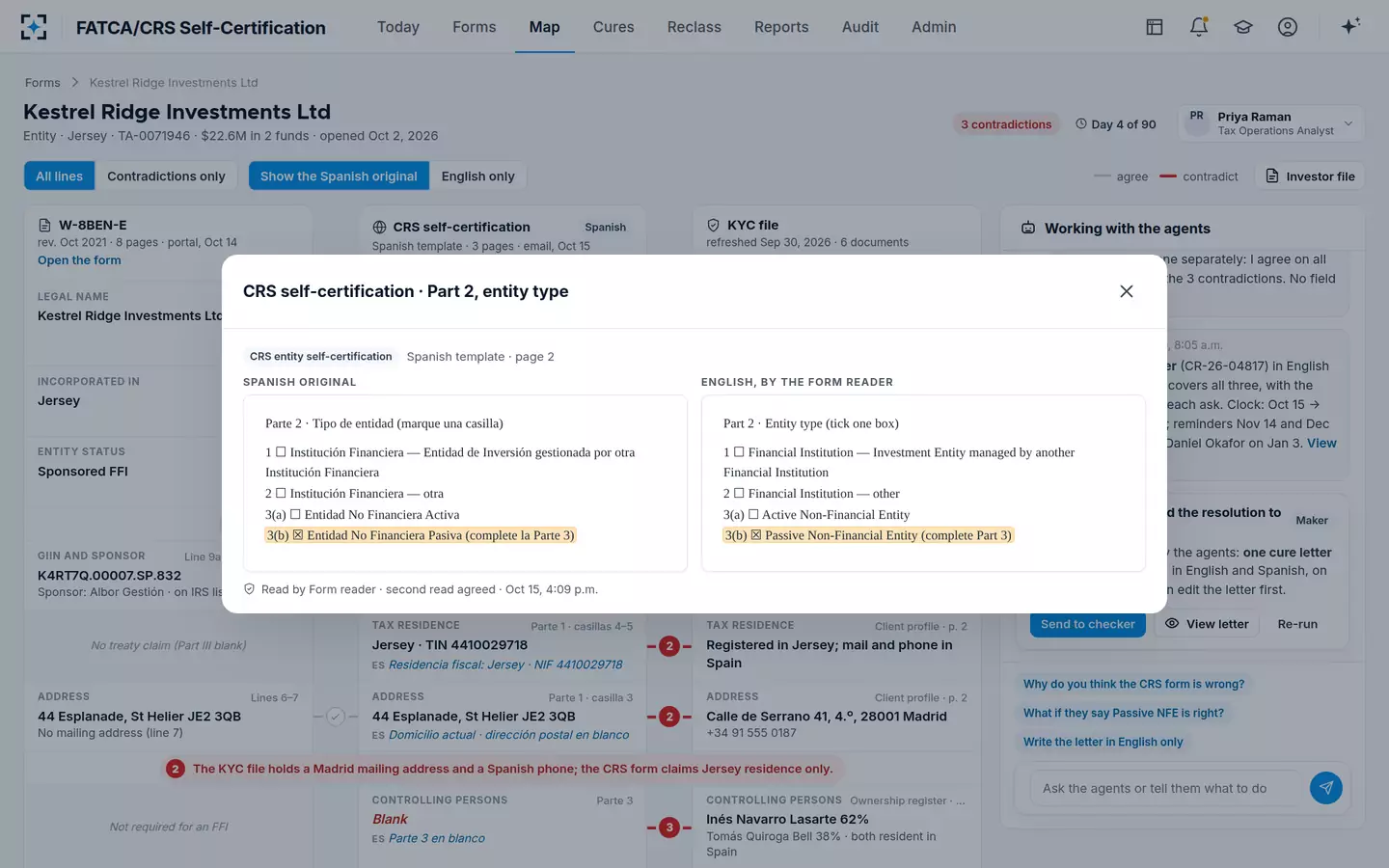
Language is where a hand review most often loses the thread. A reviewer who cannot read a template either sends it for translation, which takes days, or reads the boxes by position, which works until a jurisdiction's template orders them differently. Neither leaves a translation on file for the checker or the examiner.
What does a second independent read add?
A way to know when the first read is wrong. The second read runs separately on every field; where it agrees, the value stands with its source, and where it disagrees, the field goes to a person with both readings instead of to the next step. On Kestrel Ridge's forms the second read agreed on all 24 fields and on the three contradictions, and no field was unreadable.
It also makes clean forms cheaper to accept. On the sample morning, the agents had validated 287 forms since the previous Friday; 208 were clean with the second read agreeing, and they waited for a person to accept them in one pass. Clean acceptance is still a decision, made by the analyst and the checker, but it is made on forms that two reads and every rule have already passed.
Who approves a reclassification?
Three people, never the agents. The analyst prepares the reclassification with the reason and what changes in FATCA and CRS reporting, the tax operations checker checks it, and the head of fund tax signs it; nobody approves their own work, and one person never holds maker and checker on the same fund. A cure letter needs two: the analyst prepares, the checker approves with a reason code.
The analyst asks why; the agent answers with sources and stops
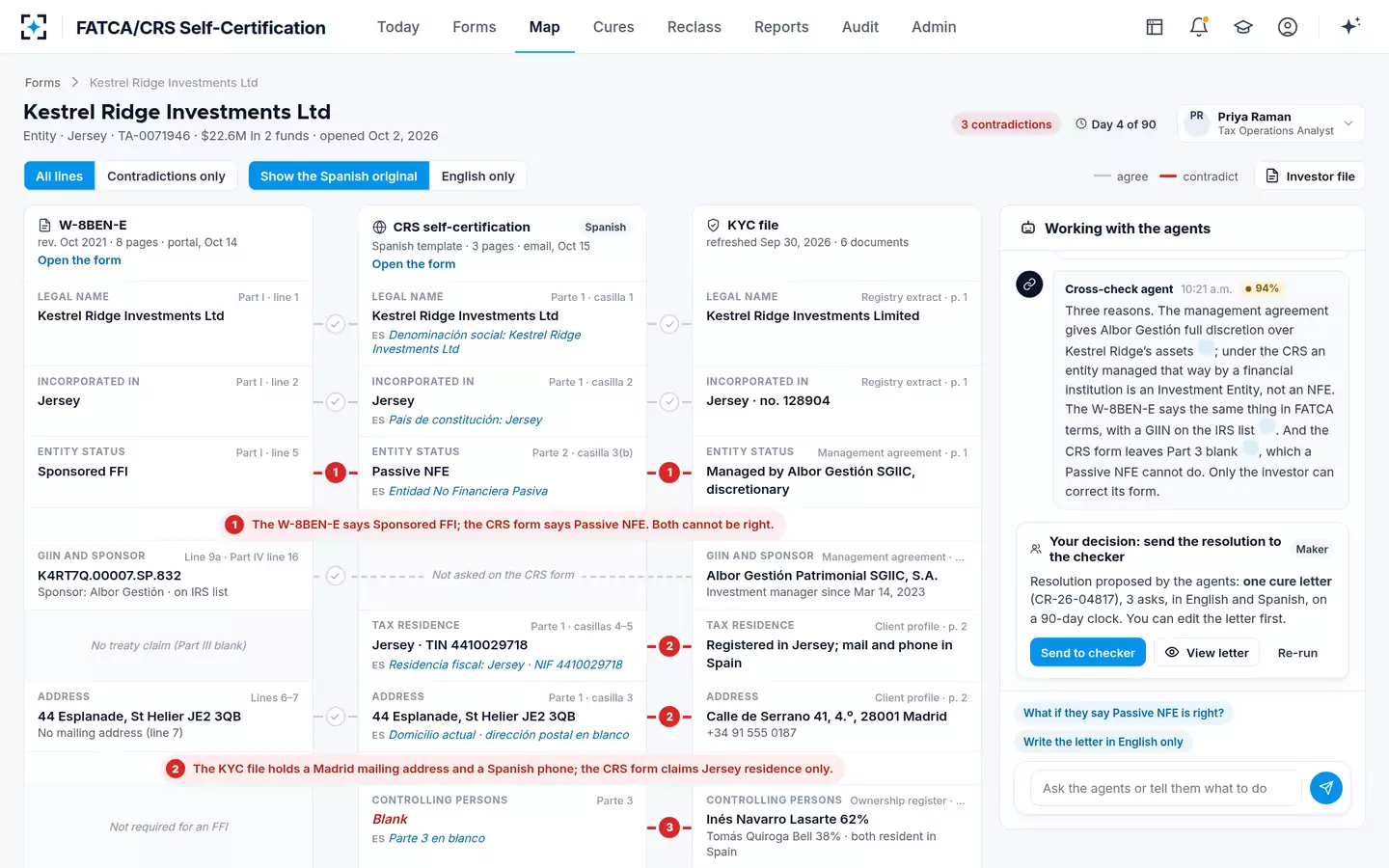
What does the audit trail show?
Every action by people and agents, with who, what, when, why and the evidence. In the solution's sample, the trail is hash-chained, can be verified at any time, is kept for ten years and exports per investor for a regulator. For the trace above it shows the analyst opening the Spanish source page, the agent's cited answer, the resolution sent with reason code PR-CURE, the checker's approval with CU-ONE, and the letter going out with its reminders scheduled.
That is what makes a validation usable as evidence. HMRC's test for when an institution has reason to know a form is unreliable includes information it holds that is inconsistent with the claim (HMRC IEIM403180), and the ADGM regulator's guide expects records that "can be checked or audited to demonstrate compliance" (ADGM FSRA guide). A trail that shows the contradiction was found, explained and sent to the investor on a given day answers both. How to test whether a tool finds the contradictions in the first place is in tax form validation, tested with planted errors; the GIIN step is unpacked in what a GIIN lookup proves; and fitting the agents around your existing systems is in FATCA CRS software that works with your transfer agency system. The trace runs in FATCA/CRS Self-Certification.
Questions people ask
Can a foreign person give a W-9?
No. The IRS's requester instructions say a foreign person, including certain US branches of foreign persons, may not provide a Form W-9. A non-US investor documents itself on the W-8 series instead, and a W-9 from an investor with only foreign addresses on file is a contradiction to resolve.
Is an electronic W-9 valid?
Yes, if the requester's system meets the IRS conditions: it must ensure the information received is what was sent, make reasonably certain the person submitting is the person named, provide the same information as the paper form and end with an electronic signature under penalties of perjury.
What is a B notice?
When the IRS tells a payor that the name and TIN on an information return do not match its records, the payor may have to send the payee a "B" notice asking for a corrected TIN. IRS TIN matching before filing is designed to reduce such notices.
What happens if Part II of a W-9 is not signed?
For interest, dividend and broker accounts opened after 1983, the payee must sign the certification or backup withholding will apply, at 24% of reportable payments. On the sample morning, an unsigned W-9 for a fictional trust was on the analyst's list for the next day.
Does a partnership investor need to complete line 3b?
If it has foreign partners, owners or beneficiaries and gives the W-9 to a partnership, trust or estate in which it holds an interest, yes. The IRS added line 3b in the March 2024 revision, and warns that a partnership, trust or estate that fails to complete it when required may not receive the information it needs to file correct returns and furnish correct statements to its own partners or beneficiaries.