A GIIN lookup means searching the IRS's FATCA Foreign Financial Institution (FFI) list, which the IRS describes as "A monthly published list of financial institutions registered, accepted, and issued a Global Intermediary Identification Number (GIIN) in accordance with FATCA regulations" (IRS, FFI list search and download tool). The search, by GIIN, legal name or country, tells a fund whether an institution that gave it a W-8BEN-E is registered under that number. It does not tell the fund whether the institution is the kind of entity its form says, whether the name on the form is the name on the list, or whether the entity should have a GIIN at all. Fund operations teams check the GIIN because the regulations require it for many statuses; the risk sits in treating the match as the whole check. Botminds' FATCA/CRS Self-Certification runs the lookup on every W-8 that needs one and sets the result beside the form's status and the investor's CRS form.
Examples come from the solution's sample data on a fictional fund manager, Quillfield Capital. The rules are quoted from the IRS's own pages and the Treasury regulations.
A GIIN lookup is three checks, and a person decides any mismatch
Agent
ShapeChecks the 19 characters against the IRS composition rules: separators, category code, country code, no letter O.
Never: Guesses a corrected number
Agent
ListLooks up the GIIN and the name in the current monthly FFI list, and notes the month of the file used.
Never: Relies on last year’s download
Agent
StatusCompares the category code and the list entry with line 5, the Part completed and the CRS form’s classification.
Never: Treats a match as proof of status
A person decides
AnalystDecides on any mismatch: a similar name, a branch GIIN, an “applied for” form, a status the list cannot show.
A person decides
CheckerApproves the resolution with a reason code; the result and the list month go on the audit trail.
How do I look up a GIIN?
Use the IRS's FFI List Search and Download Tool. It searches the current list by GIIN, by financial institution name or by country, and the IRS user guide notes that the entire list can be downloaded in CSV or XML; a full PDF is not offered "due to the size of the file" (IRS Publication 5147). A team checking one form searches by GIIN. A team checking thousands downloads the monthly file and matches against it, which is also the only way to show an examiner which month's list a decision relied on.
Search by GIIN first and read the name that comes back, rather than searching by name and accepting the first hit. Group structures produce many similar names, branches appear as the institution's name followed by "- Branch", and a name search can return a sister entity with its own GIIN. The number is the key; the name is the test.
What the 19 characters of a GIIN tell you
A GIIN is a structured identifier, not a random code, and its structure catches errors before the lookup does. The IRS sets the format as XXXXXX.XXXXX.XX.XXX, "a 19-character identification number made up of several identifiers", and adds a rule worth testing on every form: "These characters will never contain the letter “O”" (IRS, GIIN composition). A GIIN with an O in it is a zero someone mistyped.
Reading a GIIN: four fields, each with a rule a form can break
| Positions | Field | What it holds | What to check |
|---|---|---|---|
| 1–6 | FATCA ID | Numbers and capitals. For a sponsored entity, the sponsoring entity’s FATCA ID; for a branch, its institution’s | For a sponsored FFI, it should match the sponsor’s own GIIN |
| 8–12 | Type | Numbers and capitals: 00000 for a lead FI or sponsoring entity, 99999 for a single FI, otherwise the member’s or sponsored entity’s own characters | A sponsoring entity’s 00000 on a form claiming sponsored status |
| 14–15 | Category code | LE lead FI · SL single FI · ME member FI · BR branch · SP sponsoring entity · SF sponsored fund · SD sponsored direct reporting NFFE · SS sponsored subsidiary · SB sponsored subsidiary’s branch | Does the code fit the status ticked on line 5? |
| 17–19 | Country | ISO 3166-1 numeric code of the GIIN holder; 999 means “Other” | Does it match line 2 and the tax residence on the CRS form? |
The category code is the most useful of the four for a fund. A W-8BEN-E that ticks "Sponsored FFI" on line 5 should carry a GIIN whose category code is that of a sponsored entity and whose first six characters belong to the sponsor named in Part IV. A form that names one sponsor and carries a GIIN built on another's FATCA ID, or a sponsoring entity's own code, is not proved wrong by that alone, but it is a question for the investor before the form is relied on.
How often is the IRS FFI list updated?
Monthly. The IRS user guide says the FFI list, "First published in June 2014", is "updated and published monthly, with prior months' lists available for download", and that the current list "is available on IRS.gov on the first day of each month" (IRS Publication 5147). To appear on it, an institution must be in approved status both five business days before the last business day of the month and on the last business day itself.
The clocks around a GIIN
1st
day of each month that the IRS publishes the current FFI list
90
days from receiving a W-8 marked “applied for” to obtain and verify the GIIN
1
year after removal from the list, at the latest, that a withholding agent is treated as knowing
19
characters in a GIIN, with three full stops and never the letter O
The monthly rhythm has two consequences. A newly registered institution can be weeks away from its first appearance, which is why a form may say "applied for". And a lookup is a statement about one month: a GIIN that was on the list in January may not be on it in June, so a fund that checked once at onboarding and never again knows less than it thinks.
Does a GIIN on the list prove the entity's chapter 4 status?
No. The list proves registration and the issue of a GIIN; it does not show which chapter 4 status the entity claims on a given form, or that the conditions of that status are met. The IRS's own note on the list says it contains the names of institutions and other entities "that have completed FATCA registration with the IRS and obtained a global intermediary identification number", and it directs users to the regulations for the rules on documenting payees (IRS, FFI list notice).
What the GIIN does do, under the regulations, is satisfy one condition of several statuses. A withholding agent that receives a claim of participating FFI or registered deemed-compliant FFI status must confirm that the payee's name, "including a name reasonably similar to the name the withholding agent has on file for the payee", and its GIIN appear on the most recently published list within 90 days of the claim (26 CFR 1.1471-3(e)(3)(i)). The rest of the status still rests on the form: the line 5 box, the Part of the form that certifies the conditions, and anything in the fund's files that contradicts it.
For a CRS form, a GIIN is evidence, not a field. The ADGM regulator's guide suggests checking the FFI list for a GIIN as one of the reasonableness checks when an entity declares itself a financial institution (ADGM FSRA guide). The converse matters as much: an investor with a GIIN that certifies itself a passive NFE on its CRS form has some explaining to do, the conflict examined in the entity form against its W-8BEN-E.
What if the form says 'applied for'?
The fund may accept it, with a 90-day deadline to obtain the GIIN and verify it on the list. The regulation allows an institution whose registration is in process to provide a Form W-8 "writing “applied for” in the box for the GIIN", and gives the withholding agent "90 days from the date it receives the Form W-8 to obtain a GIIN and to verify the accuracy of the GIIN against the published IRS FFI list before it has reason to know that the payee is not a participating FFI or registered deemed-compliant FFI" (26 CFR 1.1471-3(e)(3)(i)). The W-8BEN-E instructions say the same to the person filling in the form: the requester "must receive and verify your GIIN within 90 days" (IRS, W-8BEN-E instructions).
The clock starts on receipt, not on account opening and not on the next monthly list, and it should be diarised on the day the form arrives. Given the IRS's publication rule, a registration approved late in a month may not appear until the list after next, so a 90-day window covers roughly two or three monthly lists. A fund that waits for the investor to volunteer the GIIN will usually find day 90 has passed.
What do you do when the name on the list differs from the form?
Decide whether it is "reasonably similar", and record why. The regulation's test is not an exact match: the name, including a name reasonably similar to the one on file, and the GIIN must appear on the list (26 CFR 1.1471-3(e)(3)(i)). The IRS user guide explains where differences come from: the name on the list appears "in the exact way it was input during registration", and an institution can edit it in the registration system, in which case "the updated name will appear on a future published list" (IRS Publication 5147).
"Ltd" for "Limited", a missing comma, or a former name updated last month are reasonably similar. A different legal entity in the same group is not, even if the brand is the same. Branches are their own case: where the payment goes to a branch identified in Part II of the form, the branch's GIIN on line 13 is the one to verify, not the head office's on line 9a. A decision on a name mismatch belongs to a person, with the list entry, the form and the registry extract side by side.
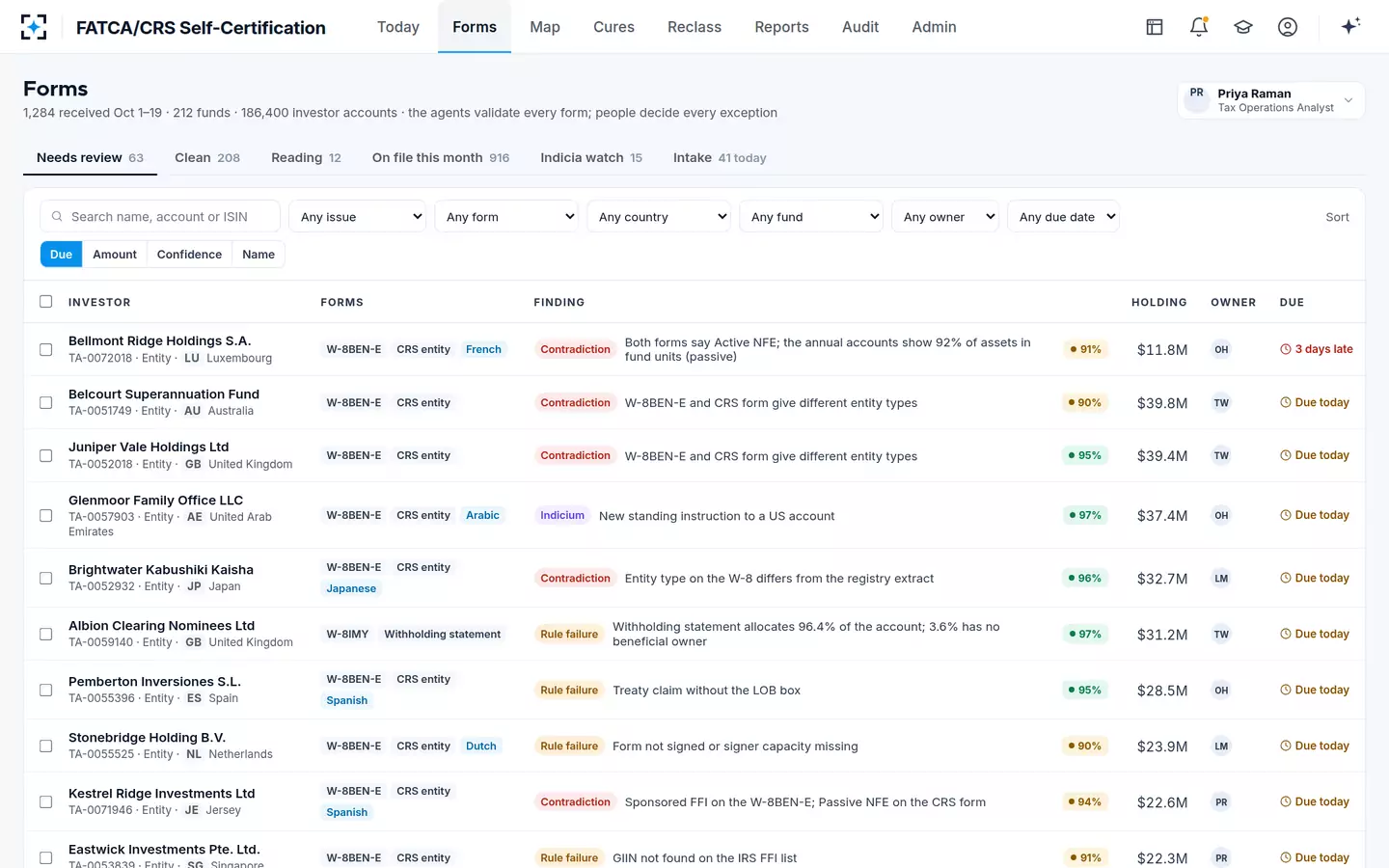
A GIIN that is not on the list arrives as a rule failure with an owner
Which entities don't need a GIIN?
Most entity investors in a fund. The IRS's notice on the list says plainly that "many other entities are not required to register with the IRS and obtain a GIIN under FATCA, and instead must meet different requirements" (IRS, FFI list notice). Going by the statuses the W-8BEN-E instructions list for line 9a below, active NFFEs, passive NFFEs other than direct reporting ones, exempt beneficial owners and certified deemed-compliant FFIs are among them.
The W-8BEN-E instructions list who must enter a GIIN on line 9a: participating FFIs, registered deemed-compliant FFIs including sponsored FFIs, reporting Model 1 and Model 2 FFIs, direct reporting NFFEs, sponsored direct reporting NFFEs and foreign trustees of trustee-documented trusts, plus certain nonreporting IGA FFIs (IRS, W-8BEN-E instructions). A blank line 9a is therefore correct for an active NFFE and a defect for a sponsored FFI. A GIIN on a passive NFFE's form is a question too: unless the entity is a direct reporting NFFE, which reports its own US owners to the IRS and must register (HMRC IEIM404040), it should not have one.
When an institution drops off the list
Removal ends the protection of the earlier lookup, with a long tail. The regulation says that if an FFI is removed from the published list, the withholding agent knows it is not a participating or registered deemed-compliant FFI "on the earlier of the date that the withholding agent discovers that the FFI has been removed from the list or the date that is one year from the date the FFI's GIIN was actually removed from the list" (26 CFR 1.1471-3(e)(3)(i)). A fund that never re-checks is deemed to know within a year anyway, so the practical control is a periodic re-match of every GIIN on file against the newest list.
The regulations also reward the lookup in one specific way. A withholding agent that has confirmed an FFI's GIIN on the current list within 90 days of receiving its withholding certificate "does not need to apply the standards of knowledge" in the US-indicia rules of 1.1441-7(b)(5) to that certificate (26 CFR 1.1471-3(e)(4)(ii)(B)). For a registered institution, the GIIN check replaces a review of US addresses and phone numbers. For everyone else, those indicia still matter, as the KYC change that sends a form back explains.
Before relying on a W-8BEN-E's GIIN
- The status on line 5 is one that needs a GIIN
Otherwise a GIIN is either harmless extra information or a sign the wrong box was ticked.
- The 19 characters fit the composition rules
Full stops in positions 7, 13 and 16, a valid category code, a numeric country code, no letter O.
- The GIIN is on the current month’s list, under a reasonably similar name
Record the list month; keep the entry with the form.
- The category code fits the status, and the sponsor fits Part IV
A sponsored FFI’s GIIN should be built on its named sponsor’s FATCA ID.
- The country code fits line 2 and the CRS form
A GIIN for one country on a form claiming residence in another needs a branch or an explanation.
- “Applied for” has a 90-day date in the diary
Counted from the day the form was received.
- Every GIIN on file is re-matched against new lists
Removal is known, at the latest, a year after it happens.
Three checks, one decision: the GIIN lookup inside FATCA/CRS Self-Certification
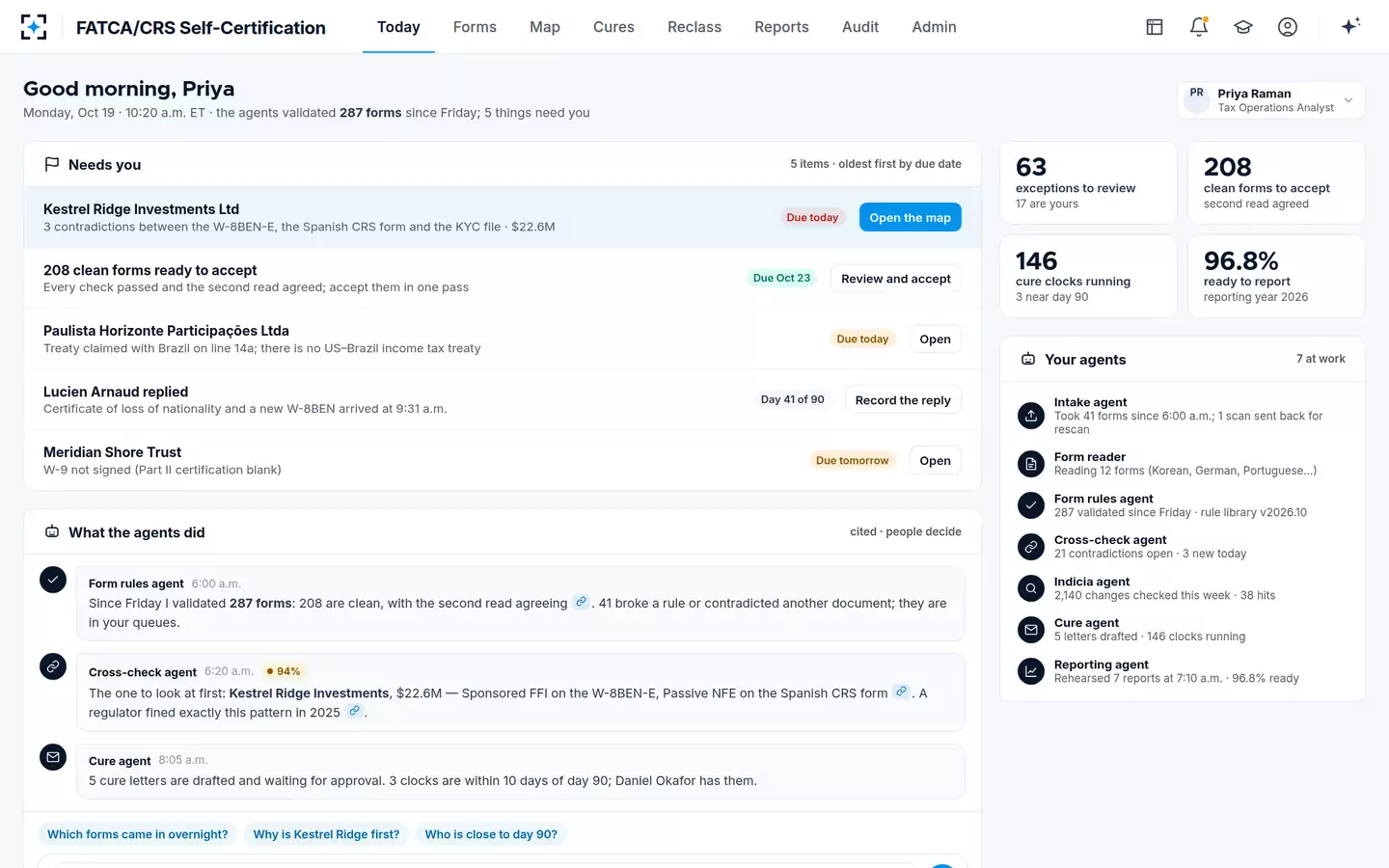
In FATCA/CRS Self-Certification the GIIN check is part of the form rules agent's work on every W-8: revision, required parts, signature, signer capacity, GIIN on the IRS FFI list, TIN format, treaty and limitation on benefits, chapter 3 and 4 status, and expiry. The agent flags and never corrects; the cross-check agent then sets the result beside the CRS form and the KYC file, so a GIIN that is on the list but sits under a status the CRS form contradicts is caught as a contradiction rather than passed as a clean form.
The sample morning shows both halves. One Singapore entity's W-8BEN-E failed the rule outright, with its GIIN not found on the IRS FFI list. Kestrel Ridge's form passed the lookup, its GIIN on the list under its sponsor, and still went to the top of the analyst's queue, because its CRS form called it a passive NFE. The lookup did its job in both cases; in the second, it was not the check that mattered.
The analyst's morning: what the agents checked, and what needs a person
What a validation tool should catch beyond the GIIN, and how to test whether it does, is set out in tax form validation, tested with planted errors. The lookup, the status check and the contradiction map work together in FATCA/CRS Self-Certification.
Questions people ask
Is a GIIN the same as a TIN?
No. A GIIN identifies an entity registered for FATCA; the IRS says entities assigned one can use it "to identify themselves to withholding agents and tax administrators for FATCA reporting purposes." A TIN is a tax identification number issued by the country of residence, and a CRS form asks for the TIN, not the GIIN.
Can I download the whole IRS FFI list?
Yes, in CSV or XML, from the FFI List Search and Download Tool; only search results are available as PDF. Prior months' lists can also be downloaded, which lets a fund show which list a past decision relied on.
How do I check a sponsored FFI's GIIN?
Look it up, then read its structure. Under the IRS composition rules, a sponsored entity's GIIN begins with the sponsoring entity's FATCA ID and carries category code SF for a sponsored fund or SS for a sponsored subsidiary, so it should tie back to the sponsor named in Part IV of the W-8BEN-E.
Is a W-8BEN-E with 'applied for' valid?
It can be relied on for a limited time. The withholding agent has 90 days from receiving the form to obtain the GIIN and verify it on the published list; after that it has reason to know the payee is not a participating or registered deemed-compliant FFI.
What happens if a GIIN is later removed from the list?
The withholding agent is treated as knowing the institution is no longer a participating or registered deemed-compliant FFI from the earlier of the date it discovers the removal or one year after the removal. A periodic re-match of every GIIN on file against the newest list is the control.
Does a fund need a GIIN on every entity investor's form?
No. Going by the IRS's line 9a instructions, active NFFEs, passive NFFEs other than direct reporting ones, exempt beneficial owners and certified deemed-compliant FFIs need not register. A GIIN is required on line 9a only for the statuses the IRS instructions list, such as participating, registered deemed-compliant and sponsored FFIs and direct reporting NFFEs.