A FATCA CRS self-certification form is the investor's own signed statement of where it is resident for tax, its taxpayer identification number (TIN) in each of those places, and, for an entity, what kind of entity it is under the Common Reporting Standard (CRS) and the US Foreign Account Tax Compliance Act (FATCA). A fund, its transfer agent or its administrator must collect one when an account opens and confirm two things before relying on it: that the form is valid, meaning complete, signed and dated, and that it is reasonable against everything else on file, from the KYC address to the management agreement. The work is hard because the second test needs the form read next to other documents, field by field, usually in another system and often in another language. Botminds' FATCA/CRS Self-Certification exists for that reading: its agents read every form, set it beside the W-8 or W-9 and the KYC file, and hand each disagreement to a person.
The worked examples come from the solution's sample data: a fictional manager, Quillfield Capital, whose investor services team received 1,284 tax forms across 212 funds in the first nineteen days of October 2026. The rules come from the regulators' own texts, linked where they are used.
An individual's form and an entity's form ask different questions
Individual self-certification: One person, or each holder of a joint account
Entity self-certification: The entity, and for a passive NFE each person who controls it
Individual self-certification: Full name and residential address
Entity self-certification: Entity name in full and operational address: street, city, country
Individual self-certification: Every jurisdiction of tax residence
Entity self-certification: Every jurisdiction of tax residence
Individual self-certification: One per reportable jurisdiction, or the reason there is none
Entity self-certification: One per reportable jurisdiction, or the reason there is none
Individual self-certification: Date of birth (not needed for FATCA alone)
Entity self-certification: Entity type: financial institution, active NFE or passive NFE
Individual self-certification: The account holder, or a person with authority, signs or positively affirms
Entity self-certification: An authorised person, with name and title or capacity
What is a FATCA CRS self-certification form?
It is a statement, signed under the account holder's own responsibility, that lets the financial institution decide which countries the account must be reported to. The CRS is a multilateral standard under which participating jurisdictions exchange account information with one another, so the form asks for every jurisdiction of tax residence. FATCA asks a narrower question: for an individual, whether the holder is a US person; for an entity, its FATCA status and any substantial US owners. The US forms for that are the W-9 for US persons and the W-8 series for everyone else. Where these forms sit in a private fund's booklet, and why the fund needs them before the close, is covered in subscription documents in private equity.
There is no single official template. HMRC's manual is plain on the point: "There is no prescribed format for a self-certification but it may, for example, form part of the account opening documentation" (HMRC IEIM403140). That is why a fund with investors in thirty countries receives dozens of versions of the same form: its own, the investor's bank's, a distributor's, and the local tax authority's template in the local language. Each is acceptable if it carries the required information and allows the fund to determine residence. None is acceptable merely because it was filled in.
The form also has a second life after it is signed. The fund must keep testing it against what it learns, and it stops being reliable the moment the fund knows or has reason to know that something on it is wrong. The rest of this guide is about what "required information" and "reasonable" mean in practice, field by field.
Is a CRS self-certification the same as a W-8BEN-E?
No. A W-8BEN-E is an Internal Revenue Service withholding certificate: a foreign entity uses it to establish its status for US withholding under chapter 3 and its FATCA status under chapter 4, and to claim any treaty rate. A CRS self-certification establishes tax residence for every participating jurisdiction and says whether the entity is a financial institution, an active non-financial entity (NFE) or a passive NFE. The two overlap on name, address and entity type, and they are signed under different penalty regimes.
In a jurisdiction that implements FATCA through a Model 1 intergovernmental agreement, a fund may collect FATCA status on its own combined form rather than on IRS paper. The ADGM regulator's guide sets the bar for that: the form "must enable the RFI to determine whether or not the Account Holder is a tax resident in the US for tax purposes", and if the holder is a US resident the fund must obtain the US TIN, which may be on a Form W-9 (ADGM FSRA guide). In practice most fund investors that are entities hand over both a W-8BEN-E and a CRS form, which is how contradictions are born: two forms, signed on different days by different people, each describing the same company. The places where they must agree, and the 2025 case that turned on one of them, are in the entity form against its W-8BEN-E.
The fields an entity form must carry, and what each one is checked against
A valid entity form carries eight things, and each has a document on file it should be read against. The table pairs them, with what goes wrong on each; where a regulator found the defect on a real form, the example comes from the ADGM decisions of 2025 discussed below.
Eight fields on an entity self-certification, and the evidence each must agree with
Entity name, in full
What it must sayThe legal name, as on the registry extract
Read it againstRegistry extract; the W-8BEN-E line 1
What goes wrongA name that differs from the registry extract or the other form
Operational address
What it must sayStreet, city and country, not a box number
Read it againstThe KYC file’s registered and correspondence addresses
What goes wrongA residence claim in one place and every address on file in another
Every jurisdiction of tax residence
What it must sayAll of them, not only the one the fund asked about
Read it againstIncorporation, management, addresses, phone numbers
What goes wrongThe section left blank, which made the form invalid outright
TIN for each reportable jurisdiction
What it must sayThe number, or the reason there is none
Read it againstWhether that country issues TINs, and their shape
What goes wrong“No TIN is required” for a country that issues them; a TIN for a country that does not
Entity classification
What it must sayOne box: financial institution, active NFE or passive NFE
Read it againstThe W-8BEN-E line 5; licences; the management agreement
What goes wrongTwo inconsistent boxes ticked; the section left empty
Controlling persons
What it must sayFor a passive NFE, each person, with residence and TIN
Read it againstThe AML ownership and control file
What goes wrongControlling-person forms collected years after the account opened
Signer and capacity
What it must sayName, title or capacity, signature or positive affirmation
Read it againstThe signatory list and any power of attorney
What goes wrongNo capacity stated; a typed name, which the IRS says is not an electronic signature
Date
What it must sayDated, at the latest, on the day the fund received it
Read it againstThe date of receipt in the intake log
What goes wrongA date of birth written where the signature date belongs
Two fields deserve a second look. Tax residence is the one investors most often leave incomplete, because a company incorporated in one place and managed in another may be resident in both, and the form asks for all of them. The TIN is the one most often filled in wrongly with confidence: the regulator's guide says a fund "can generally rely on the TINs provided" and need not check every number's validity, but that a missing TIN for a country that issues them gives the fund reason to know the form is unreliable (ADGM FSRA guide). HMRC's manual adds that some jurisdictions do not issue TINs at all and that, from 1 January 2026, institutions must use reasonable efforts to obtain a missing TIN on a reportable pre-existing account whenever they update its AML/KYC information (HMRC IEIM402040).
Entity classification is the field that decides how much else the form must contain. A financial institution needs no controlling persons on its CRS form; an active NFE needs none; a passive NFE needs every one, with residence and TIN. Classification is a judgement the investor makes, and the fund must test it, which is what the passive NFE vs active NFE decision tree walks through.
Who can sign a self-certification for an entity?
A person with authority to sign for the entity, identified by name and title or capacity. The ADGM guide lists the "Name, Title or Capacity and Signature or other positive affirmation of the person authorised to sign the SCF on the Account Holder's behalf" among the details a valid entity form must contain (ADGM FSRA guide). The IRS asks the same of the W-8BEN-E: it must be signed and dated by an authorised representative or officer, who checks a box certifying legal capacity to sign; an agent signing under a power of attorney must attach it; and "Simply typing your name into the signature line is not an electronic signature" (IRS, Instructions for Form W-8BEN-E).
Positive affirmation covers forms completed online or by telephone. The fund must be able to show that it happened: the ADGM guide expects the affirmation to be captured so that the institution "can credibly demonstrate" it, for example by a voice recording or a digital footprint, and kept for audit with the form. A checker reviewing an entity form should therefore see three things together: the signature or affirmation record, the signer's name and capacity, and the signatory list or power of attorney that shows the capacity is real.
The date is the companion field. HMRC's manual says the form "must be dated no earlier than the date the Account Holder received the form", and that an undated form may be date-stamped by the institution on receipt (HMRC IEIM403140). Regulators are not pedantic about it: in its October 2025 decision on ADS Investment Solutions, the ADGM regulator accepted a form on which the signer had written a date of birth instead of the signature date as one "that would have been valid but for an inconsequential error" (ADGM FSRA, ADS decision). An absent signer capacity is not that kind of error.
What is a controlling person, and when does the form need one?
A controlling person is a natural person who exercises control over an entity, identified the way the institution's AML rules identify beneficial owners. The CRS asks for them only when the account holder is a passive NFE, or a professionally managed investment entity in a jurisdiction that does not participate in the CRS, which the standard treats as passive for this purpose (HMRC IEIM403480).
The identity of controlling persons may come from the KYC file, provided the AML procedures follow the Financial Action Task Force's Recommendations 10 and 25 as adopted in 2012. Their tax residence may not. HMRC's guidance is explicit that, to decide whether a controlling person is reportable, an institution "may only rely on a self-certification from either the entity Account Holder or the Controlling Person" (HMRC IEIM403480). Ownership thresholds come from the AML rules: in the US, for example, the beneficial-ownership rule for legal-entity customers looks to each individual holding 25% or more of the equity, plus one individual with significant responsibility to control, manage or direct it (31 CFR 1010.230).
The amended CRS adds one more field. For reporting on calendar year 2026 onwards, institutions must report the role of each controlling person, such as ownership control, control through other means or senior managing official, with a transition that makes it mandatory for all controlling persons from calendar year 2028 (HMRC IEIM402184). A controlling-person form that names the person but not the role will block a report that used to pass.
What the amended CRS adds to a form that used to be enough
2026
first calendar year whose reports must say whether a valid self-certification is held
£300
UK maximum per account holder when a fund fails to obtain a valid self-certification
2028
year from which the role of every controlling person must be reported
Does a self-certification expire?
A CRS self-certification has no expiry date; it stays valid until a change in circumstances makes it unreliable. HMRC's manual puts it this way: "A self-certification remains valid unless the Reporting Financial Institution knows, or has reason to know, that the original self-certification is incorrect or unreliable" (HMRC IEIM403180). A change of address to another country, a new controlling person or a new telephone code can each end it, and the fund then has a limited window to obtain a new form, worked through in the KYC change that sends a form back.
The W-8BEN-E is different: it generally runs until the last day of the third calendar year after the year it was signed, unless a change in circumstances ends it sooner. The IRS wording and the settlement consequences of a lapsed form are covered in how long a W-8BEN-E is valid, a guide in the loan settlement series. A fund holding both forms therefore runs two clocks per investor, one fixed and one triggered.
Some classifications carry clocks of their own. A start-up NFE can claim active status only for the first 24 months after it was formed. HMRC's example is a company incorporated on 1 February 2024 whose start-up status lapses in February 2026; the fund asks for a new form within 90 days, receives nothing, and must report the account as lacking a valid self-certification (HMRC IEIM402183). A reasonable explanation for a missing TIN is time-limited too: in another of HMRC's examples, an investor who has just moved and has not yet received a TIN gives an explanation the institution should treat as valid "for only 12 months".
Can a local-language template be accepted?
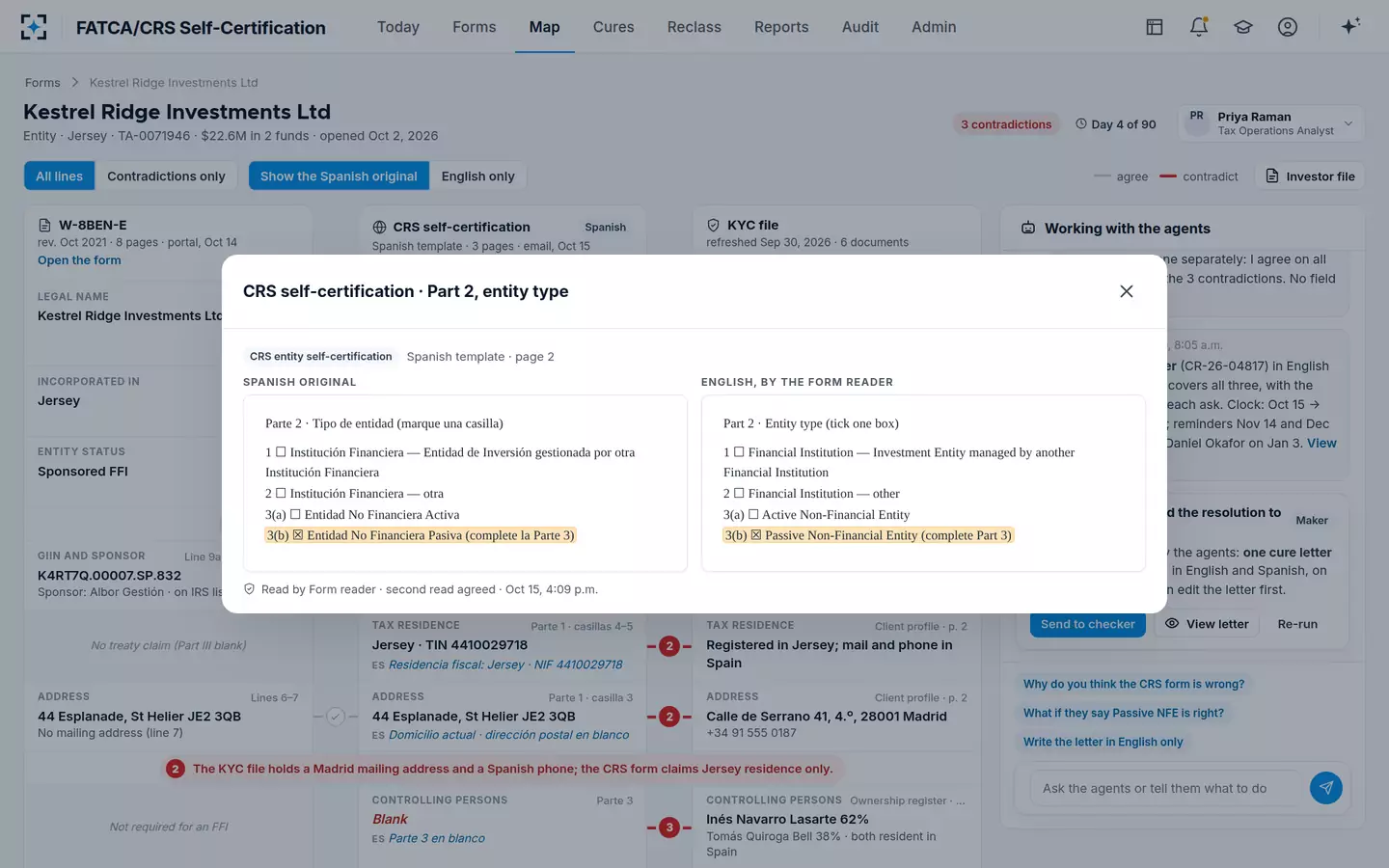
Yes, if it carries the required information and the fund can read it well enough to test it. With no prescribed format, a Spanish, Japanese or Arabic tax authority template is as valid as the fund's own form. The difficulty is operational, not legal: a reviewer who cannot read "Entidad No Financiera Pasiva" cannot tell whether the box ticked matches the W-8BEN-E, and a translation made once, by hand, is rarely attached to the file where a checker or an examiner can see it.
HMRC's manual allows a fund to pre-populate a form with what it already holds, "except for the jurisdiction(s) of residence for tax purposes" (HMRC IEIM403140), which is a useful rule of thumb for reading any template: the residence answer must be the investor's own. A form on which the residence box was filled in by the institution is not a self-certification of residence, whatever language it is in.
A Spanish entity form, read in its own language beside the English
Seven defects regulators found on real forms in 2025
The most useful reading list for anyone reviewing self-certifications is a regulator's penalty file. In 2025 the Abu Dhabi Global Market's Financial Services Regulatory Authority published a run of CRS and FATCA penalty decisions that describe, form by form, what made a self-certification invalid or unreasonable. Each defect below would have been visible to a reviewer who read the form against the file.
What made a form invalid or unreasonable, in the ADGM decisions of 2025
- Tax residence left blank
One account holder at Investcorp Saudi Pre-IPO Growth Fund LP and two at Ousoul Assets Custodian left the jurisdiction of residence empty. Without it the form is not valid at all.
- “No TIN is required” for a country that issues TINs
An Ousoul investor resident in Ireland wrote it; the regulator noted that Ireland issues TINs automatically to individuals.
- A TIN for a country that issues none
An investor resident in the British Virgin Islands supplied one; the fund also reported self-generated TINs for BVI and Cayman residents.
- Two entity classifications ticked
One investor chose two inconsistent CRS categories, and the fund did not ask which was right.
- The classification section left empty
Without it the fund could not tell whether the investor was a passive NFE with controlling persons to report.
- TINs that do not fit the country’s format
At Wahed Invest, TINs for India, Switzerland and Pakistan that clearly did not conform to those countries’ formats.
- Residence in one place, every address in another
Wahed Invest investors certified UAE residence while the KYC file held home addresses in Kyrgyzstan, Nigeria, Singapore and Hong Kong.
None of the seven needed tax advice to spot. The regulator's guide says so in terms: reasonableness checks "do not require an RFI to obtain tax advice or perform a legal analysis to determine tax residency." They need a reader who compares the form with the file, every time, including on the forms that arrive in bulk in the weeks before a reporting deadline.
"If there is any inconsistency in the information the RFIs hold in relation to an Account Holder, the SCF fails to meet the reasonableness test."
ADGM Financial Services Regulatory Authority, guide to validity and reasonableness checks on self-certification forms
What a failed check leads to is spelled out alongside it: the institution must either obtain a new, valid form or document a reasonable explanation, with supporting documents where needed, of why the original stands. A note on the file that says "checked" is neither. What one unresolved form costs once a regulator counts them is set out in FATCA and CRS penalties.
Reading every field against the file: where FATCA/CRS Self-Certification fits
FATCA/CRS Self-Certification reads each W-9, W-8 and CRS form when it arrives, checks it against its own rules and then against the other forms and the KYC file, so the field-by-field reading above happens on every form rather than on a sample. Seven agents do the reading and drafting; the analyst, the checker and the head of fund tax decide. The agents never accept a form, choose a classification or send a letter.
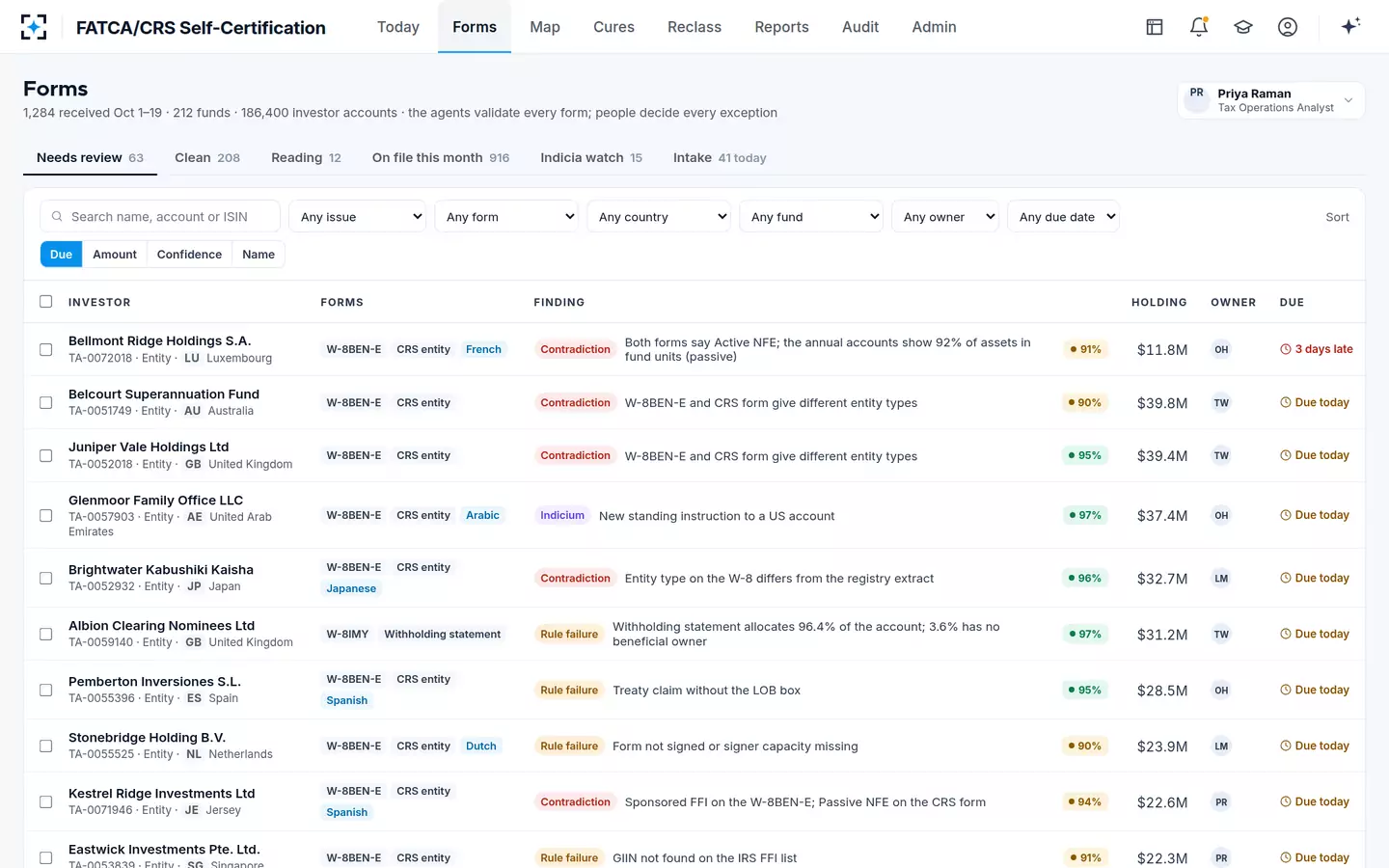
At the sample manager, the work list on the morning of 19 October showed what that reading produces: an entity whose W-8BEN-E and CRS form both said active NFE while its annual accounts showed 92% of assets in fund units; a form not signed, or with signer capacity missing; a treaty claim without the limitation-on-benefits box; and a GIIN not found on the IRS FFI list. Each line names the finding, the agent's confidence, the holding, the owner and the due date.
Every form arrives with its finding, confidence, owner and due date
The design target is that no conflicting classification stays on file, and that each investor receives one letter covering every defect, in English and the investor's language, instead of one request per form. Those are targets, not measured results. The way to see what the reading finds on your own investors is to run it on forms you have already accepted; that is how FATCA/CRS Self-Certification is shown to new teams.
Questions people ask
Is there an official OECD self-certification form?
No single form is mandatory. HMRC's manual says there is no prescribed format, and tax authorities, banks and fund administrators publish their own templates. Any of them is acceptable if it carries the required fields and lets the institution determine every jurisdiction of tax residence.
What is the difference between an individual and an entity self-certification?
An individual form describes one person: name, residential address, every tax residence, a TIN for each and date of birth. An entity form describes the company or trust and its classification, and for a passive NFE it brings a self-certification for each controlling person, so one entity investor can mean three or four forms.
What if the investor has no TIN?
The form must give the reason. Some jurisdictions, such as the Cayman Islands and the British Virgin Islands, do not issue TINs, and the ADGM regulator penalised a fund in 2025 for reporting self-generated numbers for residents of both. A missing TIN for a country that does issue them gives the fund reason to know the form is unreliable.
Can the fund fill in the form for the investor?
Partly. HMRC allows an institution to pre-populate a self-certification with information it already holds, except the jurisdictions of tax residence, which must be the account holder's own answer. The investor still signs or positively affirms the whole form.
Do existing investors need a new form under the amended CRS?
Not automatically. Pre-existing individual accounts were never required to have a self-certification, so HMRC's penalty for failing to obtain one does not apply to them. From 2026 a fund must report whether it holds a valid form, and must keep asking for a missing TIN on a reportable pre-existing account whenever it updates that account's KYC information.
How long must a fund keep the form?
The ADGM regulator's guide says documentation should be kept for at least six years from the date of despatch, and national rules vary. The solution's sample settings keep forms and letters for six years after the account closes and the audit trail for ten.