A failed trade settlement in the loan market is a trade that has been agreed and confirmed but cannot be closed, because one document, one consent or one signature is outstanding at one firm. It is not a failure in the equity sense — nobody buys the position in, and the trade does not unwind. It just sits, and from the seventh business day the seller pays the buyer for every day of it. Across a desk, the same eight blockers come up again and again, and the first three of them are paper the buyer could have had ready before the trade was struck. Botminds' Loan Trade Settlement reads the settlement mailbox and the administrative agents' notices, names what holds each open trade and which firm holds it, and quotes the message, notice or clause behind the answer.
Every figure describing a trade, a firm or a desk on this page is sample data from the working software, on invented banks, funds, borrowers and agents. The research figures come from the Treasury, the Internal Revenue Service and the Securities and Exchange Commission, linked where they appear.
Where a desk’s late days came from in one month
What causes a failed trade settlement in the loan market
The structural answer is that a loan trade is not cleared by anybody. A par trade needs a confirmation and allocations, a signed assignment and pricing letter, the administrative agent's consent after its own identity and tax checks, often the borrower's consent, and a funding memo — and each of those waits on a different firm with its own queue. The Securities and Exchange Commission put the mechanism plainly when it proposed removing the less liquid classification for fund holdings: "Because the process of trade settlement for bank loans is not standardized and involves many parties, the settlement process can take longer" (SEC, proposing release, December 2022). In the same release the Commission noted that many bank loans take more than seven days to settle, and that only "a fraction of traded bank loan interests has a standardized settlement process and transparent prices and quotations".
The operational answer is narrower and more useful. A trade stops because one party is waiting for one thing, and the desk does not know which party or which thing. Each hand-off is its own email thread, and the status on the settlement platform is what the parties typed into it rather than what is actually holding the trade. So the analyst's morning goes on reading whole threads to find out who a trade is stuck on, and a chase written at the end of that reading is often sent to a firm that already did its part.
That gap between "late" and "late because of X, at firm Y" is the whole difference. "Waiting on consent" covers a borrower that has never seen the request, a borrower that has seen it and is deemed to have consented, and an agent that has not yet forwarded it — three different next moves. A blocker is only actionable when it names a party, a document and a date.
The eight blockers, ranked by the days they cost
Rank them by days, not by how often they appear. A short allocation shows up on plenty of trades and is fixed in an afternoon; a buyer's identity file at an agent shows up less often and costs a week and a half. On the sample desk the ranking below holds, and the order is stable from month to month because it follows the number of firms each blocker has to travel through.
The eight blockers as Loan Trade Settlement ranks them: who holds each, and the move that clears it
1. The buyer’s identity and tax file at the agent
Who can move itThe buyer, with the agent
The evidence that proves itThe agent’s own request, naming the document and the date it asked
The moveSend the named document to the agent, from the buyer, with the request quoted back
Days4–9
2. The assignment or pricing letter still unsigned
Who can move itWhichever side has not signed — often us
The evidence that proves itThe signature page, and who it is sitting with
The moveRoute it to the one named signatory, not the shared mailbox
Days2–5
3. The wrong form sent in good faith
Who can move itThe buyer
The evidence that proves itThe form on file beside the form the agent asked for
The moveName the right form and who signs it before the buyer tries again
Days3–7
4. The submission the agent cannot find
Who can move itThe agent
The evidence that proves itThe sender’s own copy, with its date and recipient
The moveResubmit and ask for written confirmation of receipt
Days5–11
5. The silent borrower on a consent request
Who can move itThe borrower, or the clause
The evidence that proves itThe agent’s delivery notice, and the transfer section of the agreement
The moveCount the business days to deemed consent and tell the counterparty the date
Days5–20
6. The agent’s own transfer queue
Who can move itThe agent
The evidence that proves itTwo “in queue” replies, against that agent’s own median
The moveEscalate on the agent’s own record, not on a general complaint
Days4–13
7. The allocation that came back short
Who can move itThe counterparty
The evidence that proves itThe allocation beside the confirmation
The moveFix the allocation before anyone signs anything
Days1–3
8. Our own signature, or our own form
Who can move itUs
The evidence that proves itThe step with nothing outstanding from anyone else
The moveSign it today; nothing else is waiting
Days1–4
Two things stand out when the blockers are laid side by side. The top four are all paper, and all four are visible to the buyer before the trade is agreed. And the party that can move a blocker is almost never the party being chased: on a document request raised by an agent, the agent cannot act until the buyer sends the document, so a chase to the agent asking for progress buys nothing but a polite reply.
The ranking also explains the shape of the estimated time a late par trade spends in each stage. On a trade that needs both agent and borrower consent, the agent's identity, tax-form and consent work is the longest stage at about six business days, followed by getting the assignment and pricing letter signed at four and borrower consent at five; the confirmation and allocations take three and the funding memo and wires two. The documents are not the stage anyone watches, and they are where the time goes.
Blocker one: the buyer’s know-your-customer and beneficial-ownership file at the agent
The single biggest cause of late days on the sample desk was an agent waiting for a buyer's identity or tax document: a third of all of them. This is not an agent being obstructive. An administrative agent taking on a new lender of record is a covered financial institution onboarding a legal entity customer, and the rule it is following is written down. Covered institutions must keep written procedures, reasonably designed and built into their anti-money-laundering programme, to identify and verify the beneficial owners of legal entity customers (31 CFR 1010.230(a)). The owners in question are every individual who directly or indirectly owns 25 per cent or more of the customer's equity, plus one individual with significant responsibility to control or manage it.
Two consequences follow for a settlement desk. The first is that a buyer new to the agent’s bank cannot talk its way past it. Since February 2026 the Financial Crimes Enforcement Network has allowed covered institutions to identify a legal entity customer’s beneficial owners when it first opens an account, when they learn facts that make what they hold unreliable, and as their own risk-based procedures require — rather than at every new account (FinCEN, FIN-2026-R001). The relief is optional, so an agent may still ask on every transfer, and a fund it has never onboarded is a new customer whatever its reputation. The second is that the file does not refresh itself. FinCEN’s consolidated answers on the rule say covered institutions need not ask for or refresh beneficial ownership information as a routine part of periodic reviews unless a specific risk-based concern calls for it (FinCEN, CDD Rule FAQs, May 2026, B.18). So a buyer's file at an agent can be years old, perfectly compliant, and still missing the one document this transfer triggers.
On the sample desk this blocker appeared four times in one morning in four different forms: a buyer owing an agent a beneficial-owner form, another owing a current Form W-9, a third owing a manager's authority document, and a fourth whose Form W-8BEN-E had expired and was resent at T+13. Each is a different document, from a different signatory, on a different trade. A single line saying "KYC hold" on four trades is the reason a desk cannot act on them.
How long is a W-8BEN-E valid, and why expiry is a settlement problem
A Form W-8BEN-E is generally valid until the end of the third calendar year after it is signed. The Internal Revenue Service's instructions are explicit: "Generally, a Form W-8BEN-E will remain valid for purposes of both chapters 3 and 4 for a period starting on the date the form is signed and ending on the last day of the third succeeding calendar year, unless a change in circumstances makes any information on the form incorrect" (IRS, Instructions for Form W-8BEN-E). A form signed in March 2023 therefore expires on 31 December 2026, whatever happens in between, and a change of circumstances can kill it sooner.
That rule has an awkward property for a settlement desk: a form expires on a calendar date nobody is watching, and the first firm to notice is an agent in the middle of a transfer. The trade is already confirmed, the price is already agreed, and the delayed-compensation clock is already running when the hold appears. The fix costs a week; the prevention costs an afternoon in January.
The identity and tax documents a loan transfer asks for, and what expires each one
| Document | What it is for | Who signs it | How long it lasts | What ends it early |
|---|---|---|---|---|
| Form W-9 | A US entity certifies its taxpayer identification number so the payer need not withhold as a backup. | An authorised officer of the entity | No fixed expiry | A change of name, structure or taxpayer identification number |
| Form W-8BEN-E | A non-US entity claims its status, and any treaty rate, on US-source income. | An authorised officer of the entity | To the last day of the third succeeding calendar year after signature | Any change in circumstances that makes information on the form incorrect |
| Beneficial-ownership certification | Names the individuals who own 25 per cent or more, and one who controls, so the agent can verify them. | The individual opening the relationship, certifying the information | Until the information stops being accurate | A change of ownership or of the controlling person |
| Manager or authority document | Shows that the signatory may bind the fund, and that the manager may act for it. | The fund, or its manager under its own documents | Until the authority changes | A change of manager, delegation or signatory list |
| Agent’s own onboarding forms | The administrative agent’s standing instructions, wire details and contacts for the new lender. | The buyer’s operations team | Per agent, usually standing | A change of account, custodian or contact |
The buyer-side file worth having ready before the year’s first trade
- A W-9 or W-8BEN-E signed this year or last
A W-8BEN-E expires at the end of the third calendar year after signature, so a form signed three Januaries ago has months left and no warning attached to it.
- The beneficial-ownership certification, refreshed when ownership moved
The agent must identify every individual owning 25 per cent or more and one controlling individual. If a stake crossed that line this year, last year’s certification is wrong.
- The manager’s authority, current to today’s signatory list
A fund whose manager changed, or whose signatory left, will be asked for this at the worst possible moment.
- The standing settlement instructions each agent holds for you
Agents hold these per credit, not per fund. A fund that moved custodian last quarter has stale instructions at every agent it has not traded with since.
- One named person per agent who can answer a document request
A request sent to a shared mailbox is answered by whoever reads it, which is why a form can be sent twice and still be outstanding.
- A list of which agents hold which of your credits
The same fund is a known customer at one agent and a new legal entity customer at the next; the second is the one most likely to hold a trade.
Blocker two to four: the unsigned assignment, the wrong form, the lost submission
These three are the second band, together a quarter of the late days, and they share a cause: a document that exists but is not where it needs to be. They are also the three a desk is most likely to mistake for each other.
An unsigned assignment or pricing letter is the cheapest to fix and the easiest to miss, because nothing is outstanding from anyone else and so nothing arrives to remind anybody. On the sample desk this appeared as a trade waiting on the desk's own signature — tagged as ours, with no counterparty to chase — and as a buyer's own tax form that the closer had already sent to one agent on the ninth day. A step with nobody else in it does not generate mail, and a desk that works from its inbox therefore never sees it.
The wrong form is more expensive, because the buyer believes it has acted. A US fund sends a W-9 where the agent asked for a manager's authority; a non-US fund sends a certification where the agent asked for a treaty claim. The chase that works names the document, the signatory and the agent's own request; a chase that says "your KYC is outstanding" starts the cycle again.
The lost submission is the most expensive of the three and the hardest to talk about. On the sample desk an assignment sent to an agent could not be found and was resubmitted on the eighteenth day — more than a week of carry paid for an envelope. The only thing that shortens it is the sender's own dated copy, which turns a disagreement into a date, and a written confirmation of receipt on the second attempt.
Blocker five: the silent borrower, and what it is actually waiting for
A borrower that does not answer a consent request held a fifth of the late days on the sample desk, and it is the blocker where the longest waits happen: five to twenty business days, sometimes more. It is also the one most often misread, because silence looks like refusal and is usually nothing of the kind. A borrower's treasurer has no settlement clock, no delayed compensation to pay and no reason to prioritise a transfer between two lenders.
What matters is that many credit agreements already answer silence. Where the transfer section deems the borrower to have consented unless it objects within a stated number of business days of receiving the request, the trade has a date rather than an open question — but only if someone has the agent's delivery notice, the clause, and a business-day calendar. On the sample desk that arithmetic turned a trade sitting at twenty-three days past trade date into a settlement two days out, and stopped the delayed compensation at $60,024 instead of $83,605. How a deemed consent clause works, and what has to be true before you rely on it, is worked through clause by clause elsewhere in this series.
The same trade, blocked at the agent and blocked at the borrower, needs opposite moves
Blocked at the agent on a document request
- Days the buyer holds: getting the document signed and sent · 70%
- Days the agent holds: reviewing it once it arrives · 30%
Blocked at the borrower on a consent request
- Days the clause decides: the deemed-consent period, counted from delivery · 80%
- Days the desk holds: proving delivery and telling the counterparty · 20%
Blocker six to eight: the agent queue, the short allocation, our own signature
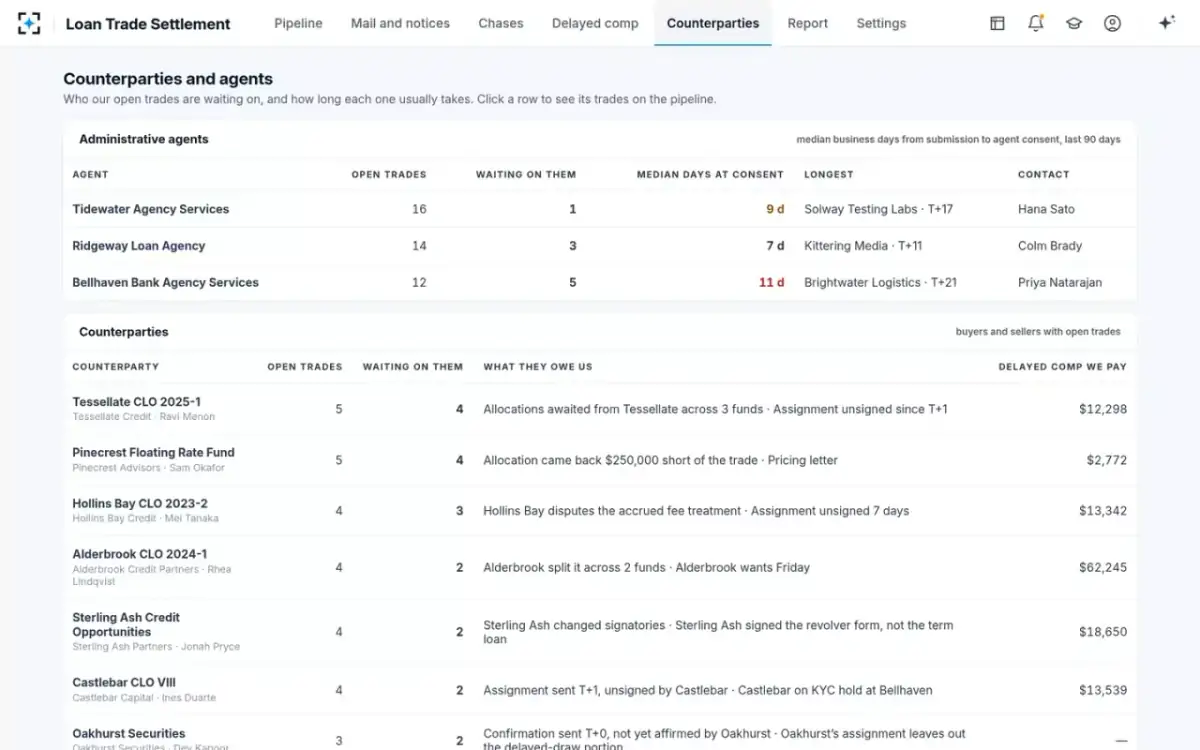
The last band is small in days and large in frustration. An agent's own transfer queue is a genuine blocker — on the sample desk one trade had been with its agent for thirteen days against that agent's own median of nine, after two replies saying it was in the queue. The thing that moves it is the agent's own record: a median, a count of trades currently sitting with that firm, and the delayed compensation those trades are costing. A general complaint moves nothing; "this one is thirteen days against your nine, and these three others are with you too" moves a queue.
A short allocation — an allocation that comes back for less par than the confirmation says — is cheap if it is caught on day one and expensive if it is caught after the assignment has been drawn. It belongs at the front of the process, which is where the trade intake reader flags it.
Our own signature is the honest one. On the sample desk, five of forty-two open trades were waiting on us: our signature, our form, our funding memo. No chase will ever arrive for these, because the only firm that could send it is the one holding them.
Forty-two open trades, each with its blocker and the firm that holds it
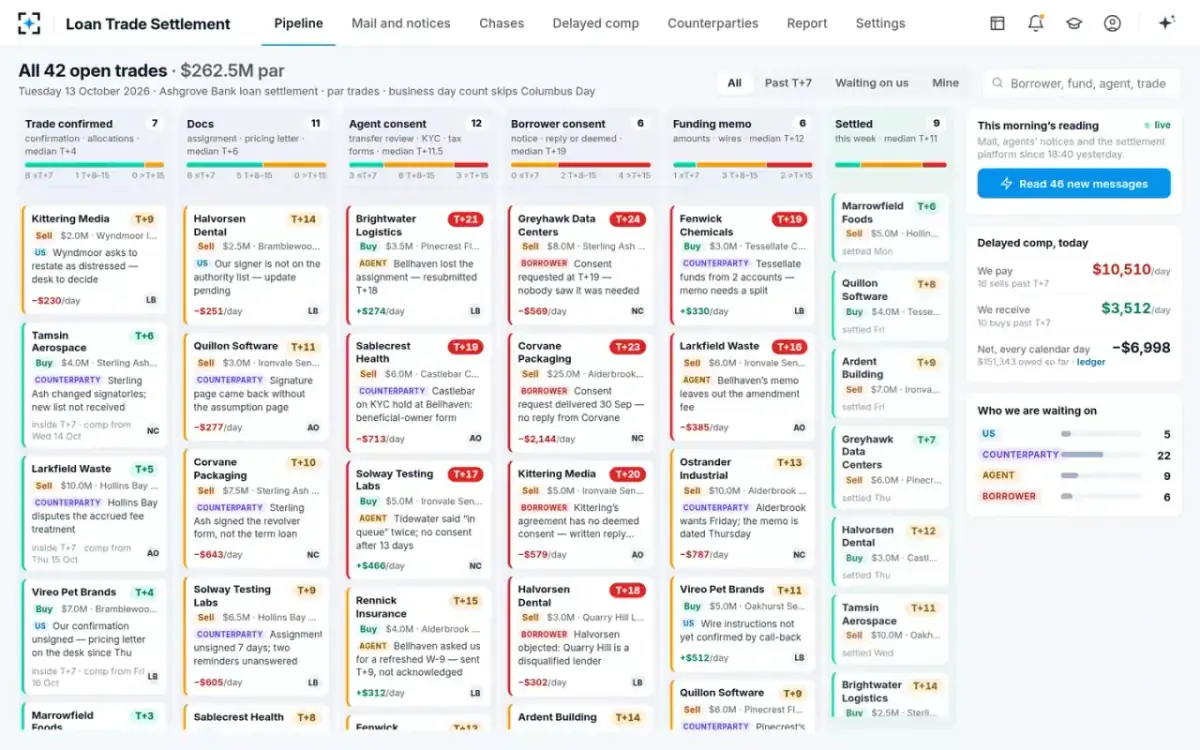
That split is the number to ask for. Twenty-two trades held by counterparties, nine by agents, six by borrowers and five by the desk itself is four different queues of work for four different people, and no amount of chasing in aggregate will shorten any of them.
Why the platform status is not the blocker
A settlement platform holds the trade, its documents and its close lists, and it reports the status the parties typed into it. That status is a fact about the platform, not about the trade: "pending agent consent" is true for a trade whose agent is waiting on a buyer's tax form and for a trade sitting in that agent's queue, and the two need opposite moves. The real status lives in the mailbox, in the agents' notices and in the transfer section of the credit agreement, which is why a desk with a perfectly maintained platform can still spend its morning reading threads.
This is the part a buyer evaluating software should test hardest. How the four ways of running settlement compare sets out what each layer actually covers; the short version is that recording a status and attributing a blocker are different jobs, and most of the market only does the first.
Clearing a stuck trade: the chase that goes to the one person who can move it
A chase works when it is addressed to the party that can act, says why now, carries the evidence, and asks for something with a date on it. All four parts matter, and the first is the one desks get wrong, because the inbox tells you who wrote last rather than who is holding the trade.
On the sample desk the eight chases drafted in one morning went to seven different firms, and each one named a document, a date and a person: a current W-8BEN-E for one agent, a beneficial-owner form owed by one buyer, a confirmation of receipt for the assignment resubmitted on the eighteenth day, an escalation to the agent holding a trade thirteen days against its own median. Each draft quoted the message or notice behind it. The analyst sends, edits or skips each one; nothing goes to a borrower without the desk head's approval.
Every chase in Loan Trade Settlement says why now, and carries its proof
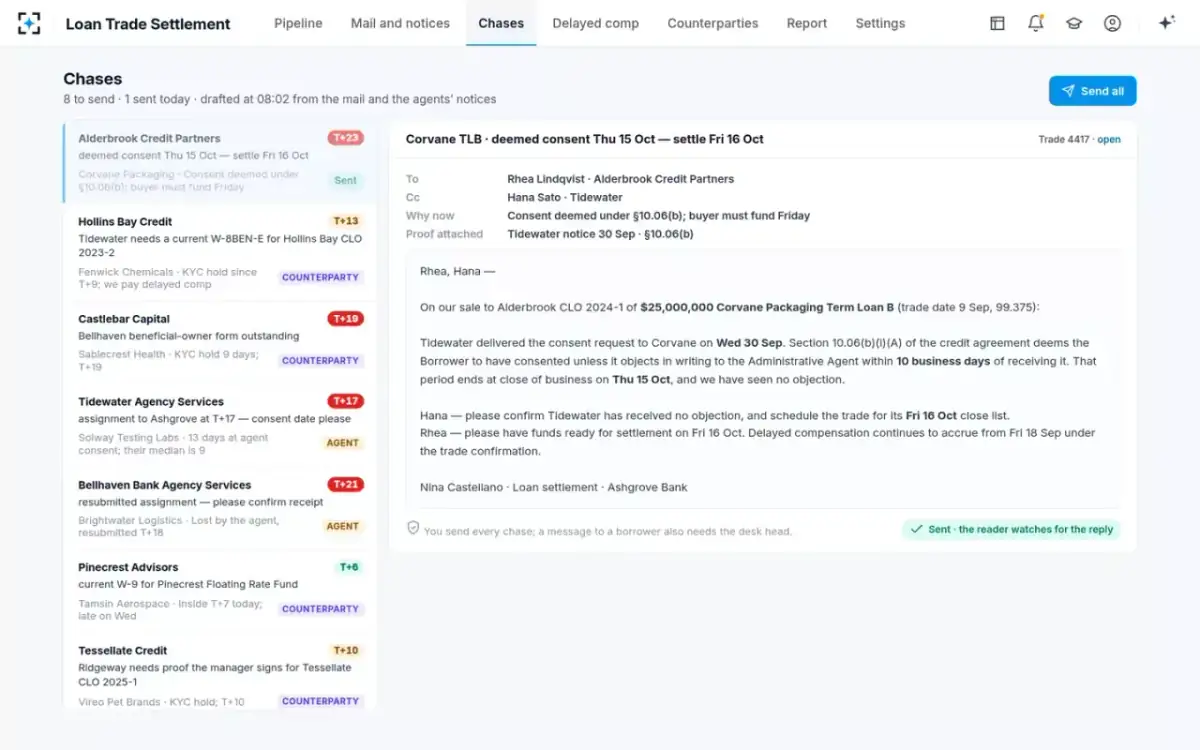
The measure of whether this is working is not how many chases went out. It is whether the desk's median days to settle is falling and whether the share of trades settling inside its own target is rising. On the sample desk, over six months, the median fell from fourteen days past trade date to eleven, the share settling inside seven days rose from 21 per cent to 34 per cent, and delayed compensation paid fell from $412,300 to $297,400 a month. What delayed compensation is, and how it is calculated line by line, explains what those dollars are made of.
Each agent and counterparty with its own median, its own queue and its own cost
Questions people ask
What is the most common cause of late loan settlement?
Documents, and specifically the buyer's identity and tax documents at the administrative agent. On the sample desk that single family of holds caused 34 per cent of all late days in a month, ahead of unsigned, wrong or lost documents at 24 per cent and borrower consent at 21 per cent. Almost all of it is paper that exists, or could exist, before the trade is agreed.
What is a KYC hold on a loan trade?
It is the administrative agent declining to complete a transfer until it has identified and verified the incoming lender. The agent is a covered financial institution onboarding a legal entity customer, and under 31 CFR 1010.230 it must have written procedures to identify and verify beneficial owners — every individual owning 25 per cent or more of the buyer, plus one controlling individual. For a buyer new to the agent it is not discretionary. For an existing customer, FinCEN’s February 2026 relief lets the agent rely on what it already holds unless facts call it into question, but the relief is optional and the agent’s own procedures may still ask.
What happens if a loan trade does not settle?
Nothing dramatic, which is part of the problem. There is no buy-in and no automatic unwind; the trade stays open and the economics shift. From the seventh business day on a par trade the seller compensates the buyer for the delay, net of the buyer's cost of carry, so every late day moves money from the seller to the buyer. The exposure also stays on the seller's book, and a fund on the buy side waits longer for the proceeds it expected.
Who is responsible when a loan trade is late?
Commercially, the seller carries the delay through delayed compensation, whoever caused it — including when the hold is the buyer's own outstanding document. That asymmetry is why sellers care about attribution: a trade held by a buyer's missing form still costs the seller money every day, so knowing which firm holds it is worth more to the seller than to anyone else.
How do you clear a stuck loan trade?
Find the one party that can act, prove why, and ask for something dated. In practice that means reading the agent's notices and the mail rather than the platform status, checking the transfer section of the credit agreement for a deemed-consent route before assuming a silent borrower is a dead end, and sending one specific request to one named person rather than a status enquiry to a shared mailbox.
Why do loan trades fail to settle more often than bond trades?
Because nothing about a loan transfer is standardised. The Securities and Exchange Commission's December 2022 proposing release describes bank loans as not standardised, with individualised legal documentation, and settlement that relies on manual processes; it also notes that only a fraction of traded bank loan interests has a standardised settlement process. A bond trade moves through a clearing system; a loan trade moves through a chain of firms, each of which can stop it.