Secondary loan trading is the buying and selling of syndicated loans that already exist — term loans and revolving commitments a group of banks funded when the credit agreement closed, sold on afterwards to other banks, credit funds, collateralised loan obligation vehicles and insurers. It is not a securities market with a longer clock. Nothing central matches the trade, nothing central holds the asset, and a party who is on neither side of it — the administrative agent, and often the borrower — has to act before ownership can move. That is why a par trade’s settlement date is decided by a chain of documents and consents rather than by the price two desks agreed in a minute. Botminds’ Loan Trade Settlement is software for that chain: it reads the settlement mailbox and the agents’ notices, names what holds every open trade and who holds it, and writes the chase for the one person who can clear it.
The desk on this page is a fictional sample: Ashgrove Bank, 42 open trades, $262.5 million of par. Its people, counterparties, funds, borrowers and agents are invented, and every figure that describes them is sample data rather than a customer’s result. The market and legal figures come from regulators and courts, linked where they appear.
The market a settlement desk works inside
$6.9T
of commitments in the 2025 Shared National Credit portfolio, across 6,857 borrowers
45%
of those commitments held by US banks — but only 22% of the non-pass ones
$1.4T
size of the US leveraged loan market at the end of 2024, on the FSOC’s figures
81%
of non-pass commitments that are leveraged loans
What is secondary loan trading, in one paragraph
When a large company borrows, it rarely borrows from one bank. An arranger underwrites the facility and syndicates it: a group of lenders each take a share of the commitment, and one of them is appointed administrative agent to run the loan — to hold the register of who the lenders are, to take the borrower’s interest payments and pass them on, and to be the single address for notices. That is the primary market, and it ends when the deal funds.
The secondary market is everything after that. A lender who wants out sells its share; a buyer who wants the credit, the spread or the collateralised loan obligation warehouse slot buys in. What changes hands is not a certificate. It is a position under a specific credit agreement: a funded amount of a term loan, sometimes an unfunded revolving commitment as well, and with it the rights and obligations that agreement gives a lender — to be paid, to vote on amendments, to be told things. Those rights exist only because the agent’s register says the buyer is now a lender. Until the agent writes the buyer into that register, the trade has happened economically and not legally.
That single fact explains nearly everything a settlement desk does. The two desks cannot complete their own bargain. They have to persuade a third firm, and sometimes a fourth, to finish it for them.
What is a par loan, and what makes a trade “par” rather than distressed
A par loan is a loan that is trading on the market’s standard short-form documents, with the seller giving a narrow set of promises: that it owns what it is selling, that it has not already pledged it, and that it has done nothing to impair it. “Par” is a documentation convention, not a price. A loan quoted at 88 can still trade par if the parties are content with those narrow promises, and a loan quoted at 99 can trade distressed if the buyer wants more.
Distressed documentation is the other regime, and it is a different piece of work. The buyer takes representations about the whole chain of title — every previous owner of the position — along with indemnities, an allocation of voting history, and the right to unwind if something in that chain turns out to be wrong. The paperwork is longer, the diligence is real, and settlement takes correspondingly longer. In the sample desk’s settings, delayed compensation starts at T+7 for par and near-par trades and at T+20 for distressed ones, which is the clearest statement anyone makes of how differently the two are expected to behave.
So the first question on every ticket is which documents the trade is on. It decides the forms, the diligence, the clock and, if the trade goes late, the money. The sample trade followed through this series — $25,000,000 of the Corvane Packaging Term Loan B, sold at 99.375 — is a par trade on par documents, and it still took more than three weeks.
Who is on the other side: banks, funds and the vehicles that buy loans
The buyer side of the secondary market is no longer mostly banks. Collateralised loan obligation vehicles are a major class of buyer of broadly syndicated loans; loan mutual funds and exchange-traded funds buy and sell in response to the money coming in and going out; insurers and pension funds buy for the floating-rate coupon; business development companies and credit funds buy both broadly syndicated paper and their own direct loans. Banks remain large holders and large sellers, and the Shared National Credit programme shows where they sit in the credit: US banks hold 45 per cent of all commitments reviewed, but only 22 per cent of the non-pass ones. When a loan weakens, it tends already to have moved somewhere else.
The exception proves what a secondary market is for. Private credit — loans made directly by funds rather than syndicated — has grown to a size the Financial Stability Oversight Council puts alongside the leveraged loan market, and it mostly does not trade. The Council’s 2025 annual report draws the contrast itself: unlike most broadly syndicated loans, private credit loans are usually held to maturity, and the absence of secondary trading, together with thin information on borrowers, makes timely valuation hard and the sector opaque (FSOC 2025 Annual Report). A traded loan has a price other people have to agree with. A loan that never trades has only a model.
How does secondary loan trading work, step by step from the trade to the funding
Here is the whole chain for an assignment of a par term loan, with the firm that has to act at each step. Nothing in it is optional, and no step can start before the one in front of it has finished. Five of the eight need somebody outside the two trading desks.
The chain a par trade walks, and who has to act at each step
Both desks
The tradeFacility, side, par amount, price and trade date agreed by telephone or chat, then written down the same day.
Both desks
The confirmationOne document the two sides sign: what was traded, on which documentation, and whether accrued interest travels with it.
Buyer
AllocationsThe buying firm names the funds behind the trade and the share each one takes. An allocation that comes back short is a new negotiation, not a clerical fix.
Both desks
Assignment and pricing letterThe agent’s own transfer form, signed by both sides, with the money terms kept in a separate pricing letter.
Buyer → agent
Questionnaire, tax forms, identity checksWire instructions, notice addresses, a W-9 or the right W-8 form, and whatever else the agent needs to know who it is paying.
Administrative agent
Agent consentThe agent reviews the transfer, takes its processing fee and accepts the buyer onto the register of lenders.
Borrower
Borrower consentRequired unless the buyer already counts as a lender, an affiliate of one or an approved fund — and sometimes deemed given if the borrower says nothing.
Agent → both desks
Funding memo and wiresThe exact amount to send, built from price, accrued interest and fees. Then the money moves and the register changes.
Read the chain as a queue rather than a checklist. Each step is a different firm’s inbox, with its own staffing, its own holidays and its own view of how urgent your trade is — and the seller’s desk, which pays for the delay, has the least control over steps five, six and seven. That is also why a settlement platform’s status and the real blocker are so often different things: the platform shows what the parties typed, while the blocker is the specific thing a named person has not done. Eight of the commonest are set out in the guide to why loan trades fail to settle.
The four parties on a trade that only has two sides
Who is in a loan trade, what each one controls, and what its silence costs
| Party | On the trade? | What it controls | What happens when it goes quiet |
|---|---|---|---|
| Seller | Yes — one of the two sides | Its signature on the assignment, the accrued interest and fees it must pass over, and whether it chases its own agent. | Nothing moves, and on a par trade the seller is usually the side paying delayed compensation for the wait. |
| Buyer | Yes — the other side | Its own signature, its allocations, its identity and tax paperwork, and having the money ready on the day. | The agent will not consent. A tax form that expired months ago can hold a $25 million trade as firmly as a dispute over price. |
| Administrative agent | No | Whether the transfer is accepted, the register of lenders, its processing fee, its checks on the buyer, and the date the consent request reaches the borrower. | The trade waits. The agent has no economic interest in your settlement date and nothing running against it. |
| Borrower | No | Its consent, where the credit agreement requires it, and the names on the list of lenders it will not accept. | Weeks — unless the agreement deems consent given after a stated period of silence. |
The asymmetry in the last column is the whole problem in one table. The firms that can stop a trade are not the firms that are charged for stopping it. A settlement desk cannot change that, but it can stop guessing which of the four it is waiting on, which is the difference between a chase that lands and a chase that annoys someone who already did their part.
Why a loan trade is not a securities trade — and what the courts say the instrument is
Loan traders talk like securities traders, and the instruments look superficially alike, but a syndicated term loan is generally not treated as a security — which is why none of the securities market’s plumbing applies to it. There is no central counterparty, no depository holding the position in book-entry form, no affirmation standard and no settlement cycle set by rule.
The question has been litigated. In Kirschner v. JPMorgan Chase Bank, the Second Circuit considered whether the notes evidencing a syndicated term loan were securities under the Supreme Court’s Reves test and held that they were not: the court affirmed that “plaintiff failed to plausibly suggest that the notes are securities under Reves” (Second Circuit, No. 21-2726-cv, 24 August 2023). The decision turned on a fact pattern — sophisticated institutional lenders, restrictions on transfer, a regulated banking context — rather than on a rule that all loans are outside the securities laws, so the answer is not automatic for every facility. But for the broadly syndicated market it settled the working assumption the market had already been built on.
The consequence for an operations team is procedural. Ownership of your position is whatever the agent’s register says it is; your evidence that a trade settled is a countersigned assignment and a wire, not an entry at a depository; and the settlement date is the date the slowest party in the chain finishes, not one anyone promised you.
How long does a loan trade take to settle, on the regulators’ own numbers
The market’s own target is T+7 for a par trade, a guideline set by the loan market’s trade association rather than by any regulator. The published evidence says the market does not hit it. The SEC, examining how open-end funds classify the liquidity of what they hold, put the numbers on the record twice. Around the time it adopted its liquidity rule in 2016, it reported, the median settlement time for a loan sale was about 12 days. By July 2021 the average time to settle a par trade had reached T+23, then a seven-year high, with a median of T+15 (SEC, Open-End Fund Liquidity Risk Management Programs, December 2022).
Seven days is the target; the published measurements are two to three times it
- Trade date to settlementT+7
- Trade date to settlementabout 12 days
- Trade date to settlementT+15
- Trade date to settlementT+23
Those figures are measurements of a market, not of any one desk, and they are several years old. They are still the most useful public anchor a settlement manager has, because they come from a regulator reading fund filings rather than from anyone selling a remedy. Where the days actually go, and why the gap between seven and twenty-three is structural rather than careless, is the subject of the guide to the settlement cycle.
What the paperwork actually is: confirmation, allocations, assignment, consent, tax forms, funding
The file a par assignment needs before an agent will process it — the list Loan Trade Settlement works from
- The trade confirmation
From both desks. Facility, side, par amount, price, trade date, which documentation the trade is on, and whether it is trading with accrued interest or flat.
- Allocations
From the buyer. Which funds or vehicles take what share. A short allocation is a change to the trade, not a detail.
- The assignment and assumption agreement
The administrative agent’s own form. Signed by seller and buyer, countersigned by the agent, and signed by the borrower where its consent is required.
- The pricing letter
From both desks. The money the assignment deliberately does not show: price, accrued interest, fees, any ticking fee on a delayed-draw tranche.
- The administrative questionnaire
From the buyer. Wire instructions, notice addresses and the contacts the agent will use for the rest of the loan’s life.
- Tax and identity forms
From the buyer. A W-9 or the right W-8 series form, plus whatever the agent needs to identify who it is paying. Expiry dates matter as much as the forms.
- Consents
From the agent, and from the borrower unless the buyer is already a lender, an affiliate of a lender or an approved fund under the agreement.
- The funding memo, then the wires
From the agent or the seller. The exact amount to send on the day, built from price, accrued interest, fees and the agent’s processing fee.
Read that list again and count how many pieces the buyer owns. Five of the eight start on the buying side, and three of those five — allocations, the questionnaire and the tax forms — are routine administration that no trader thinks about on the day of the trade. That is why the single most common blocker on a late par trade is not a disagreement. It is a form.
What arrived overnight, tied to the trade it belongs to
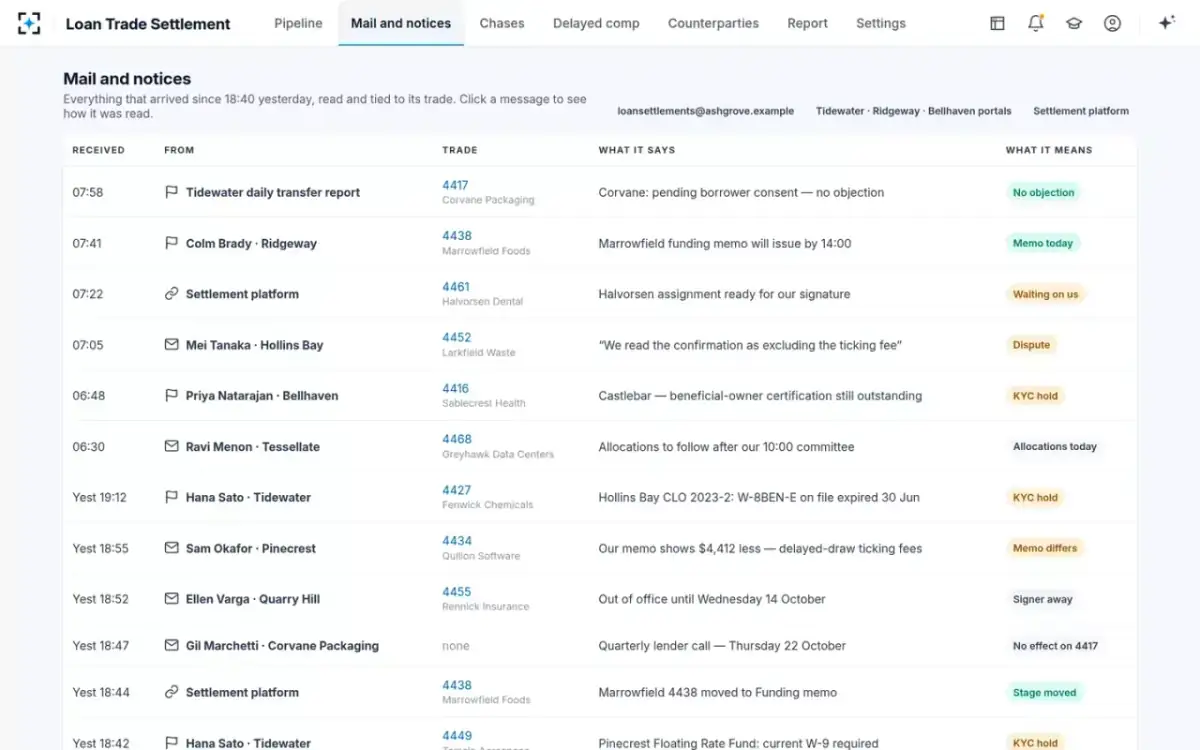
Where the chain breaks, and what naming the holder of each open trade changes
A settlement desk’s real difficulty is not that trades are late. It is that lateness is undifferentiated: 42 open trades are all “in progress”, and finding out which are genuinely stuck, and on whom, means reading threads one at a time — which takes the morning, and is out of date by lunch.
Naming the holder changes the shape of the day. On the sample desk’s morning of Tuesday 13 October, the 42 open trades split by who was holding them: the counterparty on 22, the administrative agent on 9, the borrower on 6, and the desk itself on 5. The five tagged to the desk are the interesting ones — an unsigned confirmation, an assignment waiting on the desk’s own authorised signer, a W-9 the desk owes an agent. Nobody is chasing those, because the firm that is late is the firm that would do the chasing.
Every open trade, its blocker and who holds it, in Loan Trade Settlement
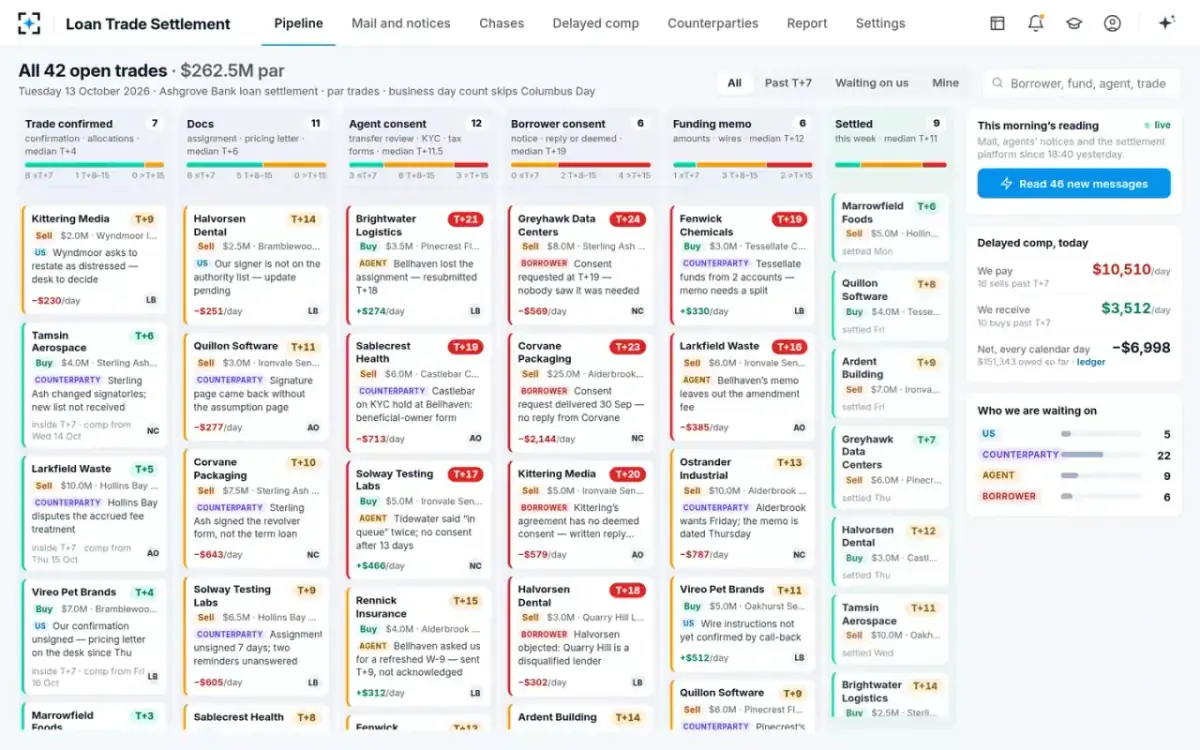
From there the work becomes ordinary. The trade with the oldest blocker gets a chase to the person who can clear it, with the message or clause that proves the hold attached. The trades waiting on a borrower get read against the credit agreement, because a transfer section often contains a way through that nobody has counted — deemed consent after a period of silence is the usual one. And the cost of the wait stops being a monthly surprise: delayed compensation is two pieces of arithmetic per trade, and both can be shown with their working.
To see the chain, the holders and the chases on one screen, start from Loan Trade Settlement.
Questions people ask
What is the difference between par and distressed loan trading?
It is a choice of documentation, not of price. On par documents the seller promises only that it owns the position, has not encumbered it and has not impaired it. On distressed documents the buyer also takes representations and indemnities covering every previous owner in the chain of title, plus unwind rights. Distressed trades take much longer to settle, which is why desks commonly start delayed compensation later on them — at T+20 rather than T+7 in the sample desk’s settings.
Who buys syndicated loans in the secondary market?
Collateralised loan obligation vehicles are major buyers of broadly syndicated loans, alongside loan mutual funds and exchange-traded funds, insurers, pension funds, business development companies and credit funds. Banks remain large holders and frequent sellers: the 2025 Shared National Credit report found US banks holding 45 per cent of reviewed commitments but only 22 per cent of the non-pass ones.
Does the borrower have to agree before its loan can be sold?
Usually, but with wide exceptions. A typical US credit agreement requires the borrower’s consent to an assignment unless an event of default has occurred, or unless the buyer is already a lender, an affiliate of a lender or an approved fund. The consent must not be unreasonably withheld or delayed, and many agreements deem it given if the borrower does not object in writing within a stated number of business days.
Why do loan trades settle so slowly?
Because the two parties to the trade cannot finish it alone. Five of the eight steps need a firm that is not on the trade — the administrative agent, and often the borrower — and none of those firms is paying for the delay. The SEC has described bank loan settlement as a process that is not standardised and involves many parties, and reported an average of T+23 for par trades in July 2021 against the market’s seven-day target.
What documents does a loan trade need?
A confirmation, allocations, a signed assignment and assumption agreement on the agent’s form, a pricing letter carrying the economics, the buyer’s administrative questionnaire, its tax and identity forms, the agent’s consent and often the borrower’s, and finally a funding memo against which the money is wired. The agent also takes a processing fee — $3,500 in the fictional sample agreement used in this series.
Is a syndicated loan a security?
Generally not, on the current state of the law. In Kirschner v. JPMorgan Chase Bank the Second Circuit applied the Supreme Court’s Reves test and held the notes at issue were not securities. The holding rests on the facts of that syndication rather than on a blanket rule, so a particular facility can still raise the question — but the broadly syndicated market’s settlement machinery is built on the assumption that none of the securities market’s central matching and clearing applies.