A loan trading platform is shared infrastructure for settling syndicated loan trades: it holds the trade and its documents, carries the close lists, and shows each party the stage the trade has reached. It is genuinely useful, and for an active desk it is usually the first tool worth having. What it does not do is read the settlement mailbox, where the reason a trade has stopped actually lives — so the question for a buyer is rarely "which platform" and almost always "which layer of this job is missing". Botminds' Loan Trade Settlement is built for one of those layers; this guide is about all four, including the ones it does not touch.
The sample figures on this page come from a fictional desk inside the working software, and are labelled where they appear. The public figures come from the Securities and Exchange Commission and from the banking agencies' joint third-party risk guidance, linked in place.
The four layers of settlement work, and where the gap is
Layer 1
The trade itself
What it isFacility, side, counterparty, fund, par, price, trade date, and the documents the trade will need.
What goes wrongA confirmation that does not match the allocation, or an allocation that comes back short.
Who covers itWell covered. A settlement platform, and most loan administration systems, hold this properly.
Layer 2
The documents
What it isThe assignment and pricing letter, consent requests and replies, identity and tax forms, the funding memo.
What goes wrongA document that exists but is at the wrong firm, unsigned, superseded or expired.
Who covers itPartly covered. Platforms store what is uploaded to them; nothing knows about the version sitting in somebody’s sent items.
Layer 3
The status
What it isWhere the trade has reached, stage by stage, as the parties report it.
What goes wrongA status that is stale, optimistic, or true but useless — “pending agent consent” on two trades that need opposite moves.
Who covers itCovered, with a catch. The status is what the parties typed, not what the trade is waiting on.
Layer 4
The attribution
What it isWhich single firm is holding this trade, for which document or decision, with the message, notice or clause that proves it.
What goes wrongNothing — this layer is mostly not held anywhere. It is reconstructed each morning out of an inbox.
Who covers itThe gap. It is the layer that decides who gets chased, and the one nobody sells as a product category.
What is a loan trading platform, and what it is actually for
A loan trading platform exists because a loan trade has no central counterparty and no settlement system to push it through. Instead, two firms and an administrative agent have to agree, in order: what was traded, who the buyer is, what documents the transfer needs, when the agent will put it on a close list, and when the money moves. A platform gives those parties one place to see the same trade and the same documents, and that is worth a great deal — it removes the version problem from the trade and from the close list.
It is worth being clear why such a thing is needed at all, since equity and bond desks manage without one. The Securities and Exchange Commission's December 2022 proposing release puts the structural reason bluntly: only a small part of the traded bank loan market has a standardised settlement process and transparent prices (SEC, proposing release). Where there is no standard process, a shared place to put the trade is the first thing anyone builds.
So a platform is a system of agreement. It is not, and was never designed to be, a system of attribution.
The four layers of a settlement desk, and which tools cover which
Settlement work has four layers, and they are easy to run together because the same people do all four. Separating them is the single most useful thing a buyer can do before looking at any product, because almost every desk already covers the first three and almost none covers the fourth.
The trade itself is held well — by the platform, by the loan administration system, by the blotter. The documents are held adequately, with the familiar caveat that a system only knows about documents put into it. The status is held and reported, which looks like the answer and is not, because a status is what somebody typed. The fourth layer — which firm is holding this trade, for what, with the evidence — is the one that decides what the desk does next, and the one that is almost never held anywhere.
That is why a desk with an immaculate platform can still start its morning reading whole threads. Nothing is broken; the layer that answers the morning's question was never in scope.
What a loan trading platform does not do
Four things, specifically, and each of them is a real gap rather than a complaint about any product.
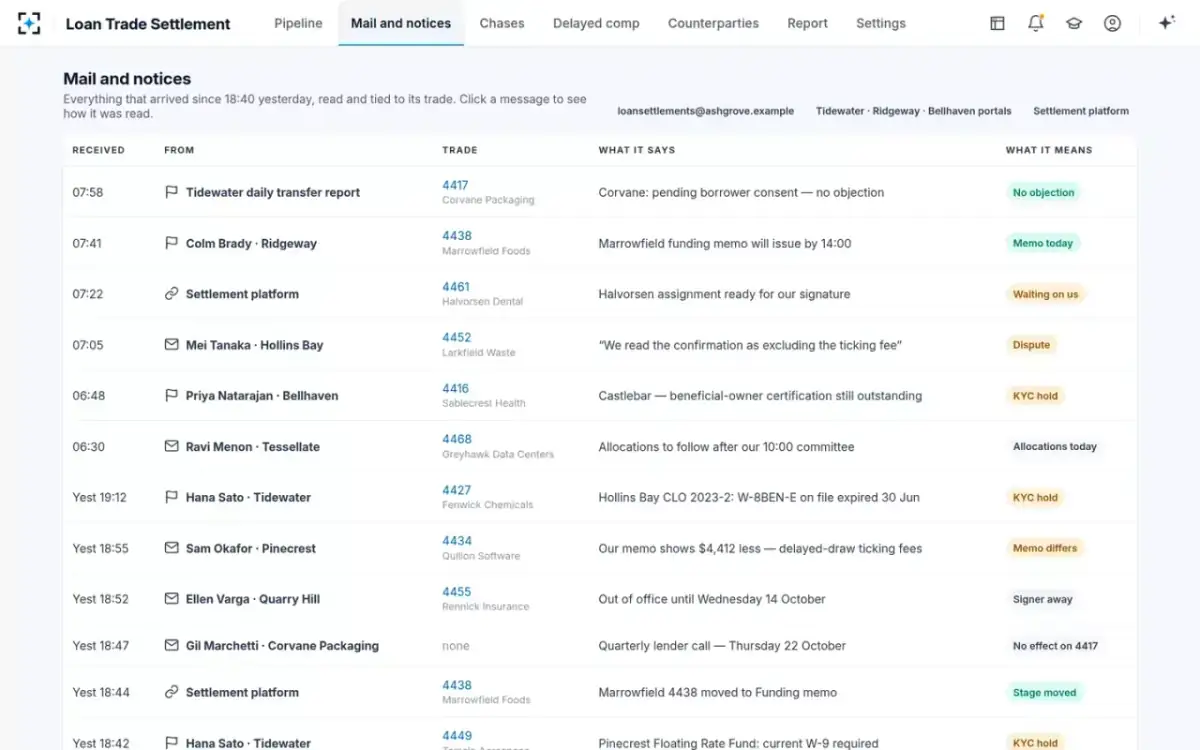
It does not read your mail. Consent requests, document requests, objections, out-of-office replies and the agent's "we have it, it's in the queue" all arrive as email, and none of it is in the platform unless somebody puts it there.
It does not read the credit agreement. Whether this buyer needs the borrower's consent at all, whether the transfer meets the minimum, whether the borrower's silence has already become consent under a deemed-consent clause — those answers live in the transfer section of each facility's own agreement. What a deemed consent clause requires before anyone may rely on it works through the clause itself.
It does not attribute. "Pending agent consent" is a true statement about two trades that need opposite moves — one where the agent is waiting on the buyer's tax form, one where the agent has everything and has not reached it yet. The eight blockers, ranked by the days they cost separates them.
And it does not price the delay. Delayed compensation is calculated from the trade's own economics and the days elapsed, and on a desk that both buys and sells it runs in both directions every day.
Is email still used for loan settlement? Why the mailbox is where the status actually lives
Yes, and not because desks are behind. Settlement correspondence is negotiation: an agent asking a buyer for a specific document, a buyer explaining which entity signs it, a borrower's treasurer being reminded that a request is outstanding, a counterparty proposing a date. Those are conversations between firms with no shared system, and email is the only channel all of them already have.
The Commission's description of why loan settlement resists being shortened names the same thing from the other end: in a future stress event, attempts to shorten settlement times "may fail since loans are not standardized, have individualized legal documentation, and rely on manual processes for settlement". Manual processes, in practice, means people writing to each other.
The consequence is awkward for anyone buying software. The authoritative account of what is holding a trade is in a shared mailbox, in prose, in no particular order, mixed with everything else. A tool that cannot read that mailbox is working from a copy of the truth that somebody retyped.
Loan Trade Settlement ties everything that arrived since last night to its own trade
Four ways desks run settlement, and what each one leaves open
What it fixes: One shared view of the trade, its documents and the agent’s close list, so nobody argues about versions. The thing most active desks should have first.
What it leaves open: It reports the status the parties typed. It does not read the mailbox, the agents’ notices or the credit agreement, so it cannot say which firm is holding a trade or why.
What it fixes: Nothing to buy, nothing to integrate, and complete flexibility — which is why almost every desk still has one of these underneath whatever else it owns.
What it leaves open: Attribution is redone by hand every morning, and dies with whoever maintained the spreadsheet. Nobody can say what the late days cost or what caused them.
What it fixes: Capacity, immediately, without hiring — useful for a volume spike, a migration or a desk with no settlement team at all.
What it leaves open: The responsibility does not move with the work, the knowledge accumulates outside the bank, and the measurement you get is the provider’s rather than your own.
What it fixes: The fourth layer: each open trade with its hold, the firm that holds it and the message, notice or clause that proves it, and a chase drafted to the party that can clear it.
What it leaves open: It does not execute, price or book a trade, it does not replace a settlement platform, and it sends nothing — a person sends every message.
How do you evaluate loan settlement software? Ten questions worth asking
The useful questions are the ones whose answers are demonstrable on your own trades in an afternoon. Each of these has an answer that should worry you, and the worrying answer is usually a confident generality.
Ten questions, and the answer that should worry you
- Which of the four layers does this cover?
Worrying answer: “all of it”. A tool that holds the trade, the documents, the status and the attribution is describing a category that does not exist yet, and usually means layer four is a status field.
- Does it read our settlement mailbox, and on what terms?
Worrying answer: “you can forward messages in”. Forwarding is a person deciding what matters, which is the work you were trying to remove.
- Can it show me the message behind this conclusion?
Worrying answer: a confidence score. A score is not evidence; the sender, the time and the words are.
- Does it read the transfer section of our credit agreements?
Worrying answer: “we capture the key terms at onboarding”. Terms captured once go stale, and the clause that matters is usually the one nobody captured.
- What does it do when it cannot tell?
Worrying answer: it picks the most likely option. The right behaviour is to hand the message to a person and say so.
- What can it send, and who approves it?
Worrying answer: “it can send automatically if you want”. Ask who signs off a message to a borrower, and whether that approval is a setting or a promise.
- Whose calendar does it count business days on?
Worrying answer: “calendar days”. A consent period counted on the wrong calendar gives a counterparty the wrong date, which is worse than no date.
- Can it show its working on a delayed-compensation figure?
Worrying answer: a total. A counterparty will check the rate, the days and the carry, so a claim without its arithmetic comes straight back.
- What are the settings we own on day one?
Worrying answer: “we’ll configure that for you”. Clocks, rates, chase rhythm and approval thresholds belong to the desk and change without a project.
- What does it refuse to do?
Worrying answer: nothing. A tool with no stated limits has not thought about where it sits in your controls, and your risk function will find that out before you do.
What to ask about evidence: can it show you why it believes a trade is blocked
This is the question that does the most work, so give it a whole meeting. Ask for a trade you know is stuck. Ask what is holding it. Then ask to see the thing that proves it — the message, with its sender and its time; the agent's notice, with its date; the clause, with its section number and the page it sits on.
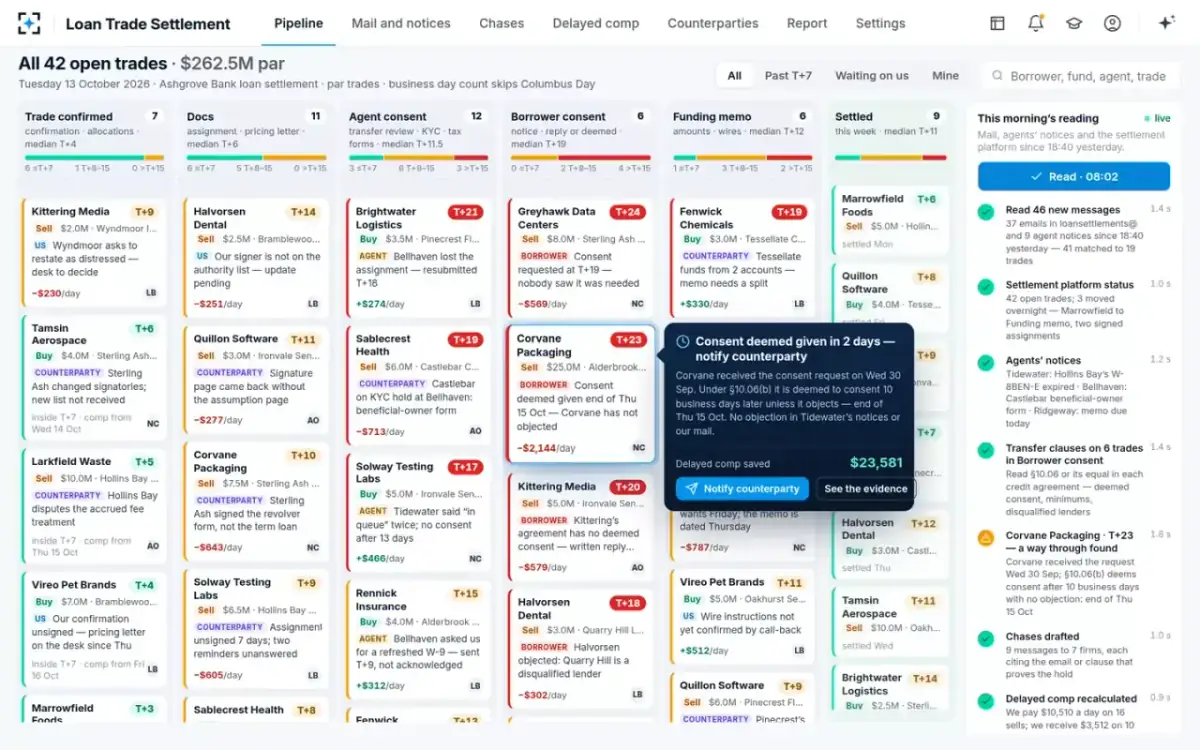
A tool that can produce those three things has read your actual correspondence. A tool that produces a paraphrase has read a summary of it, and a paraphrase is exactly where a wrong answer hides: "pending borrower consent" sounds the same whether the request was delivered three weeks ago or never sent at all, and the two are worth $23,581 apart on a single $25 million trade.
The same test applies to the money. A delayed-compensation figure should arrive with its rate, its days, its carry and the dates it runs between, because the counterparty you send it to will check all four.
One morning’s reading, step by step, with the trade that changed lifting out
The supervisory expectations that travel with anything you buy
Whatever a desk buys, the bank keeps the obligation. The Federal Reserve, the Federal Deposit Insurance Corporation and the Office of the Comptroller of the Currency say so plainly in their joint third-party risk guidance, and it is the point to put at the top of the business case: using a third party does not reduce a bank’s responsibility to operate safely and within the law, to the same extent as if it did the work itself (Interagency Guidance on Third-Party Relationships: Risk Management, June 2023).
Two practical consequences follow. The first is that a managed service does not relocate the risk: the bank still owns the settlement controls, the records and whatever is said to a borrower in its name. The second is that the selection itself is supervised work — the same guidance treats due diligence before a third party is selected as an important part of sound risk management (SR 23-4 attachment). A desk that runs an afternoon demonstration and signs is not finished; the file that explains why this tool, with what limits, and what the bank still does itself, is part of the purchase.
This is also why the "what does it refuse to do" question is not a rhetorical flourish. A risk officer reading a proposal wants the boundary written down: the mailbox is read only, nothing is sent without a person, trade economics are never edited, anything addressed to a borrower needs the desk head. Where the line sits between what agents decide and what people decide sets that out in full.
How do you measure settlement performance before and after
Take the baseline before you talk to anybody, because the baseline is the only number in the whole exercise that nobody can sell you. Four measures are enough, and all four come out of trades you have already settled.
Median business days from trade date to funding, for par trades. The share of trades that settled inside your own target. Late days by cause, which is the one that needs a human pass the first time. And delayed compensation paid and received, month by month, net.
Public benchmarks exist but are thin, and should be used for orientation rather than as a target. The Commission's December 2022 release, citing the market's own monthly summary, noted that in July 2021 "just 20% of trades settled within the LSTA guideline during July, a nine-percentage point reduction from the previous year's monthly average". For contrast, in the equity market — where there is a clearing system and a standard process — the Commission observed in its 2023 settlement-cycle rule that even before the move to T+1, "only about 68% of trades achieve affirmation on trade date" (SEC, final rule, March 2023). Neither number is your desk, and the second is a different measure in a different market; the point is that the loan market's own guideline is missed far more often than it is met.
The share of par trades settling inside the market’s seven-day standard
Take the same four measures again at three months and at six. If the median has not moved but the share inside target has, the desk is clearing its easy trades faster and its hard ones no faster, which is worth knowing before anyone writes a success story.
What to buy first if you can only buy one thing
It depends on which layer is missing, and the honest answers split three ways.
If the desk argues about what was traded, or chases documents it has already received, buy the shared place first: a settlement platform, or proper use of the one you have. Attribution over a disputed trade is worthless.
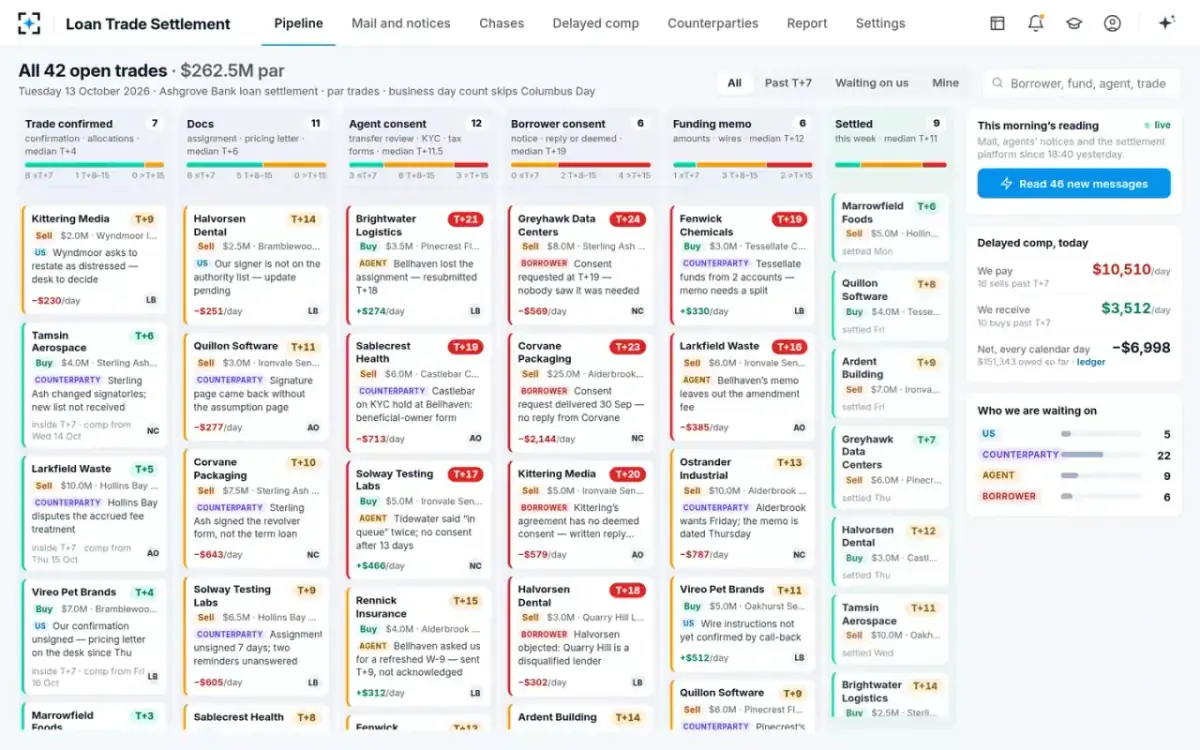
If the desk has the platform and still starts the morning reading threads, the missing layer is attribution, and that is what reading agents over the mail and the notices cover: each open trade with its hold, the firm that holds it, the proof, and a drafted chase to the party that can clear it. This is the case where a desk that "already has a platform" is nonetheless blind, and it is the common one.
If the desk's problem is capacity for a known period — a migration, an acquisition, a volume spike — buy people, with the supervisory expectations above in the file, and keep the measurement in your own hands.
The thing not to do is buy the fourth layer as a feature of something else. It is a different job from recording a status, it depends on reading correspondence nobody has structured, and a status field with a drop-down list of blockers is a desk retyping the thing it already knew.
The fourth layer, covered: every trade in Loan Trade Settlement names the firm holding it
Questions people ask
Do loan settlement platforms reduce settlement time?
They remove a real class of delay — disputes about what was traded, missing documents and close lists nobody can see — and a desk is better off with one than without. What they do not shorten is the waiting: a trade held by a buyer's expired tax form or a silent borrower waits exactly as long with a platform as without, because the platform reports that wait rather than acting on it.
What questions should you ask a settlement software vendor?
Start with which of the four layers it covers, then ask it to prove one conclusion on one of your own stuck trades — the message, the sender, the time, the clause. Then ask what it does when it cannot tell, what it can send and who approves that, whose calendar it counts business days on, and what it refuses to do. The last question tells you whether anyone has thought about where the tool sits in your controls.
Does this replace our settlement platform?
No. Loan Trade Settlement reads the settlement mailbox, the agents' notices and portals, the settlement platform's own status, the credit agreements and the confirmations and allocations, and it works out what holds each trade. It does not execute, price or book a trade, it does not hold the close list, and it sends nothing on its own. A desk that has no platform should think about that first.
Is email still a safe place for settlement correspondence?
It is where the correspondence is, which is a different question from whether it should be. The practical risk is not the channel but the dependency: when the authoritative account of a trade's status exists only in a thread, it is available to whoever has read that thread and to nobody else, it cannot be measured, and it leaves when they do. Reading the mailbox into something attributable is how a desk stops being one person's memory away from blind.
How long does a selection take, and who should own it?
The part that takes time is not the comparison; it is the baseline and the file. Expect to spend the first weeks measuring your own median, your share inside target, your late days by cause and your net delayed compensation, because without them no claim anyone makes can be checked. The owner should be the person accountable for the settlement result — usually the head of operations — with the desk head involved from the start, because the approval rules for anything addressed to a borrower are theirs.
What does the delay cost while we decide?
It is calculable, and worth calculating before the business case is written. On the fictional sample desk, late sells were accruing $10,510 a day against $3,512 received, and a single $25 million trade sitting on a silent borrower was running at $2,144 a calendar day. Multiply your own daily net by the days a decision takes and you have the cost of the status quo, in the same units as the proposal.