A syndicated loan operations analyst keeps a book of agreed loan trades moving from confirmation to funding: reading the settlement mailbox and the administrative agents' notices, working out what each open trade is waiting on, chasing the firm that can clear it, and watching what the delay costs. It is a chasing job with a clock attached, and on most desks it is done out of a shared inbox. Botminds' Loan Trade Settlement is built for that desk — it reads the mail and the notices, names what holds each open trade and which firm holds it, and drafts the chase — which makes the seats, and what each one is allowed to decide, worth setting out plainly.
The desk described here is a fictional sample one — Ashgrove Bank, four named people, forty-two open trades — used to show the work concretely. The pay and employment figures are public, from the US Department of Labor's O*NET, and they describe the nearest published occupations rather than this job itself; that caveat matters, and the section on pay returns to it.
The four seats, and the sentence each one says about the work
Today
“I know it’s stuck. I don’t know who it’s stuck on until I read the whole thread.”
With agents
Starts the day with every trade’s hold named and quoted, and the chases already drafted for her to read, edit and send.
Still theirs: she sends every chase and notice, and sets settlement dates
Today
“Half my chases go to people who already sent it — to someone else.”
With agents
Sees which trades are waiting on the desk’s own signature, and one draft per trade addressed to the firm that actually holds it.
Still theirs: he signs the assignments
Today
“I pay delayed comp every month and can’t tell you why.”
With agents
Sees delayed compensation both ways, split by which firm holds each trade, and a monthly account of what held trades past the seventh day.
Still theirs: he approves claims over $50,000
Today
Trades sit for weeks on a silent borrower, because nobody is counting the business days to deemed consent.
With agents
Sees the delayed compensation sitting on trades a borrower holds — $91,576 this morning — and the date each consent period ends.
Still theirs: she approves every message to a borrower before it goes
What does a syndicated loan operations analyst do all day?
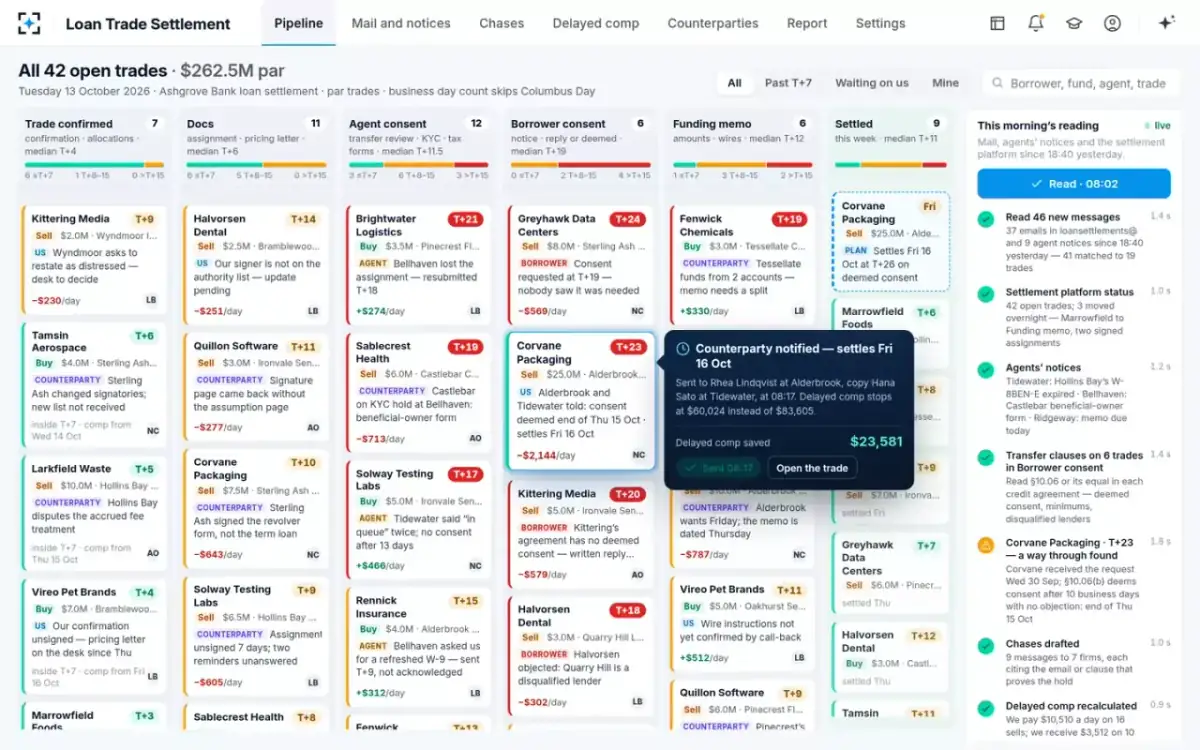
The day has four parts, and only one of them is chasing. First comes reading: the shared settlement mailbox and the agents' notices since the previous evening, each message tied to the trade it belongs to and read for what it actually means — a document request, a consent, an objection, a memo, or an out-of-office that means nothing at all. On the sample desk one morning brought 46 messages, of which 41 could be matched to 19 open trades.
Second comes attribution: turning "this trade is late" into "this trade is waiting on this firm for this document, and here is the message that says so". This is the part that eats the morning, because the answer is spread across a thread, an agent's portal and sometimes a clause in the credit agreement, and because the obvious reading is often wrong. Third comes the chasing itself, which is quick once the second part is done and futile when it is not. Fourth comes the money: knowing what each late day costs, which trades are paying it and which are earning it, and which claims need the manager's sign-off.
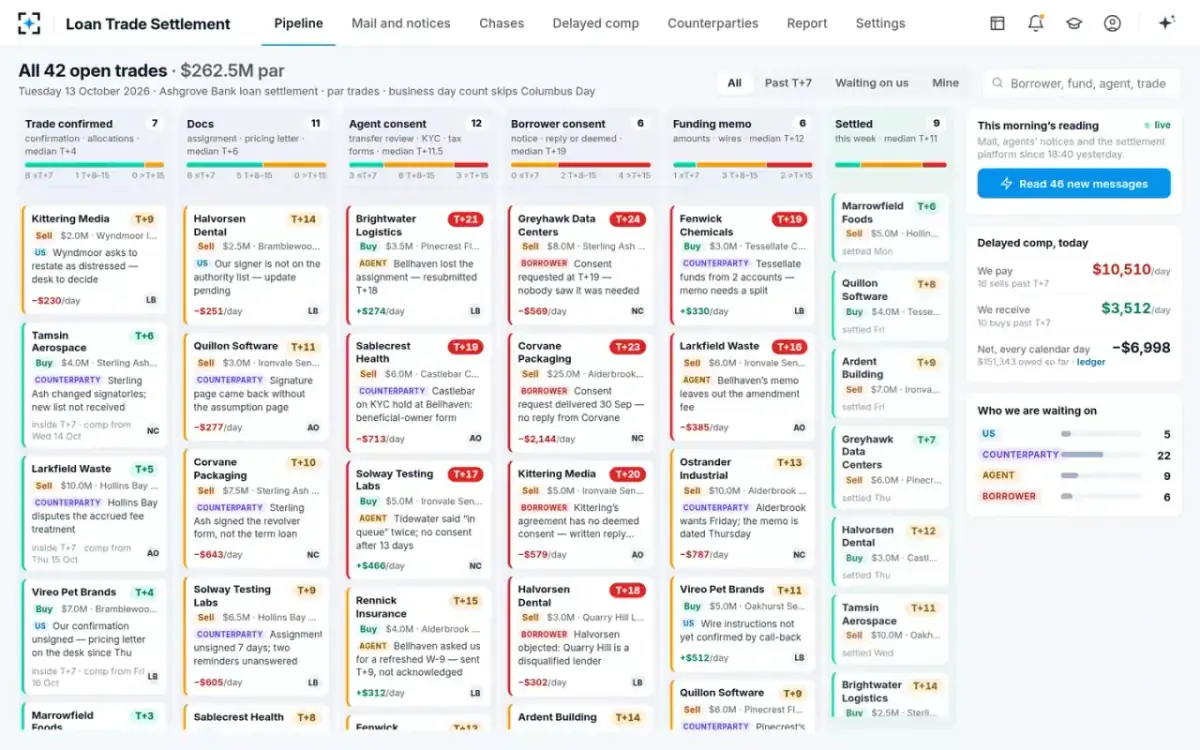
Underneath all four is a book that does not stay still. On the sample desk it is 42 open trades and $262.5 million of par across six stages, with a median age per stage, and each trade carrying its days past trade date, its hold, the firm that holds it and its delayed compensation per day.
The four seats on a loan settlement desk, and what each one decides
Small desks collapse these into two people and large ones split them further, but the four decisions are always there, and they are genuinely different decisions made with different information.
The analyst decides what to chase and when, and sends. The closer decides that a document is in order and signs it. The operations manager decides what the desk pays and claims, and carries the number upward. The desk head decides what the bank says to a borrower — which is a relationship decision wearing operational clothing, and the reason it does not sit with the person who happens to be reading the mail.
Who may do what on a settlement desk: the decision rights behind every step
| Decision | Analyst | Trade closer | Operations manager | Desk head | The agents |
|---|---|---|---|---|---|
| Read the mailbox, the notices and the platform | Yes | Yes | Yes | Yes | Yes — read only, every 30 minutes |
| Say what holds a trade, and which firm holds it | Yes | Yes | Yes | Yes | Yes, with the message, notice or clause quoted |
| Draft a chase or a notice | Yes | Yes | Yes | Yes | Yes — drafts only, never sends |
| Send a chase or a notice | Yes | Yes | Yes | Yes | Never |
| Send anything to a borrower | With the desk head’s approval | With the desk head’s approval | With the desk head’s approval | Yes | Never |
| Sign an assignment or pricing letter | No | Yes | Escalation only | Escalation only | Never |
| Set or confirm a settlement date | Yes | Yes | Yes | Yes | Never |
| Approve a delayed-compensation claim over $50,000 | No | No | Yes | Yes | Never |
| Change a trade’s price, par or counterparty | Correction only, on the confirmation | Correction only, on the confirmation | Correction only, on the confirmation | Correction only, on the confirmation | Never — a difference is reported, not edited |
What is a loan closer, and where the closer’s job ends
A loan closer is the person who takes a trade from "agreed" to "documented and signed": checking that the assignment and transfer documents match the confirmation and the allocation, that the right entity is named, that the minimum transfer amount and any approved-fund or disqualified-lender restrictions in the credit agreement are satisfied, and then signing on behalf of the firm. On a syndicated loan desk the title sometimes sits inside an agency team and sometimes inside trade support; the work is the same.
What the closer's job is not is chasing. The documents the closer signs arrive only when some other firm has acted, and on the sample desk the closer's complaint is precisely that: half the chases he sends go to people who have already sent the thing, to somebody else. That is an attribution failure, not a document failure, and no amount of closing skill fixes it.
The boundary matters when a desk is sizing itself. A desk that is late because documents are wrong needs closing capacity. A desk that is late because nobody knows which firm is holding which trade needs attribution, and hiring another closer will not move the median. The eight blockers that actually hold loan trades separates the two kinds of lateness.
The manager’s seat: paying delayed compensation and approving the claims
From the seventh business day on a par trade, the seller compensates the buyer for the delay — the interest accruing on the par amount at the loan's rate, less the buyer's cost of carry on the purchase price, netted by side. A desk that both buys and sells is therefore paying on some trades and collecting on others every single day, and the head of operations is the person who has to explain the net.
On the sample desk that number is $10,510 paid a day against $3,512 received, with $151,343 owed on sells already past the seventh day and $36,292 owed to the desk on buys. The manager's monthly question is not "how much" — the accounting gives that — but "why", and the answer has to be attributable: which causes, which firms, which trades. Over six months on the sample desk the median fell from fourteen days past trade date to eleven, trades settling inside seven days rose from 21 per cent to 34 per cent, and delayed compensation paid fell from $412,300 to $297,400 a month.
Claims are the other half of the seat. A claim is a figure the counterparty will check, so it has to come with its working: the rate, the days, the carry and the dates they run between. How delayed compensation and cost of carry are calculated, line by line, sets out the arithmetic. On the sample desk the manager approves anything above $50,000, which is a setting rather than a market convention.
The desk head’s seat: why a message to a borrower is not an operations decision
A borrower is a client of the bank, not a party to the trade, and a note asking it to answer a consent request is a message from the bank to its client. That is why on the sample desk every message to a borrower waits for the loan trading desk head, however routine it looks and however much delay it would save.
It is also where the desk head's own number lives. Of the $151,343 the sample desk owed on late sells one morning, $91,576 — three fifths of it — sat on trades a borrower was holding, spread across six trades out of forty-two. The analyst looking at the open-trade view sees six trades out of forty-two and reasonably treats them as a small corner of the book. The desk head looking at the same morning sees most of the money.
The same morning, counted in trades and counted in money
What the analyst sees: 42 open trades, by the firm holding each
- Counterparty — 22 trades · 52%
- Agent — 9 trades · 21%
- Borrower — 6 trades · 14%
- Us — 5 trades · 12%
What the desk head sees: $151,343 owed on late sells, by the firm holding each
- Trades a borrower holds — $91,576 · 61%
- Everything else — $59,767 · 39%
Two seats, one morning, opposite conclusions — and both are right. It is the clearest argument for putting the money and the holder on the same screen: a queue sorted by age tells the analyst what to do next, and a queue sorted by cost tells the desk head where to spend an approval.
A morning in Loan Trade Settlement: every trade with its hold, its holder and its daily cost
What the job pays, and how big the occupation actually is
There is no published occupation called "loan settlement analyst", and that is worth saying before any number. The US Department of Labor's occupational data covers two neighbouring jobs, and a real settlement desk sits between them: brokerage clerks, who "perform duties related to the purchase, sale, or holding of securities" and "verify ownership and transaction information and dividend distribution instructions to ensure conformance with governmental regulations" (O*NET 43-4011.00), and loan interviewers and clerks, whose summary describes checking loan papers for completeness and completing the transaction between lender, borrower and seller once a loan is approved (O*NET 43-4131.00).
The nearest published occupations, and what they pay
36,900jobs
brokerage clerks in 2025 — the securities-settlement side of the work
$65,750
median annual wage for brokerage clerks in 2025
$31.61 an hour
169,100jobs
loan interviewers and clerks in 2025 — the lending side
$50,020
median annual wage for loan interviewers and clerks in 2025
$24.05 an hour
Read those figures as a floor and a shape rather than a salary guide. The shape is the useful part: both occupations are projected to decline over 2025–2035. The seats least exposed to that are the ones where somebody decides something — what to say to a counterparty, whether a document is in order, what the bank will claim — and those are exactly the four seats above.
The market those seats serve is not shrinking. The 2025 Shared National Credit review, run jointly by the Federal Reserve, the Federal Deposit Insurance Corporation and the Office of the Comptroller of the Currency, covers loan commitments of $100 million or more shared by several regulated institutions, and found $6.9 trillion of them, 6 per cent more than a year earlier (joint press release, January 2026). Shared commitments are what the secondary market trades, and every trade in them has to be settled by somebody in one of these four seats.
The skills that separate a good settlement analyst from a fast one
Speed is the obvious virtue and the wrong one to hire for. A fast analyst sends more chases; a good one sends fewer and better ones, because the hard part of the job is reading rather than writing.
What a first-year settlement analyst should be able to do by month three
- Read a transfer section and say whether this buyer needs borrower consent
Approved funds, affiliates of existing lenders, minimum transfer amounts and disqualified-lender lists all change the answer, and all of them live in the credit agreement rather than in the trade.
- Count business days on the right calendar, holidays included
A deemed-consent period that ends on a Monday holiday does not end on that Monday. Getting this wrong by one day is how a desk tells a counterparty the wrong settlement date.
- Tell an identity and tax hold from a queue delay
One is cleared by the buyer sending a document; the other is cleared by escalating at the agent. A chase sent to the wrong one of those costs a week.
- Work out delayed compensation on a trade and show the working
Interest on par at the loan’s rate, less carry on the purchase price, from the seventh business day — and the dates it runs between. A claim without its working comes back.
- Write a chase a stranger can act on without a phone call
The trade, the hold, the evidence, the ask and a date. Anything the recipient has to look up is a day added.
- Know which of the four seats a question belongs to
A message to a borrower, a signature on an assignment and a claim over the threshold are somebody else’s to make, and routing them early is faster than routing them late.
The underlying skill is reading a credit agreement for a way through rather than for a rule. A settlement analyst who treats a silent borrower as a dead end waits; one who checks whether the transfer section deems consent after a stated period, finds the agent's delivery notice and counts the business days, has a date. What a deemed consent clause requires before you may rely on it covers that in full.
How the work changes when the blocker arrives named instead of hunted
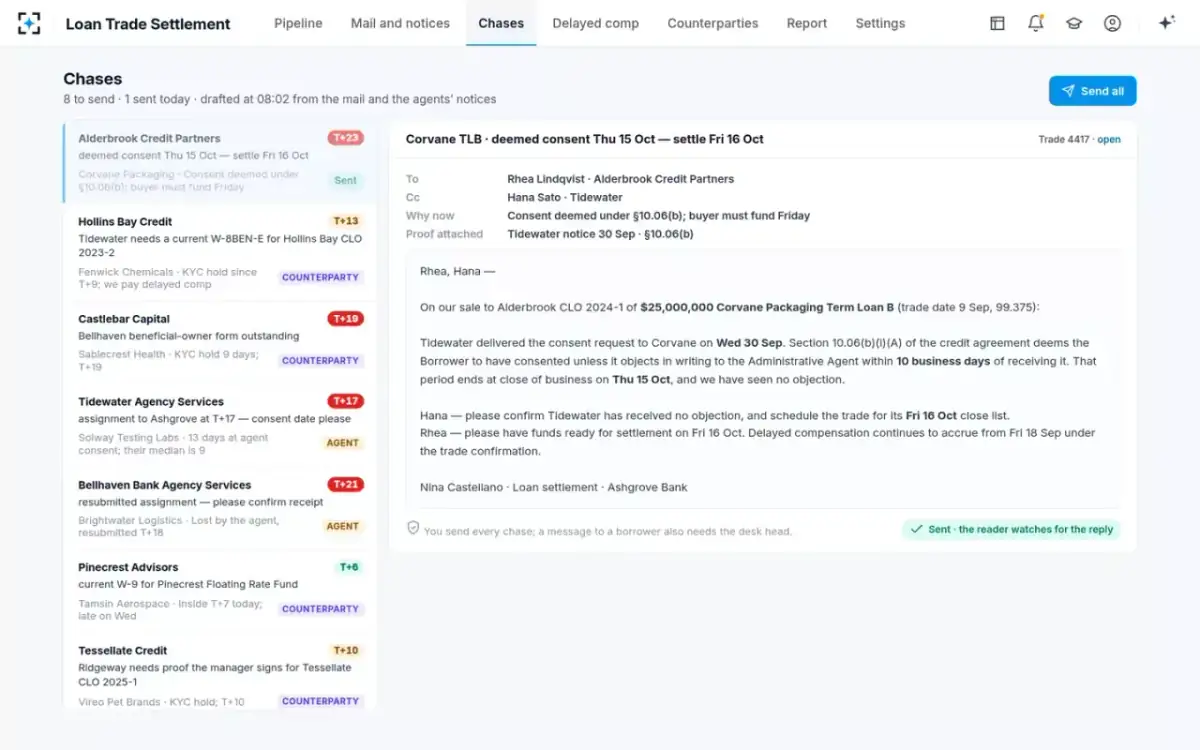
The difference is not that the chasing disappears. It is that the morning starts after the reading instead of before it. On the sample desk the reading of 46 messages and 9 agent notices is done when the analyst sits down, each message tied to its trade and read for what it means; the trades whose status changed have lifted out of their columns; and each hold is stated with the message, notice or clause it rests on, so the analyst can disagree with it by looking at the evidence rather than by starting again.
What that buys is not speed in sending. It is accuracy in addressing. A chase that reaches the firm that can act, on the first attempt, with the agent's own request quoted back, removes the two-day round trip that a vague chase produces — and on a desk paying five figures a day for delay, round trips are the expensive part.
“I know it’s stuck. I don’t know who it’s stuck on until I read the whole thread.”
Nina Castellano, the sample desk’s settlement analyst
In Loan Trade Settlement the drafts arrive written, and the analyst decides which ones go
What does not change: who sends, who signs, who approves
The mailbox stays read-only. Nothing replies on the desk's behalf, and no message reaches a counterparty, an agent or a borrower without a person sending it. The closer still signs the assignments. The manager still approves the claims above the threshold. The desk head still approves anything addressed to a borrower, and trade economics — price, par, counterparty — are never edited: a difference between the confirmation and the allocation is reported to the analyst, not quietly fixed.
That division is deliberate, and it is the reason the job survives the software rather than being replaced by it. Reading a hundred messages and attributing each one to a trade is work that rewards patience and punishes nobody when it is handed over. Deciding what the bank says to a client, and what it will pay or claim, is not.
A settlement date, set by the person who sent the notice
For the buyer's view of what all of this is worth, and what it is not, the four ways a desk can run settlement compares them layer by layer.
Questions people ask
How many people work in loan settlement operations?
Nobody publishes that number. The nearest public figures are two neighbouring occupations in the US Department of Labor's data: 36,900 brokerage clerks and 169,100 loan interviewers and clerks in 2025. A syndicated loan settlement desk draws on both and is counted in neither, so treat those figures as context for the size of the clerical labour market around this work, not as a headcount for the job.
What does a loan operations analyst earn?
The published medians for the nearest occupations are $65,750 a year for brokerage clerks and $50,020 for loan interviewers and clerks, both for 2025. A settlement analyst at a dealer, a bank's syndicated loan desk or a fund is a more specialised role than either, and pay varies by city, by firm type and by whether the seat carries sending or signing authority.
What skills does a loan settlement analyst need?
Reading a credit agreement's transfer section with confidence, counting business days on the right calendar, telling an identity-and-tax hold from a queue delay, working out delayed compensation and showing the arithmetic, and writing a chase a stranger can act on. The last one is underrated: most of the delay a chase causes comes from the recipient having to look something up.
Who approves a message to a borrower?
On the sample desk, the loan trading desk head, every time — because the borrower is a client of the bank rather than a party to the trade, and a consent chase is a message from the bank to its client. Where that approval sits is a policy each bank sets, and putting it with the relationship owner rather than with whoever is reading the mail keeps a client decision with the person who owns the client.
What is the difference between loan operations and loan servicing?
Servicing runs the loan itself for its whole life: interest periods, rate settings, drawdowns, repayments, fee calculations and the payments to the lender group. Settlement operations runs the transfer of a position from one lender to another, and ends when the trade funds. The two touch at the administrative agent, which does both, and a trade settling mid-period creates servicing work — but the skills, the clocks and the counterparties are different.
Is loan operations a good career?
The honest answer has two halves. The clerical half of the work is under real pressure — the two nearest published occupations are both projected to decline over 2025–2035 — and anyone whose day is only typing a status into a platform should expect that to continue. The decision-carrying half is not: reading a transfer section for a way through, deciding what the desk claims, and owning what the bank says to a borrower are seats that get more valuable as the volume of trades rises and the paperwork around each one does not get simpler.