A deemed consent clause is the sentence in a credit agreement’s transfer section that says the borrower is treated as having consented to an assignment if it does not object within a stated period — ten business days, in the sample agreement used here — after the administrative agent delivers the request. It is the most valuable sentence in the section and the easiest one to misuse, because it does not say that a quiet borrower has agreed. It says that a borrower who received a specific notice on a specific date, and did not object in the stated way by the stated time, is treated as having agreed. Those are facts somebody has to hold. Botminds’ Loan Trade Settlement reads the clause, counts the business days from the date the agent actually delivered the request, and shows the date and the evidence together, so the call is made from the record rather than from an impression that it has been long enough.
The agreement, the parties and the dates on this page are a fictional sample: the Corvane Packaging credit agreement, Tidewater Agency Services as administrative agent, and a $25,000,000 sale from Ashgrove Bank to a collateralised loan obligation vehicle. Nothing here is legal advice, and no clause is standard — the words in your own transfer section are the only ones that count.
What is a deemed consent clause, and where it sits in a credit agreement
It sits inside the conditions on assignment, usually in the article headed Successors and Assigns, as a proviso attached to the borrower’s consent right rather than as a clause of its own. In the sample agreement it is §10.06(b)(i)(A): the borrower’s consent is required for assignments to a buyer that is not already a lender, an affiliate of a lender or an approved fund — “provided that the Borrower shall be deemed to have consented to any such assignment unless it shall object thereto by written notice to the Administrative Agent within ten (10) Business Days after having received notice thereof”.
Three design features are worth noticing, because they are what make the clause workable at all. It runs from the borrower’s receipt of notice, not from the trade date or the date the seller asked the agent to send it. It requires an objection in a particular form, in writing, to a particular recipient, the administrative agent — so a grumble to the relationship banker is not an objection. And it is a proviso on a consent right that is itself qualified: the consent may not be unreasonably withheld or delayed. The clause is the market’s answer to a borrower who simply does not engage, and it is drafted narrowly on purpose.
The anatomy of a transfer section, and where the deemed consent sentence sits in it
- Who may take an assignment
- Any lender may assign to one or more assignees, subject to the conditions that follow. The conditions, not the permission, are where the work is.
- Minimum amount
- In the sample agreement, no less than $1,000,000 of a term loan, unless the agent and the borrower agree otherwise.
- Whose consent is needed
- The borrower’s, not to be unreasonably withheld or delayed, unless an event of default is continuing or the buyer is a Lender, an Affiliate of a Lender or an Approved Fund. The administrative agent’s, for any buyer outside those three.
- The deemed consent sentence
- The borrower is deemed to have consented unless it objects by written notice to the administrative agent within ten Business Days after receiving notice of the assignment.
- Form and fee
- The agent’s own assignment and assumption, a processing and recordation fee of $3,500, and the buyer’s questionnaire and tax forms where it is not already a lender.
- Who may never take it
- Any Disqualified Lender named on the schedule, the borrower or its affiliates and subsidiaries, and any natural person.
- Business Day
- Any day other than a Saturday, Sunday or a day on which commercial banks are authorised or required to close in New York. The definition is what makes the count a date.
When is borrower consent deemed given on a loan assignment?
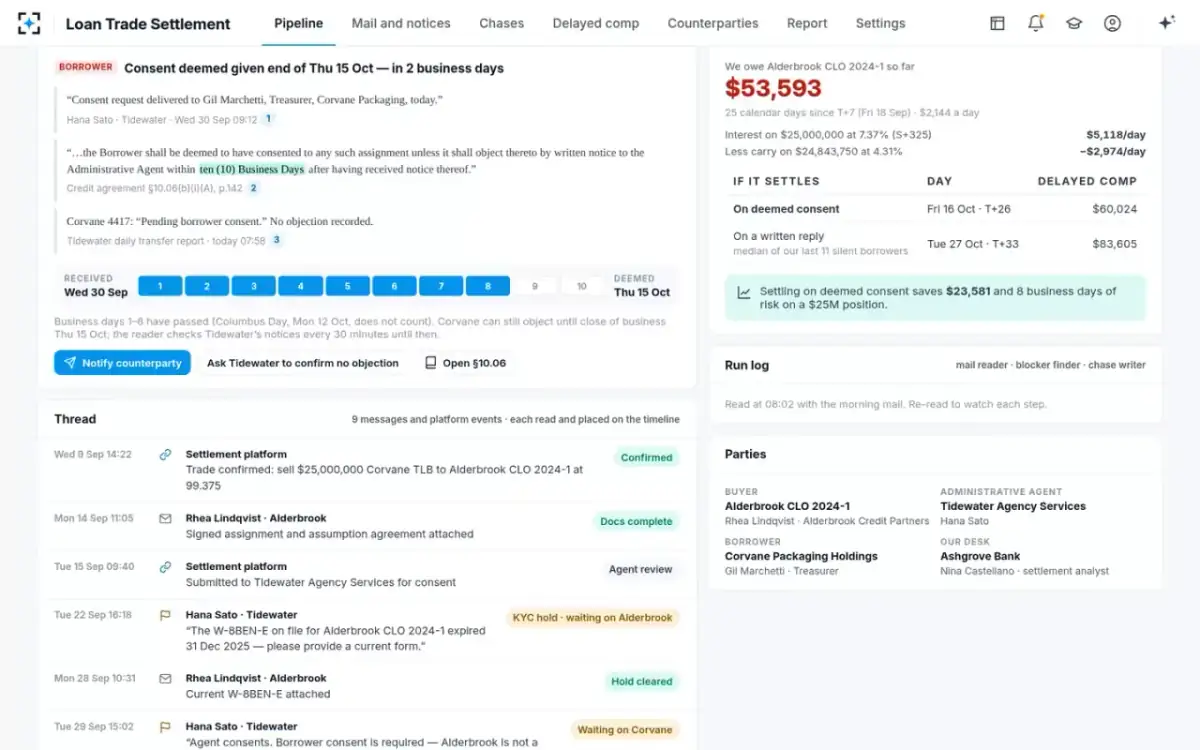
On the date the stated period expires, provided the request was delivered and no objection was made in the required form. In the sample trade that date is the close of business on Thursday 15 October: the agent delivered the consent request to the borrower’s treasurer on Wednesday 30 September, the period is ten business days on the New York calendar, and Columbus Day on Monday 12 October does not count.
Two things do not happen on that date. The borrower does not become unable to object afterwards in any practical sense — it can still complain, and a desk that has annoyed a borrower has a relationship problem whatever the clause says. And the trade does not settle: deemed consent clears one condition, and the agent still has to process the assignment, the funding memo still has to issue and the money still has to move. In the sample trade, consent deemed at the close of Thursday 15 October produced a settlement on Friday 16 October, at T+26.
What the date does is turn an open-ended wait into a planned one. Before it is counted, the trade is “waiting on the borrower”, which is a sentence with no end in it. After it is counted, the trade has a settlement date that can be put on an agent’s close list and told to a counterparty.
How do you count the period: business days, which calendar, and from which event
Counting is where the mistakes are, and all three variables have to come from the agreement rather than from habit.
From which event. The clause in the sample runs from the borrower “having received notice thereof”. That is the agent’s delivery to the borrower, not the seller’s email to the agent and not the date the request was drafted. The difference is routinely several days, and it always runs the wrong way for the desk that assumed the earlier date.
Which calendar. The agreement defines Business Day, and in the sample it is a day other than a Saturday, Sunday or a day on which commercial banks are authorised or required to close in New York. A desk that counts on its own local calendar, or on a generic weekday count, will be out by one day several times a year — and being out by one day on a deemed consent call is the whole error, not a rounding one.
Inclusive or exclusive. A period expressed as “within ten Business Days after” receipt ordinarily excludes the day of receipt and includes the tenth day after it. Where a clause instead says “from”, or fixes a date certain, the arithmetic changes. The safe practice is to write the counting convention down once, apply it the same way on every trade, and show the dates rather than the number of days.
One ten-business-day clock, with the holiday that moves the date
- Days 1–7Thu 1 – Fri 9 Oct
- Holiday12 Oct
- Day 813 Oct
- Days 9–1014–15 Oct
Does silence count as consent? What general assignment law does and does not do here
Outside the clause, no. Silence is not acceptance as a general matter of contract, and a borrower who ignores a consent request has not agreed to anything. Every bit of the effect comes from the sentence the parties wrote, which is why a desk that cannot produce the sentence has nothing to rely on.
There is a tempting argument in the other direction, and it is wrong in this setting. Article 9 of the Uniform Commercial Code makes contractual restrictions on assignment ineffective in a wide range of cases — terms that prohibit, restrict or require somebody’s consent to the transfer of an account, chattel paper, a payment intangible or a promissory note (UCC §9-406). Read alone, that looks as though it dispenses with the borrower’s consent entirely. It does not, because of the subsection that comes immediately after it.
Why the sale of a loan is the case where the contract’s consent term still binds
Subsection (d) does not apply to the sale of a payment intangible or promissory note.
Uniform Commercial Code §9-406(e), as published by the Legal Information Institute
A secondary loan trade is an outright sale of exactly that kind of asset, and the override in subsection (d) is withdrawn for it. The neighbouring section, 9-408, does reach such sales, but only to protect the buyer’s property interest: that interest, it says, “does not require the person obligated on the promissory note or the account debtor to recognize the security interest, pay or render performance to the secured party” (UCC §9-408(d)). Becoming a lender the borrower and the agent will deal with is another matter, so the consent requirement in the transfer section still has to be satisfied — by consent given, by an exception that makes it unnecessary, or by the clause that deems it after a period of silence. There is no fourth route.
This is also why the characterisation of what is being traded keeps coming back. The courts have had to decide whether syndicated loan notes are securities, and in Kirschner v. JPMorgan Chase Bank the Second Circuit concluded on the facts before it that they were not (Second Circuit, No. 21-2726-cv, August 2023). The practical lesson for a settlement desk is the same either way: the instrument you are moving is a contract right under a negotiated agreement, and the agreement’s own words decide what has to happen before it can move.
The three facts you must hold before you call consent deemed
A deemed consent call is an assertion that three things are true at once. If any one of them is missing, the honest position is that the trade is still waiting, however long it has been.
The decision path on one trade, and the point where it stops being arithmetic
Agent
Is consent required at all?Read the transfer section against the buyer. A buyer that is already a lender, an affiliate of a lender or an approved fund does not need the borrower’s consent, and the question ends here.
Agent
Was the request delivered, and when?Find the administrative agent’s own notice of delivery, with the date, the recipient and the time. The seller’s request to the agent is not the event the clause runs from.
Agent
Count the period on the right calendarApply the agreement’s Business Day definition, skip the bank holidays it excludes, and produce a date rather than a number of days.
Agent
Is there an objection on the record?Check the agent’s current transfer report and everything received since delivery. An objection has to be in writing, to the administrative agent, within the period.
A person decides
Call it, or stop and askThe desk head approves the call and any message that goes to the borrower. With the clause, the delivery date and a clean report, the trade gets a settlement date; without all three, it does not.
Never: treat silence as consent without the clause text and the agent’s delivery date
The evidence file behind a deemed consent call in Loan Trade Settlement
- The clause itself, quoted with its section and page
Not a summary. The sentence decides the period, the form of objection and the recipient, and all three are argued about later.
- The agent’s delivery notice, with date, time and recipient
In the sample trade: the agent’s notice that the request was delivered to the borrower’s treasurer on Wednesday 30 September at 09:12.
- The calendar you counted on
Which Business Day definition, and which holidays you excluded. Columbus Day on Monday 12 October moved the sample trade’s date by one day.
- The agent’s current transfer report
Showing the trade as pending borrower consent with no objection recorded, read on the morning of the call rather than the week before.
- Everything received since delivery, read and matched
An objection does not have to arrive in a document headed “objection”. The mailbox and the agent portals both have to be read against the trade.
- The notice you then send, and who approved it
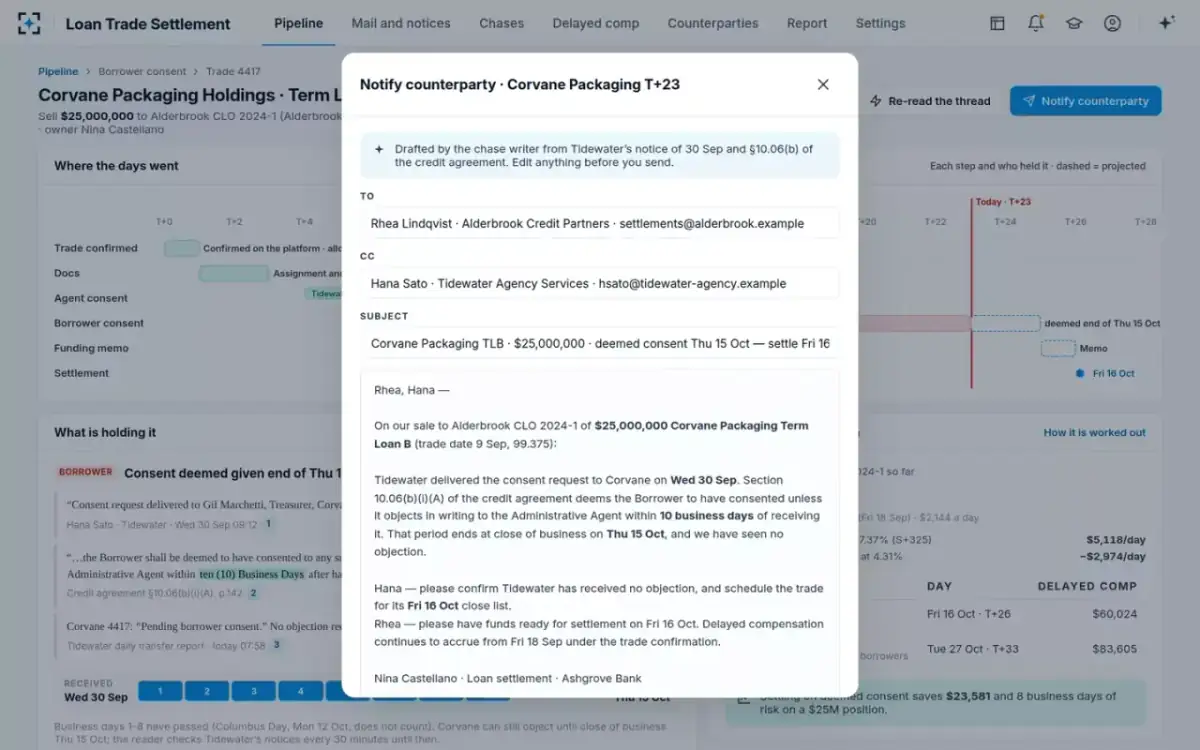
The counterparty and the agent are told the date, the clause and the delivery date, so the trade can be put on a close list. A message that touches the borrower needs the desk head.
The hold, its three proofs and the clock, on one trade
When borrower consent is not required at all: lenders, affiliates, approved funds
Before counting anything, check whether the question arises. US credit agreements commonly excuse the borrower’s consent in two situations.
The first is an event of default that has occurred and is continuing. The reasoning is straightforward: a borrower in default does not get to choose its creditors. The second is the identity of the buyer. If the buyer is already a lender under the facility, an affiliate of one, or an approved fund — ordinarily a fund that invests in loans and is managed by a lender or by the same adviser as one — the borrower has no say, because the agreement decided in advance that such a buyer is acceptable.
Whether a particular buyer falls inside those definitions is a reading exercise, and it is where a trade is most often slowed by assumption. On the sample trade the buyer was a collateralised loan obligation vehicle that was not managed by an existing lender and did not qualify as an approved fund under this agreement’s definition, so consent was required — and the whole deemed-consent question followed from that single determination. Had the vehicle qualified, the trade would have gone to the agent and settled without the borrower hearing about it.
The other transfer conditions in the same section: minimums, eligible assignees, disqualified lenders
Deemed consent clears one condition. The paragraph it sits in contains several more, and a desk that treats the consent date as the settlement date discovers them one at a time.
The minimum amount is checked at the trade, not at settlement: in the sample agreement an assignment of a term loan must be at least $1,000,000 unless the agent and borrower agree otherwise, which matters when allocations come back split among several funds. The disqualified lender list is a schedule of named firms the borrower negotiated at closing — four names in the sample — and an assignment to one of them is void rather than late. The agreement also bars assignments to the borrower, to its affiliates and subsidiaries, and to any natural person. And the agent’s own consent is a separate condition from the borrower’s, with its own identity and tax checks behind it; a deemed borrower consent does nothing to move it.
The order these are checked in is a practical choice worth making deliberately. Eligibility and minimum are cheap to check and fatal if wrong, so they belong at the trade. Consent and the agent’s processing are slow and belong to a clock. The full set, and who answers each one, is laid out in the guide to participation and assignment.
What it is worth: the days and the money a correctly called deemed consent saves
On the sample trade, the arithmetic is unambiguous. Delayed compensation had been accruing from Friday 18 September at $2,144 a calendar day on the $25,000,000 position, and stood at $53,593 on the morning of Tuesday 13 October. Settling on the deemed date meant a settlement on Friday 16 October and a final figure of $60,024. Waiting for a written reply — on this desk’s own record, a median of Tuesday 27 October across the last eleven silent borrowers — meant $83,605. The difference is $23,581 and seven business days of market risk on the position.
Across a month the effect is smaller per trade and steadier. On the sample desk’s September figures, six trades settled on deemed consent, a median of seven business days sooner than a written reply would have produced, and borrower consent fell to 21% of late days from a materially higher share before the clauses were being read. That is the honest shape of the benefit: not a dramatic saving on one trade, but the removal of a category of open-ended wait.
The notice that turns a counted date into a settlement date
Context for the saving: the SEC has reported an average of T+23 and a median of T+15 for par trades in July 2021, against the market’s own seven-day target (SEC, Open-End Fund Liquidity Risk Management Programs, December 2022). A trade held open by a silent borrower is one of the reliable ways a desk ends up in that tail, and it is one of the few that a clause already in the agreement can close. How the cost of the wait is actually calculated, line by line, is set out in the delayed compensation guide; to see the clause, the clock and the evidence on one trade, start from Loan Trade Settlement.
Questions people ask
What proof do you need to rely on deemed consent?
Three things, held together. The clause itself, quoted with its section, because it sets the period, the form of objection and the recipient. The administrative agent’s record of delivering the request to the borrower, with the date. And evidence that no objection was made in the required form within the period — in practice the agent’s current transfer report, read on the day of the call, plus everything that arrived in the mailbox since delivery.
How do you count the deemed consent period?
On the calendar the agreement defines, from the event the clause names. In the sample agreement that is ten Business Days after the borrower received notice, with Business Day defined by reference to New York bank closures, so Columbus Day does not count. The day of receipt is ordinarily excluded. Write the convention down once and apply it the same way every time, and publish the resulting date rather than a number of days.
Can a borrower object after the deemed consent date?
It can say anything it likes; the question is what effect it has. The clause fixes the consequence of not objecting in the stated way within the stated period, and a late objection does not undo that. But a deemed consent is not a licence to ignore a borrower who then raises a real concern — and if the objection suggests the original notice never reached the right person, the first of the three facts is the one to re-examine.
When is borrower consent not required for an assignment?
Typically when an event of default has occurred and is continuing, or when the buyer is already a lender under the facility, an affiliate of a lender, or an approved fund as that term is defined in the agreement. The definitions do real work: a credit fund that looks like an obvious market participant may still fall outside “approved fund” if it is not managed by a lender or by a lender’s adviser.
What is a disqualified lender list?
A schedule of named firms — competitors, distressed investors, sometimes specific funds — that the borrower negotiated at closing and to which its loans may not be assigned at all. It is a different kind of condition from consent: an assignment to a name on the list is not slow, it is impermissible. The sample agreement names four, and also bars assignments to the borrower, its affiliates and subsidiaries, and to any natural person.
Does a deemed consent mean the trade can settle immediately?
No. It clears the borrower’s consent condition only. The administrative agent still has to accept the buyer and record the assignment, which has its own identity and tax checks, the funding memo still has to issue, and the money still has to move. In the sample trade, consent deemed at the close of Thursday 15 October produced a settlement the following day, at T+26.