Loan administration software is the system that holds a syndicated or bilateral loan for its whole life: the facility and its tranches, each lender's position and commitment, interest periods and rate settings, drawdowns and repayments, fees, payment schedules and the executed documents. It does that job well, and it is the right thing for it. What it does not hold is the correspondence in which a trade is actually negotiated to a close — the agent's document request, the buyer's reply, the consent request and the borrower's silence — and that is the gap this guide is about. Botminds' Loan Trade Settlement is built to sit in that gap rather than to replace the system underneath it.
Sample figures on this page come from a fictional desk inside the working software and are labelled where they appear. The public figures come from the Securities and Exchange Commission, the Financial Stability Oversight Council and the banking agencies' joint third-party guidance, linked in place.
What is loan administration software, and what sits inside it
A loan administration system — sometimes a loan servicing or agency system, depending on who is selling it — is the authoritative place where a lender or an administrative agent keeps the loan itself. Its job is arithmetic over time: given the facility's terms, what is owed by whom, when, at what rate, and who gets paid what.
That job is substantial, and the market it serves is large. The 2025 Shared National Credit review by the Federal Reserve, the Federal Deposit Insurance Corporation and the Office of the Comptroller of the Currency found the share of commitments rated special mention or classified down to 8.6 per cent from 9.1 per cent a year earlier (joint press release, January 2026) — a statistic that exists only because somebody's systems hold, correctly, the positions and commitments behind it.
So the question is never whether to have one. It is what the system is not, and where the rest of the work lives.
Does loan administration software handle trade settlement?
Partly, and the part it handles is the part after the trade settles. A loan administration system records the transfer once it has happened: the seller's position down, the buyer's position up, the agent's lender list updated, the accruals split at the settlement date. That is a genuine piece of settlement work and it is done well.
What the system does not do is get the trade there. It has no view of the agent's queue, no copy of the consent request, no reading of the transfer section of the credit agreement, and no idea that the buyer's tax form expired in December. Those are the things that decide whether the transfer happens on the seventh business day or the twenty-third, and none of them is an arithmetic problem.
The Securities and Exchange Commission's account of why fund-held loan trades settle slowly points at the same place: settlement for bank loans relies on manual processes, which in practice means people writing to each other about documents. A system that is excellent at arithmetic over structured terms is, by construction, not reading that.
The loan administration system and the settlement layer: two different jobs
The loan administration system: The loan: facility, tranches, lender group, positions, rates, accruals, payments, fees, executed documents.
The settlement layer, as Loan Trade Settlement covers it: The open trade and its hold: which firm is waiting on what, with the message, notice or clause that proves it.
The loan administration system: The credit agreement’s economic terms, the agent’s notices of rate settings and payments, and whatever operations types in.
The settlement layer, as Loan Trade Settlement covers it: The settlement mailbox, the agents’ notices and portals, the settlement platform’s status, the transfer sections of the credit agreements, confirmations and allocations.
The loan administration system: Nothing about a trade in flight. It records the transfer once it has settled.
The settlement layer, as Loan Trade Settlement covers it: Nothing on its own either — it attributes and drafts. A person sends, signs, sets the date and approves the claim.
The loan administration system: The facility, over its life.
The settlement layer, as Loan Trade Settlement covers it: The open trade, over the days between confirmation and funding.
The loan administration system: The correspondence in which the trade is negotiated to a close.
The settlement layer, as Loan Trade Settlement covers it: Everything after settlement: accruals, payments, fees, the lender list, the loan’s whole life.
The settlement gap, drawn: what is in the system and what is in the mailbox
The clearest way to see the gap is to list, for one stuck trade, which facts live where. On the sample desk's largest open hold — a $25 million sell to a fund, sitting at twenty-three days past trade date — every economic fact was in the system and every fact that explained the delay was in a mailbox.
One trade, two places: the facts that were held and the facts that were loose
Inside the system
- The facility, the tranches and the lender group
- Positions, commitments and unfunded amounts
- Interest periods, rate settings and accruals
- Drawdowns, repayments, fees and payment schedules
- Executed documents, once somebody files them
- The trade, once it has settled
Outside it, in the mailbox
- The agent asking the buyer for a tax or identity document
- The buyer explaining which entity signs it
- The consent request, and the date the agent delivered it
- The borrower’s silence, and what the transfer clause makes of it
- The agent’s “we have it, it is in the queue” — twice
- Which single firm is holding this trade, today
Read the right-hand column again: every line on it is a sentence somebody wrote to somebody else. None of it is structured, none of it arrives in a field, and all of it decides when the trade settles. That is the gap — not a missing feature in the system of record, but a different kind of material that no system of record was built to read.
It is also why "we already have a system" and "we start the morning reading threads" are both true at the same time on most desks. The four layers of settlement work, and which tools cover which, sets the same point out by layer rather than by trade.
What this kind of system should integrate with, and in which direction
The direction matters more than the list. A settlement layer should read widely and write almost nothing, because everything it could write is a decision somebody else owns.
The integration map, and which way each connection runs
| Source | What it gives | Direction | Read only? |
|---|---|---|---|
| The settlement mailbox | The correspondence itself: document requests, consents, objections, memos, and the ones that mean nothing. | In | Yes — nothing is sent or replied to from it |
| The settlement platform | Trade status, documents and the agent’s close lists. | In | Yes |
| Administrative agents’ portals | Notices and the daily transfer reports, per agent. | In | Yes |
| Credit agreements | The transfer section of each facility — consent, minimums, approved funds, disqualified lenders, the Business Day definition. 188 facilities on the sample desk. | In | Yes |
| Trade confirmations and allocations | Facility, side, par, price, funds, trade date, and the documents the transfer will need. | In | Yes |
| A rate feed | The overnight financing rate and the monthly cost of carry used in the delayed-compensation arithmetic. | In | Yes |
| The loan administration system | Nothing is written to it. The transfer is booked by the people who book transfers, after settlement. | Neither | Not connected |
The one-way design has a side effect worth naming in a selection: it makes the thing removable. A layer that only reads can be switched off on a Friday and leave the desk exactly where it was, which is a materially easier proposition for a risk review than one whose removal means unpicking entries.
How long does it take to go live, and what makes it longer
The honest answer is that the software is not usually the long pole. Three things are.
The first is access to the mailbox, on terms your security function is happy with — read-only, scoped to the settlement mailbox, with what is retained and for how long written down. Start this conversation on day one, because it is the only item with a queue in front of it.
The second is the credit agreements. The transfer section of each facility has to be readable, which means the agreements have to be somewhere reachable in a usable form. On the sample desk that is 188 facilities. A desk whose agreements are scattered across deal folders will spend its first fortnight on this and nothing else.
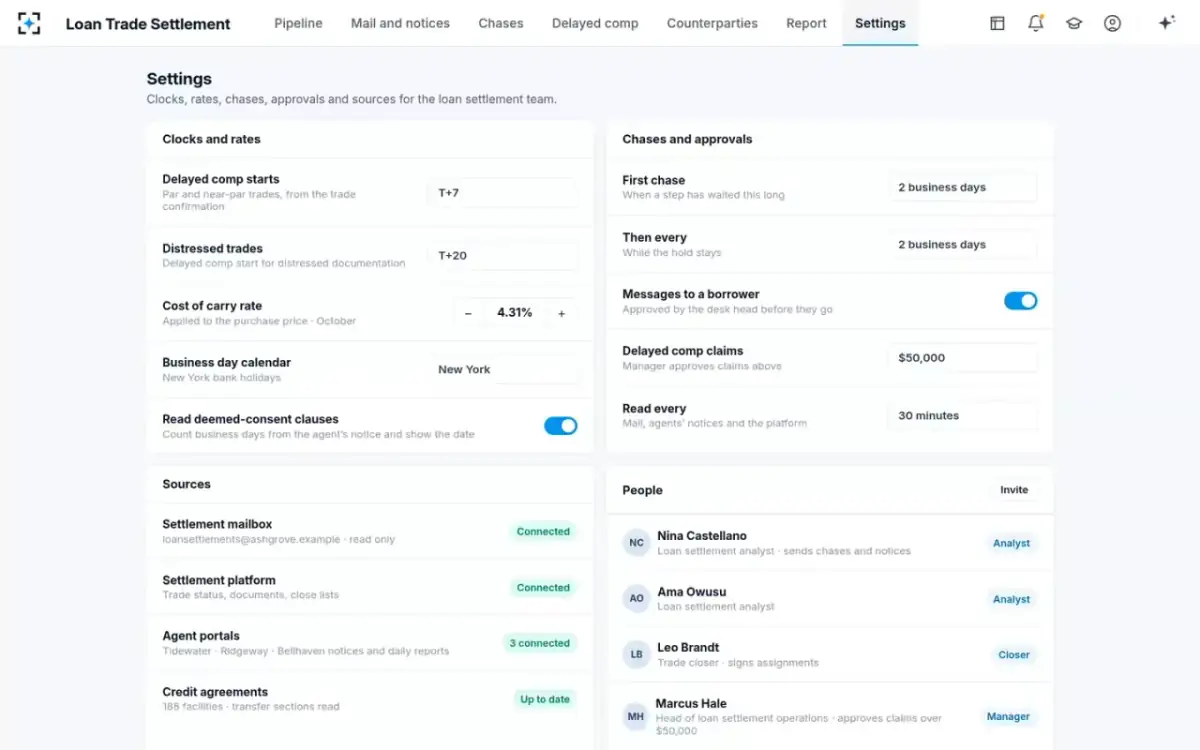
The third is the settings, which are quick but need the right people in the room: when delayed compensation starts, the carry rate, the business-day calendar, whether deemed-consent clauses are read at all, when the first chase goes and how often after, who approves a borrower message, and the claim threshold above which the manager signs. Those are decisions, not configuration, and the desk head and the head of operations have to make them.
The settings a desk owns in Loan Trade Settlement: clocks, rates, chase rhythm and approvals
What data do you need to start: the shortest honest list
Four things, and a desk that has them can start the pilot set out below.
Read access to the settlement mailbox, including the sent items — half the evidence that a document was already supplied is in what your own people sent. The open trades themselves, as confirmations and allocations, however they are held today, including a spreadsheet. The credit agreements for the facilities those trades are in, with their transfer sections. And the desk's own settings: the clocks, the calendar, the approvals, the thresholds.
Two things you do not need to start, despite being asked for them often: a connection to the loan administration system, and a clean history. The first is not used; the second is the thing the exercise produces rather than something it needs.
How to run a pilot on your own open trades, in four weeks
Run it on live trades, not on a sample of settled ones. A settled trade has lost the thing you are testing — the ambiguity about who was holding it.
A four-week pilot, and the decision at the end of each week
- Week one — take the baseline, before anything is switched on
Median business days to fund, share of trades inside your own target, late days by cause, and delayed compensation paid and received last month. Decision at the end of the week: are these four numbers obtainable at all? If not, that is the first finding.
- Week two — read-only on the mailbox and the agreements, no chases
Let it read and attribute while the desk works as usual. Decision: on how many open trades does the attribution match what the analyst believed, and where it differs, who was right?
- Week three — drafts, read but not sent
Chases are drafted and the analyst reads them without sending. Decision: how many would have gone to the firm that could actually clear the trade, and how many would have needed more than a light edit?
- Week four — send, with the approvals live
The analyst sends; borrower messages go to the desk head; claims above the threshold go to the manager. Decision: did any approval rule fail to hold, and did anything leave without a person?
- At the end — compare against week one, and against nothing else
The only comparison that means anything is your own baseline. A vendor’s figure from another desk is not evidence about yours.
The week-two question is the one that decides a pilot. If the attribution agrees with the analyst on every trade, nothing has been gained; if it disagrees and is wrong, you have found that out in a week; if it disagrees and is right, you have found the days the desk has been losing. All three outcomes are useful, which is what makes it a good test.
What to measure after go live, and the baseline to take first
Four measures, taken before anything changes and again at three and six months. Each has a defined unit and comes out of trades you have already settled.
The four numbers to write down before anything is switched on
Median days to settle
median(business days from trade date to funding)
Par trades only; keep distressed separate, since their clock starts later. The median rather than the mean, because one eighty-day trade should not flatter or ruin a month.
Head of operations
Share inside your own target
trades funded within target ÷ trades funded
Use your own target, not the market’s. A desk that targets the seventh business day and a desk that targets the tenth are both measuring something real; comparing them is not.
Head of operations
Late days by cause
Σ late days, grouped by what held the trade
The one that needs a human pass the first time, and the one that tells you what to fix. On the sample desk, buyer identity and tax documents at the agent accounted for a third of them.
The settlement analyst
Delayed compensation, net
paid on sells − received on buys, per month
Both directions, every month. A desk that only tracks what it pays is measuring half of its own position.
Head of operations
Be careful what the measures are made to do. The banking agencies' joint third-party guidance makes the point in the context of service-level agreements, and it applies just as well to an internal target: performance measures should not reward volume or speed at the expense of accuracy, compliance, or the bank and its customers (Interagency Guidance on Third-Party Relationships, June 2023). A settlement desk rewarded only on median days will find ways to settle the easy trades faster, which is why late days by cause belongs in the set.
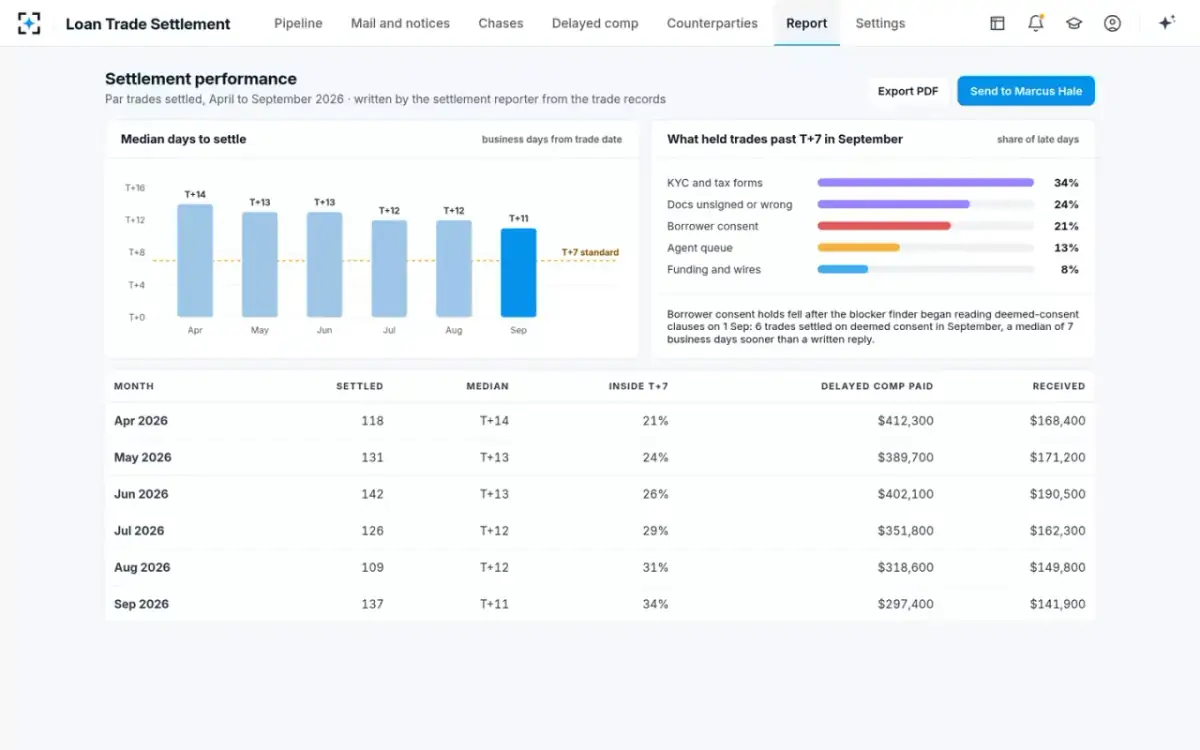
What six months looked like on the sample desk, in business days to settle
The monthly account in Loan Trade Settlement, every figure tied to the trades it came from
Where this solution fits, and three cases where it is the wrong answer
It fits where a desk trades regularly, its settlement correspondence lands in a mailbox the bank may read, and the thing it cannot answer each morning is which firm is holding which trade. That is a common position and it is the one this is built for.
Three cases where it is the wrong answer, stated plainly because finding them out in month three is expensive.
A desk that does not trade. A lender that originates and holds, or an agent that administers without a secondary book, has no open trades to attribute. The work it does have — servicing, rate settings, payments — belongs to the loan administration system, and nothing here touches it.
A desk whose settlement correspondence does not reach a readable mailbox. If the negotiation happens on the telephone, or in a system the bank cannot grant read access to, the evidence this depends on does not exist. The honest answer in that case is that the first project is the mailbox, not the software.
A book of private credit held to maturity. Where positions are not traded, there is no settlement clock and no delayed compensation. The Financial Stability Oversight Council's 2025 annual report describes the scale of that market — private credit funds in North America with "estimated AUM of $1.1 trillion as of year-end 2024, up from approximately $565 billion at year-end 2019" (FSOC 2025 Annual Report) — and the relevant point for a buyer is that a book held to maturity has a valuation and transparency problem rather than a settlement one.
There is a fourth case that is not a disqualification but changes the arithmetic: a desk whose trades are few and large. The value here is proportional to delayed compensation and to the number of simultaneous holds, so a desk with six open trades can do this properly by hand, and should.
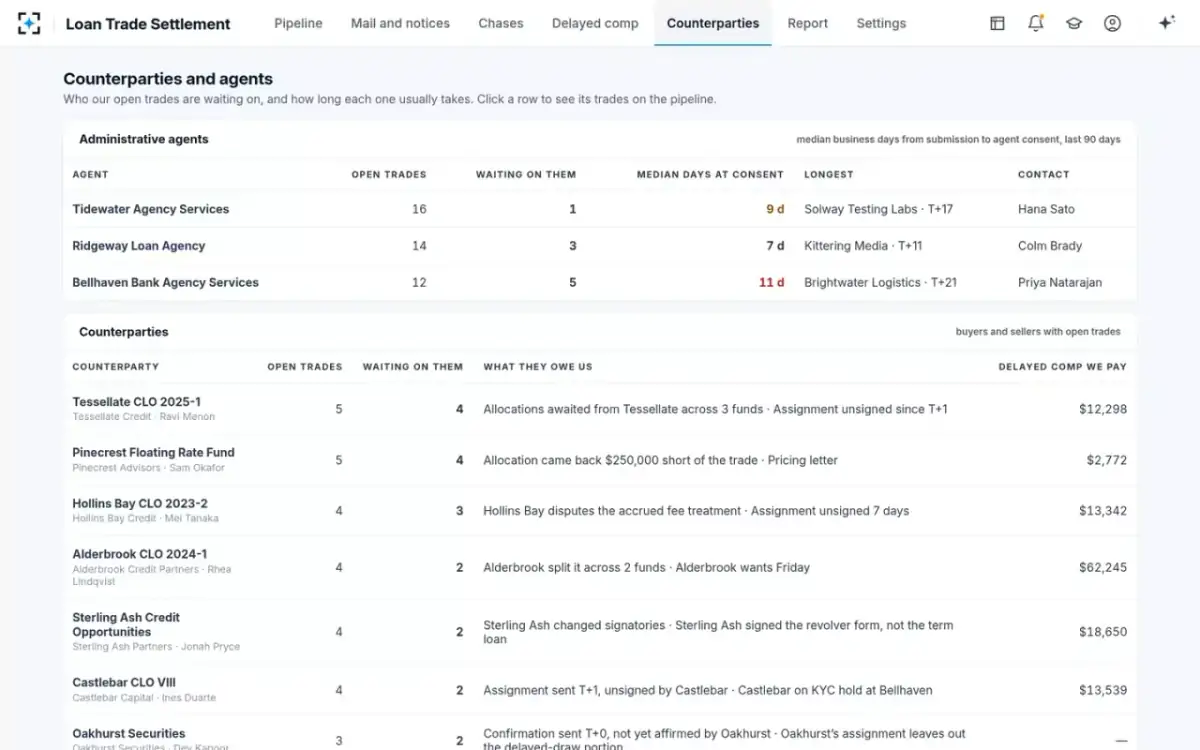
Each agent and counterparty, with the trades and the cost sitting on it
For what the correspondence actually contains, and the holds that come out of it, the eight blockers ranked by the days they cost is the underlying material; for the limits on what reads it, what each agent may and may not decide sets the boundary out in full.
Questions people ask
What should loan administration software integrate with?
For the loan itself: the general ledger, the payments rail, the rate sources, the document store and whatever reporting the lender group needs. For settlement, the useful connections run the other way and mostly into a different layer — the settlement mailbox, the agents' portals and notices, the settlement platform's status, the credit agreements and the confirmations and allocations. The key question to ask of any settlement integration is its direction: anything that writes back into the system of record is taking a decision somebody owns.
What is the difference between loan servicing and loan settlement software?
Servicing software runs the loan: positions, interest periods, rate settings, drawdowns, repayments and fees, for the life of the facility. Settlement software runs the transfer of a position between lenders, and its clock is days rather than years. They meet at the moment a trade funds, when the servicing system records the new lender list — and the whole period before that moment, where a trade is either on time or expensive, sits outside both unless something is reading the correspondence.
Can we keep our loan administration system and add this?
That is the intended arrangement. Nothing is written into the loan administration system and no connection to it is needed; the settlement layer reads the mailbox, the agents' notices, the platform's status, the credit agreements and the confirmations, and hands the desk its open trades with the hold and the holder named. The transfer is still booked by the people who book transfers, in the system they already use.
What does a four-week pilot need from us?
Read access to the settlement mailbox including sent items, the open trades as confirmations and allocations in whatever form they exist, the credit agreements for those facilities, and an hour each from the head of operations and the desk head to set the clocks, the calendar, the chase rhythm and the approval thresholds. The week-one baseline — median days, share inside target, late days by cause, net delayed compensation — is work you should do whether or not the pilot goes ahead.
How is this different from building it ourselves?
The hard part is not the plumbing; it is the reading, and specifically the discipline that no conclusion is shown without the message, notice or clause behind it. A desk that builds this itself usually ends with a status field and a drop-down list of blockers, which is the desk retyping what it already knew. If you do build, make the evidence a condition of the claim from the first day, because retrofitting it is the part nobody gets round to.
What if the delay is not costing us anything?
Then check, because it probably is, and in both directions. From the seventh business day a par trade accrues delayed compensation on the par amount at the loan's rate, less the buyer's cost of carry; a desk that both buys and sells is paying on some trades and collecting on others every day. There is a further cost that does not appear on any statement: the Securities and Exchange Commission noted that funds with significant extended-settlement holdings "have used borrowing through lines of credit to meet redemptions, but lines of credit may not be available to all funds and borrowing imposes costs that can dilute the value of the fund for remaining investors".