Delayed compensation is what a buyer is paid when a loan trade settles after its target date, and cost of carry is the deduction that makes it fair. The logic is short: had the trade settled on time, the buyer would have been earning the loan’s interest on the full par amount — but it would also have had to fund the purchase price on that date, which it has not yet done. So the sum has two legs. Interest on par at the loan’s own rate, less carry on the purchase price at a funding rate, for every calendar day the trade is late. Every dispute you will ever have about the figure is a dispute about one of four inputs behind those two lines, which is why Botminds’ Loan Trade Settlement never shows the number without its working.
The trade worked through here is a fictional sample: $25,000,000 of the Corvane Packaging Term Loan B, sold by Ashgrove Bank at 99.375 with a trade date of Wednesday 9 September. The firms, funds and people are invented and the figures are sample data, not a customer’s result. The calculation is shown on a 360-day basis throughout, because that is the basis this facility’s interest is computed on; check your own.
One late trade, at the moment the desk looked at it
$2,144
a calendar day, net, on a $25,000,000 position
$5,118 of interest less $2,974 of carry
$53,593
owed after 25 days late, on the morning of Tuesday 13 October
$23,581
the difference between settling in three days and waiting eleven more
$6,998
a day leaving the desk across its whole book, after netting buys against sells
What is delayed compensation and cost of carry, in one paragraph
A loan trade has an economic date and a legal date, and delayed compensation is the bridge between them. The economic date is the target settlement date the two desks worked to when they agreed the price; from that date, the market’s convention is that the buyer owns the risk and the return of the position. The legal date is whenever the administrative agent finally records the transfer. In between, the seller is still the lender of record, still being paid the loan’s interest by the agent, and still has not received the purchase price. Delayed compensation moves the difference to where the parties agreed it should sit.
Nothing about this is charitable. It is the mechanism that stops a slow settlement from quietly handing the economics of a position to whichever side happens to be holding it. Without it, a seller would have no reason at all to chase an agent, and a buyer would be paying for market exposure it had no way to realise.
Institutions feel the same effect one level up. The SEC, looking at why bank loan funds trade differently from other funds, noted that “bank loan funds, unlike other funds, experience specific trading costs related to bridging the settlement gap, i.e., the costs related to using financing during the time it takes for a loan trade to settle” (SEC, Open-End Fund Liquidity Risk Management Programs, December 2022). Delayed compensation is the trade-level version of that financing cost, and it is paid by somebody every single time a trade runs long.
How is delayed compensation calculated? The two legs, written out
The sum on the sample trade, term by term, as Loan Trade Settlement shows it
Interest on par
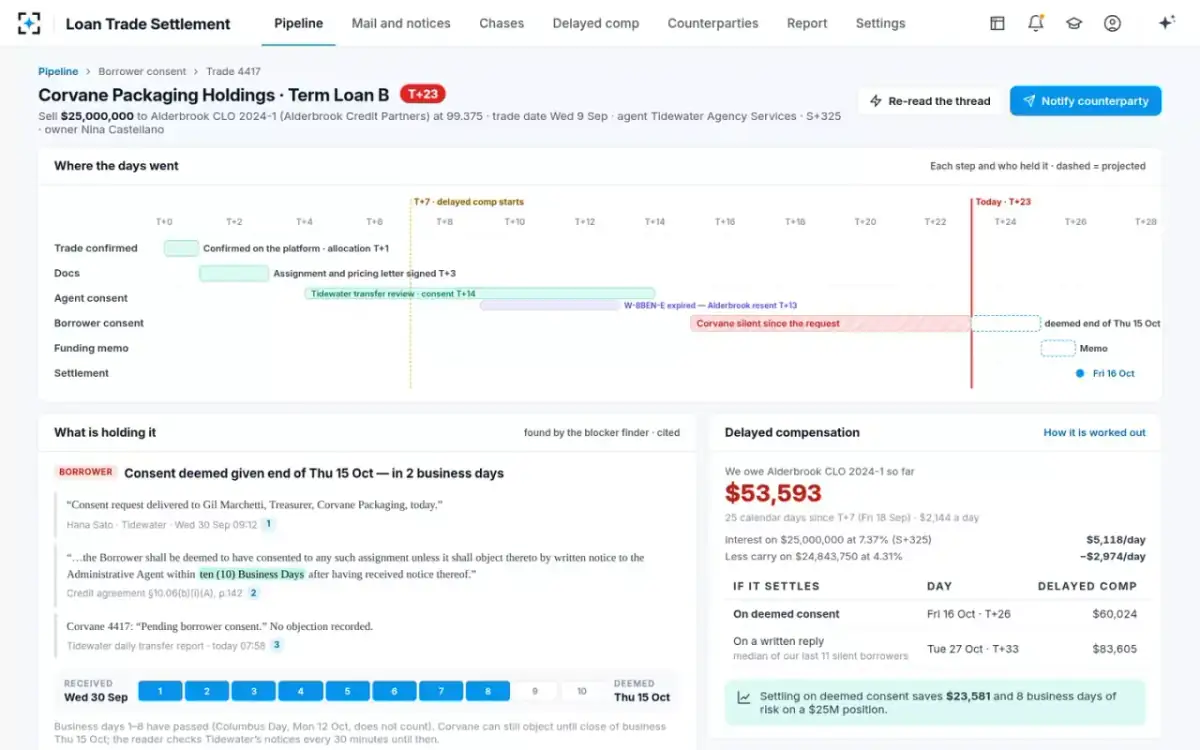
$25,000,000 × 7.37% ÷ 360
The loan’s own rate for the period — S+325 on this facility — applied to the full par amount, because that is what the buyer would have been receiving as a lender of record.
$5,118.06 a calendar day
Cost of carry
$24,843,750 × 4.31% ÷ 360
The purchase price at 99.375, at the funding rate agreed for the month. The buyer has not paid this money yet, so it is still earning on it.
$2,974.35 a calendar day
Net, per calendar day
$5,118.06 − $2,974.35
What the seller owes the buyer for each day the trade runs past its start date. On a trade where the buyer itself caused the delay, the convention reverses and the buyer forfeits.
$2,143.71, shown as $2,144
The claim
$2,143.71 × 25 calendar days
Friday 18 September, the start date on this desk’s settings, to Tuesday 13 October. Calendar days, not business days: the loan accrues interest at the weekend too.
$53,593
Two structural points are worth drawing out of that table. The first is that the two legs are applied to different principal amounts: interest to par, carry to the price paid. On a trade at 99.375 the gap is small; on a trade at 82 it is not, and a desk that applies both rates to the same number will be materially wrong. The second is that the net can go either way. When the loan’s rate is below the funding rate — a tight-spread facility in a period of expensive money — the carry leg is larger than the interest leg, and the compensation runs from buyer to seller instead.
Leg one: interest on par at the loan’s own rate
The first leg uses the loan’s coupon, not a market rate and not the buyer’s cost of money. The sample facility pays SOFR plus 325 basis points, and at the rate set for the current period that is 7.37%, so the loan is throwing off $5,118.06 a day on a $25,000,000 position. That accrual is real: the borrower is paying it and the agent is passing it to the lender of record, which is still the seller.
Three details decide whether your first leg is right. Which rate period — a term loan resets on a schedule, and a trade that straddles a reset accrues at one rate before it and another after. Par, not the price — the buyer’s entitlement is to the interest the facility pays, which is computed on the full outstanding amount. And what else travels: a facility with a ticking fee on an undrawn delayed-draw tranche, or with an amendment fee paid in the window, needs those handled explicitly in the confirmation rather than discovered at the claim.
Leg two: the cost of carry on the purchase price, and where that rate comes from
The second leg is the one with a choice in it, because nobody publishes “the carry rate”. It stands for the buyer’s funding — the money it has not had to put up yet — and desks set it as a policy: an overnight benchmark, a benchmark plus a spread, or a flat rate agreed for the month and reviewed when rates move.
The benchmark underneath almost all of those choices is SOFR. The New York Fed publishes it as “a broad measure of the cost of borrowing cash overnight collateralized by Treasury securities”, and — the operationally important part — “each business day, the New York Fed publishes the SOFR on the New York Fed website at approximately 8:00 a.m. ET” (Federal Reserve Bank of New York, SOFR data). A daily rate published at a known time is a rate two desks can agree to use without arguing about the source.
On the sample desk the carry rate is a setting: 4.31% for October, applied to the purchase price. It is worth seeing where that sits. The loan pays SOFR plus 325 basis points at 7.37%, which implies a base of 4.12% for the period; the carry rate is 19 basis points above it. That is what a funding rate should look like — a little more than the risk-free overnight rate, because the buyer is not the US Treasury. A desk that sets carry at the benchmark exactly is quietly overstating what it is owed; one that sets it far above is giving money away.
When does delayed compensation start accruing, and why the start date is the common argument
It starts on the trade’s target settlement date — T+7 for par and near-par trades on the sample desk, T+20 for distressed ones — and both of those are the desk’s own configured clocks rather than anything a regulator sets. The seven-day convention is the market’s own, carried in the documents the two desks sign.
On the sample trade, the trade date is Wednesday 9 September and seven business days later is Friday 18 September, so the meter started there. That looks mechanical, and most of the time it is. The arguments arise in four recognisable situations:
An amended confirmation. If the trade is re-papered — a changed amount, a corrected facility, a different documentation type — one side will say the clock restarts and the other that the original trade date stands. Decide it at the time, in writing. A buyer-caused delay. Where the hold is the buyer’s own — its tax form, its questionnaire, its signature — the convention is that the buyer does not get paid for the days it caused, which turns a calculation into a question of fact about whose step was outstanding. A trade that becomes distressed between agreement and settlement, where the start date convention differs. And allocations that change, where a short or re-split allocation arrives after the target date and the sub-trades have different histories.
None of the four is resolved by arithmetic. All four are resolved quickly if the desk can produce a dated history of who was holding the trade on each day — which is the same record that tells it who to chase. How a desk builds that history, and the eight holds it usually finds, are set out in the guide to failed trade settlement.
The day count, the holiday calendar and the four inputs people disagree about
The four inputs behind every delayed compensation dispute
| Input | How it goes wrong | What to agree in advance | The evidence that settles it |
|---|---|---|---|
| Start date | One side counts from the original trade date, the other from an amended confirmation — or the buyer caused part of the delay and says nothing. | The target date convention for par and distressed, and the rule for amended confirmations, written into the desk’s settings rather than remembered. | The confirmation, with its trade date, and a dated history of which party each step was waiting on. |
| The loan rate | A rate period reset inside the window, or the wrong margin where a facility has a pricing grid tied to leverage. | That the loan’s own rate for each accrual period is used, split at the reset date where the window straddles one. | The agent’s rate-setting notice for each period. |
| The carry rate | A flat rate carried over from a month when money cost something different, or two desks using different benchmarks. | The benchmark, the spread over it if any, and how often it is reset. SOFR is published every business day at about 8:00 a.m. ET. | The published benchmark for the dates in question, and the desk’s own setting with the date it changed. |
| The day count | Calendar days against business days, or a 360-day basis against 365 on a facility that uses the other. | Calendar days for accrual, and the basis the facility’s own interest uses — stated on the claim. | The credit agreement’s interest provisions, and the basis printed beside the number. |
The holiday calendar deserves its own sentence, because it catches desks in a way that feels unfair. Accrual runs on calendar days — the borrower pays interest at the weekend — but the start date is reached by counting business days, on the calendar the trade works to. A New York bank holiday inside that count moves the start date by a day, which moves the whole claim by one day’s accrual. On a $25 million position that is $2,144, and it is exactly the sort of difference that produces a two-week email thread.
Which side pays: netting what you owe on sells against what you are owed on buys
A desk is on both sides of the market, and the direction of each claim follows the direction of the trade. On a sale that settles late, the desk pays: it is still receiving the loan’s interest, and the buyer is not. On a purchase that settles late, the desk is paid. A desk that reports only what it pays is reporting half a position and will overstate what the delay costs it.
The sample desk’s two sides on one morning, and the only number a manager should carry
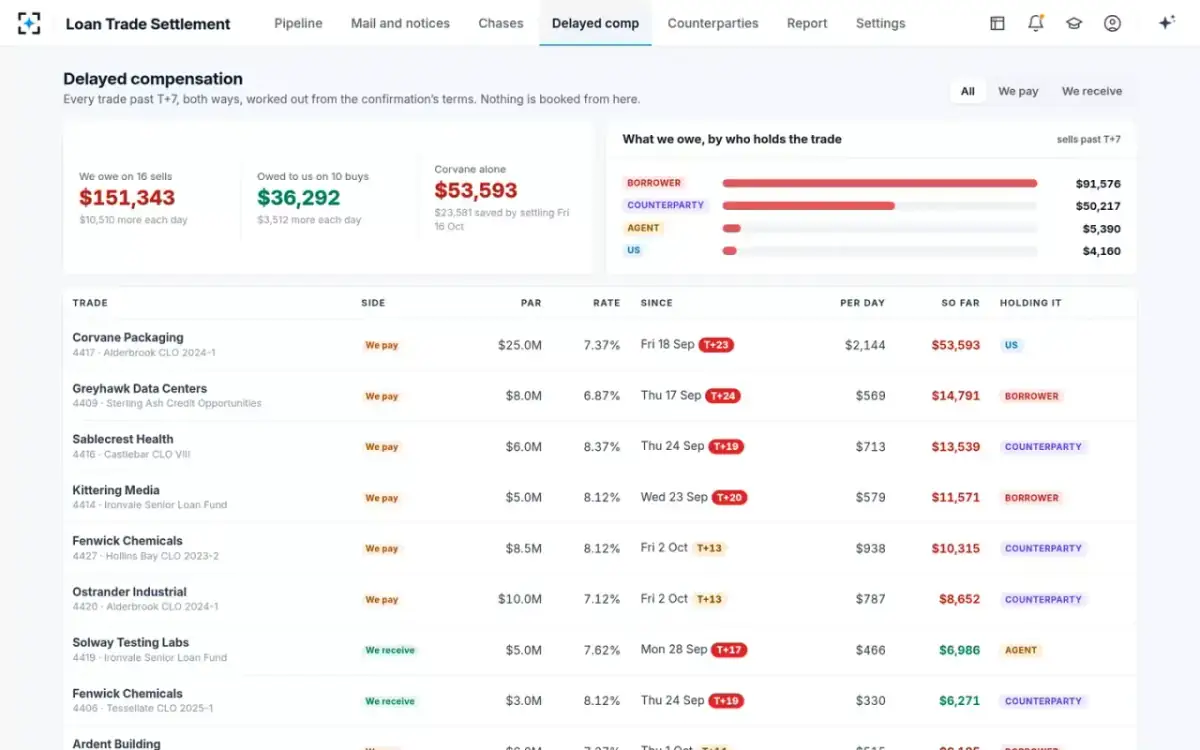
What we owe, on sells: 16 sells
What we are owed, on buys: 10 buys
What we owe, on sells: $10,510
What we are owed, on buys: $3,512
What we owe, on sells: $151,343
What we are owed, on buys: $36,292
What we owe, on sells: $53,593 on one $25,000,000 position
What we are owed, on buys: $6,986 on a $5,000,000 position held at its agent
What we owe, on sells: Borrower $91,576 · counterparty $50,217 · agent $5,390 · us $4,160
What we are owed, on buys: Mostly counterparty and agent holds, on trades where our own file is complete
What we owe, on sells: Deciding which trade to chase first, and which hold to escalate.
What we are owed, on buys: Making sure a claim is actually made, and that a buyer-caused day is not quietly conceded.
Netting is a reporting convention, not an accounting one. Each claim is between a particular buyer and a particular seller on a particular trade, and two desks that trade with each other frequently will often settle a month’s claims as one payment — but the figures still have to exist per trade, because that is how a dispute is resolved and how a buyer-caused day is identified.
Every trade past the start date, both ways, in Loan Trade Settlement
A worked example, from the trade to the claim
Put the whole thing together on the sample trade. The desk sold $25,000,000 of a term loan at 99.375 on Wednesday 9 September. Seven business days later, on Friday 18 September, the meter started at $2,143.71 a calendar day. By the morning of Tuesday 13 October — 25 days of accrual, and T+23 on the trade — the claim stood at $53,593, and the trade was waiting on a borrower that had not answered a consent request delivered on Wednesday 30 September.
From there the desk had two futures, and the arithmetic made the choice for it.
The same trade, at four possible settlement dates
The credit agreement deemed the borrower’s consent given at the close of Thursday 15 October, ten business days after the agent delivered the request, with Columbus Day not counted. Settling the next day cost $60,024. Waiting for a reply that this desk’s own history said would arrive around Tuesday 27 October would have cost $83,605. The $23,581 between them was not won by negotiating anything; it was won by counting business days correctly and telling the agent and the counterparty the date. The clause, the counting and the proof it needs are set out in the deemed consent guide.
The working behind the number, beside the trade it belongs to
What the number is for: pricing the chase, not the accounting entry
The most useful column on a delayed compensation screen is not the total. It is the amount per day, because that is what ranks the work. A $25,000,000 position at $2,144 a day earns a phone call this morning; a $3,000,000 position at $330 a day earns an email this week. Without the per-day figure, a desk chases the oldest trade, which is frequently the one it can do least about.
Two disciplines keep the number honest. Nothing is booked or paid from the working. It is a calculation for operational decisions, and a claim becomes a claim when a person raises it — on the sample desk, with the head of operations approving anything above $50,000. Every figure shows its arithmetic, so a counterparty’s different number can be diagnosed rather than argued with: start date, loan rate, carry rate, day count, and which of the four you disagree about.
It is also the number that makes the case for doing any of this. A desk paying $10,510 a day across sixteen late sells is paying for an absence of information more often than for an absence of effort — and the market it sits in is not getting simpler: nearly half of the commitments in the 2025 Shared National Credit review were leveraged, and leveraged loans made up 81% of the non-pass ones (Federal Reserve, FDIC and OCC, 2025 SNC Program report). More trading, in more complicated credits, through the same chain. Where those days actually go, and against what the market has been measured, is in the settlement cycle guide. To see the per-day figure beside the hold it belongs to, start from Loan Trade Settlement.
Questions people ask
Who pays delayed compensation, the buyer or the seller?
On a par trade that settles late through no fault of the buyer, the seller pays the buyer: the seller is still receiving the loan’s interest as lender of record, and the buyer is not, so the net of the two legs moves across. Where the delay was the buyer’s own — its tax form, its questionnaire, its signature — the convention is that the buyer forfeits compensation for the days it caused, which is why a dated record of who was holding each step matters as much as the arithmetic.
What rate is used for cost of carry?
A funding rate, chosen as a matter of policy rather than published anywhere as “the” carry rate. Most desks start from SOFR, which the New York Fed publishes every business day at around 8:00 a.m. ET, and add a spread, or fix a rate for the month and review it when rates move. On the sample desk the October rate is 4.31%, about 19 basis points above the base implied by the loan’s own coupon.
What is the day count for delayed compensation?
Accrual runs on calendar days, because the loan pays interest at weekends too. The basis — 360 or 365 — should follow the facility’s own interest convention, and should be stated beside the figure. The start date is different: it is reached by counting business days from the trade date on the applicable calendar, so a bank holiday inside that count shifts the whole claim by a day’s accrual.
Is delayed compensation netted across trades?
For reporting and often for payment, yes; for calculation, no. Each claim belongs to one trade between one buyer and one seller, and has to be computed that way so that a disagreement can be traced to an input and a buyer-caused day can be identified. Desks that trade with each other frequently commonly settle a month of claims in a single payment, which is a convenience on top of the per-trade figures rather than a replacement for them.
How much does a late loan trade cost?
Multiply the net per-day figure by the calendar days of delay. On the sample $25,000,000 trade the net is $2,143.71 a day — $5,118.06 of interest on par at 7.37% less $2,974.35 of carry on $24,843,750 at 4.31%, both on a 360-day basis — so twenty-five days late is $53,593 and thirty-nine days is $83,605. Across a book the figure that matters is the net of what is owed on sells against what is owed on buys.
Does delayed compensation cover everything the delay costs?
No. It covers the carry on the position and nothing else: not the market risk the buyer is running on a price it agreed weeks ago, not the operational cost of the chasing, and not the liquidity consequence for a fund that sold to meet redemptions. The SEC has described the financing cost of bridging the settlement gap as a trading cost specific to bank loan funds, which is the same economics seen from the fund’s side rather than the trade’s.