The difference between a loan participation and an assignment is who the borrower’s lender is afterwards. An assignment substitutes the buyer for the seller on the administrative agent’s register: the buyer becomes a lender of record under the credit agreement, with the right to be paid directly, to vote and to enforce — and, because it is joining somebody else’s contract, it needs whatever consents that contract requires. A participation changes nothing on the register. The seller stays the lender, keeps the documents, keeps the vote and keeps collecting from the agent, and the buyer holds a contract against the seller promising to pass the money along. Botminds’ Loan Trade Settlement reads the transfer section of each credit agreement behind an open trade, so a desk knows which route a trade can actually take before it promises a settlement date.
The agreement quoted throughout is a fictional sample used in this series — the Corvane Packaging credit agreement, dated March 2025, with Tidewater Agency Services as administrative agent — and its parties, schedules and amounts are invented. The law and the regulatory material are real and linked where they appear. Nothing here is legal advice; the transfer section of your own agreement is the only text that governs your own trade.
What is the difference between a loan participation and an assignment?
In an assignment the buyer steps into the seller’s shoes. The agent records it, the borrower learns of it, and from the effective date the buyer is owed interest and principal by the borrower, votes its own position on amendments and waivers, and takes on the seller’s unfunded obligations — a revolving commitment assigned is a commitment the buyer now has to fund. The seller is out.
In a participation the seller stays exactly where it was. It remains the lender of record and the party the agent pays, and it grants the buyer a participating interest in its position by a separate contract that the borrower is typically never told about. The participant’s money comes from the seller, not the borrower. Its remedy, if the money does not arrive, is against the seller. And its exposure is to two credits at once: the borrower, who may not pay, and the seller, who may not be able to pass on what it was paid.
That is the whole trade-off, and it is a credit decision rather than an operations shortcut: a participation is quick because it avoids the agent and the borrower, and it leaves you one step removed from the asset for exactly the same reason.
Assignment against participation, row by row — the choice Loan Trade Settlement flags before a settlement date is promised
Assignment: The buyer. The agent writes it into the register of lenders.
Participation: The seller. The register does not change and the borrower sees nothing.
Assignment: The agent, for all lenders, with the buyer now among them.
Participation: The seller, in its own name, as it did before.
Assignment: The agent’s, and the borrower’s unless an exception applies. Plus minimums, eligibility and the disqualified lender list.
Participation: Usually none under the credit agreement. The seller is selling its own economic interest, not transferring the loan.
Assignment: The buyer votes its own position on every amendment and waiver.
Participation: The seller votes. The participation contract normally reserves a short list of matters on which the participant must agree.
Assignment: The agent, which pays the buyer directly.
Participation: The agent, which pays the seller, which pays the participant.
Assignment: The borrower.
Participation: The borrower and the seller. If the seller fails, the participant is a creditor of the seller for money in transit.
Assignment: An ordinary purchase of a loan interest.
Participation: A sale only if the interest transferred meets the participating-interest definition; otherwise the seller has borrowed, not sold.
Assignment: Everything the agreement’s transfer section imposes.
Participation: Whatever the participation contract imposes, plus any restriction the credit agreement puts on participations themselves.
Assignment: The full chain, including two third parties who are not on the trade.
Participation: Two parties and one document, so days rather than weeks.
What a loan participation actually is, in the regulators’ words
A loan participation is a sharing or selling of ownership interests in a loan between two or more financial institutions. Normally, a lead institution originates the loan and sells ownership interests to one or more participating banks at the time the loan is closed.
FDIC, RMS Manual of Examination Policies, Section 3.2 — Loans
The FDIC’s examination manual goes on to describe exactly the feature that matters at settlement: the lead institution “retains a partial interest in the loan, holds all loan documentation in its own name, services the loan, and deals directly with the customer for the benefit of all participants” (FDIC, Section 3.2). Everything a participant owns runs through that sentence. It does not hold the documents. It does not service. It does not deal with the borrower. Its entire position is the promise of an institution that does all three.
The manual describes the bilateral participation sold at origination rather than a secondary trade, but it is the same structure a trading desk reaches for when the agent or the borrower is slow — and so is the warning that follows: “If not appropriately structured and documented, a participation loan can present unwarranted risks to both the seller and purchaser of the loan.”
What an assignment moves, and what it leaves behind
An assignment moves the position; it does not move history. Three things stay behind, and each of them surfaces later.
Accrued interest and fees belong to whoever held the position on the day they accrued, which is why the pricing letter, not the assignment, carries the money. Votes already cast stay cast: the buyer inherits the amendment, not the chance to have voted against it. And the seller’s own promises survive — on par documents a narrow set about title and encumbrance, on distressed documents a much longer set reaching back through every previous owner of the position.
What the buyer takes on is the other half of the sentence. An assignment of a revolving commitment is an assumption of the duty to fund it, and an assignment of a delayed-draw tranche can carry a ticking fee obligation with it. Both are ordinary, and both are regularly missed in the confirmation, which is how a desk discovers at the funding memo that the amount to wire is not the amount it expected.
The same $25 million, drawn twice
Assignment
- Borrower→
- Administrative agent→
- Buyer, on the register
The seller is gone from the chain. The buyer is a lender: paid directly, votes directly, enforces directly. The register is the proof.
Participation
- Borrower→
- Administrative agent→
- Seller, still on the register→
- Buyer, by contract only
One more link, and it is a credit. The buyer is paid by the seller, votes through the seller, and in the seller’s insolvency is arguing about what it bought rather than collecting it.
Does a participation need borrower consent? The consent question, answered both ways
Usually not, and the reason is structural rather than generous: there is nothing for the borrower to consent to. Its contract is unchanged, its lender is unchanged, and the money still comes from and goes to the same place. What the seller has done is sell an economic interest in its own asset, which most credit agreements permit expressly — often while prohibiting the participant from having any direct relationship with the borrower or the agent.
An assignment is the opposite. The buyer is becoming a party to the borrower’s contract, so the borrower gets a say, bounded by what the agreement negotiated. In the sample agreement, §10.06(b) requires the borrower’s consent — not to be unreasonably withheld or delayed — unless an event of default has occurred and is continuing, or unless the buyer is already a lender, an affiliate of a lender or an approved fund. The buyer on the sample trade, a collateralised loan obligation vehicle, is none of those three, so the borrower’s consent is required, and the trade accordingly waited on a borrower who never replied.
It is worth knowing why the agreement’s consent requirement holds at all, because general commercial law points the other way for most assignments. Article 9 of the Uniform Commercial Code makes anti-assignment terms ineffective in a range of cases: a term that bars the transfer of an account, chattel paper, a payment intangible or a promissory note, or makes it depend on the obligor's consent, is ineffective to that extent (UCC §9-406(d)). But the very next subsection withdraws that rule for one case, and it is precisely the case a loan trade is: an outright sale of a payment intangible or a promissory note. Section 9-408 protects the buyer’s property interest in such a sale, but it does not oblige the borrower to recognise the buyer or to pay it (UCC §9-408(d)). To become a lender the borrower and the agent deal with, the buyer still needs the consents, and the transfer section means what it says.
Who votes the loan, and who the borrower has to pay
Voting is the right most often given away by accident. Under an assignment the buyer votes its own position: every amendment, every waiver, every consent request that goes round the lender group. Under a participation the seller votes, because the seller is the lender. A well-drafted participation reserves a short list of matters on which the participant’s agreement is needed — typically a reduction in principal or the interest rate, an extension of a payment date, and a release of all or substantially all of the collateral or the guarantors — and leaves everything else to the seller’s discretion.
That list is shorter than most buyers assume. A covenant reset, a change in reporting, an incremental facility, the addition of a new lender, an amendment to the transfer section itself: in a participation, none of those is the participant’s decision. For a fund whose mandate depends on influencing outcomes, a participation is not the same asset at all.
Payment follows the same logic and introduces the timing risk. The borrower pays the agent; the agent pays the lender of record; the lender of record pays the participant. Each link adds a day and a counterparty. In a seller’s insolvency, money sitting at the middle link is the subject of an argument rather than a payment — which is why the next question matters more than it sounds.
Is a loan participation a true sale? The participating-interest test
A participation can be a sale of an asset or, in substance, a secured loan from the participant to the seller, and the difference decides what the participant owns if the seller fails. The accounting question comes first. As the FDIC’s manual puts it, “Before considering whether the conditions for a sale have been met, the transfer of a portion of an entire financial asset must first meet the definition of a participating interest.”
The definition comes from the accounting standard for transfers, ASC Topic 860, which the same manual says governs loan participations, and it is demanding in a way that trips up negotiated terms. The interest transferred has to be a proportionate share of the whole financial asset; all cash flows have to be divided in that same proportion; no participant can be subordinated to another; and no party can have the right to pledge or exchange the whole asset unilaterally. Features that buyers often ask for — a first-loss slice, a priority on recoveries, a yield that does not track the loan’s — are precisely the features that break the test. Fail it, and the transfer is not a sale: the seller keeps the asset on its balance sheet and the participant has made it a loan.
Five questions to settle before a trade is done as a participation
- Does the credit agreement allow participations, and on what terms?
Most do, many restrict the participant’s voting and information rights, and a few prohibit participations to the same list of disqualified lenders that bars an assignment. Get the wrong answer and the trade is unwound.
- Are you comfortable with the seller as a credit?
You are taking the borrower and the seller. Ask what happens to money in transit if the seller enters a proceeding, and how long your claim would take to resolve.
- Does the interest meet the participating-interest definition?
Proportionate share, proportionate cash flows, no subordination between participants, no unilateral right to pledge the whole asset. A first-loss or priority feature means the transfer is not a sale.
- Which votes do you actually need?
Name them in the contract. Anything not reserved is the seller’s to cast, including amendments that change the credit you thought you bought.
- Is this permanent, or a bridge to an assignment?
A participation entered as a temporary structure needs its exit written down: who pays the agent’s fees on the eventual assignment, what happens if the borrower never consents, and who carries the position until then.
The credit you take on when you take a participation
There is a second-order point that only shows up in a bad year. A participant’s claim is contractual, and the law has been asked more than once what kind of instrument a syndicated loan actually is. In Kirschner v. JPMorgan Chase Bank, the Second Circuit set out the framework: under the Supreme Court’s Reves test a court compares a note with the kinds of notes that are not securities, starting from a presumption that every note is one (Second Circuit, No. 21-2726-cv). The presumption is rebuttable, and on the facts of that syndication it was rebutted — but the framework is a reminder that the characterisation of what you hold is a question with consequences, and that it can differ between an assignment of a lender position and a contract right against a seller.
The settlement consequence is simpler. The SEC, classifying how quickly funds can turn holdings into cash, singled out US bank loan participations as a category that has historically taken longer to settle than the broader securities markets (SEC, Investment Company Liquidity Risk Management Programs, 2016). A participation entered to save days at the agent can cost them again on the way out, when the participant wants to become a lender of record and has to do the assignment it avoided — by which time the borrower’s consent position may have changed.
When a desk settles as a participation anyway — and the three conditions for it
Desks do choose participations, and often for good reasons: a fund has to hold the position before quarter-end, a buyer’s onboarding at the agent will plainly take weeks, a borrower is in the middle of an amendment and will not look at consent requests. In each case the participation is a bridge.
Three conditions make that bridge safe. First, the seller is a credit the buyer would lend to unsecured, because that is effectively what it is doing. Second, the participation agreement names the reserved votes and the information the participant will get, rather than leaving both to practice. Third, the exit is written down before the bridge is built: the trigger for converting to an assignment, who bears the agent’s processing fee at that point, and what happens if the consent that was unavailable in October is still unavailable in February.
Where a desk gets this wrong it is usually the third: a participation entered as a two-week expedient and still outstanding at the next reporting date has quietly become a position nobody chose.
The transfer section, read for which route a trade can take
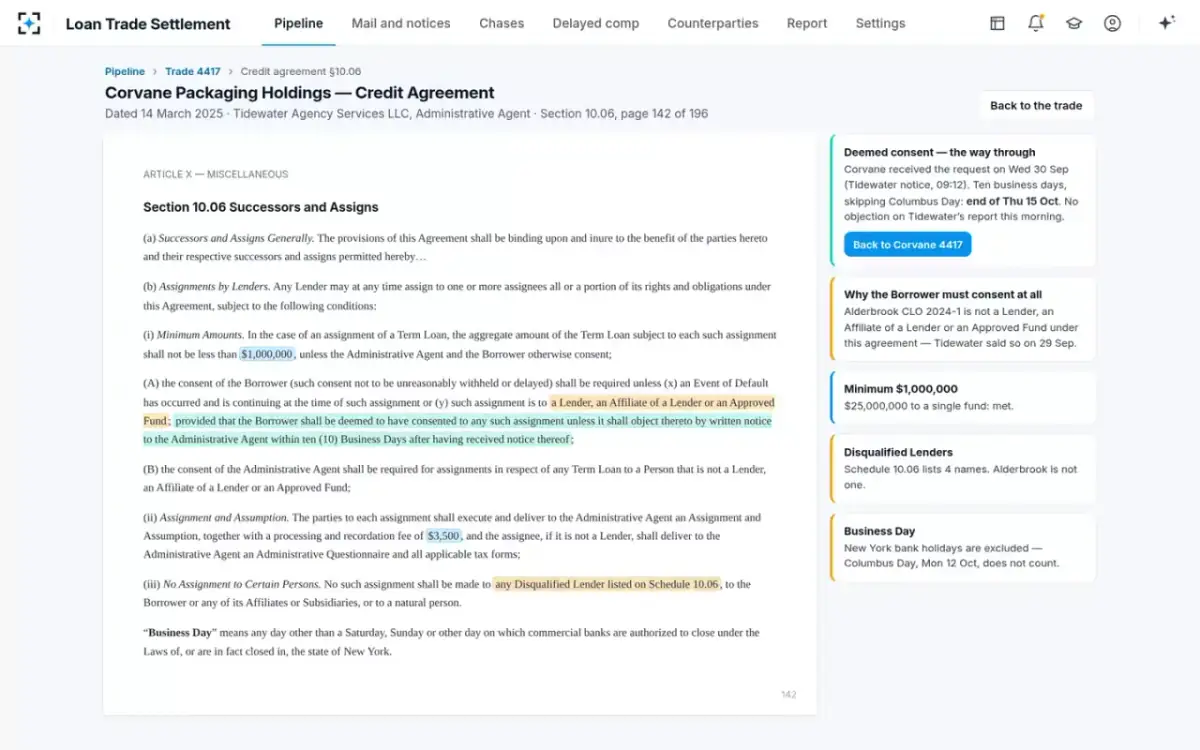
What the choice does to the settlement clock and to delayed compensation
The conditions a transfer section puts on an assignment, and who answers each one
| Condition in the sample §10.06 | What it asks | Who answers it | What it does to the clock |
|---|---|---|---|
| Minimum amount | Is the assigned amount of the term loan at least $1,000,000, unless the agent and borrower agree otherwise? | The two desks, at the confirmation. | None, if it is checked at the trade. A short allocation discovered later restarts the documents. |
| Agent consent | Will the administrative agent accept this buyer, after its own identity and tax checks? | The agent, on its own timetable. | The longest single step on most trades, and the one a desk has least influence over. |
| Borrower consent | Is the buyer already a lender, an affiliate of a lender or an approved fund — and if not, will the borrower agree? | The borrower, via the agent. | Days if the exception applies, weeks if it does not, unless the agreement deems consent after a period of silence. |
| Eligible assignee | Is the buyer on Schedule 10.06 of disqualified lenders, the borrower itself, an affiliate of it, or a natural person? | The seller, before it trades. The agent checks again. | None if checked early. A disqualified buyer discovered late is a broken trade, not a delay. |
| Assignment and assumption, with the fee | Is the agent’s own form executed, with the processing and recordation fee of $3,500 paid? | Both desks, then the agent. | Usually a day or two, and a predictable one. |
| Business Day definition | Which calendar counts the days in every clause above? | The agreement — New York, in the sample. | Decides the actual date every other condition matures on. A holiday nobody counted moves a settlement date. |
The clock matters because the money does. From the target settlement date, a late par trade accrues delayed compensation whichever structure is eventually used, and the structure decision is usually taken while that meter is already running. A participation stops the meter earlier because it settles sooner; it does not remove the question of who owed what for the days before it. How that sum is built, and which of its four inputs desks actually argue about, is set out in the delayed compensation guide.
The better answer, where the agreement allows it, is often neither a participation nor a longer wait. If the transfer section deems the borrower’s consent given after a stated number of business days from the agent’s delivery of the request, an assignment that looked blocked may simply be an assignment whose date nobody has counted — deemed consent is the clause, and the counting is the work. To see a transfer section read against an open trade, start from Loan Trade Settlement.
Questions people ask
Is a loan participation a true sale?
Only if it is structured as one. The transferred interest must first meet the definition of a participating interest: a proportionate share of the whole asset, proportionate cash flows, no subordination between participants, and no unilateral right in one party to pledge or exchange the entire asset. Features such as a first-loss slice or a priority on recoveries break the test, and the transfer is then accounted for as a secured borrowing rather than a sale.
Does a participation need the borrower’s consent?
Ordinarily no, because the borrower’s position does not change: the lender of record, the documents and the payment route are all the same. Many credit agreements permit participations expressly while restricting the participant’s voting and information rights. A few restrict participations to the same disqualified-lender list that governs assignments, so the transfer section still has to be read.
Who votes the loan in a participation?
The seller, because the seller is still the lender. A participation agreement normally reserves a narrow list of matters for the participant — typically a reduction of principal or interest, an extension of a payment date, and a release of all or substantially all collateral or guarantors. Everything else, including covenant amendments and incremental facilities, is voted by the seller.
What is a participating interest?
The accounting definition a transfer of part of a financial asset must meet before it can be treated as a sale at all. It requires each participant to hold a proportionate ownership interest in the entire asset, cash flows to be divided in the same proportions, no participant to be subordinated to another, and no party to have the right to pledge or exchange the whole asset without the others’ agreement.
Can a credit agreement really stop a lender selling its loan?
For an outright sale, yes. UCC §9-406(d) makes contractual terms that bar or condition an assignment ineffective in many settings, but §9-406(e) disapplies that rule to the sale of a payment intangible or a promissory note. A secondary loan trade is that kind of sale. Section 9-408 still protects the buyer’s ownership, but it does not oblige the borrower to recognise the buyer, so becoming a lender of record still runs through the consents and eligibility conditions in the transfer section.
When should a desk settle as a participation instead of an assignment?
When the position has to be held before the agent or the borrower can realistically act, and three conditions hold: the seller is a credit you would take unsecured, the reserved votes and information rights are written into the participation agreement, and the route back to an assignment — trigger, fees and fallback — is agreed before the participation is entered rather than after.