The LSTA settlement cycle is the loan market’s own target for how quickly a secondary trade should close: seven business days from the trade date for a par or near-par trade, with a longer clock for distressed trades. It lives in the standard trading documents the market signs rather than in anybody’s rule book, which is the single most important thing to understand about it. No regulator sets it, no exchange polices it, and the only consequence of missing it is a sum of money the two desks owe each other. Meanwhile the firms that actually decide the date — the administrative agent, sometimes the borrower — never signed the target and are not charged for missing it. Botminds’ Loan Trade Settlement exists for that gap: it names the hand-off each open trade is sitting in, the firm sitting on it, and what the wait is costing.
Every figure describing a desk on this page comes from a fictional sample: Ashgrove Bank, its counterparties, agents and borrowers are invented, and the numbers drawn from them are sample data or stated design targets rather than a customer’s measured result. The market figures are regulators’ own, linked where they appear.
What is the LSTA settlement cycle, and who enforces it
Three separate things travel under the same name, and keeping them apart is most of the battle.
The first is the target: par and near-par trades aim to settle T+7, counted in business days from the trade date, and distressed trades run on a longer clock — T+20 on the sample desk. The second is the documentation — the standard confirmation, assignment and pricing-letter forms the market uses, which is what makes it possible for two desks to agree a trade in a minute and still know what they have agreed. The third is delayed compensation, the formula that decides who pays whom once the target has passed, so that a slow settlement does not quietly transfer the economics of the loan from one side to the other.
Only the third has teeth, and they are contractual teeth. There is no fine, no suspension, no status against a regulator’s rule. If a trade settles at T+26, the trade settles at T+26 and the parties do the arithmetic. That is why the cycle behaves less like a deadline and more like a price: once a desk understands that every day past the target has a dollar figure, the question stops being “are we late?” and becomes “who is holding this, and what is the cheapest way to move them?”
How many days does a par loan trade take to settle? What the regulators have put on the record
The loan market publishes its own settlement statistics through an industry association, but the most useful independent record comes from the SEC, which has had to care about loan settlement for a quite different reason: an open-end fund that owns bank loans has to classify how quickly it could turn them into cash, and a long settlement cycle is a liquidity problem before it is an operations problem.
What the SEC has measured about bank loan settlement
12days
median settlement time for a loan sale around the time the liquidity rule was adopted, in 2016
T+15
median time to settle a par trade by July 2021
T+23
average time to settle a par trade in July 2021 — a seven-year high at the time
90%+
of bank loan investments reported by open-end funds classified as less liquid
The sentence worth keeping is the Commission’s own measurement: “By July 2021, the average time to settle a bank loan par trade in the secondary market increased to a then seven-year high of T+23, and the median was at T+15” (SEC, December 2022). Average above median means a long tail: most trades are late, and some are very late indeed. A desk whose median is respectable can still be carrying a handful of trades that are three or four weeks old, and those few carry most of the money.
Two cautions about using these numbers. They describe a market at a moment, not your desk, and the moment was several years ago. And they come from a regulator reading fund filings, which means they cover the loans funds hold rather than the whole secondary market. They are still the right public anchor, because they were not produced by anyone with a remedy to sell.
A settlement cycle nobody can shorten alone: the five hand-offs
Between the trade and the wire there are five hand-offs, and each one is a different firm’s queue. Nothing about the cycle is continuous work: most of the elapsed time is a document sitting in an inbox at a firm that has no clock running against it.
Where a late par trade’s business days go, hand-off by hand-off
- Confirmation3 d · desks
- Assignment4 d · desks
- Agent consent6 d · agent
- Borrower consent5 d · borrower
- Funding2 d · agent
- Trade date to settlement7 business days
Read the lanes together and the arithmetic of the cycle is obvious. Thirteen of the twenty days belong to the two firms that are not on the trade. Even a desk that does its own two hand-offs perfectly — signing the day the document arrives, allocating before the close — buys back seven days at most and still misses the target. That is not an excuse for sloppiness on the first two. It is the reason a settlement desk’s real skill is in the last three.
How a loan settlement cycle differs from T+1 in equities
The comparison is unavoidable because somebody in every firm makes it. In May 2024 the standard US securities settlement cycle halved: the SEC adopted “rule amendments to shorten the standard settlement cycle for most broker-dealer transactions from two business days after the trade date (‘T+2’) to one business day after the trade date (‘T+1’)” (SEC, Shortening the Securities Transaction Settlement Cycle, March 2023). If equities can settle in a day, the question goes, why do loans take a month?
Two settlement cycles that only look like the same thing
US equities, T+1: A Commission rule with a compliance date. Missing it is a regulatory matter.
Par loan trades, T+7 target: A market convention carried in standard trading documents. Missing it is an arithmetic exercise between two desks.
US equities, T+1: A fungible security. One share is every other share.
Par loan trades, T+7 target: A position under one individually negotiated credit agreement, with its own transfer section.
US equities, T+1: Central. Allocation, confirmation and affirmation are required by rule to be completed, under written agreement, by the end of trade date.
Par loan trades, T+7 target: Bilateral. A confirmation signed by two desks, then documents exchanged by email.
US equities, T+1: Nobody outside the trade. A clearing agency stands between the parties.
Par loan trades, T+7 target: The administrative agent, and often the borrower. Neither is on the trade and neither pays for delay.
US equities, T+1: Book entry at a central depository.
Par loan trades, T+7 target: A register of lenders kept by the agent, changed by a countersigned assignment.
US equities, T+1: Nothing beyond an account.
Par loan trades, T+7 target: Identity, tax status and eligibility under the agreement — questionnaire, W-9 or W-8, and that it is not a disqualified lender.
The SEC noticed the difference long before it shortened the equity cycle. In the 2016 liquidity rule it wrote that “transactions in certain types of securities — such as certain foreign securities and U.S. bank loan participations — have historically entailed settlement periods that are longer than standard settlement periods in the broader securities markets” (SEC, Investment Company Liquidity Risk Management Programs, November 2016). A fund holding loans was told to classify them for what they are rather than hope they behaved like equities. A settlement desk should take the same instruction: the loan cycle is not a slow version of T+1, it is a different mechanism, and the techniques that shortened the securities cycle — central matching, a hard affirmation deadline, a rule — are not available here.
When does delayed compensation start, and what the clock is doing to the economics
Delayed compensation starts when the target passes, and on the sample desk that is T+7 for par and near-par trades and T+20 for distressed ones. Those are settings the desk owns, not laws: the start date, the carry rate and the business-day calendar are all chosen, and two desks that have chosen differently will produce two different numbers for the same late trade.
What the clock does to a book is easier to see in aggregate than on one ticket. On the sample desk’s morning of Tuesday 13 October, sixteen sells were past the target and ten buys were; the desk was paying $10,510 a calendar day and receiving $3,512, a net $6,998 a day leaving the firm while nothing was being decided. The largest single line was one trade at $53,593 and counting. Only the net is a management number, and it is the number that makes a settlement desk worth staffing. The two legs of the sum, the day count and the four inputs people argue about are worked through in the guide to delayed compensation and cost of carry.
Where the days actually go, step by step
The same five hand-offs, by hand and with Loan Trade Settlement
The biggest proportional saving is on borrower consent, and it is worth being precise about why, because it is not persuasion. A borrower that has gone quiet usually stays quiet. What changes is that the credit agreement is read: if the transfer section deems consent given a stated number of business days after the agent delivered the request, and the agent’s report shows no objection, the trade can be scheduled without the borrower ever replying. That is a counting exercise, done properly, with the clause and the delivery date on the file — the deemed consent clause has a guide of its own.
The saving at the agent is smaller and duller: it comes from the buyer’s tax form being current before the agent asks for it, from the questionnaire going with the assignment rather than after it, and from the chase landing on the person who is actually holding the file. None of those is clever. All of them need somebody to know, that morning, which trade is in which queue.
The four numbers a settlement desk should publish about itself
Most settlement desks are measured by exception: somebody asks about one bad trade. Four numbers, published monthly, turn that into management. Median business days to settle, because the mean hides behind the tail. Share settled inside the target, which is the number that moves when process changes. Delayed compensation paid and received, both ways, because a desk that only reports what it pays is reporting half a position. And the causes of late days by share, which is the only one of the four that tells you what to do next.
Six months of a desk’s own cycle, and what held the trades
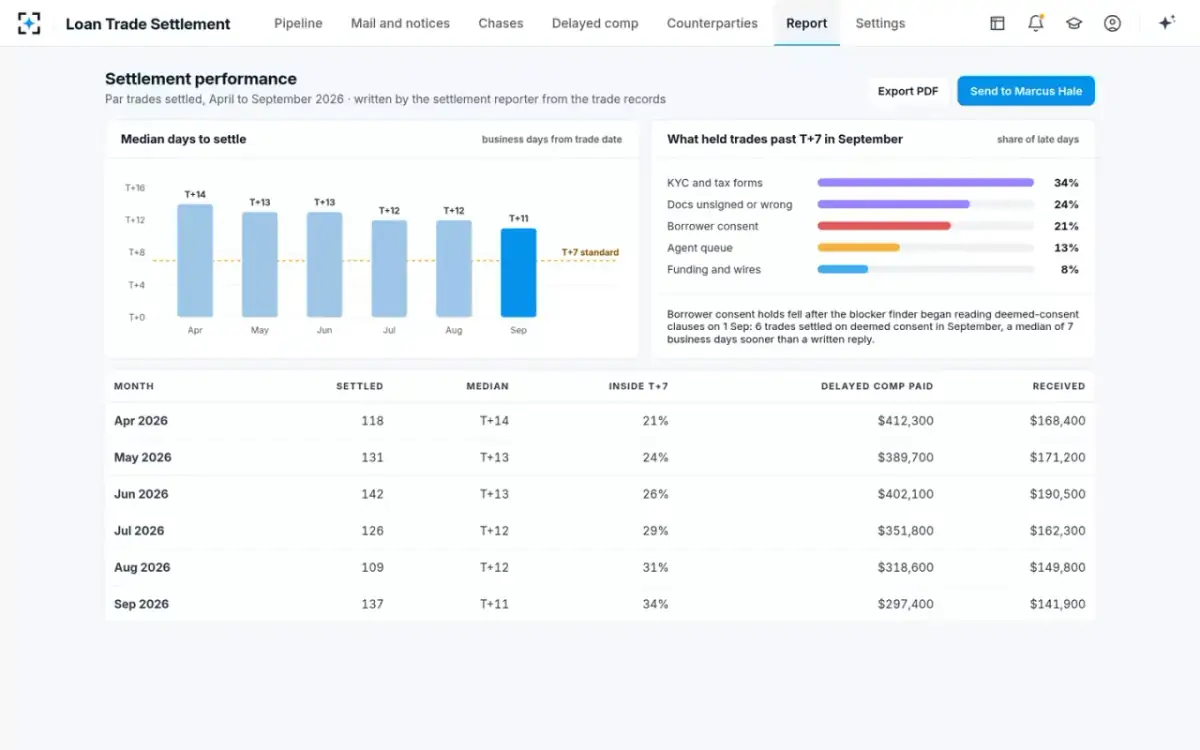
Notice what the cause column does to the conversation. “We are at T+11” invites an opinion. “Thirty-four per cent of our late days last month were identity and tax forms” names a piece of work: get the buyer’s forms current before the agent asks. That is also why the causes have to be derived from the trades rather than typed by whoever closed them — a free-text reason field reliably produces the reason the closer remembers, not the one that cost the days.
Why the platform status and the real blocker are not the same thing
Bank loans are not standardized and have individualized legal documentation.
SEC, Open-End Fund Liquidity Risk Management Programs and Swing Pricing, December 2022
Many parties means many status fields, and none of them is the truth. A settlement platform shows what somebody typed: in queue, pending consent, docs received. Those are states of a workflow, not statements about who is holding the trade. On the sample desk one trade had been “in queue” at its agent twice over thirteen days, against that agent’s own median of nine — the status had not changed and the trade had been stuck for a week. Another showed “pending borrower consent” for sixteen days while the credit agreement had already deemed that consent given.
The blocker is a different kind of fact: the specific thing a named person at a named firm has not yet done, with the message, notice or clause that proves it. It is derivable, but only by reading everything that arrived — the mailbox, the agents’ notices, the platform’s own events — and tying each item to its trade. That is the work the reading agents do every thirty minutes on the sample desk, and the eight blockers they most often come back with are catalogued in the guide to failed trade settlement.
What changes when every open trade names its blocker and its holder
A cycle measured rather than assumed
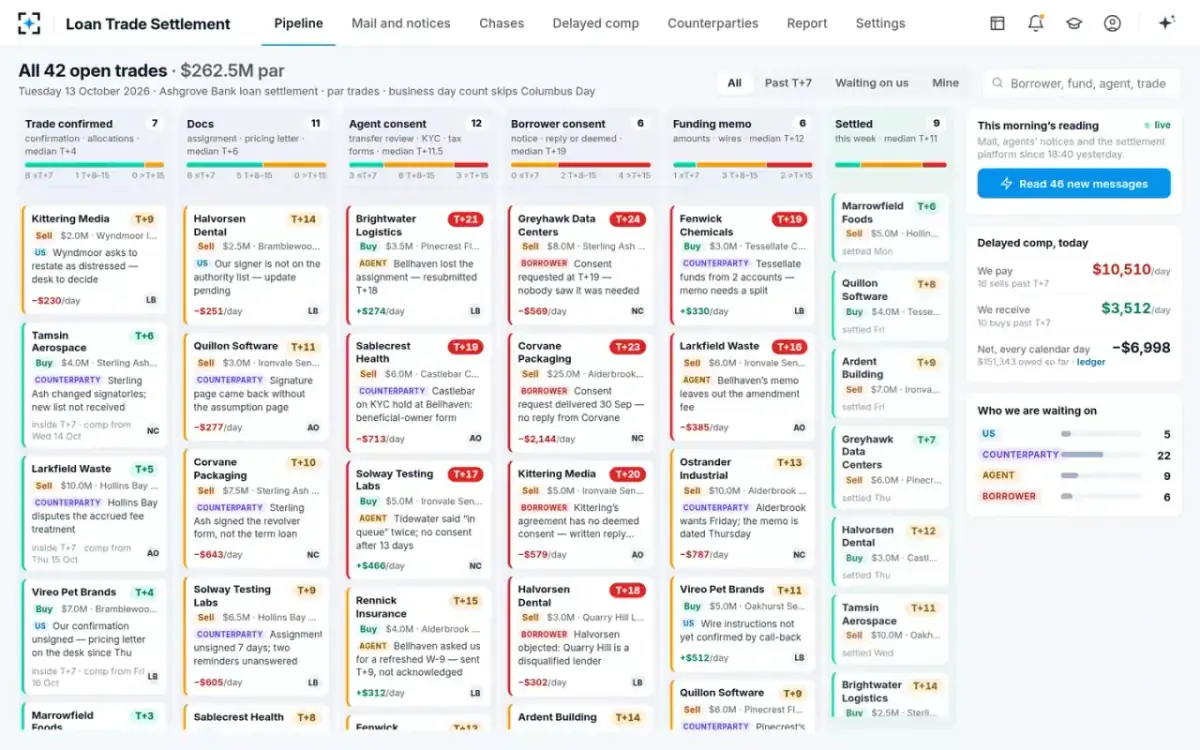
A column median is more useful than a book median because it is actionable. The sample desk’s borrower-consent column sat at T+19 and its agent-consent column at T+11.5; those two numbers, side by side, say that the work this quarter is reading transfer sections, not chasing agents harder. Had they been reversed, the work would have been the buyer’s onboarding file.
The same view does one more thing that a report cannot: it names the trades the desk itself is holding. Five of the forty-two were waiting on Ashgrove Bank’s own signature, its own form, its own confirmation. Nobody chases those, because the firm that is late is the firm that would do the chasing — and they are the only days in the whole cycle a desk can take back without asking anyone’s permission.
To see the stages, their medians and the firm behind each one, start from Loan Trade Settlement.
Questions people ask
What does T+7 mean in loan settlement?
Seven business days after the trade date, counted on the relevant market calendar — in the United States, usually New York. It is the target settlement date for a par or near-par trade and the date from which delayed compensation ordinarily starts to accrue. It is a convention in the market’s standard trading documents, not a regulatory deadline, and a trade that settles later is late rather than invalid.
Are the settlement rules binding, and what happens if you miss them?
They bind the two desks because the desks adopted them in their trade documents; they bind nobody else. There is no regulator, exchange or clearing house that polices the loan settlement cycle. The consequence of missing the target is the delayed compensation calculation — interest on par at the loan’s rate less carry on the purchase price — which moves money between buyer and seller but imposes no penalty beyond that.
Why do so many par trades miss T+7?
Because the two parties to the trade cannot finish it. Three of the five hand-offs sit with the administrative agent and the borrower, neither of whom is on the trade and neither of whom pays for the delay. On the sample desk’s own September figures, identity and tax forms caused 34% of late days, unsigned or wrong documents 24% and borrower consent 21%.
Does the seven-day target count business days or calendar days?
The target itself is counted in business days from the trade date. Delayed compensation, once it starts, generally accrues on calendar days, because it is standing in for interest the buyer would have been earning. Mixing the two conventions is one of the commonest reasons two desks produce different numbers for the same late trade, so both should be written down in the settings a desk works from.
Is the loan settlement cycle getting shorter?
The published record is mixed. The SEC reported a median of about 12 days for a loan sale around 2016 and a median of T+15 with an average of T+23 by July 2021 — that is, worse over that stretch rather than better. More recent independent measurement is thin. The honest answer for any particular desk is to measure its own median, its own share inside the target and its own causes, because the market average does not tell a manager what to fix.
What is the settlement cycle for a distressed loan trade?
Longer, and deliberately so. Distressed documentation carries representations about the whole chain of title, indemnities and unwind rights, and the diligence behind them takes real time. Desks therefore commonly set the delayed compensation start at T+20 for distressed trades rather than T+7, which is the market’s own admission of how differently the two kinds of trade behave.