FATCA and CRS indicia are pieces of information a financial institution holds about an account holder that point to a tax residence or US status different from the one the holder certified: an address or telephone number in another country, a standing instruction to pay an account there, a power of attorney granted to someone living there, and, for FATCA, a US place of birth. An indicium does not prove the form wrong. It takes away the fund's right to rely on it until the investor provides a new form, or an explanation with documents, within a window that is usually 90 days. The hard part is noticing: indicia arrive as routine changes to a KYC record or a transfer agency account, keyed by someone who is not thinking about tax forms. Botminds' FATCA/CRS Self-Certification checks each such change against the self-certification on file as it happens.
The examples come from the solution's sample data on a fictional fund manager, Quillfield Capital, whose indicia agent checked 2,140 KYC and transfer agency changes in one week. The rules are quoted from the Treasury regulations and HMRC's International Exchange of Information Manual.
A change opens a 90-day window under both regimes; the solution's clock divides it
- Investor’s 30 days to give a new form30 d
- Fund may still apply the prior statusto day 90
- Prior status, until confirmed or replaced90 calendar days
- Letter to reminder 1day 30
- To reminder 2day 60
- To escalationday 80
- Fallbackday 90
What are FATCA/CRS indicia?
They are the fund's own evidence against the form. Under FATCA, the regulations say a withholding agent has reason to know that a beneficial owner's W-8 is unreliable if, among other things, its account information classifies the holder as a US person, holds a US residence or mailing address, or "has a current telephone number for the account holder in the United States and has no telephone number for the account holder outside of the United States" (26 CFR 1.1441-7(b)(5)). Under the CRS the list points at every reportable jurisdiction, not only the United States, which makes it longer in practice.
Indicia matter twice. For accounts opened before the CRS and FATCA rules took effect, an electronic search for indicia was the way residence was first determined. For new accounts documented with a self-certification, indicia are how a valid form becomes unreliable: the investor moves, appoints an attorney abroad, or tells the transfer agent to pay redemptions to a bank in another country, and the form on file no longer describes the account.
The US list and the CRS list are not the same
The two lists overlap on addresses, telephones and standing instructions, and differ at the edges. US place of birth is a FATCA indicium with its own cure, and it is not on HMRC's CRS list. The CRS list, as HMRC sets it out, adds powers of attorney and hold-mail or in-care-of addresses to the electronic search, and its telephone test asks whether there is a number in the reporting institution's own country.
Indicia under FATCA and the CRS, and the paper that cures each
| Indicium | FATCA (reason to know, 1.1441-7) | CRS (HMRC, pre-existing lower-value accounts) | What cures it |
|---|---|---|---|
| Address | A current US residence or mailing address, on the form or in account information | A current mailing address in a reportable jurisdiction | For FATCA, documentary evidence of foreign status without a US address, and a written explanation; for the CRS, a self-certification backed by documentary evidence |
| Telephone | A US number, and no number outside the US | One or more numbers in a reportable jurisdiction, and no number in the UK | As for address; a non-US or home-country number on file may mean there is no indicium at all |
| Standing instructions | Instructions to pay amounts to an address or account in the US (offshore obligations) | Instructions, other than for depository accounts, to transfer funds to an account in a reportable jurisdiction | A written explanation, or documentary evidence of foreign status or residence |
| Power of attorney | Not among the reason-to-know indicia in 1.1441-7(b)(5) | A currently effective power of attorney or signatory authority for a person with an address in a reportable jurisdiction | A self-certification with documentary evidence |
| Place of birth | An unambiguous US place of birth | Not on HMRC’s CRS list | Non-US citizenship evidence plus a Certificate of Loss of Nationality or a reasonable written explanation |
What counts as a change in circumstances?
Any new or changed information that affects the status the form established. HMRC defines it as including "any change to, or addition of, information in relation to an Account Holder's status", including any addition, substitution or other change of an account holder, and then narrows it: a change "is only relevant if the new information affects the status of the Account Holder" (HMRC IEIM403020). Its example is an account holder reportable to Jersey who reports a new home address in France: a change in circumstances. Had the new address also been in Jersey, nothing would follow.
The test of knowledge is objective. HMRC says that if "a reasonably prudent person in the position of the reporting Financial Institution would question the information provided, then that is reason to know that the information may be incorrect or unreliable", and that this includes what the relationship managers know (HMRC IEIM403180). A fund cannot avoid a change by keeping it in a system the tax team does not read.
Controlling persons count too. In the ADGM regulator's 2025 decision on ADS Investment Solutions, a passive NFE's controlling person changed during the year; the firm collected the new person's self-certification, declaring residence in Algeria, then did not report the person, on advice that Algeria was not a participating jurisdiction. The firm told the regulator the advice was "ultimately incorrect"; the regulator accepted that it had acted on advice and held that the reporting was still inaccurate and incomplete (ADGM FSRA, ADS decision). A change of controller is a change in circumstances for the entity's file even when the entity's own form does not change.
How long do you have to get a new form?
Ninety days, under both regimes, counted from the day the form became unreliable. The FATCA regulation lets a withholding agent keep treating the payee as having its previous status "until the earlier of 90 days from the date that the certificate or documentation became invalid due to the change in circumstances or the date that a new certificate or new documentation is obtained" (26 CFR 1.1471-3(c)(6)(ii)(E)). HMRC gives the CRS equivalent as the earlier of 90 calendar days, the date the original form's validity is confirmed, or the date a new form is obtained (HMRC IEIM403200). A window that is still open on a closing day matters to a private fund, which is why the private equity fund close checks every form's life against that date.
The investor has a shorter clock. The W-8BEN-E instructions require the holder to notify the withholding agent "within 30 days of the change in circumstances" by providing new documentation, and the signer agrees on the form itself "to provide a new form within 30 days following a change in circumstances affecting the correctness of the form" (IRS, W-8BEN-E instructions). Most investors do not, which is why the fund's 90 days usually start from its own discovery.
The year end complicates the count. HMRC's examples show a change in August 2027 with no reply within 90 days: the account is reported for 2027 to both the old and new countries, flagged as lacking a valid self-certification. The same change in November, with the 90 days running past 31 December, lets the institution rely on the prior status for the 2027 report (HMRC IEIM403180). The cure work that piles up before each filing date is in the CRS reporting season.
How do you cure US indicia?
With documents that explain the indicium away, and the regulations specify which. For an individual with a US address or US-only telephone number, a withholding agent may still treat the holder as foreign if it holds documentary evidence of foreign status that has no US address and the individual gives a reasonable written explanation supporting the claim (26 CFR 1.1441-7(b)(5)(i)(A)). For an entity, documentation substantiating that it is organised under the laws of a foreign country can be enough, if the withholding agent does not know or have reason to know it is a flow-through entity. Standing instructions to a US account need a written explanation or documentary evidence of foreign status.
A US place of birth has the most demanding cure. The withholding agent needs documentary evidence of citizenship in another country and either a copy of the individual's Certificate of Loss of Nationality of the United States or a reasonable written explanation of the renunciation, or of why the person did not obtain US citizenship at birth (26 CFR 1.1441-7(b)(5)(ii)). HMRC's manual repeats the same three documents for UK institutions (HMRC IEIM402880). For a financial institution relying on a W-8, uncured US indicia have a deadline of their own: the regulations treat its claim of foreign status as unreliable where the indicia are not cured "within 90 days of when the U.S. indicia was first identified" (26 CFR 1.1471-3(e)(4)(ii)(A)).
Does a new phone number trigger a cure?
Sometimes, and the rule is more precise than most procedures. Under the FATCA regulation, a US telephone number is an indicium only if the fund "has no telephone number for the account holder outside of the United States". A US number added to a file that already holds the investor's home number is not, on its own, reason to know the W-8 is wrong. HMRC's CRS test is built the same way for UK institutions: telephone numbers in a reportable jurisdiction count when there is no number in the UK (HMRC IEIM402880).
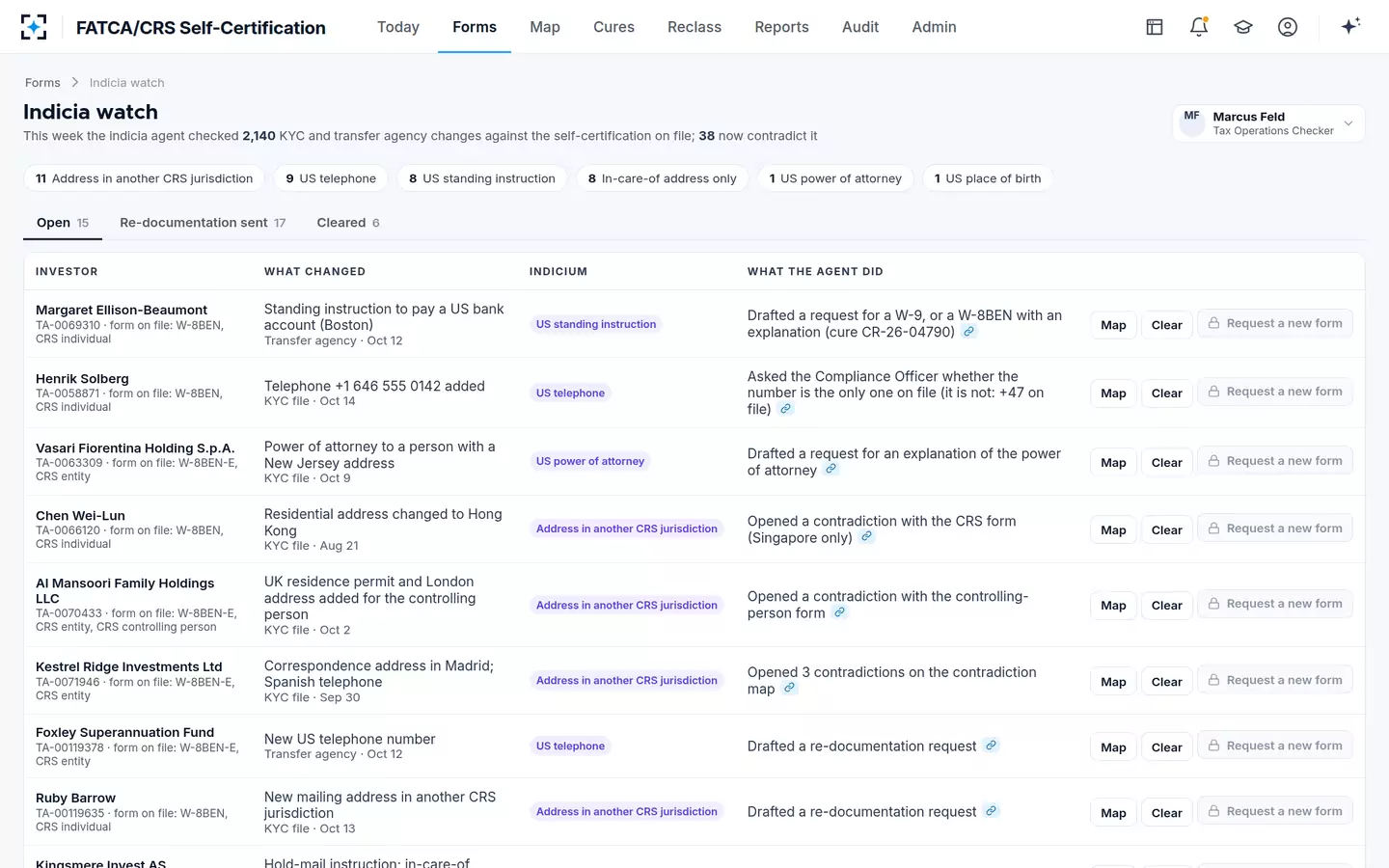
At the sample manager, a fictional investor with a Norwegian number on file added a New York number, +1 646, in October. The indicia agent did not send a letter. It asked the compliance officer whether the new number was the only one on file; it was not, because the +47 number was still there. The ADGM regulator's guide lists "Investigation of any telephone numbers associated with the Account Holder" among the reasonableness checks (ADGM FSRA guide), and the right investigation sometimes ends in no action, recorded.
One week of KYC changes at the sample manager: 38 contradicted the form on file
What happens if the investor never responds?
The fund stops relying on the old status and reports on what it knows. For a CRS self-certification, HMRC says that if neither a confirmation nor a new form arrives within 90 days, the institution "must treat the Account Holder as resident of the jurisdiction in which the Account Holder claimed to be resident in the original self-certification and the jurisdiction in which s/he may be resident as a result of the change in circumstances" (HMRC IEIM403180). For pre-existing accounts with indicia, the account "should be treated as reportable 90 days after initiating contact" (HMRC IEIM402880).
From 2026 the silence is also visible to the receiving tax authority. Reports for calendar year 2026 onwards carry an indicator of whether a valid self-certification is held, and an account whose form became unreliable and was never replaced is reported as "false" (HMRC IEIM402182). A fund with many falses has an explanation to give. Penalties in some jurisdictions now attach to the investor as well as the institution, which is set out in FATCA and CRS penalties.
Beyond reporting, the fallback is a business decision. In the solution's sample settings the agents propose one before day 90, such as reporting on the information on file and holding new subscriptions, and the head of fund tax decides; the agents never apply a fallback themselves.
Catching the change the day it happens
The control that makes the 90 days usable is a link from every KYC and transfer agency change to the self-certification it might contradict. Without it, the clock starts on the day someone happens to notice, often during the pre-reporting clean-up, by which time the 90 days have run and the fund is reporting on the old status with reason to know it is wrong.
From a keyed change to a cure letter, with people at the decisions
Agent
Indicia agentReads every KYC and transfer agency change and tests it against the self-certification and W-8 on file.
Never: Clears an indicium
Agent
Cross-check agentOpens a contradiction on the investor’s map, with the change, its source and the form line it contradicts.
Never: Decides which document is right
A person decides
Tax operations checkerClears an indicium that has an explanation on file, or confirms that the change needs a new form; compliance clears AML-relevant ones.
Agent
Cure agentDrafts one re-documentation letter per investor, in English and the investor’s language, and starts the 90-day clock.
Never: Sends without the checker’s approval
A person decides
Investor services managerOwns the clocks, the reminders and the escalation on day 80; the head of fund tax decides the day-90 fallback.
FATCA/CRS Self-Certification's indicia agent runs that link: it checks every KYC and transfer agency change for US and CRS indicia against the self-certification on file, address, telephone, standing instructions, power of attorney, in-care-of address and place of birth, and drafts the re-documentation request. It never clears an indicium; a checker does.
Indicia watch: what changed, the indicium it raises, and what the agent did
No cure clock runs out without a decision
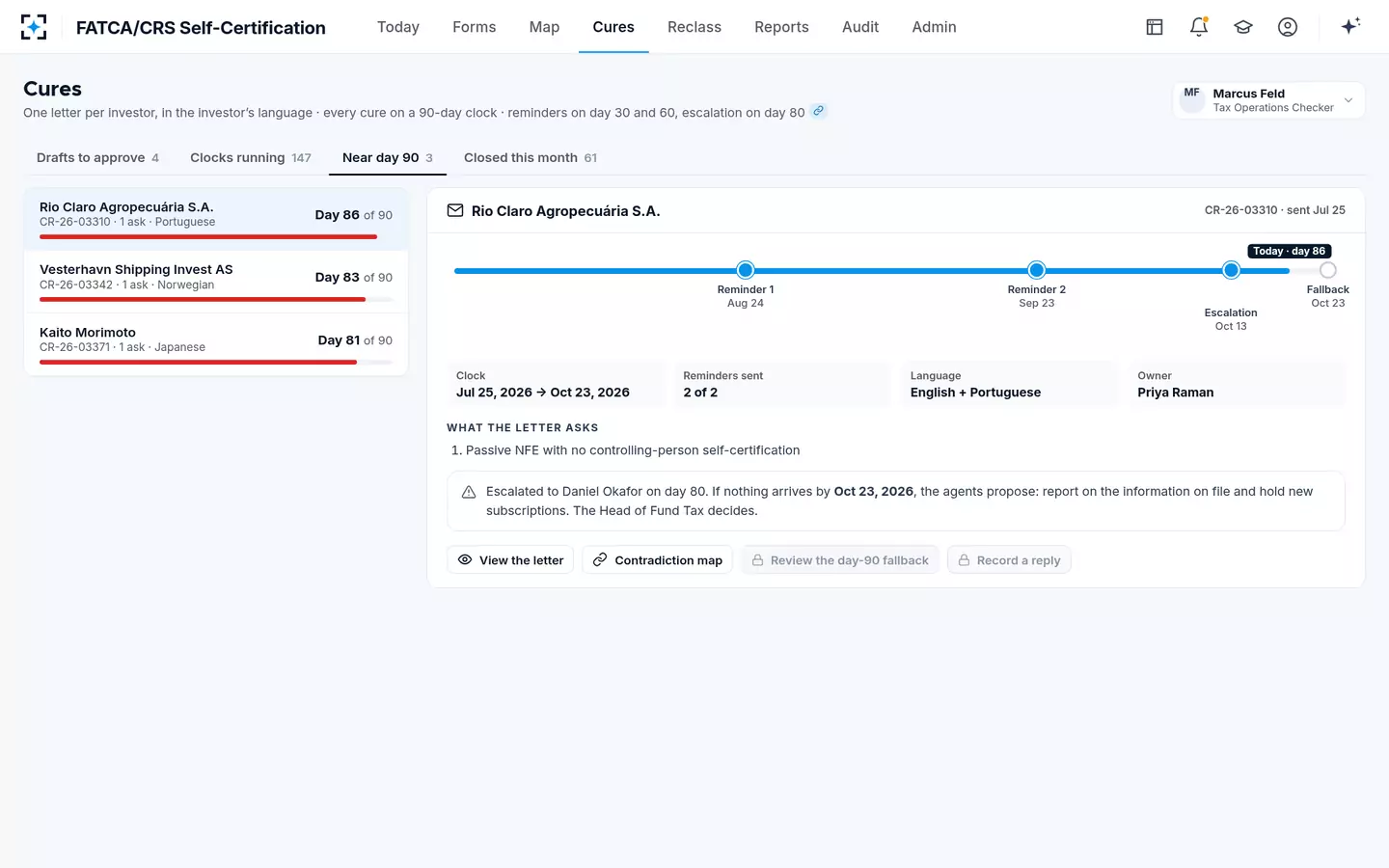
The clock also explains why the solution reads the form and the file together from the start: a contradiction found at intake is a cure with 90 days to run, and one found in May is a report filed on a form the fund had reason to doubt. The fields that make a form valid in the first place are annotated in the self-certification form, read field by field; the watch itself is part of FATCA/CRS Self-Certification.
Questions people ask
Does a US place of birth make an investor a US person?
Not by itself, but it makes a W-8 unreliable until it is cured. The cure is evidence of another citizenship plus a Certificate of Loss of Nationality or a reasonable written explanation of why the person renounced, or never obtained, US citizenship.
Is an in-care-of address an indicium?
For the CRS, HMRC lists a hold-mail instruction or in-care-of address as its own indicium in the electronic record search for lower-value pre-existing accounts, and the solution's sample watch flags in-care-of-only addresses. Whether it needs a new form depends on whether it is the only address on file.
Do indicia apply to entity investors?
Yes, with entity-specific cures. Under the FATCA regulation, a withholding agent may treat an entity with US indicia as foreign if it holds documentation substantiating that the entity is organised under foreign law, unless it knows or has reason to know the entity is a flow-through entity.
Can a fund ask for a new form even without a change?
Yes. The FATCA regulation says a withholding agent may require a new certificate or more documentation at any time before a payment, whether or not it knows of a change. Many funds refresh forms on a cycle for that reason.
Does a new controlling person count as a change in circumstances?
Yes. HMRC's definition includes any addition or substitution affecting an account holder's status, and the ADGM regulator found a fund's reporting incomplete in 2025 when a passive NFE's new controlling person, resident in Algeria, was not reported.
Does the 90-day window restart if the investor sends a defective new form?
Not under the rules quoted here. The window ends at the earlier of 90 days or receipt of a valid new form or confirmation, so an invalid replacement leaves the original clock running, which is why the solution's sample letter asks for every missing item at once.