FATCA CRS software covers three jobs that are often sold as one: collecting self-certifications and W-8 or W-9 forms from investors, checking those forms and the KYC file for validity and reasonableness, and generating, validating and filing the FATCA and CRS reports. Reporting software is built around the third job. A reporting engine turns the reportable accounts it receives into schema-valid files on time; what it cannot do is notice that the classification it was given contradicts the investor's other form, because the forms are not in it. That upstream gap is where the 2025 penalty decisions sit. Botminds' FATCA/CRS Self-Certification is built for that gap: it reads forms and KYC changes from the systems that already hold them and writes approved cures and classifications back, leaving the transfer agency system and the reporting engine in place.
Product examples come from the solution's sample data on a fictional fund manager, Quillfield Capital. The rules quoted are the regulators' own and are linked where they appear.
Six systems stay where they are; the agents sit between them and people approve what goes back
Investor portal
What the agents readForms uploaded by investors and intermediaries
What goes backCure letters, sent only after a checker approves
What it keepsThe investor relationship
Email, scans, document management
What the agents readForms from managers and intermediaries; originals and versions
What goes backNothing deleted: every version kept
What it keepsThe document of record
Transfer agency system
What the agents readAccounts, holdings, current classifications, account changes
What goes backClassifications and cures, written back only after people approve
What it keepsThe register
KYC file
What the agents readProfiles, addresses, owners, signatory lists, the change feed
What goes backQuestions and AML-relevant indicia for compliance to clear
What it keepsIdentity and ownership
IRS FFI list
What the agents readThe monthly file of GIINs and names
What goes backNothing
What it keepsRegistration status
Tax reporting engine
What the agents readReportable accounts and the FATCA and CRS schemas
What goes backBlocked accounts, each with the cure that unblocks it
What it keepsThe return and the filing
What does FATCA CRS software do?
At the reporting end, it produces the files the authorities accept. For FATCA that is Form 8966 for institutions filing with the IRS, which a financial institution "is required to file ... electronically, irrespective of the number of Forms 8966 filed" unless it has a waiver (IRS, Instructions for Form 8966), and in intergovernmental-agreement countries a FATCA file to the local authority. For the CRS it is an XML return in each jurisdiction's schema; for the 2026 calendar year the Cayman authority's guide requires the OECD's CRS XML Schema version 3.0 (Cayman DITC, Amended CRS Quick Guide). Good reporting software tracks those schemas, validates the file and keeps the filing history.
Before that, someone must decide which accounts are reportable, to where, with which TINs and controlling persons. That decision rests on the forms, and from the 2026 reporting year it has to be stated in the return itself: HMRC's list of new CRS fields includes an indicator of whether the institution obtained a valid self-certification for the account (HMRC IEIM400580). Software that generates the return from the register will faithfully report whatever the register says about each form. The question a buyer has to answer is where the judgement about each form is made, and by whom.
Does reporting software also validate forms?
It validates the report, not the forms behind it. Schema validation checks that a field is present and in the right format; form validation checks that the value is true for this investor. A return can pass every schema rule while reporting a passive NFE's controlling persons as none, because the classification on the register said "active".
A reporting engine and a form validation layer answer different questions
Reporting engine: Reportable accounts from the register
Form validation layer: W-9s, W-8s, CRS forms, the KYC file and its change feed
Reporting engine: The file against the FATCA or CRS schema; totals; filing status
Form validation layer: Each form against its own rules, against the other forms and against the file
Reporting engine: A missing TIN field, a malformed date, a wrong country code
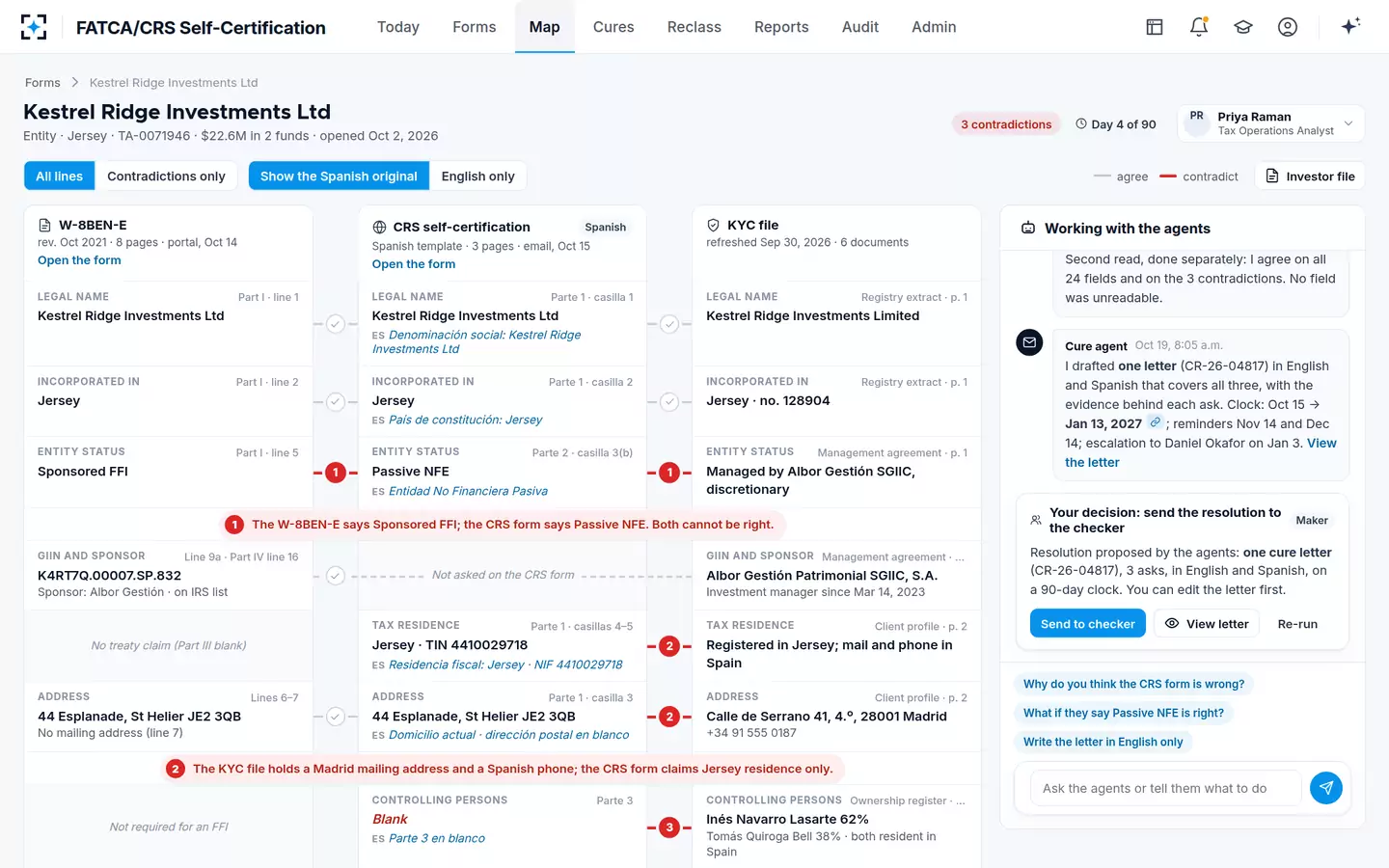
Form validation layer: Sponsored FFI on one form and passive NFE on the other; a residence the KYC addresses contradict
Reporting engine: The return, filed
Form validation layer: Cures sent, classifications approved, accounts unblocked before the return is built
Reporting engine: Fund tax reporting
Form validation layer: Tax operations, investor services and compliance
Some reporting products add form checks; ask which of the twenty errors in the planted-errors test they catch, and especially the six that need a second document. A product that checks each form alone will pass the pairing the ADGM regulator penalised in October 2025, because each of those two forms was complete on its own.
Do we need to replace our transfer agency system?
No, and it is rarely wise to try in order to fix tax forms. The transfer agency system is the register: accounts, holdings, dealing and the classification each account is reported under. It already holds most of what a form check needs, and its classifications feed the reporting engine. Replacing it to improve form validation trades a contained problem for a migration that touches every investor.
What the register does not do well is read documents and compare them. It stores the classification someone keyed, not the reasoning, and it usually does not hold the W-8BEN-E, the CRS form in its original language and the management agreement side by side. That is the work to add next to it. The register stays the system of record; the validation layer proposes changes to it, and a person approves them.
Where do the forms and KYC data come from?
From wherever they arrive today, which in most fund groups is four or five places. Investors upload forms to a portal; intermediaries and managers email them; paper still arrives and is scanned into document management; the transfer agency system holds the account and its changes; and the KYC file, often owned by another team, holds addresses, owners, signatories and the change feed. The intake step has to take all of them, match each form to its account and keep every version.
One external source is needed too: the IRS FFI list, which the IRS publishes monthly and lets users download in full (IRS Publication 5147; IRS FFI list tool). In the solution's sample settings the intake agent takes forms from the portal, the transfer agency system, email and scans, identifies the form and revision, matches it to the account and asks for a rescan when a page cannot be read; it never guesses an account and never deletes a version.
The forms, the KYC file and the reasons, side by side for one investor
How do we feed changes back to the register?
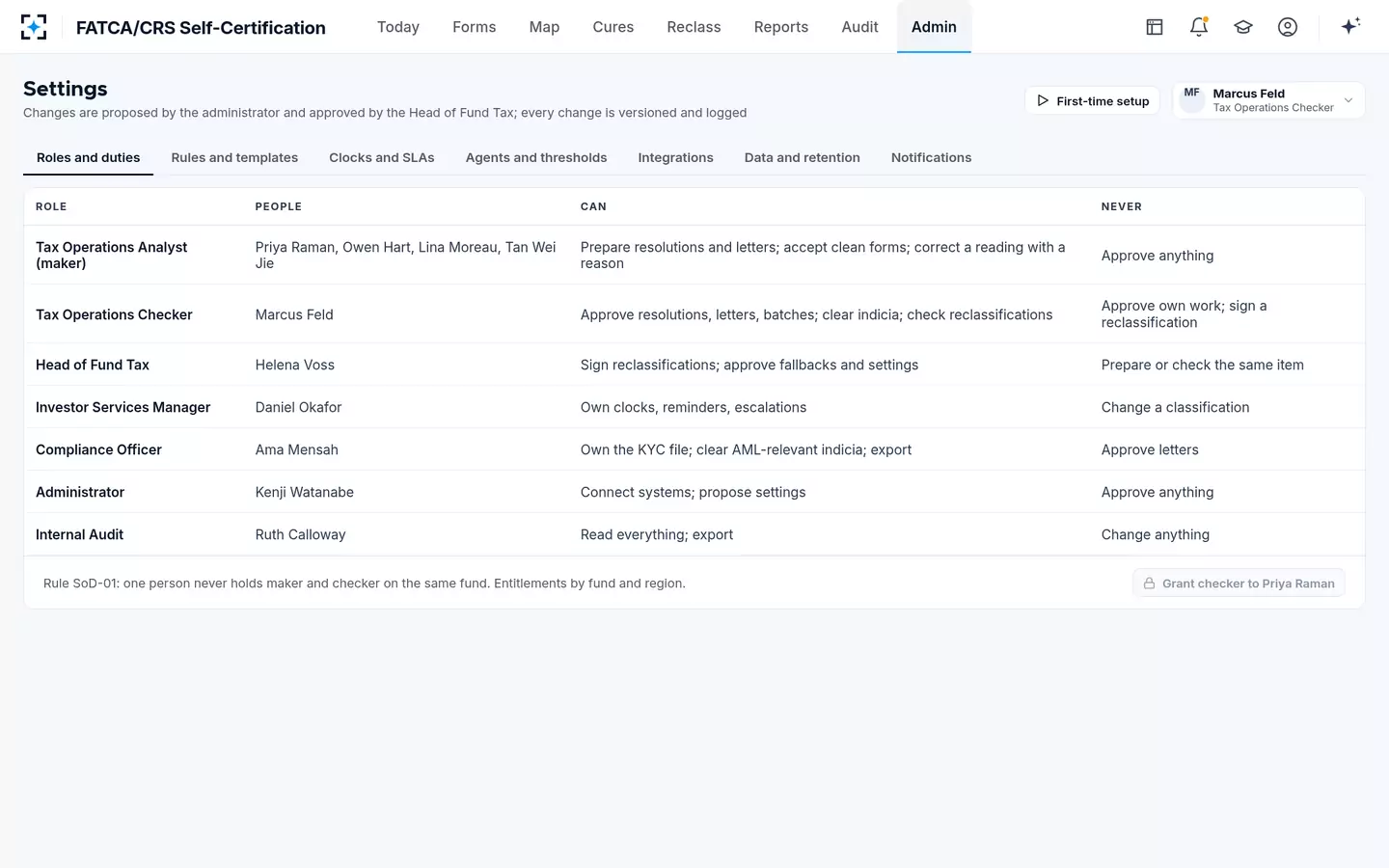
Only after people approve them, and with the reason attached. In FATCA/CRS Self-Certification the transfer agency system receives classifications and cure outcomes "written back only after a person approves", the investor portal sends letters only after a checker approves, and a classification changes only when the analyst has prepared it, the checker has checked it and the head of fund tax has signed it, with the reason and what changes in FATCA and CRS reporting. The agents never change a classification themselves.
The write-back is where regulators' expectations land. HMRC expects an institution that cannot rely on a form either to obtain a new one or to keep "a copy or a notation" of the explanation and documentation that supports the original (HMRC IEIM403180), and the ADGM regulator's guide expects records that can be checked or audited (ADGM FSRA guide). A write-back that changes a code in the register without the evidence travelling with it leaves the next reviewer with a classification and no reason.
What does go-live look like?
Three things are set before anything runs: your policy, your roles and your systems. The policy is a set of settings, not code: the rule library (in the sample, IRS forms and instructions, the OECD CRS with the 2026 amendments and 48 local CRS templates), the cure clock and its reminders, the escalation day, who decides the day-90 fallback, review times, the second-read threshold, override reason codes and retention. Each is proposed by the administrator, approved by the head of fund tax, versioned and logged.
Then a pilot on the past. Before launch, the agents check 500 forms you have already accepted, so the team sees what they would have found on its own investors, and the head of fund tax can compare that with what the last review found. Timing matters more than speed: going live before the 90-day cure windows for the next filing dates close is what turns findings into cures rather than into flags in a return, which is the arithmetic in the CRS reporting season.
Who owns what when the agents go live
Today
Owns the policy as a document and finds out about blockers weeks before the deadline.
With agents
Approves every setting, signs every reclassification and decides every day-90 fallback.
Still theirs: The policy and the filing
Today
Weighs replacing the transfer agency or reporting system to fix the forms.
With agents
Keeps both, and adds a layer that reads forms and proposes changes to them.
Still theirs: The system landscape
Today
Tracks reminders and windows in a spreadsheet or the CRM.
With agents
Owns the cure clocks, reminders and escalations in one place.
Still theirs: The investor contact
Today
Answers an examiner from forms and decisions kept in different systems.
With agents
Owns the KYC file, clears AML-relevant indicia and exports any investor’s full record.
Still theirs: The KYC file
Today
Maintain interfaces and sample the work after the fact.
With agents
Connect the systems and propose settings; internal audit reads everything and changes nothing.
Still theirs: Access and assurance
Roles and duties are settings: who can prepare, approve, sign and export
Questions to ask before you buy FATCA CRS software
Ask for answers on your own forms, not on a vendor's sample file. The questions below separate a reporting engine, a form checker and a cross-check layer, and they are worth asking of every product, this one included.
Ten questions for any FATCA CRS software, and what a good answer sounds like
| Question | A good answer |
|---|---|
| Which of our systems does it read, and which does it write to? | Reads the portal, mailboxes, scans, the register and the KYC file; writes only approved changes |
| Does it compare the W-8 or W-9 with the CRS form and the KYC file? | Yes, field by field, with each contradiction explained and cited |
| Which of the twenty planted errors did it catch on our forms? | All six cross-document errors, with the right reason |
| Can it read our local CRS templates in their languages? | Yes, with the original beside the translation on file |
| What does it do with a field it cannot read? | Sends it to a person; never fills it |
| Who can change a classification? | People only, with maker, checker and a signature, and the reason kept |
| How does it handle a change in circumstances? | Checks every KYC and register change against the form on file and starts a dated clock |
| Does it produce the new amended-CRS fields? | It knows which accounts lack a valid self-certification, and the controlling-person roles, before the return is built |
| What evidence can we give an examiner? | One export per investor: forms, readings, contradictions, letters, decisions |
| Where is investor data kept, and is it used to train models? | In the region you choose; never used for training |
Where FATCA/CRS Self-Certification fits, and where it does not
It fits between the register and the reporting engine, for fund groups whose investors are many, international and often entities: where forms arrive in several languages through several channels, where entity classifications need the management agreement to settle, and where the KYC file sits in another team's system. Its seven agents read, check and cross-examine every tax form; an analyst prepares, a checker approves, and the head of fund tax signs. Its reporting agent rehearses every FATCA and CRS report per reporting entity and jurisdiction, including the amended-CRS fields, and lists each blocked account with its cure.
It does not file. It does not replace the reporting engine, the transfer agency system or the KYC system. It gives no tax advice, and its agents never accept a form, choose a classification, send a letter, clear an indicium, apply a fallback or file a report. It does not replace the IRS's TIN matching for payors who file information returns, which the IRS describes as the way to match "TIN and name combinations with IRS records" (IRS, requester instructions). And its targets, no conflicting classification left on file and one letter per investor, are design targets to verify in a pilot, not results to assume.
For a buyer comparing options, the useful frame is cost of change against cost of error. The UK government estimated a one-off administrative cost to business of £107 million for the 2026 CRS changes, including new IT and software (HMRC, policy paper, 25 June 2025). The cost of error is per account and lands on every report that relies on a bad form, and from 2026 every report also says whether the form was valid (HMRC IEIM402182). A trace of one form through every step is in W-9 validation and W-8 checks, traced; to see the agents on a sample of forms you have already accepted, start from FATCA/CRS Self-Certification.
Questions people ask
Can we keep our current reporting provider?
Yes. The reporting engine keeps building and filing the returns; the solution sends it fewer blocked accounts and tells it which accounts lack a valid self-certification. In the sample, the reporting agent checks every report against the FATCA and amended CRS schemas but never files or edits one.
Does the solution file with the IRS or HMRC?
No. Filing stays with your reporting engine and the people who sign returns. The agents rehearse the reports and list each blocked account with the cure that unblocks it.
How are rule changes handled, such as the amended CRS?
As a versioned rule library, v2026.10 in the sample, covering IRS forms and instructions, the OECD CRS with the 2026 amendments and 48 local templates. A change to a rule or threshold is proposed by the administrator and waits for the head of fund tax's approval.
Does it handle W-8IMY withholding statements?
Yes. In the sample, a nominee's W-8IMY was flagged because its withholding statement allocated 96.4% of the account, leaving 3.6% with no beneficial owner. The flag goes to the analyst who owns the account.
Where is investor data kept?
In the sample configuration, EU investors' documents stay in the EU region, US documents in US East and APAC documents in Singapore; TINs and dates of birth are masked without the entitlement, and investor data is never used to train models.