A CRS self-certification form for an entity asks a company, partnership, trust or foundation to state its full name and address, every jurisdiction where it is resident for tax, a TIN for each, which kind of entity it is under the Common Reporting Standard, and, if it is a passive non-financial entity, who controls it. Most entity investors in a fund also sign a W-8BEN-E for the IRS, which states the same entity's FATCA status. The two forms are signed on different days, often by different people, and checked by most operations teams one at a time, so each can pass while together they say two incompatible things. Botminds' FATCA/CRS Self-Certification sets the CRS form, the W-8BEN-E and the KYC file side by side for every entity investor and marks each line where they disagree.
The examples use the solution's sample data: Kestrel Ridge Investments Ltd, a fictional Jersey company with $22.6 million in two funds of a fictional manager, Quillfield Capital. The penalty cases are real and are linked where they appear.
Most self-certification failures in four 2025 decisions needed a second document to see
Ousoul Assets Custodian · 6 findings
- Visible on the form · 50%
- Country TIN rules · 17%
- The other tax form · 33%
Investcorp Saudi Pre-IPO Growth Fund · 4
- Visible on the form · 75%
- Country TIN rules · 25%
Wahed Invest · 14
- Country TIN rules · 29%
- The KYC file · 71%
ADS Investment Solutions · 3
- Visible on the form · 33%
- The other tax form · 67%
All four · 27 findings
- Visible on the form · 26%
- Country TIN rules · 22%
- The KYC file · 37%
- The other tax form · 15%
Only about a quarter of the failures were visible on the form alone: a blank residence, an empty classification section, two boxes ticked. The other three quarters needed something else on the reviewer's desk: the country's TIN rules, the KYC file's addresses, or the investor's other tax form. A review that checks each form against its own rules catches the first group and passes the rest.
What does the CRS entity self-certification ask?
Five things, in roughly this order on most templates: who the entity is, where it is resident for tax and its TIN in each place, its CRS classification, its controlling persons if it is passive, and a signed declaration by someone authorised to give it. The ADGM regulator's guide lists the minimum for a new entity account as the entity name in full, an operational address with street, city and country, all jurisdictions of tax residence, a TIN for each reportable jurisdiction or the reason there is none, and the name, title or capacity and signature of the authorised signer, fully dated (ADGM FSRA guide).
The classification section is where an entity form does its real work. Templates usually offer financial institution, active NFE and passive NFE as separate boxes, sometimes with sub-boxes for an investment entity managed by another financial institution, and they send a passive NFE on to a controlling-person section. Kestrel Ridge's Spanish template, for example, asks for one box in "Parte 2 · Tipo de entidad", and its box 3(b), "Entidad No Financiera Pasiva", carries the instruction to complete Part 3. A form that ticks 3(b) and leaves Part 3 blank contradicts itself before anyone opens the W-8BEN-E. The fields themselves, one by one, are annotated in the self-certification form, read field by field.
Must the CRS form match the W-8BEN-E?
Not word for word, but the two must be consistent, and the institution may not rely on either while it holds information that contradicts it. The IRS's instructions to the people who receive W-8s put the standard plainly: "if you have information in your records that contradicts information provided on the form, you may not rely on the form" (IRS, Instructions for the Requester of Forms W-8). A CRS form on file is information in the fund's records. So is the W-8BEN-E when the fund is testing the CRS form.
The CRS side applies the same test in its own words. HMRC's manual says an institution has reason to know a self-certification is unreliable if it "has other account information that is inconsistent with the person's claim" (HMRC IEIM403180). The forms ask different questions, so they will not match line for line; where they ask the same question, about name, address, residence and what kind of entity this is, the answers must agree or be explained.
Five lines where an entity's W-8BEN-E and its CRS form must agree
W-8BEN-E: Part I, line 1: the entity’s name (the owner’s name, for a disregarded entity)
CRS entity self-certification: Legal name in full, matching the registry extract
W-8BEN-E: Line 2 country of incorporation; line 6 permanent residence address; line 7 mailing address
CRS entity self-certification: Operational address, and every jurisdiction of tax residence
W-8BEN-E: Line 5 chapter 4 status, e.g. sponsored FFI, active NFFE, passive NFFE
CRS entity self-certification: Financial institution, active NFE or passive NFE
W-8BEN-E: Part IV sponsor’s name for a sponsored FFI; Part XXIX substantial US owners of a passive NFFE
CRS entity self-certification: Controlling persons of a passive NFE, each with residence and TIN
W-8BEN-E: Part XXX: authorised representative, with the capacity box checked
CRS entity self-certification: Authorised signer’s name, title or capacity, signature, date
What if the entity is Passive NFE on one and Sponsored FFI on the other?
Then one of the forms is wrong, and the fund cannot rely on either until the investor fixes it or explains it. "Sponsored FFI" on line 5 of a W-8BEN-E says the entity is a foreign financial institution whose FATCA obligations a sponsoring entity has agreed to carry; under the CRS, that is a financial institution, often an investment entity managed by its sponsor. "Passive NFE" on a CRS form says the entity is not a financial institution at all. Both cannot be true of the same company on the same day.
This is the pairing the Abu Dhabi Global Market's regulator penalised in October 2025. One of ADS Investment Solutions' clients had classified itself as a passive NFE on its CRS self-certification and as a sponsored FFI on its W-8BEN-E, and the decision records what followed:
"No evidence on file to reconcile the two different classifications was provided during the Review. Accordingly, the FSRA considers that ADS failed to validate the Self-Certification and confirm its reasonableness by reference to other information it held."ADGM Financial Services Regulatory Authority, decision on ADS Investment Solutions Limited, 3 October 2025 (decision PDF)
The firm's appeal is as instructive as the finding. It said the inconsistency came from "an internal oversight during the onboarding process", that the account was never used for investment and had been closed, and that nothing inaccurate was ever reported. The regulator noted the mitigation and kept the penalty for this client on both the CRS and the FATCA counts: it is the institution's responsibility "to ensure that self-certifications are valid and to confirm its reasonableness, to ensure that correct information is reported." A contradiction is a failure when it sits on file, not when it causes a wrong report. The ADGM regulator found the mirror image too: in June 2025 an Ousoul Assets Custodian client was an investment entity on its CRS form and a passive NFE on its FATCA form (ADGM FSRA, OAC notice).
Which form is right depends on the management agreement. If a financial institution manages the entity's assets with discretion, the entity is an investment entity under the CRS, and the W-8BEN-E's sponsored FFI status can stand; the CRS form must be corrected. If nobody does, the CRS form may be right, and then the W-8BEN-E is the wrong form: the entity is a passive NFFE for FATCA, needs a new W-8BEN-E, and must provide its controlling persons. The test that decides it is laid out in passive NFE vs active NFE.
The contradiction map: three documents, three red lines
What a sponsored FFI's W-8BEN-E must carry before the fund relies on it
A sponsored FFI claim is only as good as the sponsor behind it, and the form shows the sponsor in two places. Part IV, line 16, must give "the name of the sponsoring entity that has agreed to fulfill the due diligence, reporting, and withholding obligations" for the entity, and the instructions add: "You must provide your GIIN on line 9" (IRS, W-8BEN-E instructions, Part IV). A sponsored FFI with no sponsor named, or no GIIN, has not completed the certification its line 5 box requires, and the IRS treats a missing required certification as more than an inconsequential error.
The GIIN is the second place to look. It must be on the current IRS FFI list under a name reasonably similar to the form's, and for a sponsored entity the IRS's composition rules tie the number to its sponsor, so the lookup can confirm both that the entity is registered and that it is registered as the sponsor's. What the lookup can and cannot prove is in GIIN lookup: what the IRS FFI list proves.
The sponsor relationship is also evidence for the CRS form. A sponsor that has agreed to carry an entity's FATCA obligations is often the financial institution that manages it, which is the fact that makes the entity an investment entity under the CRS. A management agreement naming that sponsor with discretion over the assets is therefore the single document most likely to settle a sponsored-FFI-versus-passive-NFE conflict.
Which address and residence should match the KYC file?
The residence the investor certifies should be consistent with the addresses, telephone numbers and documents the fund already holds, and the KYC file usually holds more of them than either tax form. The ADGM guide's own example is an account holder certifying UAE tax residence while the institution's AML/KYC procedures captured a residence address in Spain: "Due to the inconsistent information ... the SCF fails to meet the reasonableness test" until the investor provides a new form or a reasonable explanation with supporting documents (ADGM FSRA guide). Wahed Invest's 2025 decision applied that logic to ten investors who certified UAE residence while their files held home addresses in other countries, from Kyrgyzstan and Nigeria to Singapore and Hong Kong. What the KYC side of that file holds, and who keeps it, is set out in investor KYC for funds.
For an entity, three addresses matter: where it is incorporated, where it is managed and where its mail goes. A Jersey company whose correspondence address is in Madrid and whose telephone number is Spanish may well be resident only in Jersey, with Madrid the office of its manager. But the fund cannot assume so. The W-8BEN-E has its own rule for treaty claims: a mailing address outside the treaty country makes the claim unreliable unless the fund has documentary evidence or a written statement supporting it (26 CFR 1.1441-7(b)(6)). The CRS equivalent is the reasonableness test, and the answer in both cases is a written explanation, kept on file.
Who resolves a contradiction, the investor or the institution?
Both, in different roles. Only the investor can correct its own self-certification, because the form is its declaration; the institution decides whether what comes back is enough to rely on. HMRC's manual sets the two exits: the institution must obtain either "a valid self-certification that establishes the residence(s) for tax purposes of the Account Holder", or "a reasonable explanation and documentation (as appropriate) supporting the validity of the original self-certification", and retain a copy or a note of it (HMRC IEIM403180).
What the institution may not do is pick the answer it prefers and move on. Re-keying the classification in the transfer agency system to match the W-8BEN-E leaves a CRS form on file that says the opposite, which is exactly the record the ADGM regulator found. The institution also inherits what its service providers know: HMRC says a fund that relies on a service provider to review and maintain self-certifications "is considered to know or have reason to know the facts within the knowledge of the service provider", so delegating the review to an administrator does not delegate the contradiction.
What evidence closes the contradiction?
Evidence that makes one reading right and is kept where an examiner will find it. The checklist below is ordered from the strongest to the weakest closing evidence for the classification conflicts that come up most often.
What can close a classification or residence contradiction, and what cannot
- A corrected self-certification, signed by an authorised person
The cleanest fix: the investor replaces the wrong form, and the new one agrees with the other form and the file.
- A new W-8BEN-E, if the CRS form was the right one
A passive NFE is a passive NFFE for FATCA, not a sponsored FFI, so the W-8BEN-E must change and the controlling persons must be documented.
- The management agreement or the manager’s licence
It settles the managed-by question: discretion held by a financial institution makes the entity an investment entity.
- A controlling-person self-certification for each owner
Needed if the entity is passive; the CRS allows the fund to rely on one from the account holder or from the controlling person.
- A written explanation with documents, for an address or phone elsewhere
For example, a statement that the Madrid address is the manager’s office, with the management agreement behind it.
- A note on file linking the earlier form
The ADGM regulator called this best practice where a valid earlier form existed; it is housekeeping, not a cure.
- Not enough: an internal note that the team “checked”
It records a belief, not a reconciliation; ADS’s file showed no evidence reconciling the two classifications.
One investor, three contradictions, one letter
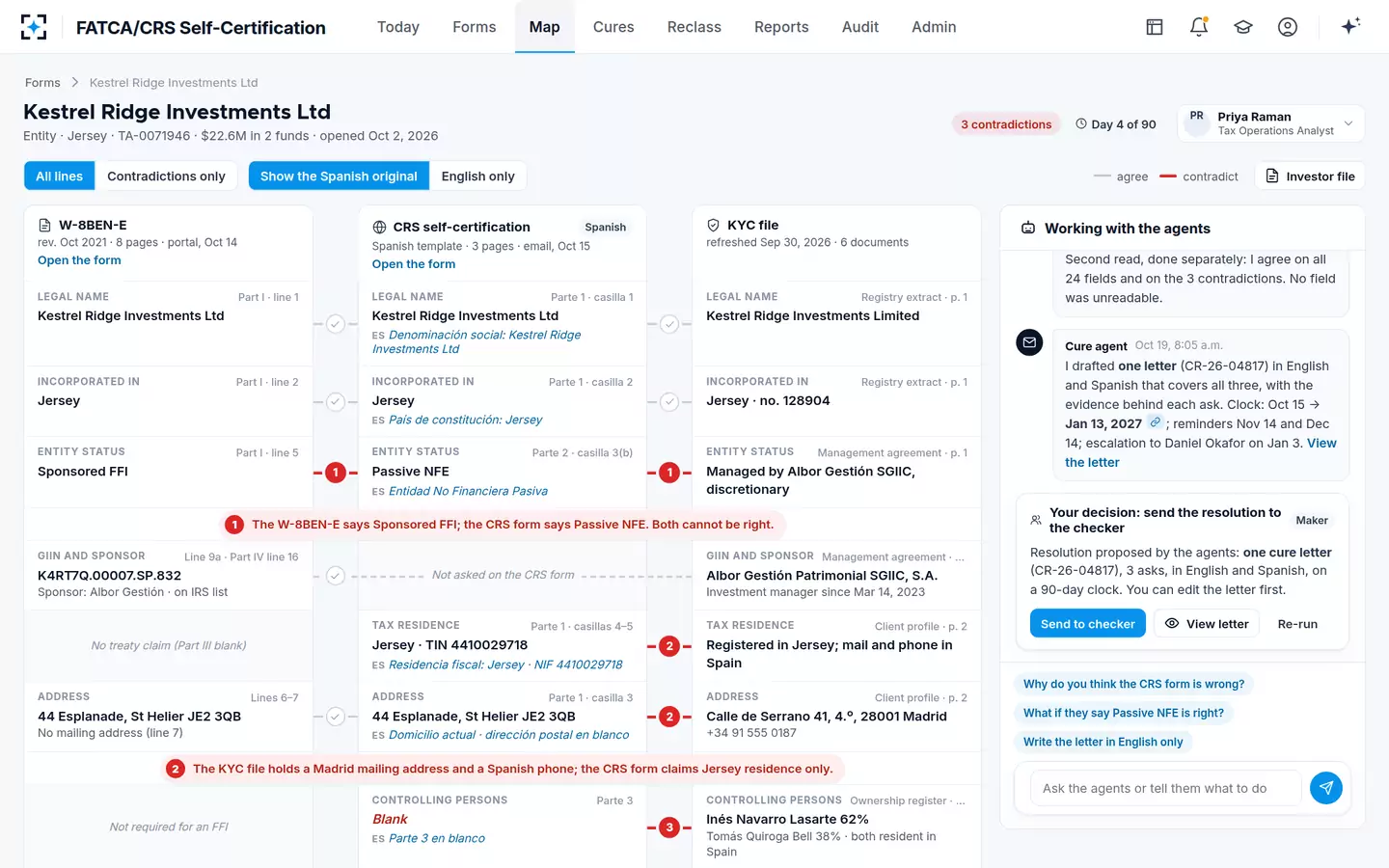
Run through FATCA/CRS Self-Certification, the sample investor shows what the map is for. Kestrel Ridge's W-8BEN-E arrived through the investor portal on 14 October and its Spanish CRS form by email the next day. Each passed its own rules: the GIIN was on the IRS FFI list and the Jersey TIN had the right shape. The cross-check found three contradictions. The W-8BEN-E said sponsored FFI and the CRS form said passive NFE. The KYC file held a Madrid mailing address and a Spanish phone while the CRS form claimed Jersey residence only. And Part 3 of the CRS form was blank although the ownership register named two owners resident in Spain.
Asked why it thought the CRS form was the wrong one, the cross-check agent gave three cited reasons: the management agreement gives a fund manager full discretion over the company's assets, which makes it an investment entity under the CRS; the W-8BEN-E says the same in FATCA terms; and a passive NFE cannot leave Part 3 blank. Then it stopped: "I cannot decide which form is right: the investor must cure."
One letter, three asks, in English and Spanish
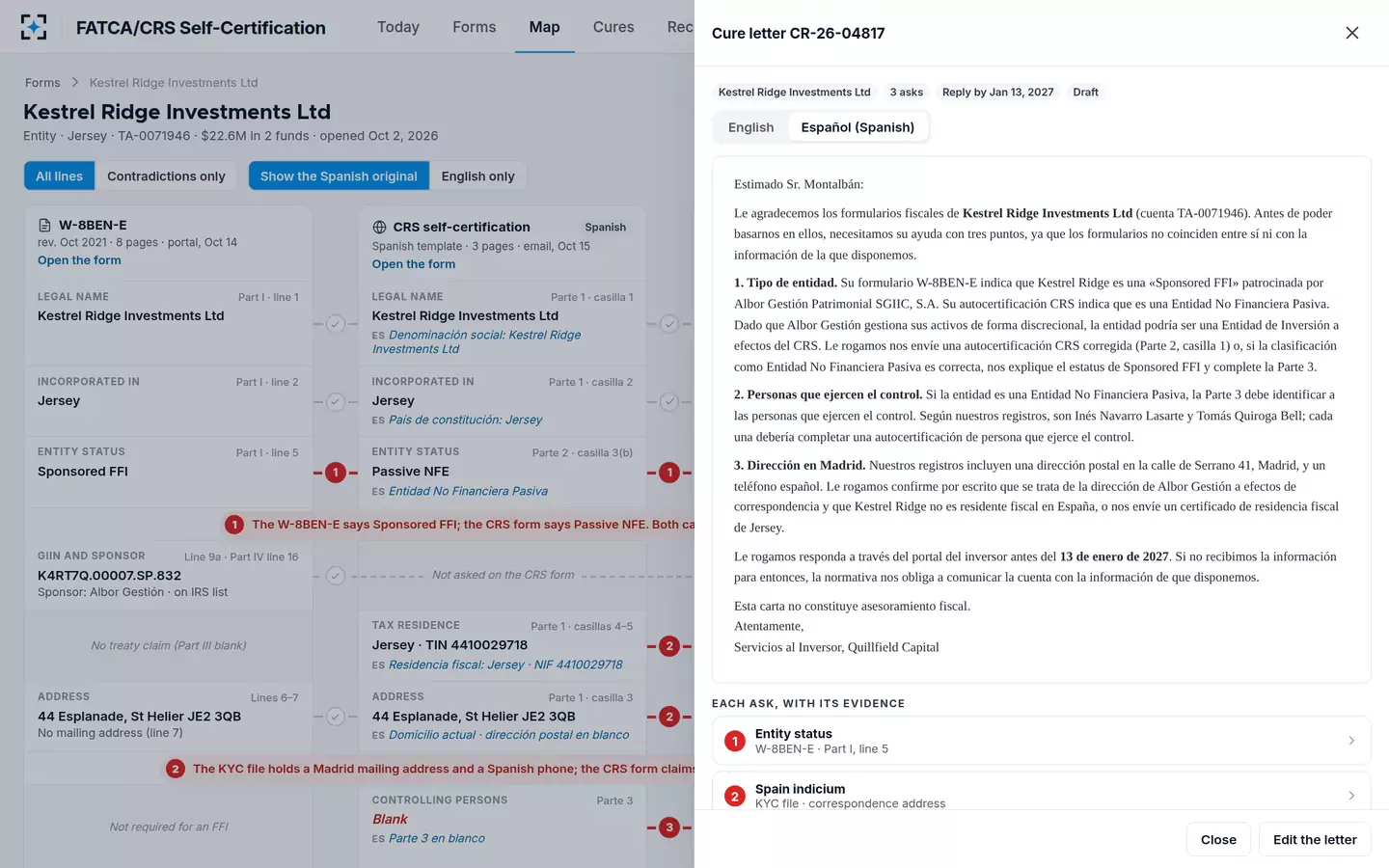
The letter asks for a corrected CRS form or, if passive NFE is right, a new W-8BEN-E and controlling-person self-certifications for both owners, plus confirmation of the Madrid address. Its 90-day clock runs from 15 October to 13 January, with reminders on 14 November and 14 December and an escalation to the investor services manager on 3 January. If nothing arrives, the agents propose a fallback and the head of fund tax decides. The design target behind it is one letter per investor instead of one request per defective form, and no conflicting classification left on file. What an unreconciled pair costs when a regulator counts is set out in FATCA and CRS penalties. The map itself is the centre of FATCA/CRS Self-Certification.
Questions people ask
Can one combined form serve for both CRS and FATCA?
In jurisdictions that implement FATCA through an intergovernmental agreement, often yes. The ADGM regulator's guide says a FATCA self-certification must let the institution determine whether the account holder is a US tax resident, and the IRS accepts alternative certifications under an applicable IGA. Many fund investors still provide a W-8BEN-E, which creates the second form that must agree with the first.
Do controlling persons have to sign their own forms?
Not necessarily. HMRC says that, to decide whether a controlling person of a passive NFE is reportable, the institution may rely on a self-certification from either the entity or the controlling person. It may not rely on the KYC file alone for the controlling person's tax residence.
Is a contradiction a breach if nothing wrong was reported?
The ADGM regulator treated it as one. ADS argued that the account was never used for investment and that no inaccurate information reached any authority; the regulator kept the penalty, saying the institution must ensure self-certifications are valid and reasonable so that correct information is reported.
What if the investor never answers the cure letter?
The fund may keep the earlier status for at most 90 days after the form became unreliable. After that, under HMRC's guidance, it must treat the account holder as resident both where the original form said and where the new information points, and from 2026 it reports that no valid self-certification is held.
Should the analyst correct the classification in the system to match one form?
No. A classification keyed to match the W-8BEN-E leaves a CRS form on file that says the opposite. The fix is a corrected form or a documented explanation; any change to the classification should follow from that evidence and be approved by someone other than the person who prepared it.