The CRS reporting deadline is set by each participating jurisdiction for the institutions resident there, so a fund group reporting from several places has several: in the UK it is 31 May, in Ireland 30 June, and in the Cayman Islands 31 July in 2026 and 30 June in 2027 for the first year of the amended standard. FATCA adds its own date, 31 March for institutions that file Form 8966 with the IRS directly, while institutions in intergovernmental-agreement countries report FATCA accounts to their own authority, usually on the CRS date. The filing itself is rarely what runs late. What runs late is the cure work behind it: the missing TINs, controlling-person forms and contradictions that must be resolved with investors before the data is right. Botminds' FATCA/CRS Self-Certification exists to move that work out of the weeks before the deadline: it rehearses every report early and lists each blocked account with the cure that unblocks it.
The sample figures come from the solution's sample data on a fictional fund manager, Quillfield Capital. Each deadline is the authority's own published date, with the day it was read; check it again before relying on it, because dates move.
The 2027 filing calendar for calendar year 2026, and the last day a 90-day cure can start
- IRS Form 8966, by 31 Mar31 Mar
- HMRC, FATCA and CRS, by 31 May31 May
- Irish Revenue; Cayman DITC, by 30 Jun30 Jun
- Revenue exchanges onward by 30 Sep30 Sep
- For 31 Mar: by 31 Dec 202631 Dec
- For 31 May: by 2 Mar2 Mar
- For 30 Jun: by 1 Apr1 Apr
- Exchange season
When is the CRS reporting deadline?
Whenever the jurisdiction where the reporting institution is resident says. The CRS is an international standard implemented by national law, and each authority chooses its own filing date, then exchanges the data with its partners later in the year. The dates below are the confirmed ones for the places a fund's investor-facing entities most often sit; a fund group with entities elsewhere needs each authority's own page, not a summary.
Confirmed FATCA and CRS dates, from each authority's own page
| Authority | What is due | Date | Source and status |
|---|---|---|---|
| IRS (United States) | Form 8966, FATCA report, for institutions filing with the IRS | 31 March of the following year; automatic 90-day extension on Form 8809-I | Instructions for Form 8966 |
| HMRC (United Kingdom) | FATCA and CRS returns | 31 May following the calendar year | IEIM400520, IEIM400580; manual updated 15 October 2026 |
| Irish Revenue | CRS and DAC2 return | 30 June each year; Revenue exchanges by 30 September | Revenue CRS and DAC2 page |
| Cayman DITC, 2026 (for 2025) | Notification; CRS and FATCA reporting; CRS Compliance Form | 30 April; 31 July; 15 September 2026 | DITC industry advisory, 2026 deadlines |
| Cayman DITC, 2027 (for 2026) | First amended-CRS returns, schema 3.0, with declaration and compliance form | 30 June 2027 | DITC Amended CRS Quick Guide, 8 December 2025 |
Two details trip teams up. The Cayman date for the first amended-CRS year, 30 June 2027 in the authority's quick guide, is a month earlier than the 31 July date used for 2025 data, so last year's calendar is wrong for next year's filing. And Ireland's onward exchange date, 30 September, is the date by which the partner jurisdiction receives the data, which is when a contradiction left on file becomes another tax authority's question.
When is the FATCA reporting deadline? Form 8966 and the IGA dates
For institutions that report to the IRS, "Form 8966 is required to be filed on or before March 31 of the year following the end of the calendar year for which the form is required to be filed" (IRS, Instructions for Form 8966). An automatic 90-day extension can be requested on Form 8809-I, no later than the due date, and the IRS may grant a second 90 days in hardship cases.
Most fund vehicles outside the US do not file Form 8966. In a country with a Model 1 intergovernmental agreement, reporting financial institutions send FATCA information to their own tax authority, which passes it to the IRS. HMRC's manual, for example, requires FATCA reporting "by 31 May next following the reporting year" (HMRC IEIM400520), the same date as the CRS, and Cayman set one reporting date for both regimes in 2026. A fund administrator with UK, Irish and Cayman vehicles therefore files FATCA three times on three local dates, not once on 31 March.
What changes with amended CRS in 2026–27?
The rules changed on 1 January 2026; the first returns showing it are filed in 2027. HMRC's manual says "The first reporting year for CRS2.0 is the calendar year 2026" (HMRC IEIM400580); the Cayman authority's guide says its amending regulations "will come into effect on 1 January 2026" and that "The first requirement to report will be in 2027 for the 2026 calendar year" (Cayman DITC, Amended CRS Quick Guide); and the EU brought the amended standard into law through DAC8, which Member States apply from 1 January 2026 (Directive (EU) 2023/2226).
The UK government's policy paper is a guide to the size of the change. It estimated a one-off administrative cost to business of £107 million, and said that about 6,000 UK reporting institutions, around 300 of them newly in scope, "will have additional due diligence to carry out and more information to report" (HMRC, policy paper, 25 June 2025). The same regulations created a duty on account holders to provide valid self-certifications and reformed the penalties, which is covered in FATCA and CRS penalties.
The first amended-CRS season, in four numbers
2026
first calendar year reported under the amended CRS in the UK, Cayman and the EU
30 Jun
2027: Cayman’s return date for that year, a month earlier than in 2026
£107m
one-off cost to UK businesses in the government’s estimate
6,000
UK reporting institutions with more due diligence and more to report
The new fields that first appear in 2027 returns, and where they come from
Five additions matter most to a fund. HMRC lists them for CRS2.0: whether the account is pre-existing or new; "whether a valid self-certification has been obtained"; whether it is a joint account and the number of holders; the type of financial account; and the roles a controlling person has in an entity account holder, or an equity interest holder in an investment entity (HMRC IEIM400580). For accounts opened before 2026, roles are needed for 2026 and 2027 only if they sit in the institution's electronically searchable data; from calendar year 2028 they are mandatory for every controlling person (HMRC IEIM402184).
Each field has a source in the investor file, and none of them is in the reporting engine. The self-certification indicator is a judgement about the form: HMRC says an account holder whose form became unreliable after a change in circumstances, or who never gave one, is reported as "false" (HMRC IEIM402182). The controlling-person role comes from the AML ownership file. The account type comes from the fund's product data. A reporting engine fed a register that does not hold these fields will fail validation or report blanks.
At the sample manager, a rehearsal run on reporting year 2026 shows the shape of the work. The reporting agent built all seven of the group's reports and checked them against the FATCA and amended CRS schemas: 43,772 reportable accounts, of which 42,371 passed and 1,401 were blocked. The blockers were 618 missing TINs, 271 missing controlling-person forms, 233 missing birth dates, 146 open cures and 133 controlling-person roles the amended CRS now requires. Every one of them is an investor letter, not a reporting-system fix.
When do cure letters need to go out?
Ninety days before the filing date, at the latest, if the answer is to be in the return. A change in circumstances gives the fund 90 days to obtain a new form, during which it may keep the old status; a new account opened without a form gets a similar window under the CRS. Count back from each filing date and the last safe day to send a letter is 31 December for a 31 March filing, 2 March for 31 May, and 1 April for 30 June.
The year end interacts with that count in a way HMRC spells out. If a change happens in August and the investor does not reply within 90 days, the account is reported for that year to both the old and the new country, flagged as lacking a valid self-certification. If the same change happens in November and the 90 days run past 31 December, the institution may rely on the prior status for that year's return (HMRC IEIM403180). Changes caught late in the year move into next year's season; changes caught in spring land in this one.
That is why the work of the season starts with the change, not with the return. A fund that only reviews forms in the six weeks before 31 May cannot finish a 90-day cure for anything it finds; it can only report on information it has reason to doubt. Catching the change when it is keyed in is the subject of the KYC change that sends a form back.
Who works the reporting season?
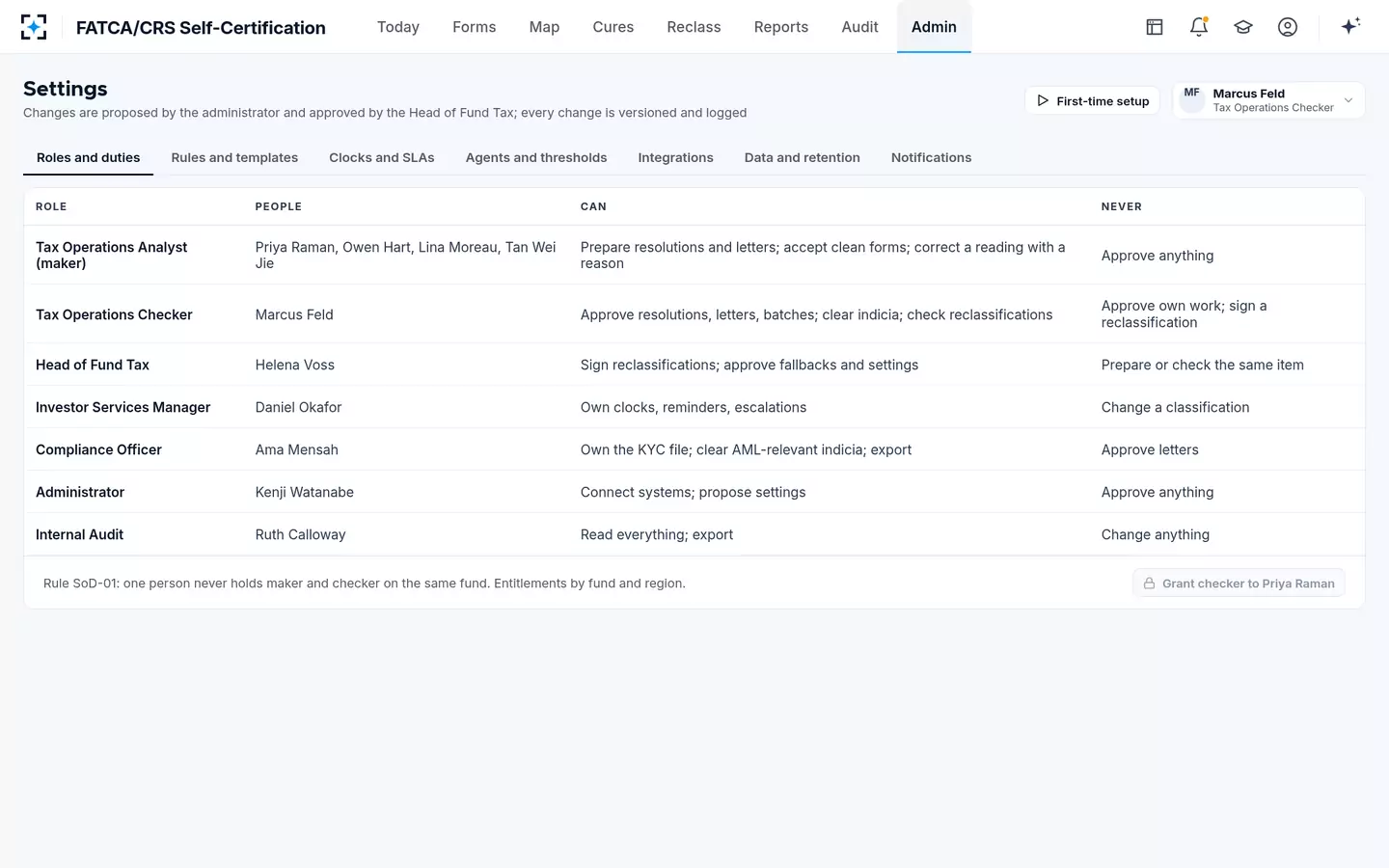
Five roles carry it in most fund groups, whatever the job titles: the analysts who review forms, a checker who approves, the head of fund tax who signs classifications and owns the filing, an investor services manager who owns the investor contact, and the compliance officer who owns the KYC file. The pressure falls differently on each.
The same season, seen by the five people who carry it
Today
Validates each form against its own rules, one at a time, and writes to the investor once per defective form; spring is a backlog.
With agents
Works a list of contradictions with their reasons and sources, and prepares one letter per investor.
Still theirs: Every resolution she prepares
Today
Reviews a sample of classifications keyed into the transfer agency system, without the other forms beside them.
With agents
Approves each resolution and letter seeing the source, the reason and who prepared it.
Still theirs: Approval, with a reason code
Today
Finds out about missing TINs and controlling persons as reporting errors weeks before the deadline.
With agents
Sees every report rehearsed months ahead, signs every reclassification and decides every day-90 fallback.
Still theirs: The filing and every classification change
Today
Tracks reminders and 90-day windows in a spreadsheet or the CRM.
With agents
Sees every clock with its reminders, escalation and proposed fallback.
Still theirs: The investor relationship and the clocks
Today
Answers an examiner about one investor from forms, letters and decisions kept in different systems.
With agents
Clears AML-relevant indicia and exports any investor’s full record from one audit trail.
Still theirs: The KYC file and the examiner
Who may prepare, approve, sign and export, and what each role can never do
Rehearsing the reports months early
A rehearsal is a full build of every report, validated against the schemas, run long before the filing date, so that every failure surfaces while there is still time for a 90-day cure. In FATCA/CRS Self-Certification the reporting agent dry-runs every FATCA and CRS report per reporting entity and jurisdiction, including the amended-CRS fields, and lists each blocked account with the cure that unblocks it. It never files and never edits a report; the filing stays with the reporting engine and the head of fund tax.
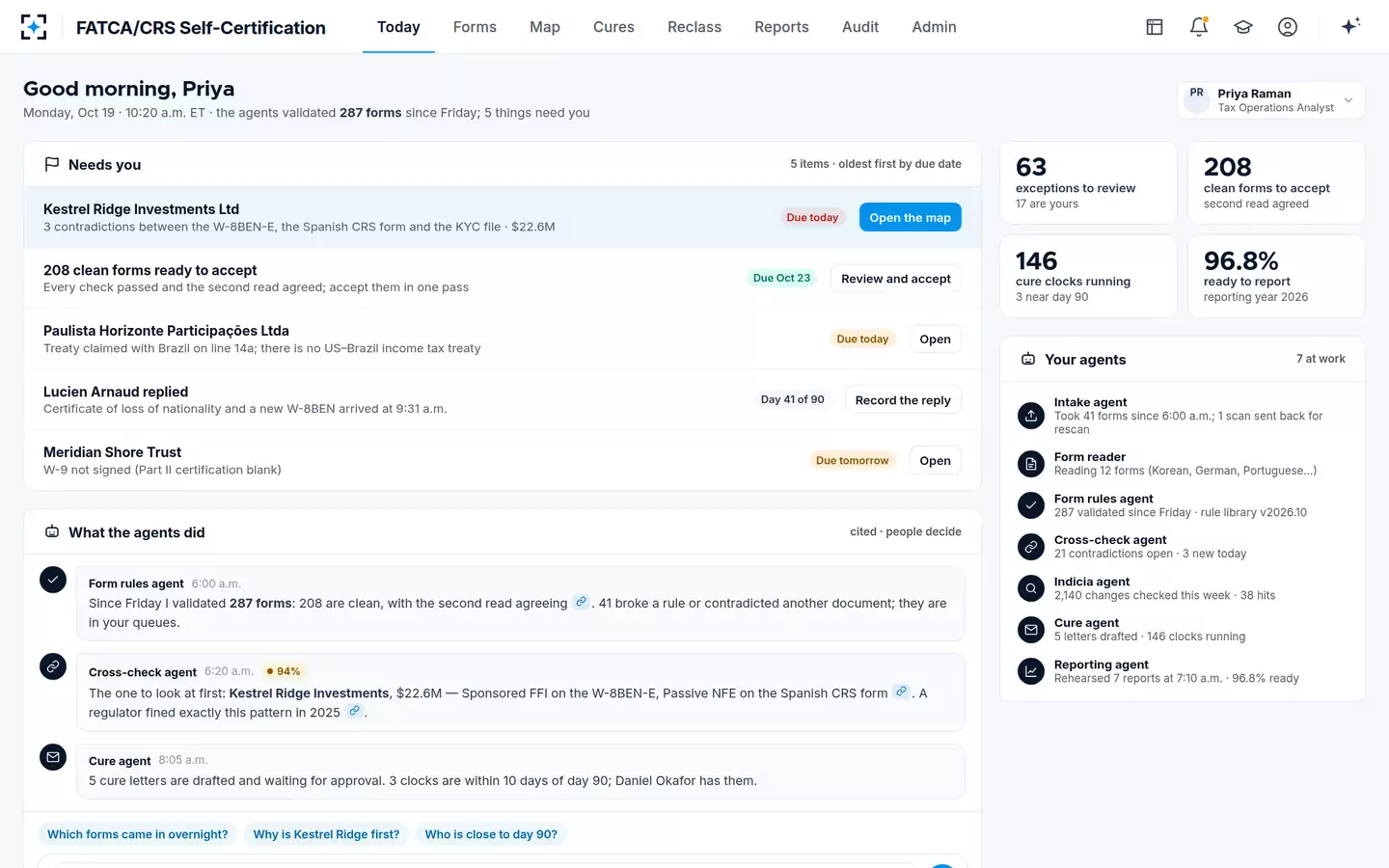
The rehearsal changes when the season's work happens. A missing TIN found in October is a reminder letter with seven months to run; found in May, it is a blank field in a return, reportable as such. On the sample morning of 19 October, the analyst's home screen showed the reporting year 96.8% ready, with cure clocks already running and three of them near day 90.
Mid-October: the season's work already on the clock
CARF arrives in the same season
The Crypto-Asset Reporting Framework (CARF) started on the same day as the amended CRS in the UK and the Cayman Islands: HMRC says that "From 1 January 2026, UK RCASPs are required to undertake due diligence on their customers" (HMRC CRYPTO49000), and the Cayman authority announced that "CARF and Amended CRS Take Effect in the Cayman Islands from 1 January 2026" (Cayman DITC). In the EU, DAC8 requires the first CARF information for periods from 1 January 2026 to be exchanged "within nine months following the end of the calendar year" (Directive (EU) 2023/2226).
For most funds CARF is someone else's report: it applies to crypto-asset service providers, not to a fund's investor register. Its effect on fund tax teams comes through the amended CRS, which, in the Cayman authority's words, now covers "Crypto-Assets held indirectly through traditional financial products, investment vehicles and derivatives" (Cayman DITC, Amended CRS Quick Guide). A fund that invests in crypto-assets stays in the CRS, with the same forms and the same season. Choosing software for the reporting itself is covered in FATCA CRS software that works with your transfer agency system; the rehearsal and the cures are part of FATCA/CRS Self-Certification.
Questions people ask
Is there one global CRS deadline?
No. Each jurisdiction sets its own filing date and its own exchange date. The UK's is 31 May, Ireland's 30 June, and Cayman's 30 June for the 2026 calendar year, so a group with entities in several places runs several deadlines.
Can the Form 8966 deadline be extended?
Yes. An automatic 90-day extension can be requested on Form 8809-I no later than the 31 March due date, and the IRS may grant a further 90 days under hardship conditions on a second Form 8809-I filed before the extended date runs out.
What is the UK penalty for filing late?
HMRC's manual sets an initial penalty of up to £5,000 if the return is not made by 31 May, and daily penalties of up to £600 per day if the failure continues after the penalty notice. Penalties are not automatic, and a reasonable excuse means no penalty.
When must a new Cayman financial institution register?
For entities that became financial institutions in 2025 the notification deadline was 30 April 2026. From 2026 onwards, the DITC's quick guide gives 31 January of the following year for new institutions, with a 30-day window to file a change notice when registered details change.
Do 2026 reports use a new XML schema?
Yes, where the amended CRS applies. The Cayman authority's guide says returns for the 2026 calendar year, due 30 June 2027, use the OECD's CRS XML Schema version 3.0, which carries the new fields such as the self-certification indicator and controlling-person roles.