Tax form validation is the check that a W-9, a W-8 or a CRS self-certification is complete, current, signed by the right person and consistent with what the institution already knows, before the fund relies on it for withholding or reporting. The IRS puts the first half plainly: a requester who receives a W-8 "must review it for completeness and accuracy with respect to the claims made on the form" (IRS, Instructions for the Requester of Forms W-8). The second half, consistency with the file, is where tools differ and where regulators have found failures. The honest way to compare tools is to seed real forms with known errors and count what each returns. Botminds' FATCA/CRS Self-Certification is one of the tools such a test should include, and this guide shows where it should and should not be expected to score.
The test below is ours, built from the IRS instructions, the Treasury regulations, HMRC's manual and the 2025 penalty decisions of the Abu Dhabi Global Market's regulator. The product examples come from the solution's sample data on a fictional fund manager, Quillfield Capital.
Twenty errors to plant in forms you have already accepted
- 1. A W-8BEN-E on a superseded revision, past its acceptance window
A prior version is acceptable only until the later of six full months after the new revision date or the end of that calendar year.
- 2. A line 5 status ticked, with its certification Part left blank
The IRS example: a certified deemed-compliant status without Part V is invalid for chapter 4.
- 3. A sponsored FFI with no sponsor in Part IV, or no GIIN on line 9a
Both are required for that status.
- 4. No signature, or a name typed into the signature line
The IRS says a typed name is not an electronic signature.
- 5. The capacity-to-sign box left unchecked
A W-8BEN-E signer must certify legal capacity to sign for the entity.
- 6. A CRS form with the tax residence section blank
Found invalid outright in two 2025 ADGM decisions.
- 7. Two CRS entity classifications ticked
Found in the ADGM decision of 2 September 2025.
- 8. A W-9 with the Part II certification unsigned
For interest, dividend and broker accounts opened after 1983, the IRS says the payee must sign or backup withholding will apply.
- 9. A treaty rate claimed with a country that has no US income tax treaty
The IRS publishes the list of treaties in force.
- 10. A treaty claim without the limitation-on-benefits box
An incomplete treaty claim, whatever the rest of the form says.
- 11. No TIN and no reason, for a country that issues TINs
Gives the fund reason to know the form is unreliable.
- 12. A TIN for a country that issues none
The British Virgin Islands and the Cayman Islands, in the 2025 decisions.
- 13. A TIN that does not fit its country’s format, or an implausible one
HMRC’s example is an Irish TIN entered as “123456789”.
- 14. A GIIN with the letter O, or one not on the current FFI list
GIINs never contain an O; the list is republished monthly.
- 15. Sponsored FFI on the W-8BEN-E, passive NFE on the CRS form
The pairing in the ADGM decision of 3 October 2025.
- 16. Investment entity on the CRS form, passive NFFE for FATCA
The mirror image, in the ADGM notice of 13 June 2025.
- 17. Different legal names or countries of incorporation on the two forms
Two forms describing what may be two entities.
- 18. Residence certified in one country, every address on file in another
The largest group of findings in four 2025 ADGM decisions.
- 19. Passive NFE with no controlling persons, while the ownership register names owners
Needs the AML file beside the form.
- 20. Active NFE certified, while the annual accounts show mostly passive assets
Needs the financial statements, not just the forms.
What is tax form validation?
It is two checks, and most definitions stop after the first. Validity asks whether the form is complete, on an acceptable revision, signed by an authorised person and dated, with every Part its claims require. Reasonableness asks whether what it says fits everything else the institution holds about the account holder. The ADGM regulator's guide names both as the "two key requirements when collecting SCFs": ensuring the form is valid and confirming that it is reasonable (ADGM FSRA guide).
The IRS frames the same split in terms of knowledge. A withholding agent may rely on a W-8 "unless you have actual knowledge or reason to know that the information is unreliable or incorrect", and it has reason to know if, among other things, "You have other account information that is inconsistent with the claims made" (IRS, requester instructions). Validation that never looks at other account information cannot meet that standard, however thorough it is on the form itself.
How do you validate a W-8BEN-E?
In order: revision, status, the Part that certifies the status, identifiers, treaty claim, signature, then the file. The revision comes first because a form on a superseded version may be unusable regardless of content; the IRS allows a prior version "until the later of 6 full months after the revision date shown on the form or the end of the calendar year the updated form is issued" (IRS, requester instructions). The current W-8BEN-E instructions are dated October 2021, and the IRS's page for the form listed no recent developments when read in October 2026.
Status is next: the chapter 3 status on line 4, the chapter 4 status on line 5, and the Part of the form that certifies the line 5 status. The IRS is explicit that a missing certification is not a small thing: "a failure to establish an entity type or make a required certification is not inconsequential" (IRS, requester instructions). Then the identifiers: a GIIN where the status needs one, verified on the IRS FFI list within 90 days of a form that says "applied for" (26 CFR 1.1471-3(e)(3)); a foreign TIN, or the reason there is none. Then the treaty claim on Part III, with the limitation-on-benefits box where the treaty has one, and a check that the treaty exists: the IRS points requesters to its list of treaties in force for that purpose.
Signature comes last on the form and first in an examiner's eyes: an authorised representative, the capacity box checked, any power of attorney attached. Then the step that makes it validation rather than proofreading: the form against the CRS self-certification, the KYC file and, for entities, the documents that prove what kind of entity this is. The GIIN step alone has more to it than a list match, as what a GIIN lookup proves sets out.
The rule numbers a W-8 check must know
6
months, at least, after a new revision date that a prior W-8 version may still be accepted
90
days to verify a GIIN after receiving a form that says “applied for”
30%
chapter 4 withholding when an account holder fails to provide its TIN on a W-9
24%
backup withholding rate on reportable payments to a payee without a valid TIN
What is TIN validation?
For a US TIN on a Form W-9 it is a real check against IRS records; for foreign TINs on W-8s and CRS forms it is mostly a plausibility check. The IRS's W-9 requester instructions describe the US service: "TIN matching allows a payor or authorized agent who is required to file information returns to match TIN and name combinations with IRS records before submitting the forms to the IRS", and a verified match can generally be relied on as reasonable cause against penalties (IRS, Instructions for the Requester of Form W-9).
No such service exists across CRS jurisdictions, and the rules do not require one. The ADGM guide says an institution "is not expected to conduct comprehensive checks on the issue or validity of TINs for every jurisdiction" and, citing the OECD's FAQs, is not required to confirm a TIN's format, though it may choose to (ADGM FSRA guide). What it may not ignore is the implausible. HMRC's example is a new Irish account holder whose self-certification gives the TIN as "123456789": the institution was not required to check the format, "the TIN is in any case implausible", and the self-certification is not valid (HMRC IEIM402183).
Two TIN errors in the 2025 ADGM decisions needed knowledge of the country rather than the form: a "No TIN is required" answer for Ireland, which "issues TINs automatically to individuals" (ADGM FSRA, OAC notice), and TINs supplied, or invented by the institution, for residents of the British Virgin Islands and the Cayman Islands, which issue none. HMRC adds that where the reason for a missing TIN is that the country does not issue them, "no further outreach is required until there is a change in circumstances" (HMRC IEIM402040).
Which errors do validation tools miss?
The ones that need a second document. Sort the twenty planted errors by what a checker must have open to see them, and eight are visible on the form alone, six need reference data such as treaty lists, TIN rules or the FFI list, and six need another document from the investor's file. A tool that validates each form against its own rules can, at best, catch fourteen.
Six of the twenty planted errors can only be seen by reading across documents
The six are not a random sample. They are the pattern the regulators published: the ADGM regulator's October 2025 decision turned on a W-8BEN-E and a CRS form that classified the same client two different ways with no reconciling evidence on file (ADGM FSRA, ADS decision), and most of the account holders in its September 2025 decision on Wahed Invest had certified a residence their own KYC addresses contradicted. A tool with a perfect score on errors 1 to 14 and none on 15 to 20 is a good proofreader for the forms that regulators fine least.
How do you test a tool before buying?
With your own forms, blind, and with traps. Take a set of forms you have already accepted, enough to include your languages, intermediaries and entity types. Have someone outside the evaluation team plant the twenty errors in copies, one or two per investor so that cross-document errors have both documents to contradict, and add three traps: things that look wrong but are not. Then run each tool on the whole set and score every flag.
The traps keep the test honest about false alarms. An undated W-8 is one: the IRS says that if a form is otherwise valid, "you may date the form from the day you receive it" (IRS, requester instructions). A US telephone number added to a file that still holds the investor's home number is another, because the FATCA indicium needs a US number and no number outside the US. A prior W-8 revision still inside its acceptance window is the third. A tool that rejects all three will flood the analysts and teach them to ignore it.
A scoring sheet for each flag a tool returns
| Outcome | What counts | Why it matters |
|---|---|---|
| Caught, right reason | The planted error is flagged with the rule or the conflicting document named | A finding a checker can approve without redoing it |
| Caught, wrong reason | The form is flagged, but for something else | The analyst still has to find the real problem |
| Missed | The planted error passes | The cost a regulator counts per account |
| False alarm | A trap, or a clean form, is flagged | Analyst time, and trust in the tool |
| Unreadable, said so | A page the tool cannot read is sent to a person, not guessed | A blank filled by a guess is worse than a blank |
| Evidence shown | The flag opens the page and line it rests on, in the original language | What an examiner will ask to see |
What is an acceptable miss rate?
No regulator or independent study publishes one, so the buyer has to set it, and the penalty rules suggest how. Penalties in the 2025 ADGM decisions were counted per account holder whose self-certification was invalid or unvalidated, and the UK's maximum for failing to obtain a valid self-certification is per account holder or controlling person too. A miss rate is therefore a count of future findings, not a percentage of quality.
A defensible standard has three parts. Zero misses on the cross-document group, because those errors have published penalty precedents and are the reason to buy a tool rather than a checklist. A miss rate on the single-form group that is no worse than your current review, measured on the same planted set by your own analysts. And a false-alarm rate low enough that a person can review every flag. Whatever the numbers, every flag should go to a person, and every decision should leave a record; the cost of each miss is worked through in what one bad self-certification costs.
Running the test on FATCA/CRS Self-Certification
FATCA/CRS Self-Certification is designed for the whole test, not only the first fourteen. The form rules agent checks each form against its own rules: revision, required parts, signature, date, signer capacity, GIIN on the IRS FFI list, TIN format per country, treaty and limitation on benefits, chapter 3 and 4 status and expiry. The cross-check agent sets the W-8 or W-9, the CRS form and the KYC file side by side for errors 15 to 20, and explains each contradiction with its sources. The form reader runs a second, independent read on every field; where the two reads disagree, or a page cannot be read, the field goes to a person.
Findings arrive typed: contradiction, rule failure or indicium, with confidence
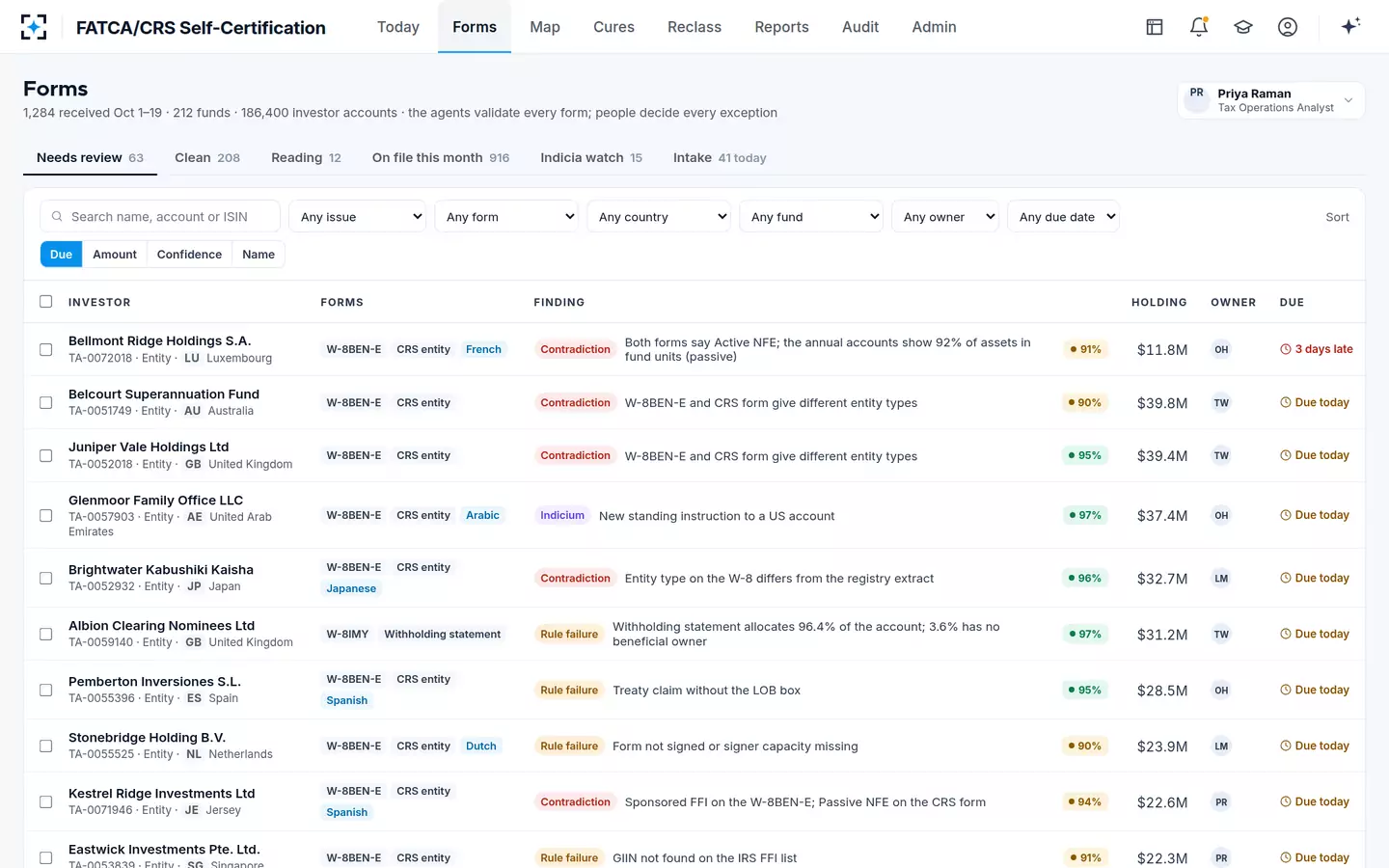
Two things the solution does not do should be in the scoring sheet as well. Its agents flag and never correct a form, and they give no tax advice; a tool that "fixes" a classification to make two forms agree would score a catch and create a new finding. And it reads forms: it does not replace the reporting engine, and reading a W-9 does not replace the IRS's TIN matching service for payors who file information returns.
Every finding and decision on one hash-chained audit trail
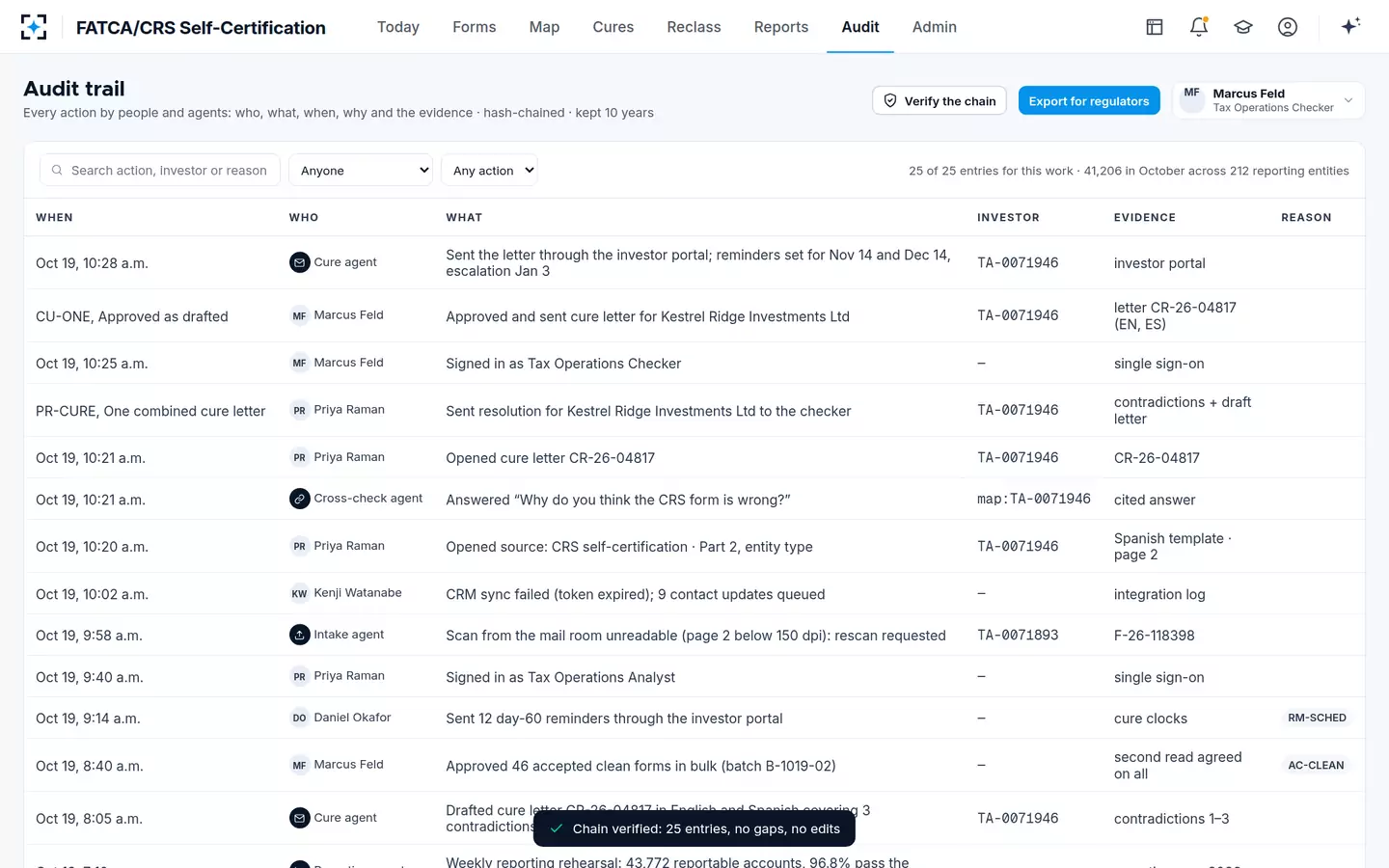
The solution is shown to new teams the same way this test works: the agents check a sample of forms the team has already accepted, and the team sees what they would have found. Before launch the sample settings run 500 such forms. The design targets are no conflicting classification left on file and about five minutes of a person's time per exception; they are targets to measure in your test, not results. A step-by-step trace of one form through the agents is in W-9 validation and W-8 checks, traced, and the test can be booked from FATCA/CRS Self-Certification.
Questions people ask
How many forms does a fair test need?
Enough to carry the twenty errors and three traps without crowding them, and to cover the languages, intermediaries and entity types you actually receive. A few hundred accepted forms usually does; the planted copies should be a minority, so that false alarms on clean forms can be measured too.
Should we plant errors in real investors' forms?
Plant them in copies kept inside the evaluation environment, never in live records, and use the vendor's data-handling terms as part of the test. The regulators' expectations on keeping self-certifications and their evidence, six years in the ADGM guide, still apply to the originals.
Is an undated W-8 invalid?
Not by itself. The IRS lets the withholding agent date an otherwise valid form from the day it was received and measure its validity from that date. That is why an undated form is a good trap: a tool that rejects it is creating work.
Does the IRS validate foreign TINs?
No public service does that across countries. IRS TIN matching covers US TINs for payors filing information returns. For foreign TINs the ADGM guide, following OECD FAQs, says institutions need not confirm the format, but HMRC treats an implausible TIN as making the self-certification invalid.
What if a tool catches an error but cites the wrong rule?
Score it separately. A flag with the wrong reason still costs the analyst the full review, and an examiner reading the file will see a finding that does not match its evidence. The useful catch names the rule or the contradicting document and opens the page it rests on.