Before any partnership tax preparation software can produce a fund's Form 1065 and K-1s, the fund has to bring seven kinds of input: its closed books with the book-to-tax adjustments; the partnership agreement and side letters, including any written selection of how income is shared when interests change; a partner file with each investor's name, taxpayer identification number, entity type, U.S. or foreign status, tax-exempt status and withholding certificate; last year's ending tax-basis capital for every partner, with section 704(c) and section 754 history; the K-1s, K-3 information and foreign documents that arrive from lower tiers; the section 1446 withholding already paid during the year; and holding-period data for anyone with carried interest. Software can compute a return in minutes; a missing partner ID, an unsigned allocation election or a lower-tier K-1 that has not arrived can hold it for weeks. Botminds' K-1 Preparation is built to start from exactly these inputs, check each one as it arrives, and say precisely what is missing and why it matters.
The rules cited are the IRS's 2025 Instructions for Form 1065, the Instructions for Forms 8804, 8805 and 8813 (January 2026) and the regulations named in each section. Examples are fictional sample data from the solution.
The inputs inventory: what to bring, what it feeds, who usually holds it
Closed books
What it containsTrial balance, book-to-tax adjustments, investment-level detail, cash and distribution records
What it feedsSchedule K, every K-1 box, the tie-out
Usually held byAdministrator, fund controller
The partnership agreement and side letters
What it containsAllocation provisions and waterfall, transfer and later-closing clauses, any dated selection of a varying-interest method or convention
What it feedsHow every item is shared; who gets what when interests change
Usually held byLegal, fund tax
The partner file
What it containsLegal name and TIN, entity type, domestic or foreign, tax-exempt status, W-9 or W-8, state residence and elections
What it feedsK-1 Part II, section 1446, Forms 8805, K-3 exceptions, state K-1s
Usually held byInvestor services, fund tax
Last year's tax picture
What it containsEach partner's ending tax-basis capital, 704(c) layers and revaluations, section 754 election and 743(b) adjustments
What it feedsItem L, Items M and N, special allocations
Usually held byFund tax
What arrives from below
What it containsLower-tier K-1s with footnotes and K-3s; dividend notices, withholding certificates and other foreign documents
What it feedsPass-through items, K-2 and K-3, liabilities from lower tiers
Usually held byFund tax, portfolio finance
Withholding already done
What it containsSection 1446 installments paid on Form 8813 and the notices sent to foreign partners
What it feedsForms 8804 and 8805, foreign partners' credits
Usually held byFund tax, treasury
Carried interest data
What it containsWho holds an applicable partnership interest; holding periods of assets sold; capital interest amounts
What it feedsSection 1061 Worksheet A for each holder
Usually held byFund tax, GP finance
What data does K-1 software need?
Everything the K-1 reports, and everything that decides how it is shared. The Form 1065 instructions ask for the partnership's and the partner's details in Parts I and II, items A to N, and in Part III each item of the partner's share plus anything else the partner needs for its federal, state and local returns. That list reaches well beyond the trial balance: entity type and retirement plan status in Part II, liabilities from lower-tier partnerships in Item K, last year's capital in Item L, contributed-property history in Items M and N.
The sharing rules come from the partnership agreement, with a backstop: "If the partnership agreement doesn't provide for the partner's share of income, gain, loss, deduction, or credit, or if the allocation under the agreement doesn't have substantial economic effect, the partner's share is determined according to the partner's interest in the partnership" (IRS, 2025). Software cannot find a fund's allocation provisions on its own; someone has to bring the LPA, the amendments and the side letters that change economics for particular investors.
The partner file: W-9s, W-8s and section 1446 withholding
The partner file is the input most often incomplete and most expensive when wrong, because it drives withholding during the year, not just reporting after it. A partnership with effectively connected income allocable to foreign partners pays section 1446 tax in four installments, "on or before the 15th day of the 4th, 6th, 9th, and 12th months of the partnership's tax year", at an applicable percentage of 21% for corporate partners and generally 37% for others, and "must notify all foreign partners of their allocable shares" within 10 days of each installment (IRS, Instructions for Forms 8804, 8805 and 8813).
Section 1446 runs on the partner file, all year
21%
section 1446 applicable percentage for corporate foreign partners
37%
generally, for non-corporate foreign partners
4
installments during the tax year, paid with Form 8813
10days
to notify foreign partners of their share after each installment
Status comes from certificates, and the instructions are clear about who bears the risk of shortcuts. A partnership "isn't required to obtain a Form W-9", but if it relies on other means and wrongly treats a partner as not foreign, it "will be held liable for payment of the tax, any applicable penalties, and interest"; and if no certificate is provided, "the partnership can presume the partner is foreign". For Form 8805, the instructions require "a separate Form 8805 for each foreign partner" and Copy A of each attached to Form 8804.
The same file decides whether a fund can use the K-2/K-3 domestic filing exception, which depends on the type of every direct partner, and which investors need unrelated business taxable income detail. One partner file, kept current at every closing and transfer, serves all of them; the exception test itself is in the K-2/K-3 domestic filing exception.
Last year's tax capital, 704(c) layers and the section 754 election
A first season on new software starts from last year's numbers, so last year's numbers have to come with it. Item L opens each continuing partner's year at the ending tax capital reported for it last year. Items M and N need the history of contributed and revalued property. And a section 754 election, once made, "applies both to all distributions and to all transfers made during the tax year and in all subsequent tax years unless the election is revoked", so the software needs to know whether one is in force and what section 743(b) adjustments exist for which buyers.
Bring these as partner-level schedules, not as a total. A fund that can only produce last year's Schedule M-2 cannot seed 200 partners' roll-forwards, and a beginning balance estimated now becomes a difference every year after. The roll-forward itself is worked line by line in partnership tax basis capital account reporting.
The LPA, side letters and the elections nobody wrote down
The allocation provisions are the obvious part. The less obvious part is the written choices the tax rules require. If the fund prorates income for a partner who transferred mid-year rather than closing the books, the regulation requires the agreement of all the partners, or a selection by a person with authority to make it, set out in a dated, written statement kept with the books by the return's extended due date (26 CFR 1.706-4(f)). If that statement does not exist, the default, an interim closing, applies, whatever last year's spreadsheet did.
Gather the same evidence for the other choices that change K-1s: the section 704(c) method for each contributed property, any regular monthly closings, the convention for interim closings, and the partnership representative's designation. Software that is told the method can apply it; software that has to guess it has been asked to make a decision that belongs to the partnership.
What arrives from below: lower-tier K-1s, footnotes and foreign documents
For a fund of funds or a fund that holds operating partnerships, the slowest inputs are not its own. Lower-tier K-1s bring items, liabilities and footnotes the fund passes up; the K-1 even has a checkbox, Item K2, for liabilities from lower-tier partnerships. Foreign portfolio companies bring dividend notices and withholding certificates in their own languages, and under the K-2/K-3 instructions a partnership that lacks information about a partner's foreign tax credit position has to assume the partner can claim the credit and complete the schedules on that footing (IRS, 2025 K-2/K-3 instructions).
Carried interest has its own deadline: a fund that needs Section 1061 information from a lower tier must request it within 30 days after year end, or 14 days after its own investor's request if later, and the lower tier must furnish it with its K-1 (26 CFR 1.1061-6). A request log with dates, opened on January 30, is part of what a fund brings; how the worksheet itself is built is in Section 1061 Worksheet A.
Partnership tax software for private equity: what to ask before you buy
Ask what each product needs from you, in what form, and what it does when an input is missing or wrong. The answers separate tools that compute from inputs someone else prepared from tools that do the preparation.
The same input, ready on day one or arriving in March
Ready when the season starts: Every K-1 maps to one investor; allocation can start the night the books close.
Arriving late or incomplete: Partners matched by name, or the file sent back; every downstream step waits.
Ready when the season starts: Withholding status known; Forms 8805 and state elections prepared with the K-1s.
Arriving late or incomplete: Presumed foreign, or a K-1 held until a certificate arrives.
Ready when the season starts: The software applies the method the partners chose.
Arriving late or incomplete: The default interim closing applies, whatever was done before.
Ready when the season starts: Item L rolls forward and ties to last year.
Arriving late or incomplete: Beginning balances estimated; differences carried for years.
Ready when the season starts: Funds released in early waves.
Arriving late or incomplete: Extension, estimates and a later change threshold to decide corrections.
Questions to put to any partnership tax preparation software
- What does it reject, and does it say why?
A file with missing partner IDs should be rejected on arrival, not discovered in review.
- Does it match partners by ID only?
Name matching across a register of similar fund names is how one investor gets another's K-1.
- Where does the allocation method come from?
From the LPA and the fund's written elections, cited; never inferred from last year's spreadsheet.
- Can it read the documents you actually receive?
Lower-tier K-1 footnotes and foreign withholding documents, in their own language, with the page cited.
- What does it do with an estimate?
Mark it, hold it or release it only with a named person's approval.
- Will it run on last year first?
A replay on your own filed year is the only accuracy figure that means anything for your funds.
How K-1 Preparation uses what you bring
The solution's inputs are the ones above: the administrator's capital statements, trial balance and investor register; LPAs and side letters; lower-tier K-1s; portfolio documents in their own language; W-9 and W-8 forms with IRS TIN matching; and the custodian's cash wires. It connects to the systems that hold them, the administrator, the fund accounting platform, document management, the custodian, and to the tax software that files Form 1065 and the investor portal that delivers the K-1s. It does not replace any of them.
What the agents did overnight, including the file they refused
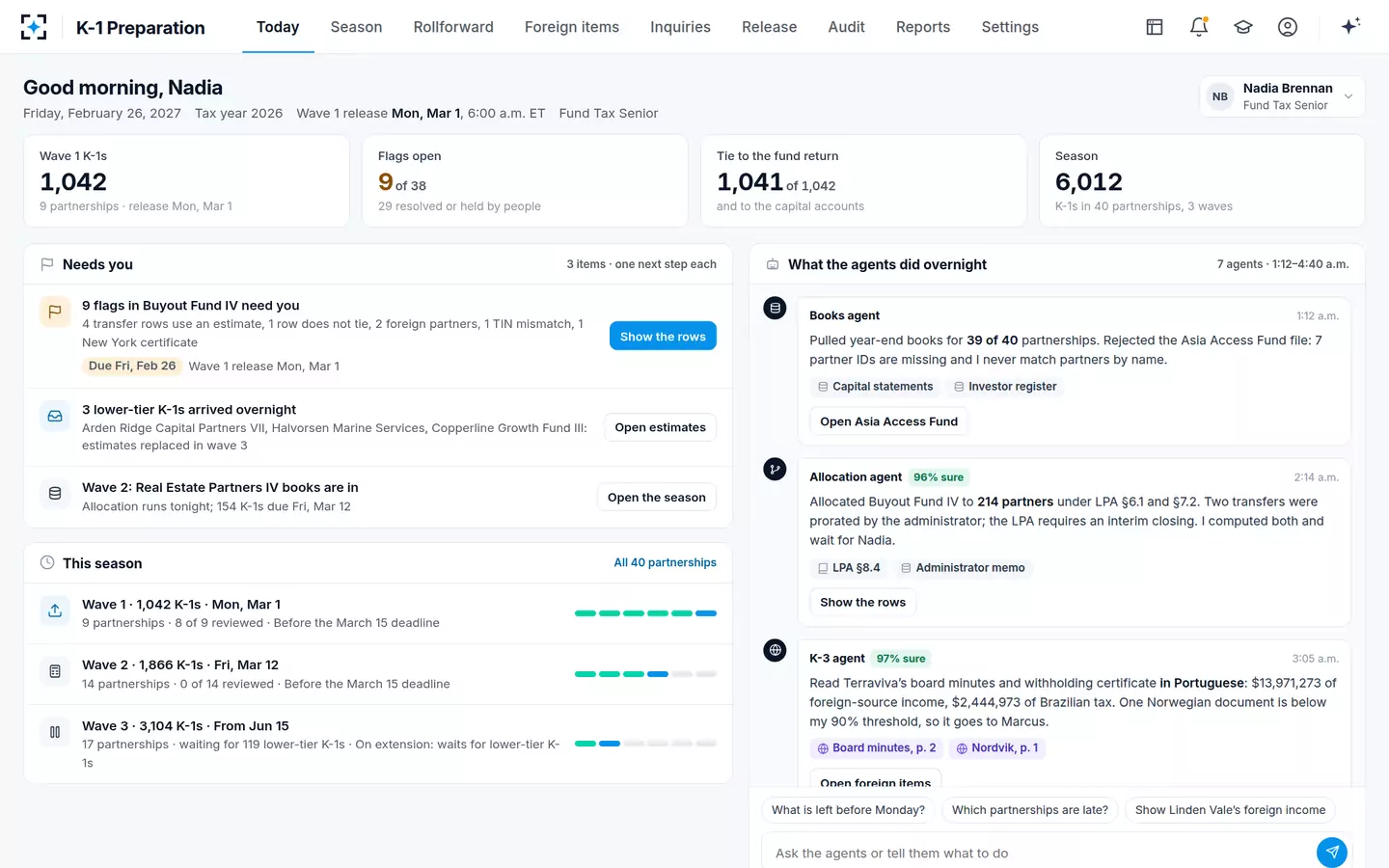
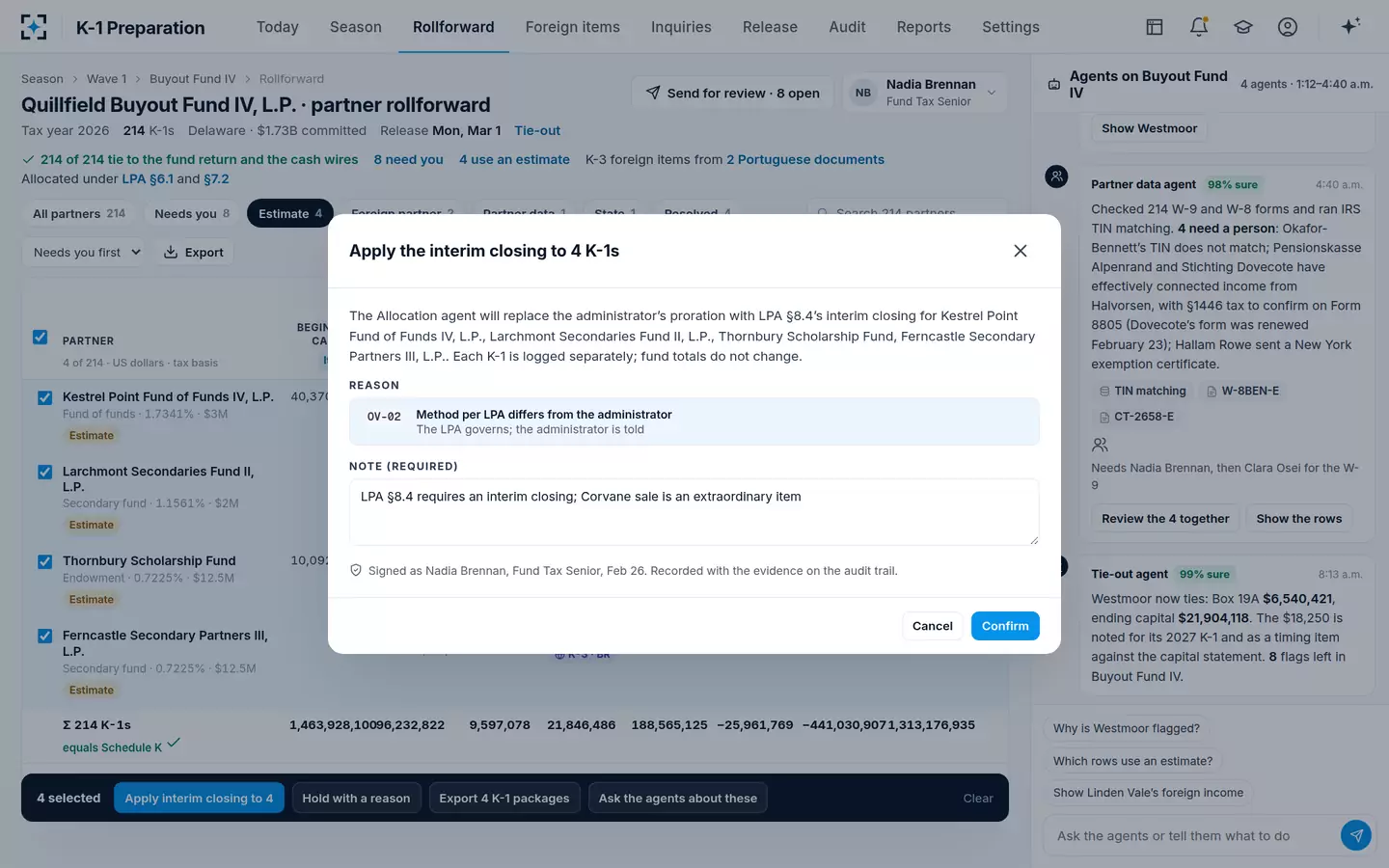
Where an input is incomplete, the agents say so rather than fill the gap. The Books agent rejects a file with a missing partner ID; the Partner data agent proposes a held K-1 when a certificate does not match IRS records; the Allocation agent waits when the LPA and the administrator disagree on a method. In the sample season, the Partner data agent's proposals for one fund, a Form 8805 to confirm for a foreign pension, a renewed W-8BEN-E, a state exemption certificate and a hold for a trust awaiting a new W-9, were confirmed by the tax senior in one review.
Partner data proposals, confirmed by a person in one review
Set-up follows the same logic. Each partnership is added with its own inputs and checked with a parallel run on the prior year before it goes live, which is why the first thing to gather is last year's filed K-1s. The rest of the solution is at K-1 Preparation.
Questions people ask
What is the best partnership tax software for private equity?
The one that does the most of your work from your own inputs, which you can only learn by testing it on them. Ask whether it applies your LPA's allocation, reads lower-tier K-1s and foreign documents, ties every K-1 to the return independently, and runs on last year's filed K-1s before you commit.
What do I need to file Form 8805?
For each foreign partner: its identifying information and status, its share of the partnership's effectively connected taxable income, and the section 1446 tax paid on its behalf through the year's installments. A separate Form 8805 goes to each foreign partner and Copy A of each is attached to Form 8804, generally due by the 15th day of the 3rd month after year end.
Do I need a W-9 from every U.S. partner?
The section 1446 rules do not require one, but a partnership that relies on other means and wrongly treats a foreign partner as domestic is liable for the tax, penalties and interest. Without a certificate the partnership may presume the partner is foreign, which means withholding.
Can partnership tax software start before the books close?
Partly. Partner data, prior-year capital, LPA provisions and elections can all be loaded and checked in advance, and section 1446 installments are due during the year anyway. Allocation and tie-out need the closed books, and funds with lower tiers also need the lower-tier K-1s.
How much prior-year data does a first season need?
At minimum, each partner's ending tax-basis capital from last year's K-1, the section 704(c) and revaluation history behind Items M and N, any section 754 election and existing 743(b) adjustments, and last year's filed K-1s to replay. Earlier years matter only where they explain those balances.