An administrative adjustment request (AAR) replaces the amended return for any partnership under the centralized partnership audit regime created by the Bipartisan Budget Act (BBA), which covers every partnership with tax years beginning after 2017 unless it validly elected out. The IRS instructions are direct: a BBA partnership "must file an AAR to request an administrative adjustment", and "shouldn't file an amended tax return or amended Schedules K-1 and/or K-3". The AAR is filed electronically as a Form 1065 with box G(5) checked plus Form 8082, or on paper on Form 1065-X, is signed by the partnership representative, and must be filed within three years; the change is either paid by the partnership as an imputed underpayment or pushed out to the investors who were partners in the year being corrected. Only partnerships with 100 or fewer eligible partners and no partnership, trust or nominee partners can elect out and amend the old way, which leaves most investment funds in the AAR world. So the cheapest K-1 error is the one found before release, and the way to find them is to replay last year's K-1s through any new process before trusting it. Botminds' K-1 Preparation is set up that way: a parallel run on the prior year before a partnership goes live.
The rules quoted are the IRS's 2025 Instructions for Form 1065, the Instructions for Form 8082 (October 2025) and section 6227. Fund examples are fictional sample data from the solution.
Large partnerships have more than doubled while the IRS examines fewer of them
Administrative adjustment request vs amended return: which one a fund files
It depends only on whether the partnership is a BBA partnership for the year being corrected. A partnership that validly elected out files an amended return with amended K-1s, as partnerships always did; a BBA partnership files an AAR. The Form 1065-X instructions give the general rule: "partnerships under BBA must file an AAR instead of an amended return unless there is specific guidance allowing for the filing of an amended return" (IRS, Instructions for Form 1065-X).
Two ways to correct a filed partnership year
Amended return (elected-out partnership): A partnership that made a valid election out of the centralized audit regime for that year.
Administrative adjustment request (BBA partnership): Every other partnership with a tax year beginning after 2017.
Amended return (elected-out partnership): Electronically, Form 1065 with box G(5) and a statement of each change; on paper, Form 1065-X.
Administrative adjustment request (BBA partnership): Electronically, Form 1065 with corrected amounts and box G(5), plus Form 8082; on paper, Form 1065-X.
Amended return (elected-out partnership): A partner or LLC member, as for the original return.
Administrative adjustment request (BBA partnership): The partnership representative, or its designated individual if the representative is an entity.
Amended return (elected-out partnership): Amended K-1s and K-3s, with the "Amended K-1" box checked.
Administrative adjustment request (BBA partnership): No amended K-1. If adjustments go to partners, a Form 8986 for the reviewed year.
Amended return (elected-out partnership): The year amended, on each partner's own amended return.
Administrative adjustment request (BBA partnership): The year the AAR is filed: the partnership pays, or reviewed-year partners report in their current year.
Amended return (elected-out partnership): The ordinary limitations rules.
Administrative adjustment request (BBA partnership): Three years after the later of filing or the original due date (without extensions), and never after a notice of administrative proceeding.
Can a BBA partnership file an amended K-1?
No, apart from narrow exceptions such as a partnership-partner filing an amended return as part of a modification during an IRS examination. The Form 8082 instructions say it in a caution box: "Use Form 8986 to notify partners of their allocable shares of adjustments, don't use an amended Schedule K-1" (IRS, Instructions for Form 8082). The statute behind it, section 6031(b), says information furnished to partners may not be amended after the return's due date except in listed cases, the first of which is a partnership that elected out.
That has a consequence investors feel. A fund that finds an error in a filed year cannot simply send a corrected K-1. If the AAR results in an imputed underpayment and the partnership pays it, the investors see nothing on their own returns; the cost is borne at the fund level in the year of the AAR, and so, in economic terms, by the partners of that year. If the partnership pushes the adjustments out, or the adjustments do not produce an imputed underpayment, each partner from the reviewed year receives a Form 8986 and takes its share into account in the current year. Neither is a quiet fix.
Who can elect out of the centralized audit regime?
Few funds. A partnership is eligible only if it has 100 or fewer eligible partners, counting the shareholders of any S corporation partner, and eligible partners are "individuals, C corporations, S corporations, foreign entities that would be C corporations if they were domestic entities, and estates of deceased partners". A partnership "isn't eligible to elect out ... if it's required to issue a Schedule K-1" to a partnership, a trust, certain foreign entities, a disregarded entity, an estate other than a deceased partner's, or "any person that holds an interest in the partnership on behalf of another person" (IRS, 2025, Schedule B, question 33).
A fund with a single feeder, fund-of-funds, family trust or nominee investor is therefore a BBA partnership, whatever its size. And the election "can only be made on a timely filed return (including extensions)"; it cannot be made later by amendment, as the Form 1065-X instructions also warn.
The administrative adjustment request process, step by step
From a discovered error to the partners, under BBA
A person decides
Tax team finds and quantifies the errorRecomputes the affected partnership-related items for the filed year and the partners whose shares change.
A person decides
Partnership representative decides the routeIf the adjustments produce an imputed underpayment: pay it at the partnership level (modifications allowed), or elect to push the adjustments out to reviewed-year partners. No imputed underpayment: they go to the partners.
A person decides
Files the AARElectronic: Form 1065 with corrected amounts, box G(5), Form 8082, and Forms 8985 and 8986 where partners take the adjustments. Paper: Form 1065-X. Signed by the partnership representative.
A person decides
Furnishes Forms 8986Each reviewed-year partner that must take adjustments into account receives its share, and reports it for the year in which it receives the statement.
The statute decides which route applies before anyone chooses. An adjustment that results in an imputed underpayment is taken into account by the partnership "under rules similar to the rules of section 6225", unless it elects the alternative; "in the case of an adjustment that would not result in an imputed underpayment", the push-out route applies automatically (26 U.S.C. 6227(b)). In practice, a correction that produces no imputed underpayment, such as one that only lowers income, reaches investors through Forms 8986; one that produces an imputed underpayment leaves the route to the partnership representative.
Push out election partnership: what it changes for investors
Pushing out moves the tax and the interest to the people who were partners in the year being corrected. Under the election, the Form 8082 instructions say interest is figured "at the partner level", from the due date of the return for the year the increase is attributable to, "at the section 6621(a)(2) underpayment rate". Each reviewed-year partner "is required to take into account its share of adjustments requested", reporting the additional tax in its own current year (IRS, Instructions for Form 8082; 26 CFR 301.6227-3).
For a fund, the choice is commercial as well as technical. Paying at the partnership level puts the cost on today's partners, including those who joined after the error; pushing out puts it on the right people but gives every reviewed-year investor, including those who have left, a Form 8986 and a reason to call. Either way, the error is visible in a way a corrected K-1 under the old rules never was.
How long a filed year stays open to an AAR
- To filingMar–Sep 2026
- Three years for an AARto Sep 2029
- Three years for an AARto Mar 2029
- Closed
Why a quiet audit calendar is no comfort
The odds that the IRS examines any given fund are low. The Government Accountability Office found the IRS "audited 54 large partnerships out of more than 20,000 that filed tax returns in 2019 (an audit rate of 0.3 percent)", and that between tax years 2010 and 2018 "almost 81 percent of large partnership audits resulted in no change to the tax return" (GAO-23-106020). TIGTA's 2026 report puts the examination rate for partnerships with at least $10 million in assets below 0.1%.
None of that makes an error safe. Investors find errors when their own figures do not match; auditors find them in the fund's statements; the fund finds them itself when next year's beginning capital does not tie. Once found, an error in a filed year is an AAR and a decision for the partnership representative, whether or not the IRS ever looks. The control that matters is the one before release.
Replay last year before you need an AAR
A replay runs a new preparation process, a new tool or a new team on the prior year's closed inputs and compares its K-1s with the ones actually filed, box by box. It measures accuracy on your own funds, before the process touches a live year, and it finds the errors in what you filed while there is still time to decide what to do about them. The method is simple; the discipline is in classifying every difference.
A K-1 replay, step by step
- Choose partnerships that carry your hard cases
Transfers and later closings, foreign portfolio companies, tiers, carried interest, a fund with a section 754 election.
- Use last year's inputs exactly as they were at filing
Closed books, the LPAs and side letters then in force, the partner file, the lower-tier K-1s actually received.
- Compare every box, item and attachment, not totals
Part III boxes and codes, Item L, Item J percentages, K-3 lines, Section 1061 worksheets, state K-1s.
- Classify every difference
An error in the filed K-1; an error in the new process; or a judgment made differently. Have the reviewer, not the preparer, mark each.
- Fix process errors and replay the affected slice
A known defect is never carried into the live season.
- Take filed-year errors to the partnership representative
With the amounts by partner, the route each would take, and the three-year deadline.
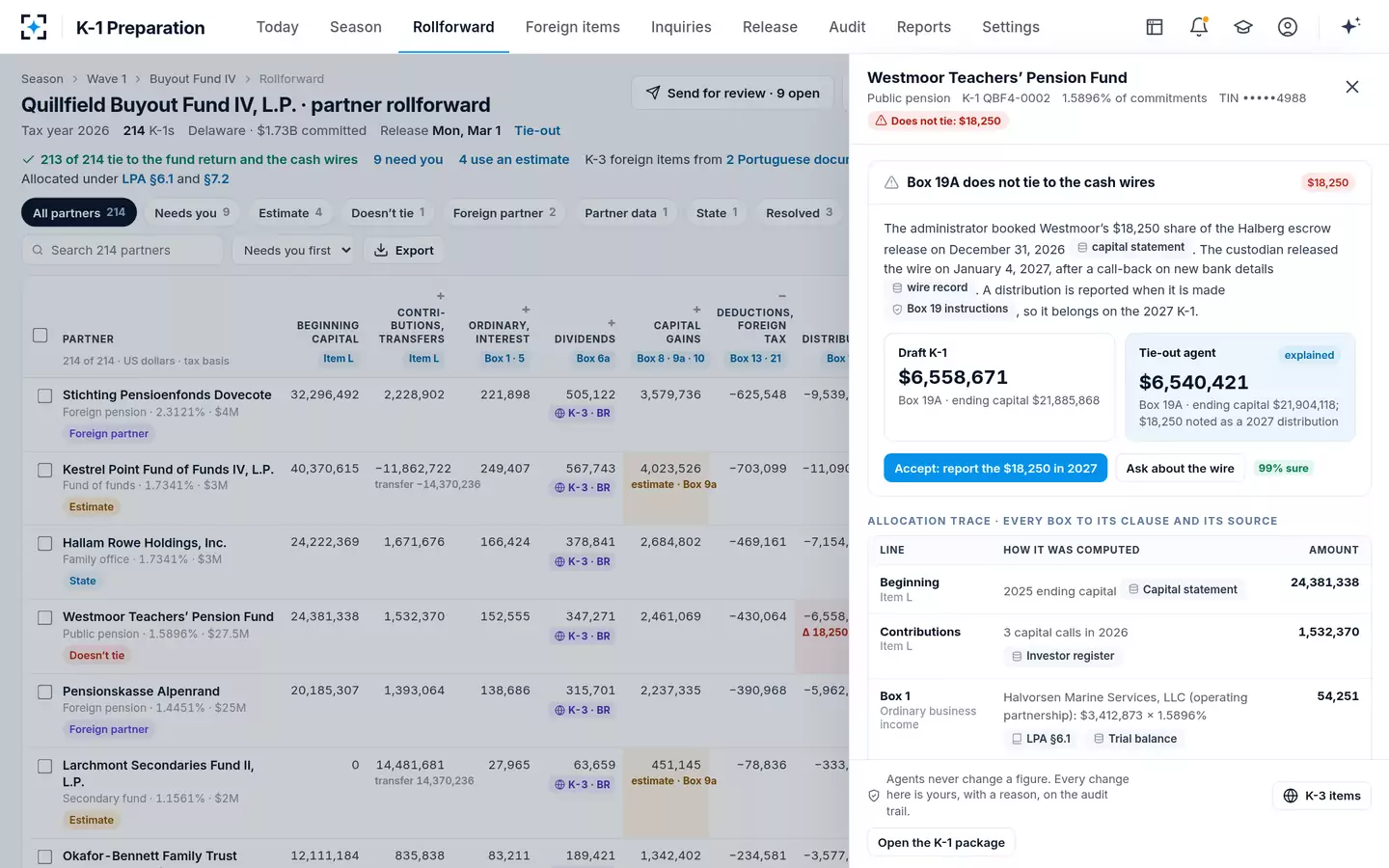
What does a replay typically surface? The categories are predictable even if the counts are not: distributions dated by booking rather than by payment, transfers allocated by a method the LPA does not permit, foreign tax above a treaty rate reported as creditable, a buyer's capital account that does not equal the seller's, Section 1061 amounts missing for a holder of carried interest. No regulator or independent study publishes how often fund K-1s contain each kind of error; a replay is how you measure it for your own funds.
The kind of difference a replay finds: a distribution in the wrong year
When a late lower-tier K-1 changes a filed year
Some AARs cannot be prevented by any review, because the information did not exist at filing. A fund that holds other partnerships can file on an estimate and later receive a lower-tier K-1 that changes the year. Then the question is not whether the K-1s were prepared well, but which route to take and whether the change is worth an AAR at all.
In K-1 Preparation, when a late lower-tier K-1 changes a filed year, the agents explain the two routes, the partnership paying the imputed underpayment or pushing the adjustments out to the reviewed-year partners, with the amounts by partner, and the tax partner, as partnership representative, decides. The fund's own change threshold, $500 and 0.5% in the sample settings, governs whether a smaller change prompts an updated estimate letter. Nothing in the process files or sends anything without a person.
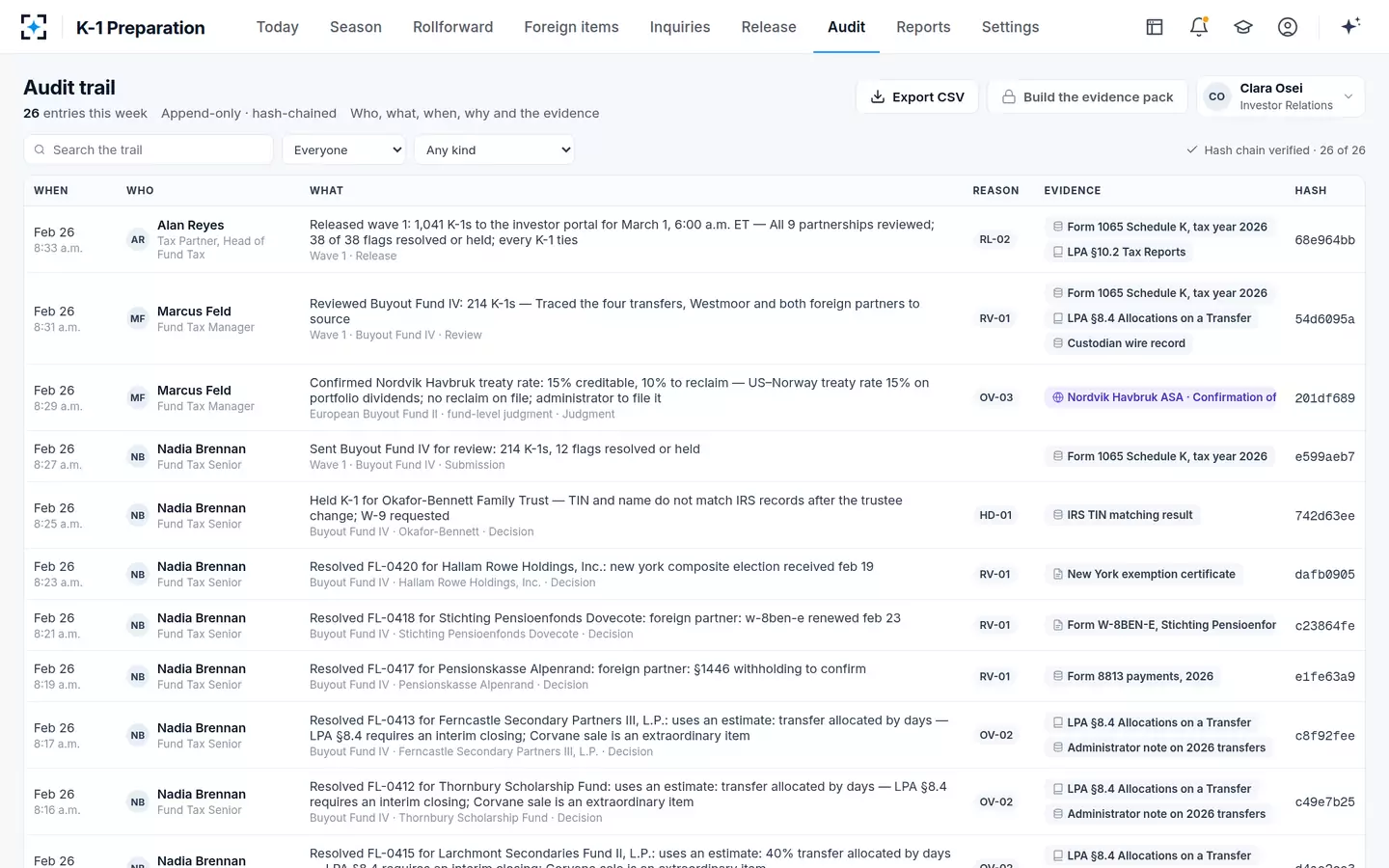
Every decision and its reason, ready for the partnership representative
The penalty side of a wrong K-1 is priced in the failure to furnish K-1 penalty; the capital roll-forward checks that catch many replay differences are in partnership tax basis capital account reporting; the solution is at K-1 Preparation.
Questions people ask
What is an administrative adjustment request?
It is the BBA partnership's way to correct one or more partnership-related items on a filed return. Section 6227 allows a partnership to request an adjustment for any year; the change is taken into account in the year the AAR is filed, either by the partnership or by the reviewed-year partners, and the AAR is signed by the partnership representative.
When is an administrative adjustment request due?
It may be filed only after the original return and no more than three years after the later of the filing date and the original due date without extensions. It may never be filed after the IRS mails a notice of administrative proceeding for that year.
How is an AAR filed electronically?
As a Form 1065 with the corrected amounts and box G(5) checked, together with Form 8082, and with Forms 8985 and 8986 where partners take the adjustments into account. Paper AARs use Form 1065-X. The Form 1065 must be signed by the partnership representative for the reviewed year.
What is a push out election?
It is the election under section 6227(b)(2), applying section 6226 rules, to have reviewed-year partners take an AAR's adjustments into account instead of the partnership paying the imputed underpayment. Each partner receives a Form 8986, reports its share in the current year and bears interest at the partner level.
Can a fund avoid AARs by electing out of BBA?
Only if it qualifies: 100 or fewer eligible partners and none of the excluded types, such as partnerships, trusts or nominees, and only on a timely filed original return. Most investment funds have at least one excluded partner.