Section 1061 Worksheet A is the IRS worksheet a partnership attaches to the Schedule K-1 of every holder of an applicable partnership interest, in a fund usually the carried interest, to report two figures: the API One Year Distributive Share Amount and the API Three Year Distributive Share Amount. The gap between them is the long-term capital gain on assets held more than one year but not more than three, which section 1061 turns into short-term gain for the holder. The worksheet starts from the K-1's Box 9a, removes the gains section 1061 does not reach and the return on the holder's own invested capital, then removes gain on assets held three years or less. On the 2025 K-1 the attachment is flagged in Box 20 with code AM, "Section 1061 information". Without it, the regulations treat the holder's whole one-year amount as if none of it were held three years. Botminds' K-1 Preparation traces and ties every K-1's Box 9a, the worksheet's first line, to the fund return before release; the holding-period split behind the rest comes from the fund's investment records.
The rules quoted are the IRS's Section 1061 reporting guidance FAQs, Worksheet A (revised January 10, 2022) and the final regulations at 26 CFR 1.1061-1 to -6. The figures in the worked worksheet are illustrative, not sample data.
A limited partner's K-1 and a carry holder's K-1 from the same fund
Limited partner (capital interest only): Net long-term capital gain, one-year holding period.
Holder of carried interest (an API): The same box, the same gain: Worksheet A starts from it.
Limited partner (capital interest only): Codes as needed; no Section 1061 information.
Holder of carried interest (an API): Code AM, "Section 1061 information", with Worksheet A attached.
Limited partner (capital interest only): More than one year for long-term treatment.
Holder of carried interest (an API): More than three years for gain on the API to stay long-term.
Limited partner (capital interest only): Realised gain by character.
Holder of carried interest (an API): Gain by asset and acquisition date; exclusions; capital interest share.
Limited partner (capital interest only): No change.
Holder of carried interest (an API): No API: "An API does not include any interest directly or indirectly held by a corporation."
Limited partner (capital interest only): Preferential rate may apply to long-term gain.
Holder of carried interest (an API): Not where section 1061 treats the gain as short-term.
What is section 1061?
It is the carried interest holding-period rule, added by the Tax Cuts and Jobs Act for taxable years beginning after December 31, 2017. In the IRS's summary, it "recharacterizes certain net long-term capital gains of a partner that holds one or more applicable partnership interests as short-term capital gains", and "generally requires that a capital asset be held for more than three years for capital gain allocated with respect to any applicable partnership interest (API) to be treated as long-term capital gain" (IRS, Section 1061 FAQs).
Final regulations, TD 9945, were published on January 19, 2021, and apply to taxable years beginning on or after that date. The rules split the work between two parties. The Passthrough Entity, the fund or the GP entity, computes and furnishes the amounts; the Owner Taxpayer, the individual, estate or trust that ultimately pays tax on the carry, computes the amount recharacterized on Worksheet B. The fund's job is Worksheet A.
Section 1061 Worksheet A, line by line
The worksheet has seven lines and two answers. Lines 1 to 4 produce the one-year amount; lines 5 to 7 apply the three-year rule to it.
Worksheet A worked: one carry holder, illustrative numbers
1
Net long-term capital gain (loss) from Schedule K-1 (Form 1065) box 9a
The holder's K-1
$9,000,000
2
Gains or losses in line 1 not subject to section 1061 under §1.1061-4(b)(7)
Section 1231 and 1256 gains, qualified dividends, mixed straddles
$0
3
Capital Interest Gains or (losses) under §1.1061-3(c)(2) included in line 1
The share that is a return on the holder's own invested capital
$900,000
4
API One Year Distributive Share Amount: line 1 − (lines 2 + 3)
Arithmetic
$8,100,000
5
Amounts in line 4 not long-term if three years replaced one year
Asset-level holding periods: sales of assets held one to three years
$2,400,000
6
Any Lookthrough Rule adjustment on a disposition of an API by the Passthrough Entity
§1.1061-4(b)(9); usually none for a fund selling portfolio assets
$0
7
API Three Year Distributive Share Amount: line 4 − (lines 5 + 6)
Arithmetic
$5,700,000
Line 2 is where most preparers make their first decision. The regulation lists four kinds of gain that section 1061 does not reach: long-term gain and loss "determined under section 1231", gain and loss "determined under section 1256", qualified dividends included in net capital gain, and gains characterised "without regard to the holding period rules in section 1222", such as certain mixed straddles (26 CFR 1.1061-4(b)(7)). Only what sits inside line 1 is removed on line 2; several of those items, such as section 1231 gain and qualified dividends, are reported in other boxes of the K-1 and never reach Box 9a.
Line 3 takes out the carry holder's return on its own money. Capital Interest Gains and Losses "are not subject to section 1061", and an allocation qualifies when it is determined "in a similar manner as the allocations with respect to capital interests held by similarly situated Unrelated Non-Service Partners" (26 CFR 1.1061-3(c)). A general partner's commitment invested alongside the limited partners, allocated the same way, is the usual example.
Line 5 is the three-year test itself, and the holding period is the fund's, not the holder's: "the partnership's holding period in the asset being sold or disposed of ... is the relevant holding period for purposes of section 1061" (26 CFR 1.1061-4(b)(8)(ii)). A fund that knows only realised gain by character, and not by asset and acquisition date, cannot fill line 5.
Section 1061 reporting: where the worksheet goes and when
It is attached to the holder's K-1 and furnished with it. The FAQ says the Passthrough Entity must attach Worksheet A to the API holder's Schedule K-1 "for tax returns filed after December 31, 2021" where it applies the final regulations, "notating the proper box and code". The FAQ, written in 2021, names Box 20 code AH; the 2025 Form 1065 instructions now list the item as "Code AM. Section 1061 information", stating that the partnership "will furnish to the partners any information needed to figure their capital gains with respect to an applicable partnership interest" (IRS, 2025). Check the code against the instructions for the year being filed.
The regulation sets out what the fund must furnish: both distributive share amounts, the gains excluded under §1.1061-4(b)(7), the Capital Interest Gains and Losses, and, when a holder disposes of an interest, information to apply the Lookthrough Rule on request (26 CFR 1.1061-6(b)). Worksheet A carries the first three.
If the three-year amount is not furnished, "all items included in the API One Year Distributive Share Amount are treated as items that would not be treated as long-term capital gain or loss, if three years is substituted for one year".
26 CFR 1.1061-6(a)(2)(ii)
What happens if Worksheet A is missing or late
The holder loses the benefit of every subtraction the fund did not report. If the one-year amount is not furnished and the holder cannot otherwise substantiate it, the one-year amount "will not be reduced by" the excluded items or the Capital Interest Gains. If the three-year amount is not furnished, the regulation treats everything in the one-year amount as failing the three-year test (26 CFR 1.1061-6(a)(2)). In the worked example that is the difference between $2,400,000 and $8,100,000 of recharacterized gain.
How much gain the carry holder must treat as short-term, with and without the worksheet
The penalty side is the same as for any K-1: a K-1 that leaves out information the partner needs is an incomplete payee statement, priced at $340 for K-1s due in 2026 and 2027. What a late or wrong K-1 costs overall is worked through in the failure to furnish K-1 penalty.
Section 1061 in tiered funds: the GP entity, the fund and the deadline to ask
Carried interest usually reaches its holders through layers: the fund allocates carry to a GP entity, which allocates it to individuals, sometimes through further entities. Each layer needs the one below. The regulation sets dates for asking and answering: an upper-tier entity must request the information "by the later of the 30th day after the close of the taxable year to which the information request relates or 14 days after the date of a request for information from an upper-tier Passthrough Entity", and the lower tier must furnish it by its own K-1 deadline under section 6031(b) (26 CFR 1.1061-6(b)(2)(iii)).
For a fund tax team the practical rule is to treat the January 30 request as a filing in its own right, dated and logged, and to build the asset-level holding periods for the fund's own sales before anyone asks. A GP entity with several funds below it cannot complete its holders' Worksheets A until every fund has completed its own. The full list of inputs a preparation process needs on day one is in partnership tax preparation software: what to bring.
Section 1061 Worksheet B: what the holder does with Worksheet A
Worksheet B is the Owner Taxpayer's, not the fund's. It combines the amounts from every Worksheet A the holder receives, with Tables 1 and 2 for dispositions of API interests, to compute the Recharacterization Amount. The FAQ explains the reporting: the holder reports gains on Schedule D and Form 8949 "as if section 1061 does not apply", then adds a "Section 1061 Adjustment" transaction that increases short-term gain and a matching one that reduces long-term gain (IRS, Section 1061 FAQs).
For the fund, Worksheet B matters only as the reason Worksheet A must be exact. Every dollar wrongly left in line 5 is a dollar the holder taxes at ordinary rates; every dollar wrongly left out is understated tax on the holder's return.
Withholding: section 1061 reaches foreign carry holders too
A fund withholding under section 1446 for a foreign partner may sometimes consider a preferential rate on long-term gain. The withholding instructions carve out carry: the partner "would not be entitled to a preferential rate if the partnership's income that otherwise is long-term capital gain is a type that is treated with respect to the partner as short-term capital gain under section 1061" (IRS, Instructions for Forms 8804, 8805 and 8813). The same holding-period analysis that fills Worksheet A therefore feeds the year's withholding installments, months before any K-1.
Records a fund needs before it can fill Worksheet A
- Who holds an applicable partnership interest
By entity and through each tier; interests held by C corporations are not APIs, S corporations are not treated as corporations.
- Acquisition and disposition dates for every asset sold
The fund's holding period, not the holder's, decides line 5.
- Character of each gain
Sections 1231 and 1256, qualified dividends and mixed straddles are excluded on line 2 where they sit in Box 9a.
- The holder's capital interest and how it is allocated
Line 3 needs allocations made like those to unrelated, non-service partners.
- Dated requests to, and answers from, lower tiers
Requests by the later of 30 days after year end or 14 days after an upper tier asks.
- Box 9a tied to Schedule K
Every later line depends on line 1 being right.
Where K-1 Preparation fits: the line everything else depends on
Worksheet A's first line is Box 9a, and Box 9a is where carry allocations, transfers and timing errors meet. In K-1 Preparation the Allocation agent applies the LPA's waterfall to every partner and box, and the Tie-out agent recomputes every K-1 independently and ties the sum of each box to Schedule K; in the fictional sample season, Buyout Fund IV's line 9a, net long-term capital gain, agrees between the return and the sum of 214 K-1s. Each box traces to its allocation step and the LPA clause it follows.
Capital gains by partner, each column labelled with its K-1 box
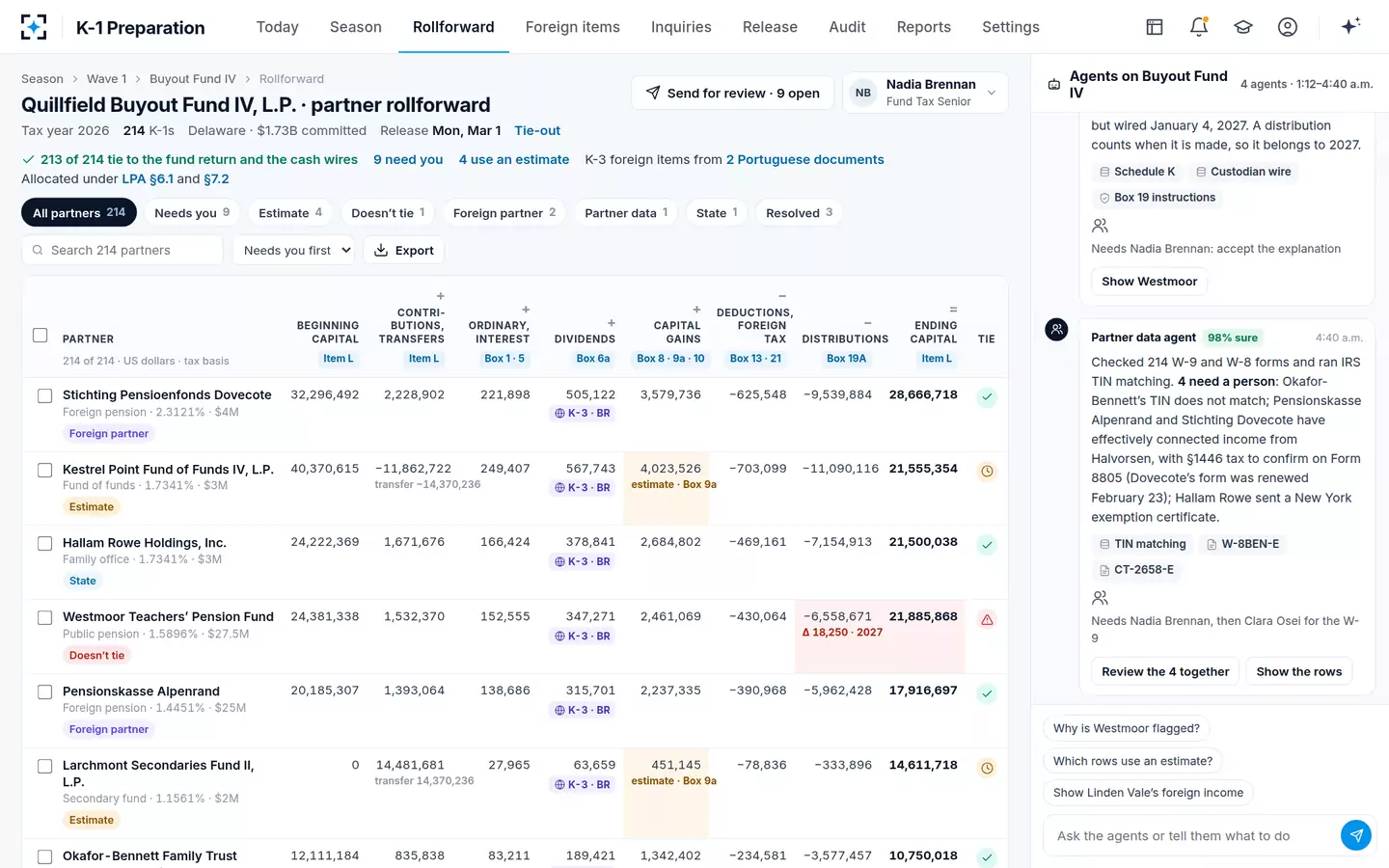
The holding-period split on lines 5 and 6 comes from the fund's investment records, and it is the tax team's to sign; the agents can cite the acquisition and sale documents behind each asset, but a worksheet that changes a holder's tax rate is reviewed by the tax manager and released by the tax partner like every other part of the K-1 package. Release posts each K-1 with its K-3, state K-1s and footnotes only after the tax partner signs.
A batch reviewed by someone who did not prepare it
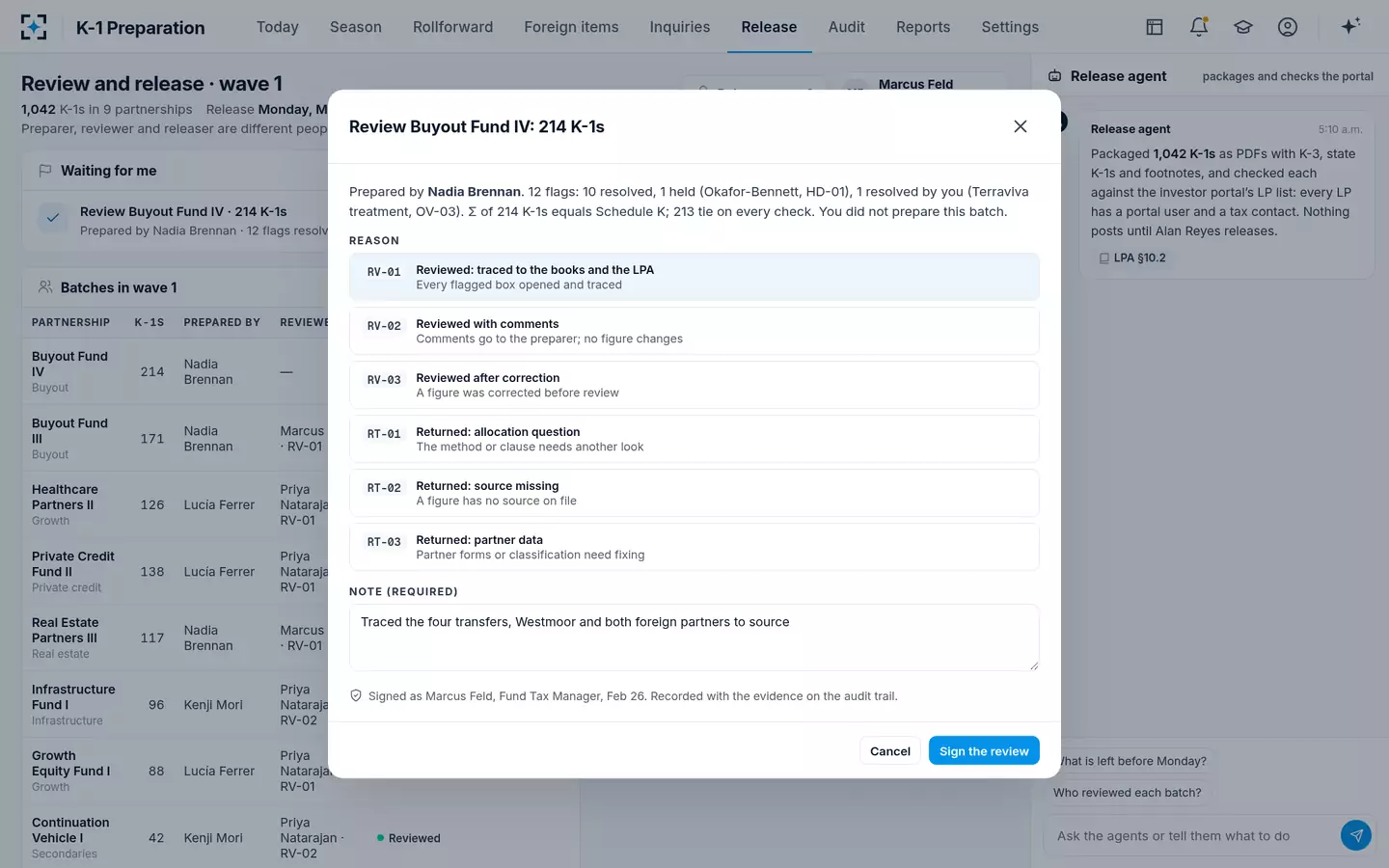
How the carry allocation itself is calculated is a waterfall question rather than a K-1 one, worked through in a private equity waterfall calculation example; the rest of this solution is at K-1 Preparation.
Questions people ask
Who has to receive Section 1061 Worksheet A?
Every holder of an applicable partnership interest issued by the partnership, including an upper-tier entity that holds the API for its owners. A limited partner with only a capital interest does not need it; an interest held directly or indirectly by a C corporation is not an API.
What box and code report section 1061 information on a K-1?
The 2025 Form 1065 instructions use Box 20, code AM, "Section 1061 information". The IRS's 2021 FAQ refers to code AH, reflecting the form at the time, so use the code in the instructions for the year being filed.
Is Worksheet A filed with the IRS?
The regulation requires the Passthrough Entity both to furnish the information to the API holder and to file such information with the IRS as forms and instructions require; Worksheet A is attached to the holder's Schedule K-1. The holder attaches Worksheet B and Tables 1 and 2 to its own return.
Are section 1231 gains subject to section 1061?
No. The regulation excludes long-term gain and loss determined under section 1231, gains and losses under section 1256, qualified dividends included in net capital gain, and gains characterised without regard to the section 1222 holding-period rules, such as certain mixed straddles.
Whose holding period counts, the fund's or the carry holder's?
For gain allocated from the fund's sale of an asset, the fund's: the regulation makes the partnership's holding period in the asset sold the relevant one. The holder's own holding period in its interest matters when it disposes of the API, where the Lookthrough Rule can apply.